BUYO ETF: Private Equity ETF | KraneShares
by Kraneshares
BUYO 6/30/2026 Harnessing The Key Drivers Powering Private Equity Buyout Funds Through Public Equities Overview of the KraneShares Man Buyout Beta Index ETF (Ticker: BUYO) info@kraneshares.com

BUYO KraneShares Man Buyout Beta Index ETF 2The statement regarding diversification refers to sector exposure, not regulatory diversification under the Investment Compan y Act of 1940. Diversification does not ensure a profit or guarantee against a loss. Please see end of presentation for term and index definitions. *Reference to ‘Man’ refers to all Man Group plc and its subsidiaries. Combined AUM of all affiliated Man investment managers. Unless otherwise stated, Total Assets reflects the Assets Under Management (AUM) as stated and described in the Man Group Annual Report or the most recent Man Group Quarterly Trading Report and Statement . All investment management services are offered through Man - affiliated investment managers.Investment Strategy The KraneShares Man Buyout Beta Index ETF (Ticker: BUYO) seeks to track the performance of the Man Buyout Beta Index, which is designed to provide exposure to a subset of public equities that feature the key characteristics of companies held in PE/buyout funds. The Index employs a systematic approach to select a portfolio of small to mid- cap stocks, targeting industries favored by PE firms as well as companies that are similar in size and display similar company - specific characteristics as those in traditional PE funds.KraneShares Man Buyout Beta Index ETF Features •Seeks to identify methodologies that buyout funds use to target takeover candidates and apply them to public equities to achieve similar results, such as delivering potentially higher long- term returns and diversification. •BUYO t argets small to mid- cap public companies that exhibit the following characteristics: 1.Belong to sectors favored by PE buyout funds, including Information Technology, Consumer Discretionary, Industrials, and Health Care. 2.Match the profile of the types of companies in which PE buyout funds tend to invest by screening for fundamental metrics, including: valuation, growth, profitability, cash management, debt capacity, business uncertainty and risk, industry dynamics and informed investor views. •BUYO u tilizes Man Group’s data -driven investment strategy, which has been used since 2018 in the Model that underpins the Index. •Intraday liquidity, lower management fee relative to traditional PE funds, and full daily holdings transparency.
3PE is popular among investors, but… has characteristics that can be improved upon Leading reasons why investors like PE BUT… Some common frustrations with PEStrong Historical ReturnsPotential Diversification*Long -Term Value Creation High Fees + Subpar Distinction between Alpha & BetaLong Time To Deploy Committed CapitalIlliquid + Long Lockups
- The statement regarding diversification refers to sector exposure, not regulatory diversification under the Investment Comp any Act of 1940. Diversification does not ensure a profit or guarantee against a loss. Please see end of presentation for definitions.Cyclicality In Distributions
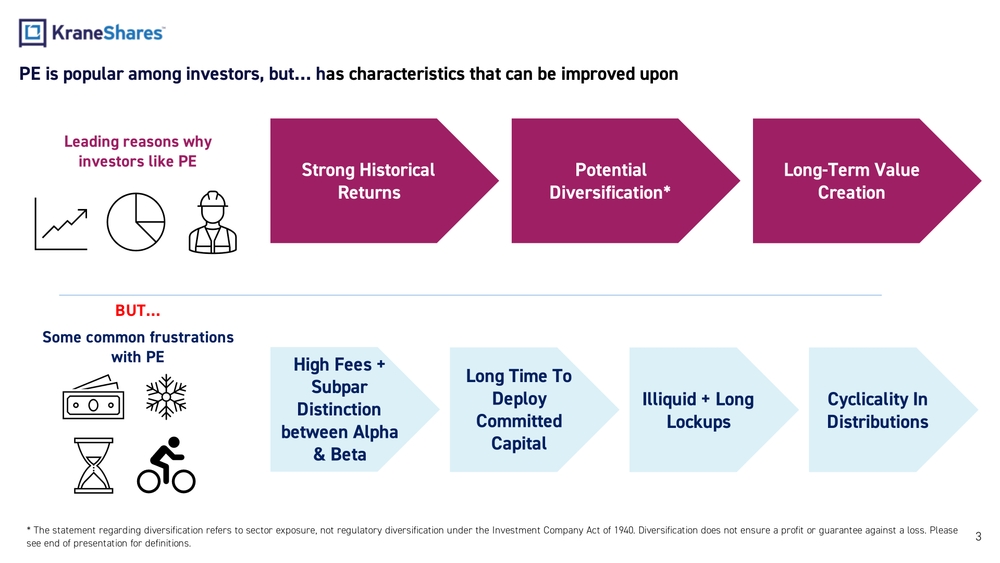
As money flows into PE, supply- demand imbalance has led the PE industry to hoard record levels of cash 41. Data from Pitchbook as of 6/30/2026. 3183483483353023063103523514244715936557528199011,0041,024 1,0081,100 02004006008001,0001,200Value of U.S. PE Dry Powder From 2006 to 2025 (in billion U.S. dollars)
Private vs Public Equity Comparison PE is a form of active equity investing, with alpha drivers that are also found in many public companies. 5Characteristics of companies found in PE portfolios: •Profitable •Growing •Cash -efficient •Stable business •Visibility and predictability of cash flows •Benefiting from positive trends •Part of attractive industries •Reasonably valued •Able to take on / service debt Can also be accessed in public equities
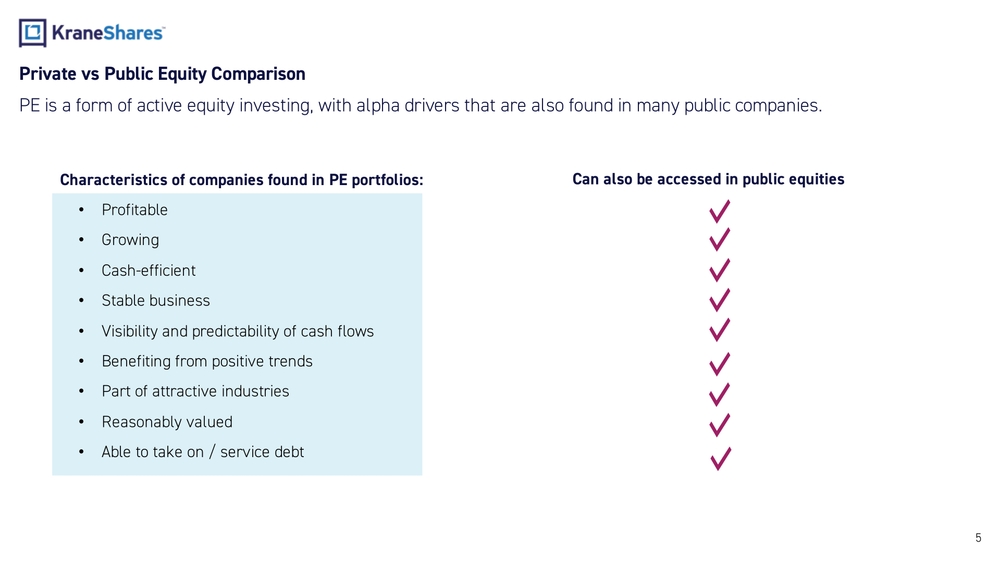
6What Types Of Companies Do PE Firms Buy? The same fundamentals that attract buyout firms to private companies also exist in public companies We believe… •Public equities are a reasonable proxy for the beta in buyout funds1, and a nuanced public equity portfolio can potentially serve as a closer proxy for buyout fund performance. •Proxy for PE alpha may be achievable by investing in public companies that closely resemble the companies in buyout funds and avoiding the industries and types of companies buyout funds typically do not target. •It is important to invest in companies that 1) are similar in size to those in buyout funds, 2) belong to the same industries as those in buyout funds, and 3) display similar company -specific characteristics as those in buyout funds. (-) Known public market alpha factor(+) Known public market alpha factor Minimal or ambiguous alphaTarget Sectors: Information Technology, Consumer Discretionary, Industrials, Health Care (-) Underweight: Financials, Utilities Smaller: $100M -$10B common deal target Cash Disciplined: Board oversight, less CapEX , Debt repaymentCheaper: Focus on free cash flow yield Higher Growth: Top-line focusMore Profitable: Operating margins important Leveraged: Significant debt in deals
- There is a 75% correlation between the total returns of PE and the public equity market using the Preqin Private Equity ex -Venture Capital Index and the Russell 2500 Index as the proxies for private and public equity. Data from Preqin Ltd and analysis by Man Group as of 8/31/2024. Retrieved 6/30/2026. See slide 8 for more detail. Please see the end of the presentation for definitions.
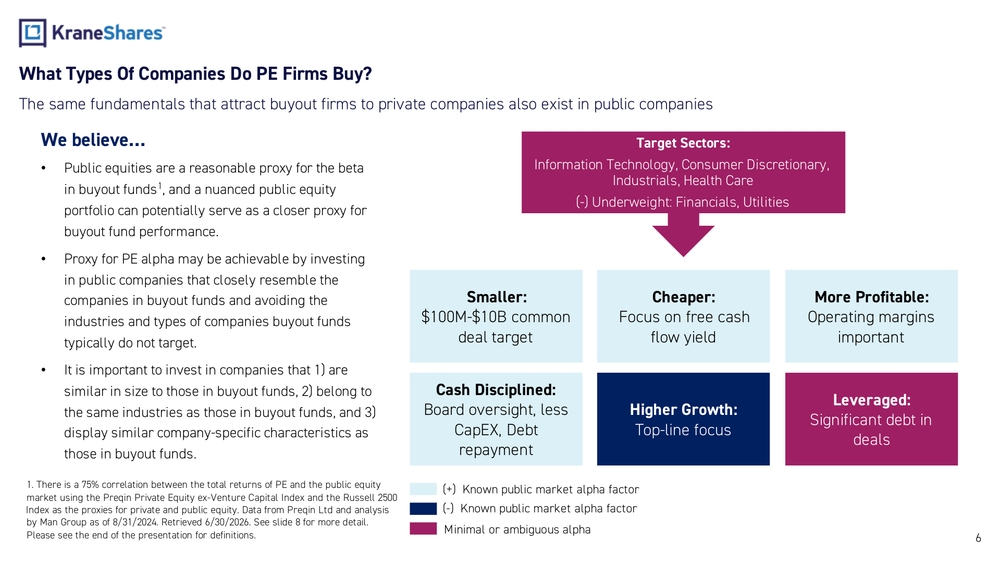
BETAComponents of PE ReturnReplicableMany of the performance drivers that benefit buyout companies are also found in select public companies …But identifying those companies and harnessing that alpha requires a nuanced approach 7REPLICABLE ALPHA TRUE ALPHAAs long- only equity portfolios, PEs' significant portion of total return is driven by broad macroeconomic influences or beta, that similarly impact public companies. Heightened leverage levels in PEs amplify this. ‒David Swensen (former Yale CIO): deals driven by financial engineering alone are simply “turbo -charged equity” True Alpha = idiosyncratic return driver employed by skilled PE managers, cannot be easily replicated in the public market (due primarily to lack of control over corporate decisions) “Replicable Alpha ” = return source requires skill but is replicableLeverage Return amplifier; tax benefits Industry Selection Analyze industry trends, competitive dynamics Valuation Identify undervalued assets Growth Focus on increasing revenue Cash Management Cost reductions emphasized Profitability Need profits to pay down debt Stability Visibility / predictability of key fundamentals Corp. Relationships Analysis of ecosystem surrounding a company Size Less efficient pricing among smaller companies, potential hidden gems Strategy Control strategic decisions, e.g., replacing management Exit Facilitate high- value exit/sale Incentives Enhance management incentives/upside Acquisitions Inorganic growthSub-Components of PE Return Source: Man Group as of 12/31/2024. Retrieved 6/30/2026 .
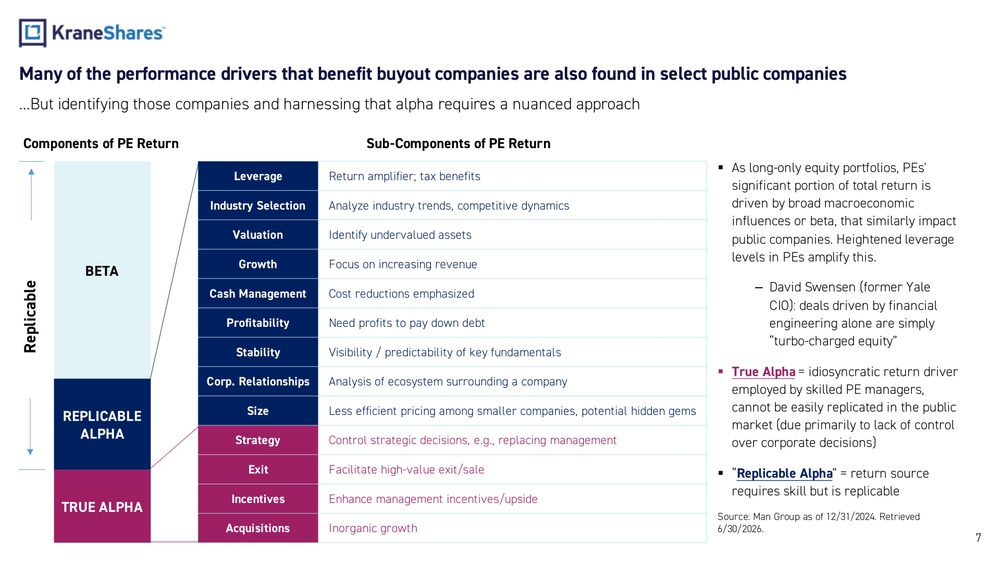
7508008509009501000105011001150Russell 2500 Index PriceRussell 2500 Index 2025 Price Chart2 8There is a strong correlation between public equities and PE, but can PE’s other return drivers be captured? There is a 75% correlation between the total returns of PE and the public equity market using the Preqin Private Equity ex -Venture Capital Index and the Russell 2500 Index as the proxies for private and public equity.1 •The PE Industry uses comparable public companies to value its portfolios •Both public and private companies are exposed to the same macroeconomic, industry -specific, and other top- down trends •Private equity investments benefit from “return smoothing”, which if applied to public equities, would increase correlation even more* •Can a filtered public equity portfolio provide a more correlated return profile to PE?
- Data from Preqin Ltd and analysis by Man Group as of 8/31/2024.
Retrieved 6/30/2026. - Data from Bloomberg as of 12/31/2025. Please see the end of the presentation for index definitions. *Private equity benefits from return smoothing, potentially increasing correlation with any index, including the Russell 2500. This feature stabilizes private equity performance compared to public indices, which show daily fluctuations. Smoothing could reduce perceived volatility and better align index returns with private equity. Price movement on a quarterly basis (example of ”return smoothing”)-8%+9%+8%+2%
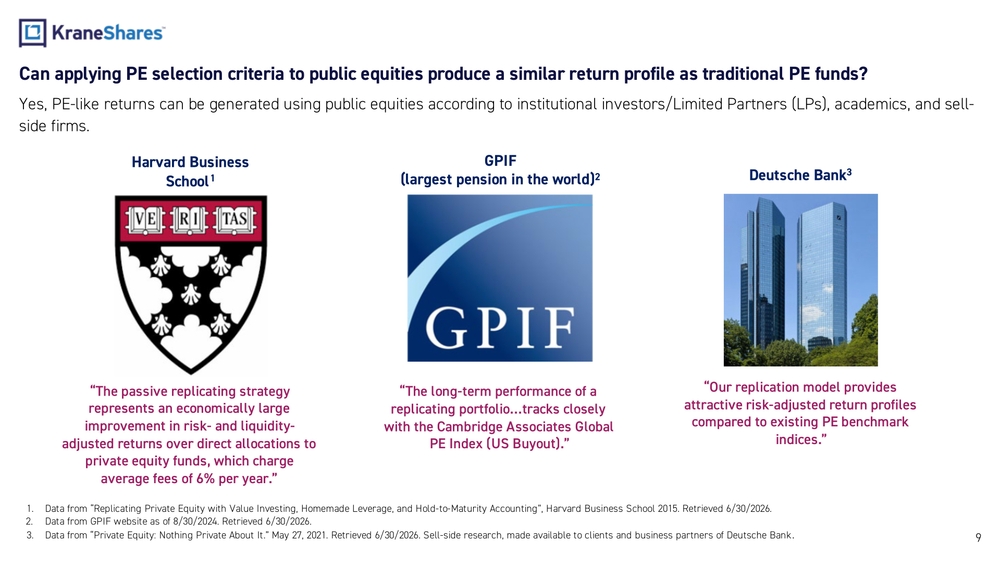
9Can applying PE selection criteria to public equities produce a similar return profile as traditional PE funds?
Yes, PE- like returns can be generated using public equities according to institutional investors/Limited Partners (LPs), academi cs, and sell -
side firms.
GPIF
(largest pension in the world)2 Deutsche Bank3Harvard Business
School1
“The passive replicating strategy
represents an economically large
improvement in risk - and liquidity-
adjusted returns over direct allocations to
private equity funds, which charge
average fees of 6% per year.”“The long -term performance of a
replicating portfolio…tracks closely
with the Cambridge Associates Global
PE Index (US Buyout).”“Our replication model provides
attractive risk -adjusted return profiles
compared to existing PE benchmark
indices.”
1.Data from “Replicating Private Equity with Value Investing, Homemade Leverage, and Hold -to-Maturity Accounting”, Harvard Busines s School 2015. Retrieved 6/30/2026.
2.Data from GPIF website as of 8/30/2024. Retrieved 6/30/2026 .
3.Data from “Private Equity: Nothing Private About It.” May 27, 2021. Retrieved 6/30/2026. Sell- side research, made available to clients and business partners of Deutsche Bank .
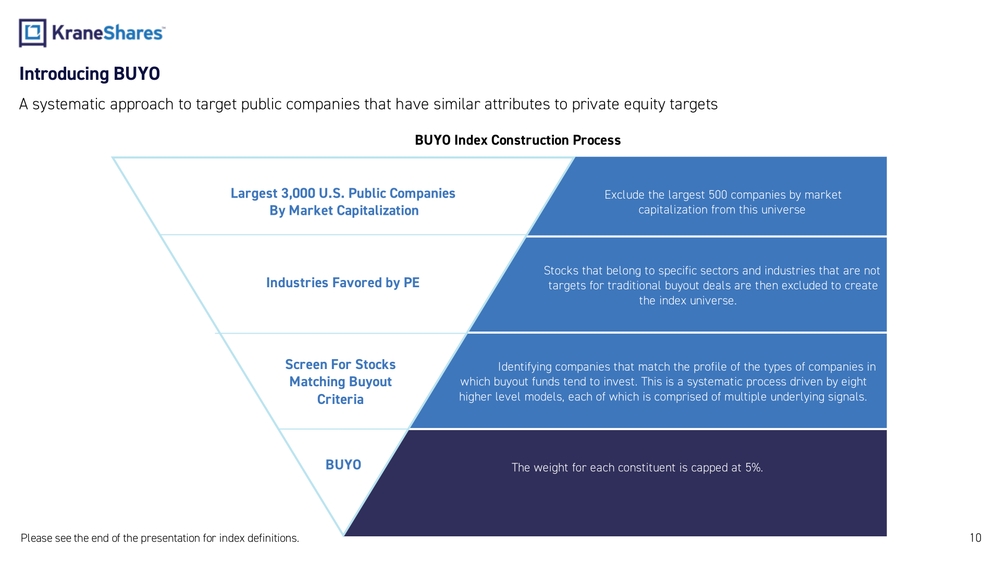
10Introducing BUYO
A systematic approach to target public companies that have similar attributes to private equity targets
Stocks that belong to specific sectors and industries that are not
targets for traditional buyout deals are then excluded to create
the index universe.
Identifying companies that match the profile of the types of companies in
which buyout funds tend to invest. This is a systematic process driven by eight
higher level models, each of which is comprised of multiple underlying signals.Largest 3,000 U.S. Public Companies
By Market Capitalization
Screen For Stocks
Matching Buyout
Criteria Industries Favored by PE
BUYOExclude the largest 500 companies by market
capitalization from this universe
The weight for each constituent is capped at 5%.BUYO Index Construction Process
Please see the end of the presentation for index definitions.
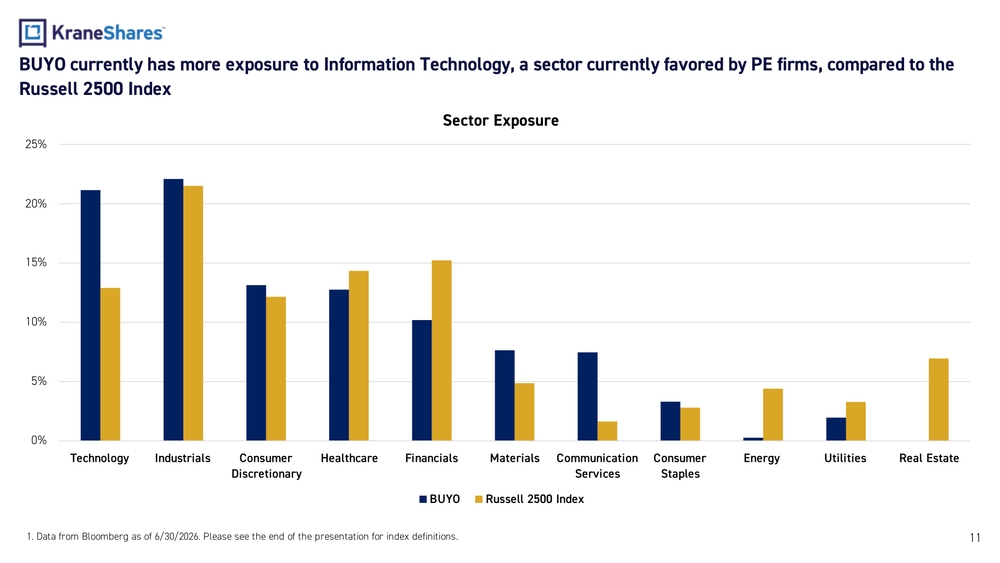
11BUYO currently has more exposure to Information Technology, a sector currently favored by PE firms, compared to the Russell 2500 Index
- Data from Bloomberg as of 6/30/2026. Please see the end of the presentation for index definitions. 0%5%10%15%20%25% Technology Industrials Consumer DiscretionaryHealthcare Financials Materials Communication ServicesConsumer StaplesEnergy Utilities Real EstateSector Exposure BUYO Russell 2500 Index
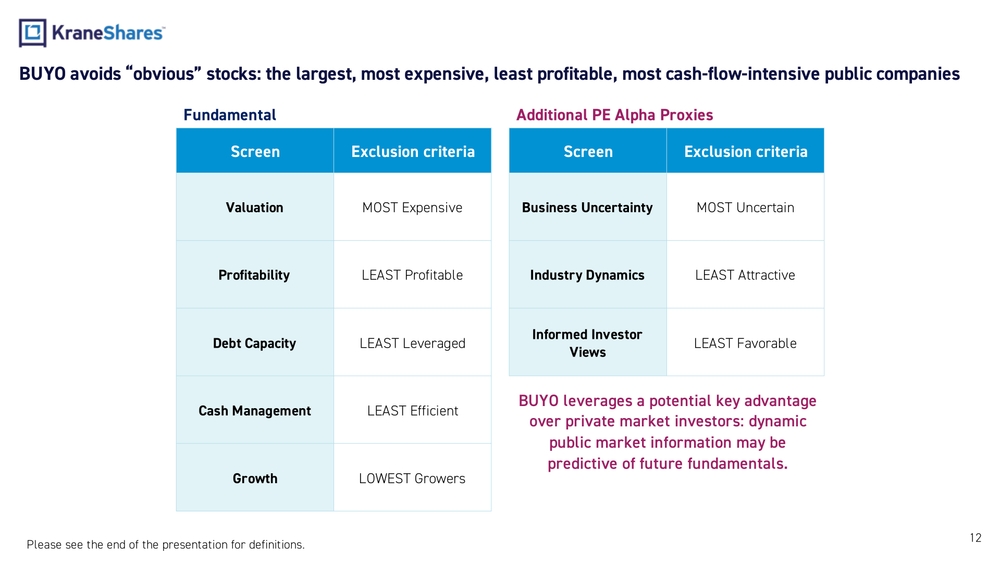
12BUYO avoids “obvious” stocks: the largest, most expensive, least profitable, most cash- flow-intensive public companies Screen Exclusion criteria Valuation MOST Expensive Profitability LEAST Profitable Debt Capacity LEAST Leveraged Cash Management LEAST Efficient Growth LOWEST GrowersFundamental Screen Exclusion criteria Business Uncertainty MOST Uncertain Industry Dynamics LEAST Attractive Informed Investor ViewsLEAST FavorableAdditional PE Alpha Proxies BUYO leverages a potential key advantage over private market investors: dynamic public market information may be predictive of future fundamentals. Please see the end of the presentation for definitions.
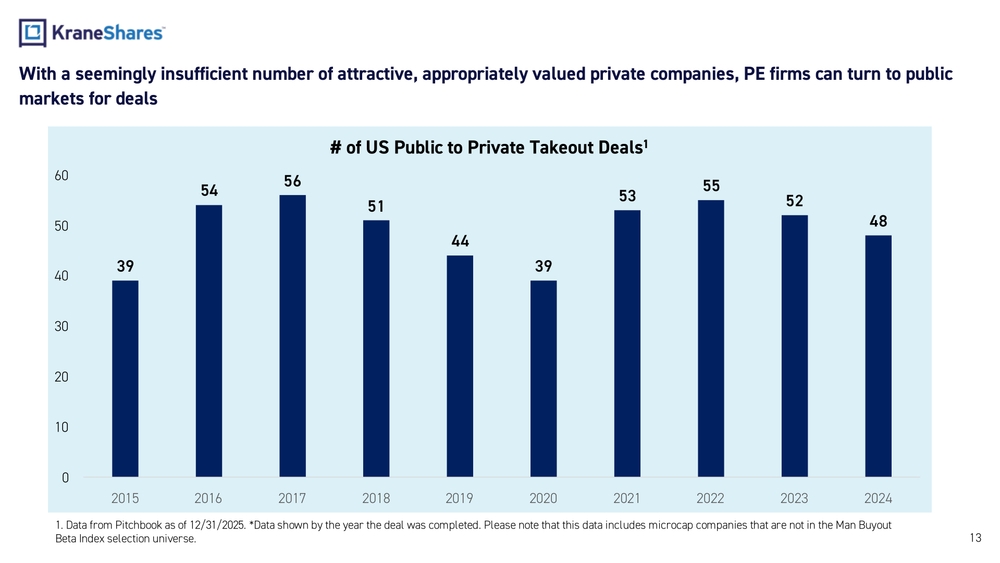
With a seemingly insufficient number of attractive, appropriately valued private companies, PE firms can turn to public markets for deals 131. Data from Pitchbook as of 12/31/2025. *Data shown by the year the deal was completed. Please note that this data includes microcap companies that are not in the Ma n Buyout Beta Index selection universe. 395456 51 44 395355 52 48 0102030405060 2015 2016 2017 2018 2019 2020 2021 2022 2023 2024# of US Public to Private Takeout Deals1
How does BUYO fit in your portfolio? A strong SMID (Small and Mid Cap) strategy possesses several key qualities that contribute to its effectiveness 14BUYO as a SMID strategy •BUYO is a US SMID investment strategy, focusing on private market signals and PE manager return drivers •The strategy offers exposure by intentionally deviating from typical sector -neutral quant approaches to align with PE deal activity sectors •The approach leverages PE firms' extensive due diligence and information advantages gained from their long -term investment horizon and related company investments •The portfolio maintains higher tracking error than typical quants while serving as a differentiated strategy through its broad alpha drivers and sophisticated risk management Please see the end of the presentation for definitions.
How does BUYO fit in your portfolio?
A strong SMID (Small and Mid Cap) strategy possesses several key qualities that contribute to its effectiveness
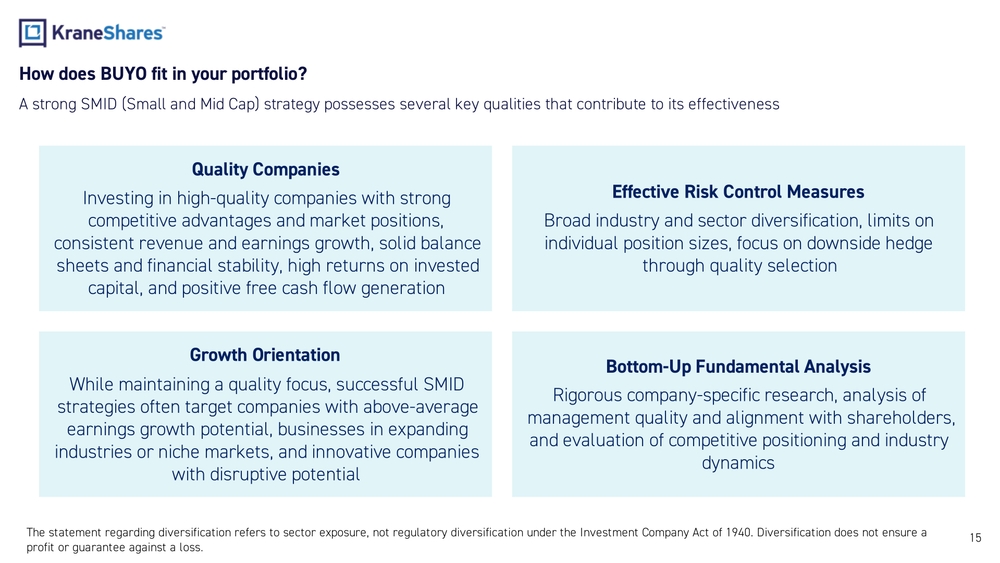
15Quality Companies
Investing in high- quality companies with strong
competitive advantages and market positions,
consistent revenue and earnings growth, solid balance
sheets and financial stability, high returns on invested
capital, and positive free cash flow generation
Growth Orientation
While maintaining a quality focus, successful SMID
strategies often target companies with above -average
earnings growth potential, businesses in expanding
industries or niche markets, and innovative companies
with disruptive potentialEffective Risk Control Measures
Broad industry and sector diversification, limits on
individual position sizes, focus on downside hedge
through quality selection
Bottom -Up Fundamental Analysis
Rigorous company -specific research, analysis of
management quality and alignment with shareholders,
and evaluation of competitive positioning and industry
dynamics
The statement regarding diversification refers to sector exposure, not regulatory diversification under the Investment Company A ct of 1940. Diversification does not ensure a
profit or guarantee against a loss.
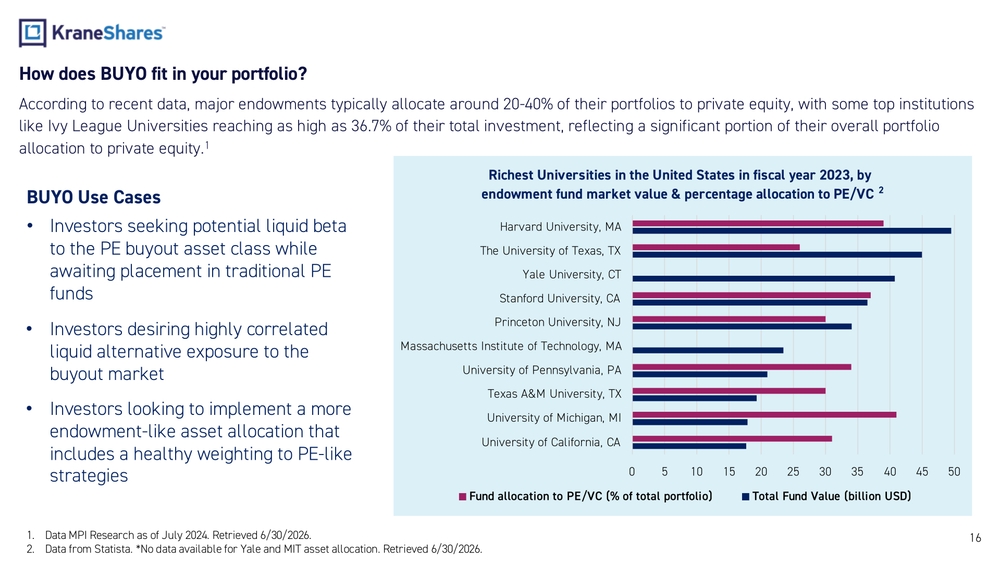
How does BUYO fit in your portfolio? According to recent data, major endowments typically allocate around 20 -40% of their portfolios to private equity, with some top institutions like Ivy League Universities reaching as high as 36.7% of their total investment, reflecting a significant portion of their over all portfolio allocation to private equity.1 161.Data MPI Research as of July 2024. Retrieved 6/30/2026. 2.Data from Statista. *No data available for Yale and MIT asset allocation. Retrieved 6/30/2026.BUYO Use Cases •Investors seeking potential liquid beta to the PE buyout asset class while awaiting placement in traditional PE funds •Investors desiring highly correlated liquid alternative exposure to the buyout market •Investors looking to implement a more endowment -like asset allocation that includes a healthy weighting to PE -like strategies 0 5 10 15 20 25 30 35 40 45 50University of California, CAUniversity of Michigan, MITexas A&M University, TXUniversity of Pennsylvania, PAMassachusetts Institute of Technology, MAPrinceton University, NJStanford University, CAYale University, CTThe University of Texas, TXHarvard University, MARichest Universities in the United States in fiscal year 2023, by endowment fund market value & percentage allocation to PE/VC2 Fund allocation to PE/VC (% of total portfolio) Total Fund Value (billion USD)
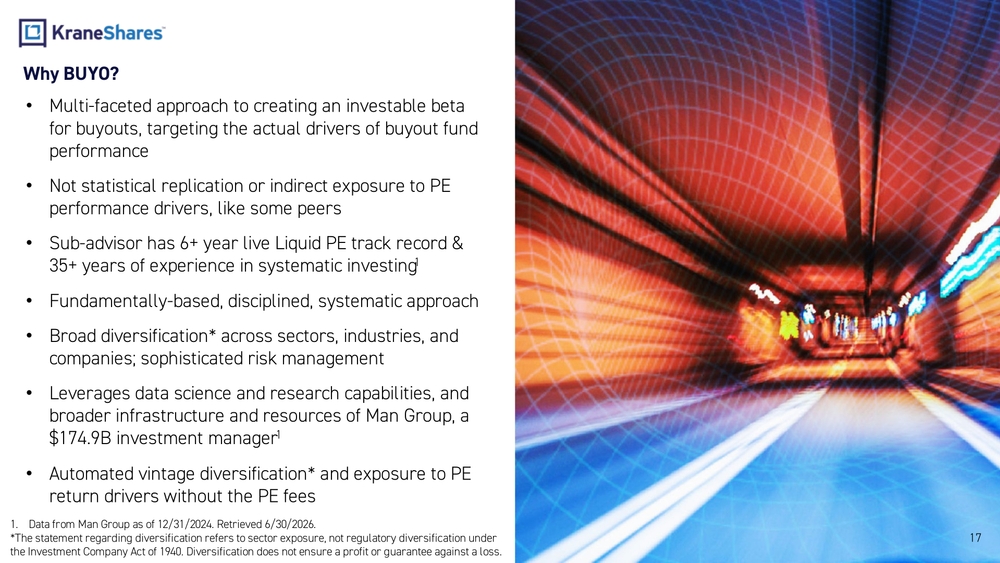
17Why BUYO? •Multi -faceted approach to creating an investable beta for buyouts, targeting the actual drivers of buyout fund performance •Not statistical replication or indirect exposure to PE performance drivers, like some peers •Sub-advisor has 6+ year live Liquid PE track record & 35+ years of experience in systematic investing 1 •Fundamentally- based, disciplined, systematic approach •Broad diversification* across sectors, industries, and companies; sophisticated risk management •Leverages data science and research capabilities, and broader infrastructure and resources of Man Group, a $174.9B investment manager 1 •Automated vintage diversification* and exposure to PE return drivers without the PE fees 1.Data from Man Group as of 12/31/2024. Retrieved 6/30/2026. *The statement regarding diversification refers to sector exposure, not regulatory diversification under the Investment Company Act of 1940. Diversification does not ensure a profit or guarantee against a loss.
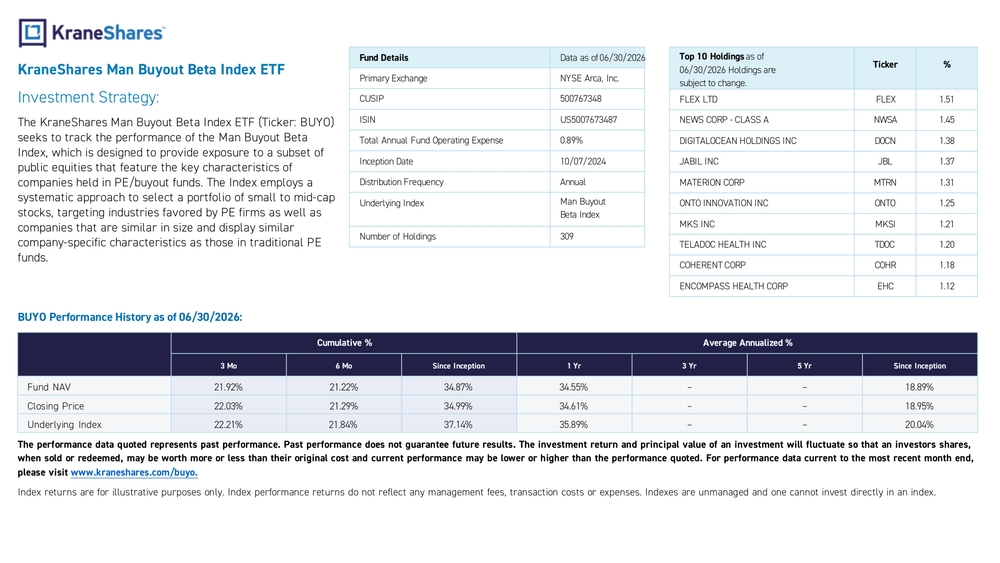
Fund Details Data as of 06/30/2026 Primary Exchange NYSE Arca, Inc. CUSIP 500767348 ISIN US5007673487 Total Annual Fund Operating Expense 0.89% Inception Date 10/07/2024 Distribution Frequency Annual Underlying Index Man Buyout Beta Index Number ofHoldings 309Top10Holdings asof 06/30/2026 Holdings are subject tochange.Ticker % FLEX LTD FLEX 1.51 NEWS CORP -CLASS A NWSA 1.45 DIGITALOCEAN HOLDINGS INC DOCN 1.38 JABIL INC JBL 1.37 MATERION CORP MTRN 1.31 ONTO INNOVATION INC ONTO 1.25 MKS INC MKSI 1.21 TELADOC HEALTH INC TDOC 1.20 COHERENT CORP COHR 1.18 ENCOMPASS HEALTH CORP EHC 1.12 BUYO Performance History asof06/30/2026: Cumulative % Average Annualized % 3Mo 6Mo Since Inception 1Yr 3Yr 5Yr Since Inception Fund NAV 21.92% 21.22% 34.87% 34.55% – – 18.89% Closing Price 22.03% 21.29% 34.99% 34.61% – – 18.95% Underlying Index 22.21% 21.84% 37.14% 35.89% – – 20.04%KraneShares Man Buyout Beta Index ETF Investment Strategy: The KraneShares Man Buyout Beta Index ETF (Ticker: BUYO) seeks to track the performance of the Man Buyout Beta Index, which is designed to provide exposure to a subset of public equities that feature the key characteristics of companies held in PE/buyout funds. The Index employs a systematic approach to select a portfolio of small to mid- cap stocks, targeting industries favored by PE firms as well as companies that are similar in size and display similar company -specific characteristics as those in traditional PE funds. Theperformance data quoted represents past performance. Past performance does notguarantee future results. Theinvestment return andprincipal value ofaninvestment willfluctuate sothat aninvestors shares, when sold orredeemed, may beworth more orless than their original cost andcurrent performance may belower orhigher than theperformance quoted. Forperformance data current tothemost recent month end, please visit www.kraneshares.com/buyo. Index returns areforillustrative purposes only. Index performance returns donotreflect anymanagement fees, transaction costs orexpenses. Indexes areunmanaged andonecannot invest directly inanindex.
KraneShares Empowering investors with access to the world’ s most powerful growth themes through ETFs, private strategies, and innovative investment solutions.
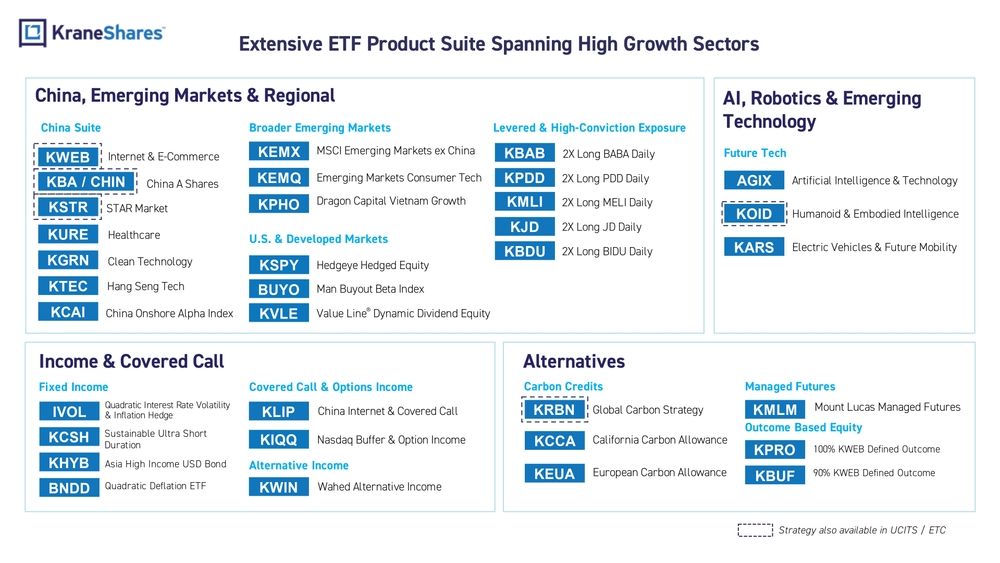
China, Emerging Markets & Regional Alternatives Income & Covered Call AI, Robotics & Emerging Technology KURE Healthcare KGRN Clean TechnologyKSTR STAR Market KTEC Hang Seng TechKWEB Internet & E -Commerce China A Shares KBA / CHIN KCAI China Onshore Alpha IndexAGIX Artificial Intelligence & Technology KOID Humanoid & Embodied Intelligence Electric Vehicles & Future Mobility KARSChina Suite Future TechBroader Emerging Markets KEMQ Emerging Markets Consumer Tech KPHODragon Capital Vietnam GrowthKEMX MSCI Emerging Markets ex China U.S. & Developed Markets KVLE Value Line® Dynamic Dividend EquityHedgeye Hedged Equity KSPY Man Buyout Beta Index BUYO Fixed Income BNDDQuadratic Deflation ETFIVOLQuadratic Interest Rate Volatility & Inflation Hedge KHYB Asia High Income USD BondSustainable Ultra Short DurationKCSH KEUA European Carbon AllowanceGlobal Carbon Strategy KRBNCarbon CreditsKPDD 2X Long PDD Daily KJD 2X Long JD DailyKBAB 2X Long BABA Daily KMLI 2X Long MELI Daily Covered Call & Options Income Managed Futures KMLMMount Lucas Managed Futures KWIN Wahed Alternative IncomeKLIP China Internet & Covered Call Outcome Based Equity KIQQ Nasdaq Buffer & Option IncomeLevered & High- Conviction Exposure KBUF90% KWEB Defined Outcome100% KWEB Defined Outcome KPRO Alternative Income KCCA California Carbon AllowanceExtensive ETF Product Suite Spanning High Growth Sectors Strategy also available in UCITS / ETCKBDU 2X Long BIDU Daily
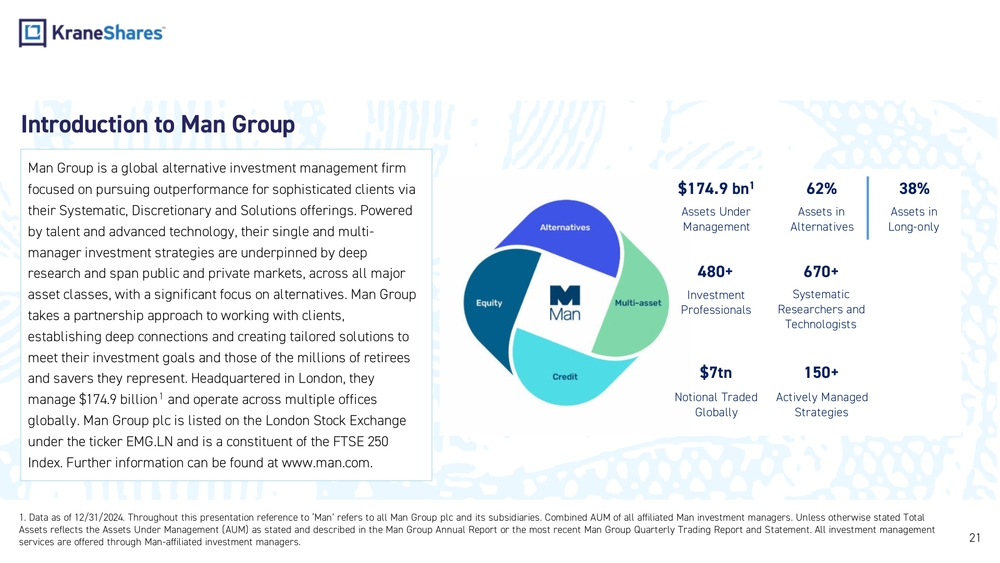
2121Introduction to Man Group Man Group is a global alternative investment management firm focused on pursuing outperformance for sophisticated clients via their Systematic, Discretionary and Solutions offerings. Powered by talent and advanced technology, their single and multi- manager investment strategies are underpinned by deep research and span public and private markets, across all major asset classes, with a significant focus on alternatives. Man Group takes a partnership approach to working with clients, establishing deep connections and creating tailored solutions to meet their investment goals and those of the millions of retirees and savers they represent. Headquartered in London, they manage $174.9 billion 1 and operate across multiple offices globally. Man Group plc is listed on the London Stock Exchange under the ticker EMG.LN and is a constituent of the FTSE 250 Index. Further information can be found at www.man.com.
- Data as of 12/31/2024. Throughout this presentation reference to ‘Man’ refers to all Man Group plc and its subsidiaries. C ombined AUM of all affiliated Man investment managers. Unless otherwise stated Total Assets reflects the Assets Under Management (AUM) as stated and described in the Man Group Annual Report or the most recent M an Group Quarterly Trading Report and Statement. All investment management services are offered through Man -affiliated investment managers. $174.9 bn1 Assets Under Management 480+ Investment Professionals $7tn Notional Traded Globally62% Assets in Alternatives38% Assets in Long- only 670+ Systematic Researchers and Technologists 150+ Actively Managed Strategies
22Index Definitions: Russell 2500 Index: The Russell 2500 Index measures the performance of the 2,500 smallest companies in the Russell 3000 Index Preqin Private Equity ex -Venture Capital Index: The Preqin Private Equity ex -Venture Capital Index represents the returns on committed capital in private equity partnerships. I t includes the amount of money invested in these partnerships and the returns that outstanding commitments would generate if invested risk -free. Te rm De finitions :Free cash flow yield (FCFY): Free cash flow yield is a financial metric that compares a company's cash flow to its overall valuation. It's a key indicator of a company's financial health and performance, and is used by investors to assess how well a company can meet its financial obligations. Operating margins: In business, operating margin —also known as operating income margin, operating profit margin, EBIT margin and return on sales —is the ratio of operating income to net sales, usually expressed in percent. Net profit measures the profitability of ventures after accounting for all costs.Capital Expenditure (CAPEX): Capital expenditure or capital expense is the money an organization or corporate entity spends to buy, maintain, or improve i ts fixed assets, such as buildings, vehicles, equipment, or land. Alpha: Alpha is a financial term that measures how well an investment strategy, portfolio manager, or trader has performed relative to a benchmark or the market. It's also known as excess return or abnormal rate of return. Beta: Beta measures an investment's volatility relative to the market and is used to quantify its risk. It's calculated as the slop e of a security's returns regressed against a benchmark market index. Tracking error: Tracking error is the standard deviation of the difference between a portfolio's returns and its benchmark's returns, measuri ng how closely the portfolio follows its benchmark over time. A higher tracking error indicates greater deviation from the benchmark, often due to active management decisions, while a lower tracki ng error suggests the portfolio closely mimics the benchmark. Alpha drivers: Alpha drivers are investments or strategies designed to generate returns that are independent of the overall market, aiming t o produce excess returns (alpha) through active management or unique sources of value. In portfolio construction, alpha drivers are contrasted with beta drivers, which track market moveme nts, as alpha drivers seek to outperform regardless of market direction.
Important Notes: Carefully consider theFunds’ investment objectives, risk factors, charges andexpenses before investing. This andadditional information canbefound intheFunds' full andsummary prospectus, which may beobtained byvisiting www.kraneshares.com /buyo .Read theprospectus carefully before investing. Risk Disclosures: Investing involves risk, including possible loss ofprincipal. There canbenoassurance that aFund willachieve itsstated objectives. Indices areunmanaged anddonotinclude theeffect offees. One cannot invest directly inan index. This information should notberelied upon asresearch, investment advice, orarecommendation regarding anyproducts, strategies, oranysecurity inparticular. This material isstrictly forillustrative, educational, or informational purposes andissubject tochange. Certain content represents anassessment ofthemarket environment ataspecific time andisnotintended tobeaforecast offuture events oraguarantee offuture results; material isasofthedates noted andissubject tochange without notice. The Underlying Index uses Numeric models in its methodology, which depend on various data sources that may be inaccurate or i ncomplete, rendering the models potentially unreliable. Historical market data may not predict future price movements, and unusual market events can lead to unexpected outcomes. Models may also have hidden biases and could incur losses if actual events diverge from their assumptions. Additionally, performance may be affected by software issues or programming errors. While the Underlying Index aims to reflect private equity performan ce and risk like private equity buyout funds, there is no guarantee that public equities will achieve this exposure or that the models will effectively provide it. The Fund may invest inderivatives, which areoften more volatile than other investments andmay magnify theFund’s gains orlosses. Aderivative (i.e.,futures/forward contracts, swaps, andoptions) isacontract that derives itsvalue from theperformance ofan underlying asset. Theprimary riskofderivatives isthat changes intheasset’s market value andthederivative may notbeproportionate, andsome derivatives canhave the potential forunlimited losses. Derivatives arealso subject toliquidity andcounterparty risk. TheFund issubject toliquidity risk, meaning that certain investments may become difficult topurchase orsellatareasonable time andprice. Ifatransaction forthese securities islarge, itmay notbepossible toinitiate, which may cause theFund tosuffer losses. Counterparty riskistheriskofloss intheevent that thecounterparty toanagreement fails tomake required payments orotherwise comply with theterms ofthederivative. TheFund isnew anddoes notyethave asignificant number ofshares outstanding. IftheFund does notgrow insize, itwillbeatgreater riskthan larger funds ofwider bid-askspreads foritsshares, trading atagreater premium ordiscount toNAV, liquidation and/or atrading halt. Narrowly focused investments typically exhibit higher volatility. TheFund’s assets areexpected tobeconcentrated inasector, industry, market, orgroup of concentrations totheextent that theUnderlying Index hassuch concentrations. The securities orfutures inthat concentration could react similarly tomarket developments. Thus, theFund issubject toloss duetoadverse occurrences that affect that concentration. Inaddition tothenormal risks associated with investing, investments insmaller companies typically exhibit higher volatility. BUYO isnon-diversified. ETF shares arebought andsold onanexchange atmarket price (not NAV) andarenotindividually redeemed from theFund. However, shares may beredeemed atNAV directly bycertain authorized broker -dealers (Authorized Participants) invery large creation/redemption units. Thereturns shown donotrepresent thereturns youwould receive ifyoutraded shares atother times. Shares may trade atapremium ordiscount totheir NAV inthesecondary market. Brokerage commissions willreduce returns. Beginning 12/23/2020, market price returns arebased ontheofficial closing price ofanETF share or,iftheofficial closing price isn't available, the midpoint between thenational best bidandnational best offer ("NBBO") asofthetime theETF calculates thecurrent NAV pershare. Prior tothat date, market price returns were based onthemidpoint between theBidand Askprice. NAVs arecalculated using prices asof4:00 PMEastern Time. TheKraneShares ETFs andKFA Funds ETFs aredistributed bySEIInvestments Distribution Company (SIDCO), 1Freedom Valley Drive, Oaks, PA19456, which isnotaffiliated with Krane Funds Advisors, LLC, theInvestment Adviser fortheFunds, oranysub-advisers fortheFunds.