2025_summer_internet_report
by Kraneshares
info@kraneshares.com +1 (212) 933 0393Summer 2025 China Internet Quarterly Earnings ReportFast & Furious: The Race For Instant Commerce

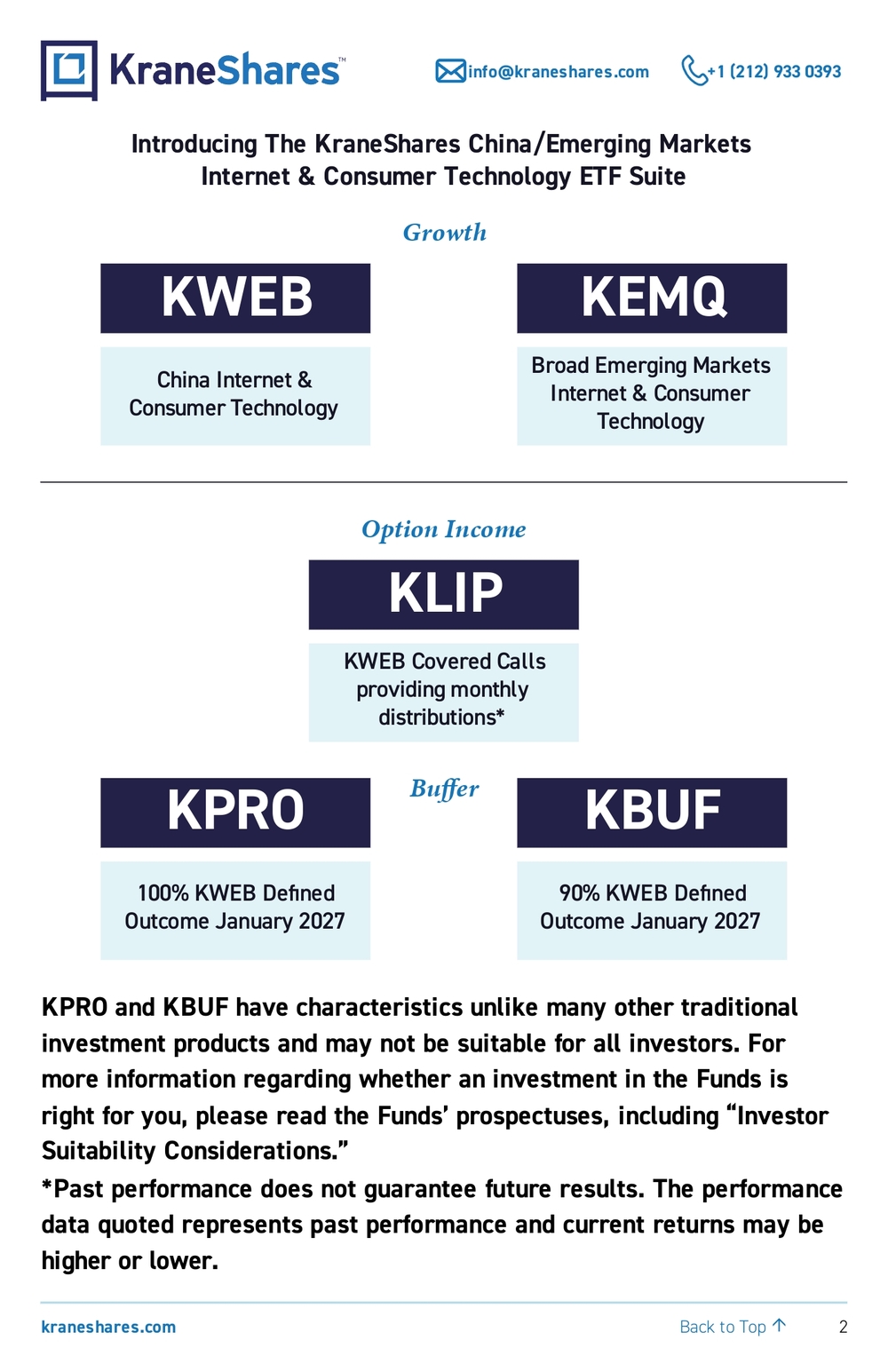
2 kraneshares.com info@kraneshares.com +1 (212) 933 0393 Back to Top ↑Introducing The KraneShares China/Emerging Markets Internet & Consumer Technology ETF Suite Option Income KLIP KWEB Covered Calls providing monthly distributions*Growth KWEB China Internet & Consumer TechnologyKEMQ Broad Emerging Markets Internet & Consumer Technology KPRO and KBUF have characteristics unlike many other traditional investment products and may not be suitable for all investors. For more information regarding whether an investment in the Funds is right for you, please read the Funds’ prospectuses, including “Investor Suitability Considerations.” *Past performance does not guarantee future results. The performance data quoted represents past performance and current returns may be higher or lower.BufferKPRO 100% KWEB Defined Outcome January 2027KBUF 90% KWEB Defined Outcome January 2027
3 kraneshares.com info@kraneshares.com +1 (212) 933 0393 Back to Top ↑Table of Contents China Internet Recent Highlights 4 KWEB Performance 6 KWEB Top 10 Holdings Financials Summary 7 KWEB Key Metrics 8 Subsector Analysis 10 Theme Highlight – Fast & Furious: The Race For Instant Commerce 14 Top 10 KWEB Holdings: Quarterly Earnings Update 21 Alibaba 21 Tencent 22 PDD Holdings 23 Meituan 24 Trip.com 25 Kanzhun 26 Kuaishou 27 Tencent Music 28 JD.com 29 Full Truck Alliance 30 Citations 31 Definitions 32 Disclosures 33
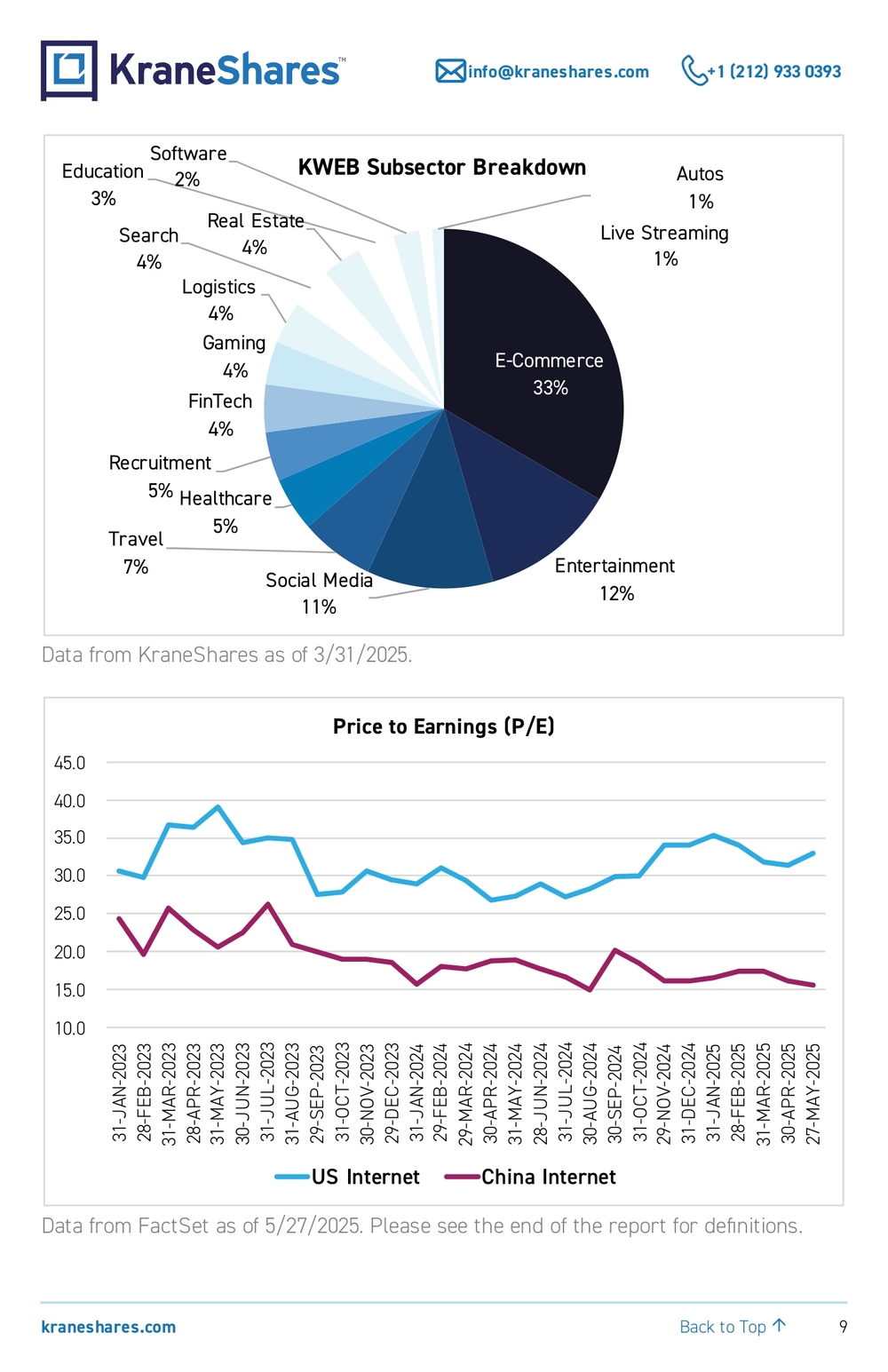
4 kraneshares.com info@kraneshares.com +1 (212) 933 0393 Back to Top ↑China Internet Recent Highlights •China internet companies had a mostly positive first quarter, though Alibaba’s earnings missed estimates as revenue and profitability growth slowed amid intense investment into AI initiatives and as the company returned significant capital to shareholders via dividends and share repurchases. •KWEB continues to deliver strong returns this year, delivering a total return of 16.49% year-to-date (YTD), as of May 20, 2025, compared to only 2.37% for the Nasdaq 100 Index.1 •KWEB’s holdings still trade at only 16 times earnings, on average, compared to 33 times for US internet companies.2 •The 90-day truce in US-China trade relations has benefited China internet equities from a sentiment perspective, though the fundamental impact is limited as KWEB’s holdings derive less than 2% of their revenues from the US. •Instant commerce, covering food delivery and the provision of general merchandise within one hour or less, has become the latest battleground for China’s E-Commerce giants, especially Meituan, Alibaba, and JD.com, leading to greater capital expenditure and exposing new growth areas in an already- saturated market. To learn more, check out this edition’s theme highlight.
5 kraneshares.com info@kraneshares.com +1 (212) 933 0393 Back to Top ↑ •China’s internet giants may wind down some of their exceptionally shareholder-friendly dividend and buyback policies and invest more in growth in the coming quarters. •The KraneShares KWEB Covered Call Strategy (Ticker: KLIP) is one of only three covered call ETFs available in the US market that use international stocks as their underlying assets.* Recently, we spoke on the benefits of this strategy, especially to KWEB investors, in a webinar. Please click here to view the replay. *Data form Morningstar as of 4/30/2025.
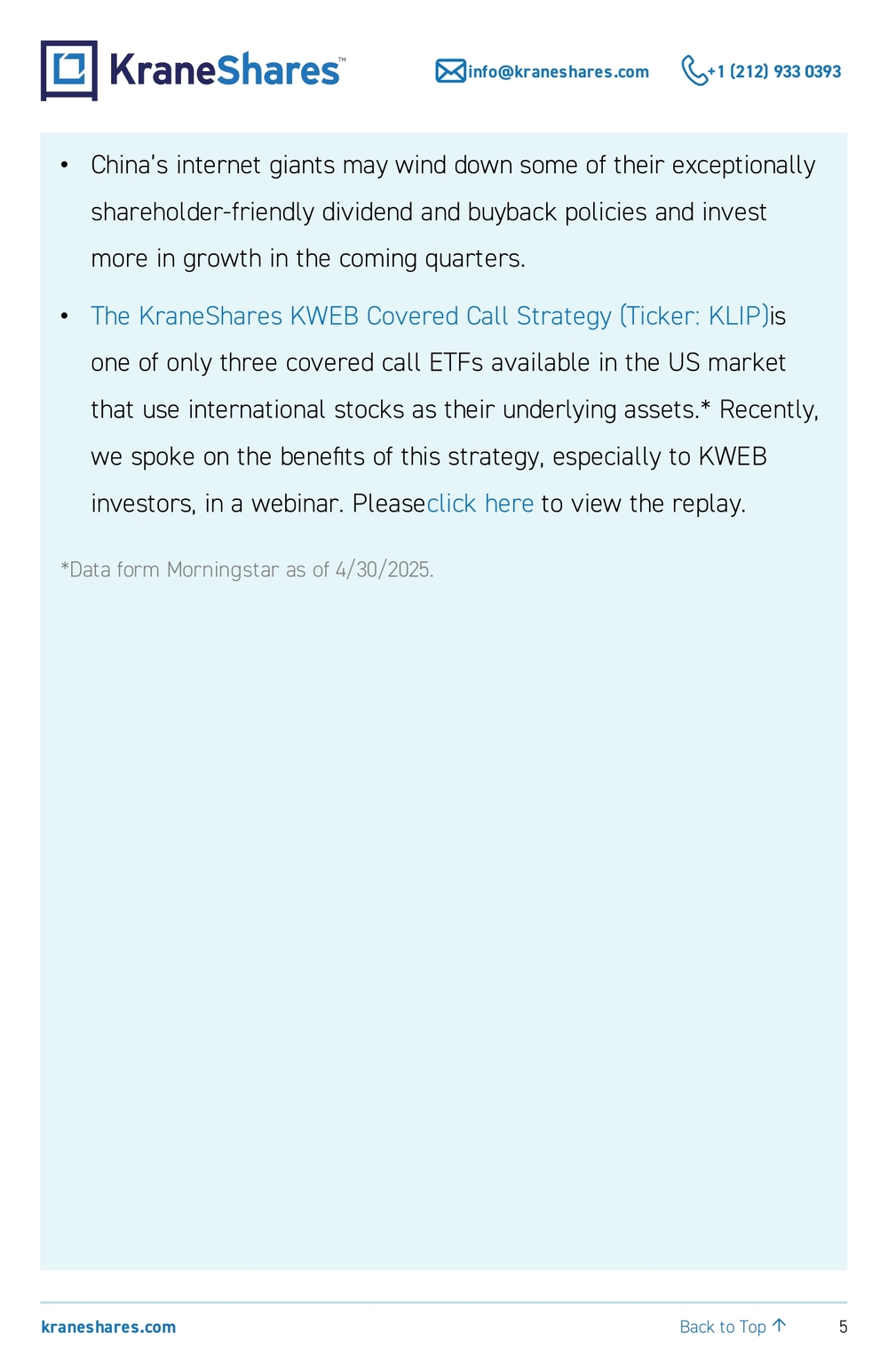
6 kraneshares.com info@kraneshares.com +1 (212) 933 0393 Back to Top ↑KraneShares CSI China Internet ETF (Ticker: KWEB) Performance Cumulative % Data as of: 05/31/2025 Fund NAV Closing Price Index 1 Month 2.32% 1.99% 2.26% 3 Month -1.90% -3.51% -2.38% 6 Month 11.30 % 9.87% 10.70% YTD 12.58% 11.97% 12.41% Since Inception 60.33% 58.45% 61.64% Avg Annualized % Data as of quarter end: 03/31/2025 Fund NAV Closing Price Index 1 Year 37.13% 37.46% 36.11% 3 Year 7.48% 8.80% 7.39% 5 Year -2.64% -2.61% -2.44% 10 Year 2.01% 2.01% 2.25% Since Inception 4.58% 4.60% 4.69% KWEB’s gross expense ratio is 0.70%. Inception Date: 7/31/2013. KWEB Index is the CSI Overseas China Internet Index. The performance data quoted represents past performance. Past performance does not guarantee future results. The investment return and principal value of an investment will fluctuate so that an investor’s shares, when sold or redeemed, may be worth more or less than their original cost, and current performance may be lower or higher than the performance quoted. For performance data current to the most recent month end, please call +(1) 855 8KRANE8 or visit our website at www. kraneshares.com/kweb .
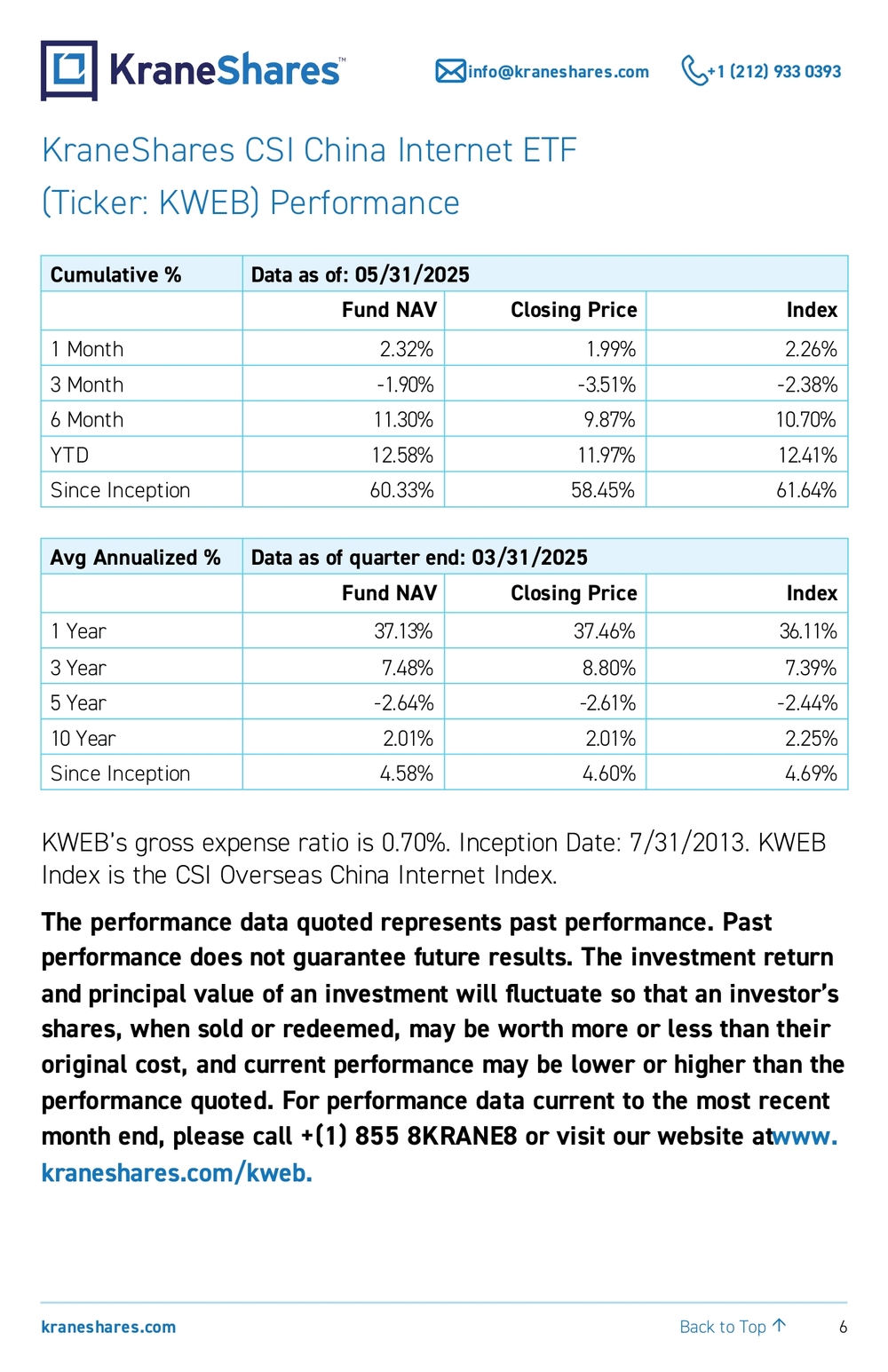
7 kraneshares.com info@kraneshares.com +1 (212) 933 0393 Back to Top ↑KWEB Top 10 Holdings Financials Summary Top 10 KWEB HoldingsKWEB Weight (%)Revenue ($ B)Net Income ($ B)Revenue Growth (%)Net Margin (%)Earnings per Share ($) Alibaba 12.16 32.5 3.6 7 11 1.5 Tencent 10.85 24.7 6.5 13 26 0.7 PDD Holdings 6.87 13.2 2 10 15 1.4 Meituan 6.66 11.9 1.2 18 10 0.2 Trip.com 4.68 1.9 0.5 16 26 0.7 Kanzhun 4.51 0.3 0.1 13 33 0.1 Kuaishou 4.11 4.5 0.5 11 11 0.1 Tencent Music 3.99 1 0.3 9 30 0.2 JD.com 3.87 41.4 1.5 16 4 1 Full Truck Alliance3.86 0.4 0.2 19 50 0.2 Total Weighted Average Total 61.56 99.3 12.8 12 20 6.1 Data as of 03/31/2025. Please see the end of the report for definitions. Figures are adjusted (non-GAAP) and % changes are year-over-year (YoY) unless otherwise indicated. Holdings are subject to change. Please see the end of the report for definitions and KWEB’s top ten holdings as of the most recent quarter-end.
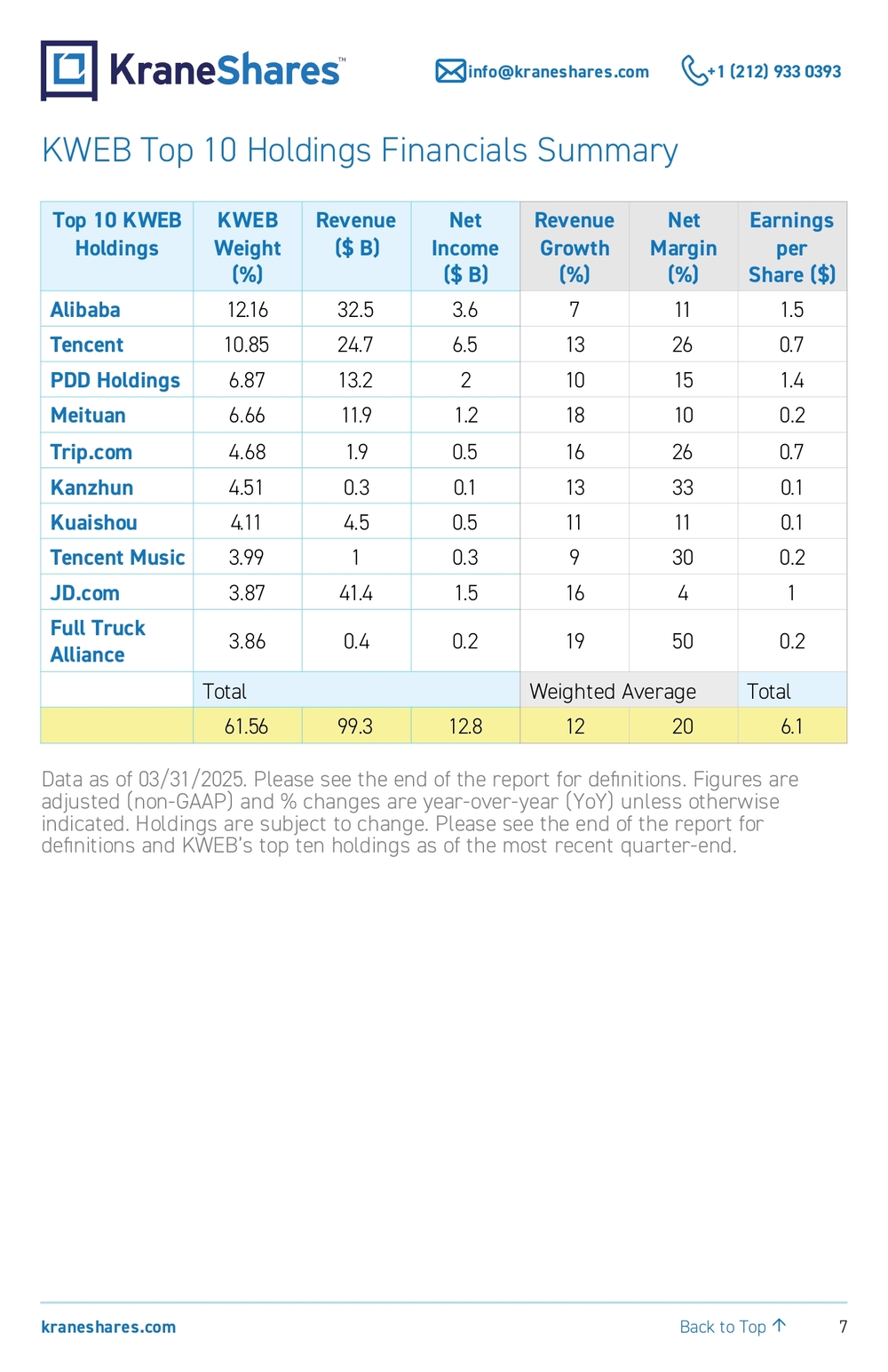
8 kraneshares.com info@kraneshares.com +1 (212) 933 0393 Back to Top ↑KWEB Key Metrics -20.00-10.000.0010.0020.0030.0040.0050.00 Real Estate Education Logistics Travel FinTech Healthcare Recruitment E-Commerce Software Gam ing Social Media Entertainment Search Autos Live Streaming%Subsector Revenue Growth Data from Bloomberg as of 3/31/2025. Please see the end of the report for definitions. -30-20-10010203040506070 FinTech Software Healthcare Gaming Logistics Travel Social Media Entertainment Real Estate Live Streaming E-Commerce Education Autos Search RecruitmentAverage % ChangeSubsector Performance (12-Month) Data from Bloomberg as of 5/23/2025.
9 kraneshares.com info@kraneshares.com +1 (212) 933 0393 Back to Top ↑E-Commerce 33% Entertainment 12%Social Media 11%Travel 7%Healthcare 5%Recruitment 5%FinTech 4%Gaming 4%Logistics 4%Search 4%Real Estate 4%Education 3%Software 2% Live Streaming 1%Autos 1%KWEB Subsector Breakdown Data from KraneShares as of 3/31/2025. 10.015.020.025.030.035.040.045.0 31-JAN-2023 28-FEB-2023 31-M AR-2023 28-APR-2023 31-M AY-2023 30-JUN-2023 31-JUL-2023 31-AUG-2023 29-SEP-2023 31-OCT-2023 30-NOV-2023 29-DEC-2023 31-JAN-2024 29-FEB-2024 29-M AR-2024 30-APR-2024 31-M AY-2024 28-JUN-2024 31-JUL-2024 30-AUG-2024 30-SEP-2024 31-OCT-2024 29-NOV-2024 31-DEC-2024 31-JAN-2025 28-FEB-2025 31-M AR-2025 30-APR-2025 27-M AY-2025Price to Earnings (P/E) US Internet China Internet Data from FactSet as of 5/27/2025. Please see the end of the report for definitions.
10 kraneshares.com info@kraneshares.com +1 (212) 933 0393 Back to Top ↑Subsector Analysis Real Estate platform KE Holdings, which operates the popular “Beike” real estate app, which is similar to Zillow in the United States, increased revenue by 42% in the second quarter. The company’s strong results exceeded revenue and net income estimates. The recent uptick in China’s real estate market, especially the market for new housing, benefited KE’s revenue growth. KE’s new home transactions increased +53%. Education technology and private tutoring platform TAL Education increased revenue by 42%. Despite the strong growth, the company missed estimates on its top and bottom lines. TAL ’s education and technology sales declined from the fourth quarter, as CICC analysts noted the cyclical nature of this business line. Logistics company Full Truck Alliance increased its revenues by +19% in the first quarter. The company has successfully increased the monetization of its online shipping transactions. Travel platforms increased revenue by +15%, on average. Trip.com saw exceptional growth in its customer base from outside of China, while domestic travel outpaced outbound travel. Meanwhile, Tongcheng Travel Holdings underperformed rival Trip.com in terms of both growth and share price performance. However, CICC analysts expect user subsidies to have leveled off for Tongcheng’s hotel booking business, which should improve margins in future quarters. FinTech platforms increased their revenues by 15%, on average. Qifu Technology had an outstanding quarter, beating estimates on adjusted
11 kraneshares.com info@kraneshares.com +1 (212) 933 0393 Back to Top ↑revenue and earnings per share and facilitating RMB 88.9 billion ($12.3 billion) worth of consumer loans, representing a 16% increase. Healthcare platform Ali Health increased revenue by +15% in the second half of its fiscal year 2025, which concluded on March 31, 2025. JD Health, KWEB’s other online healthcare holding, will not report its latest six- month period until August. Ali Health’s pharmaceutical sales business, which accounts for most of its revenue, faced pressure from competition from other online platforms during the quarter, though the company’s revenue overall maintained double-digit growth. Recruitment platform Kanzhun increased revenue by +13%, despite a slow season for job recruitment, as white collar and blue-collar jobs on the platform are becoming more balanced, a long-term goal of the company. E-Commerce companies had mixed results, growing revenues by +10%, on average. JD.com had a solid quarter, supercharged by trade-in subsidies for home appliances and electronics, though analysts have become concerned about its aggressive consumer subsidies geared towards growing its instant commerce market share, a new business line for the company. Meanwhile, Alibaba’s earnings missed estimates as investors would like to see the company investing more in growth, as its extremely shareholder-friendly dividend and buyback policies may have directed capital away from investments. PDD Holdings’ earnings also missed across the board as trade frictions weighed on its significant international business.
12 kraneshares.com info@kraneshares.com +1 (212) 933 0393 Back to Top ↑Software provider Kingsoft, specializing in enterprise software solutions, including the “Microsoft Office” of China, increased revenue by +9%. CICC analysts noted that the company’s growth in the first quarter could have been stronger, but many local governments, which are key clients of the company, delayed necessary software procurement into later quarters because they were waiting to see clarity on stimulus policies from the central government. As a result, sales of Kingsoft’s flagship WPS Office could pick up significantly later this year. Social Media companies increased revenue by +7%, on average, as Tencent exceeded estimates on both revenue and net income. Meanwhile, Weibo continues to be challenged by competition from social media rivals with more video content, especially Douyin, China’s “TikTok”. Gaming companies increased revenue by +7%. NetEase had stellar earnings in the first quarter and has reinstated its partnership with Microsoft, formerly with Blizzard before Microsoft’s acquisition, with improved terms, leading to improved margins on licensed game sales. Entertainment companies increased revenue by +6% on average, thanks to strong top-line growth from Kuaishou, NetEase Music, and Tencent Music. However, iQiyi saw negative growth as its pipeline for new content, necessary to win back users, continued to dwindle. Search engine Baidu increased revenue by a modest 3% in the first quarter. Like other search engines, including Google, Baidu faces the challenge of maintaining search traffic as users increasingly use AI chatbots for basic inquiries. Meanwhile, the company continues to
13 kraneshares.com info@kraneshares.com +1 (212) 933 0393 Back to Top ↑maintain a high cash level, higher than its market capitalization, indicating that it could probably do more to jumpstart growth. Autos marketplace Autohome, which is similar to Carvana in the United States, saw revenue decline by -10%, though it was slightly more profitable than expected in the first quarter. Price cuts for new vehicles and trade-in subsidies have weighed on Autohome’s growth by weakening the used car market. However, the company continues working closely with Ping An Insurance to develop one-stop technology solutions for purchasing and managing both vehicles and insurance policies. Live Streaming revenues declined by -11%, as both East Buy and Joyy experienced declines year-over-year. However, CICC analysts noted that Joyy’s decline is likely due to temporary adjustments in its core business and that non-core advertising services could become the new growth driver, especially considering added AI-powered enhancements.
14 kraneshares.com info@kraneshares.com +1 (212) 933 0393 Back to Top ↑Theme Highlight – Fast & Furious: The Race For Instant Commerce China’s E-Commerce and local services giants - JD.com, Alibaba, and Meituan - are engaged in a high-stakes battle to dominate the market for instant commerce. This competition reflects broader shifts in consumer behavior, technological innovations, and strategic pivots to capture growth in a saturated digital economy. Over the past two years, these companies have invested significantly in customer subsidies, logistics infrastructure, and ecosystem integration to secure their positions in a market that is projected to exceed $500 billion by 2030.3 We believe the pivot to instant delivery demonstrates the enduring growth potential of China’s internet sector, despite high E-Commerce penetration. Recent efforts at expanding instant delivery have also uncovered areas of the market with lower penetration of other types of E-Commerce and therefore higher growth potential. For example, express delivery volumes in Western China soared by +30% in 2024,4 a far more significant increase than in China’s Eastern cities. JD.com, Meituan, and Alibaba are competing for consumer wallet share
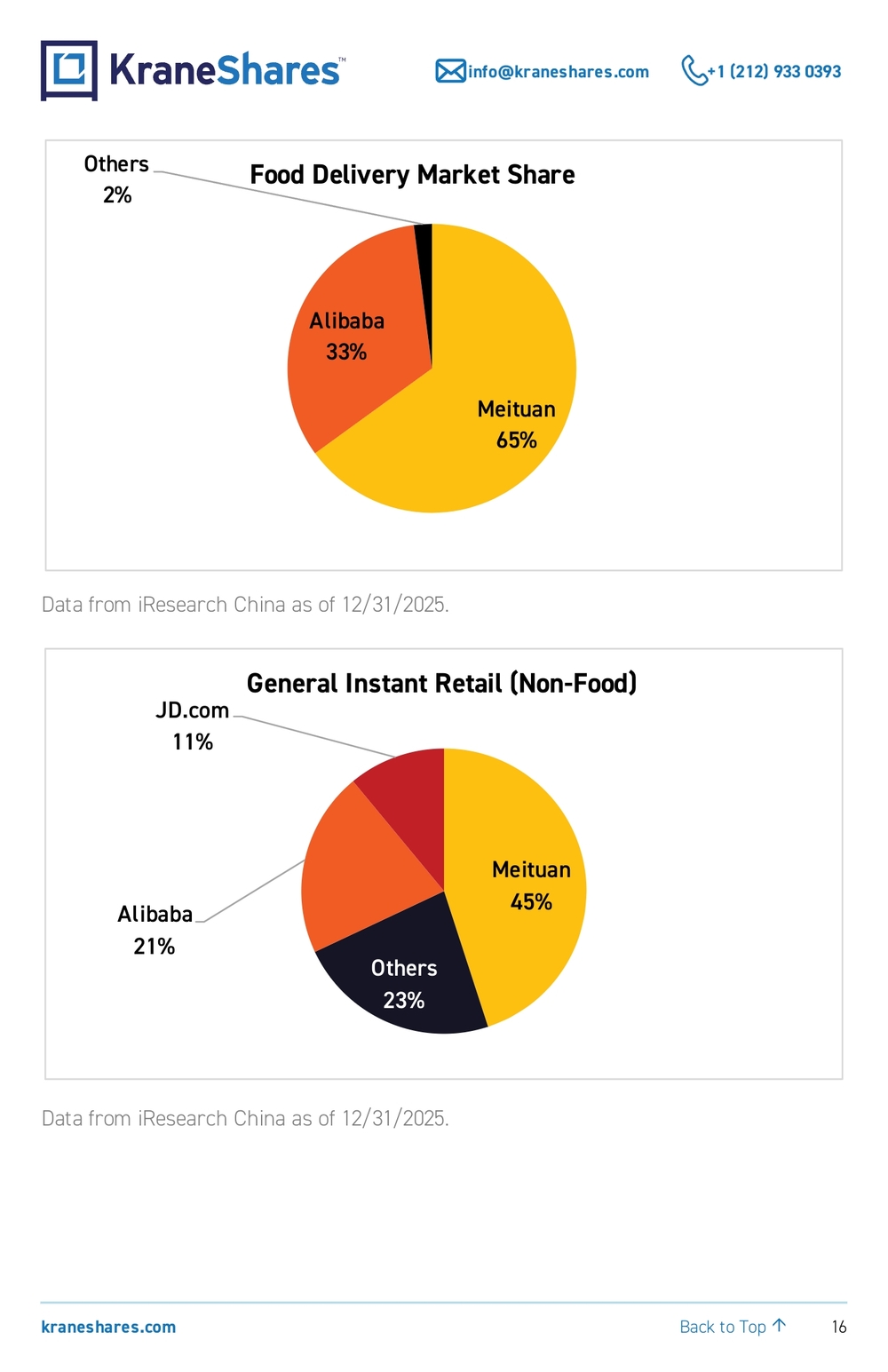
15 kraneshares.com info@kraneshares.com +1 (212) 933 0393 Back to Top ↑in this vital category across three fronts: discounts, technology, and geography. The reward? Cross-selling by capturing the consumer when in a pinch, potentially creating lasting brand loyalty. Instant Retail On The Rise China’s express delivery sector handled a record 174.5 billion parcels in 2024, a 21% year-over-year (YoY) increase, driven by the integration of instant retail into daily consumption.3 The on-demand delivery market alone processed 48.28 billion orders in 2024, with forecasts suggesting this will double by 2030.5 This growth is underpinned by consumer demand for hyper-convenience. With traditional E-Commerce growth plateauing, companies are beginning to pivot to instant retail: delivering groceries, meals, electronics, and other goods in 30 to 60 minutes. This segment leverages high-frequency, need-now purchases (e.g., food, cleaning supplies) to drive engagement with higher-margin products and services. For example, JD.com reported that 15.8% of its Q4 2024 revenue came from electronics, a category now eligible for 30-minute delivery.6 While Meituan has a stronghold over the food delivery space, capturing over 65% of market share, instant delivery of other goods is still up for grabs.
16 kraneshares.com info@kraneshares.com +1 (212) 933 0393 Back to Top ↑Meituan 65%Alibaba 33%Others 2%Food Delivery Market Share Data from iResearch China as of 12/31/2025. Meituan 45% Others 23%Alibaba 21%JD.com 11%General Instant Retail (Non-Food) Data from iResearch China as of 12/31/2025.
17 kraneshares.com info@kraneshares.com +1 (212) 933 0393 Back to Top ↑JD.com is a new entrant to the market, launching JD Takeaway for food delivery and JD NOW for general instant retail in 2025. These platforms form a unified ecosystem, supported by over 1 million riders already employed by JD’s vast logistics network.7 Targeting Consumers With Discounts Platforms are rolling out massive discounts to expand market share and acclimate consumers to ordering items for instant delivery. While these discounts are effective, they also need to be balanced with profitability. The instant retail race has triggered an RMB 30 billion subsidy war between JD.com, Alibaba, and Meituan.8 All three platforms are employing different methods to capture consumers’ attention and wallets. JD Takeaway targets deliveries from popular chains such as McDonald’s and the beloved hot pot franchise Haidilao with aggressive discounts, including daily subsidies of up to RMB 20.9 The strategy, led by former Meituan executives, focuses on leveraging JD’s main app for traffic and integrating food delivery into a broader lifestyle services menu. Through integration with Taobao, Alibaba’s food delivery platform, Ele. me, has expanded beyond meals to include pet supplies, clothing, and electronics. In April 2025, Taobao’s instant shopping feature began offering 30-minute delivery from restaurants, coffee shops, and retailers, backed by an RMB 10 billion subsidy pledge.10 This move aims to counter Meituan’s incursions into non-food categories, such as small electronics and household cleaning supplies. After a decade of experimentation, Alibaba’s technology-enabled, brick- and-mortar retail store Hema (Freshippo) has also helped grant the
18 kraneshares.com info@kraneshares.com +1 (212) 933 0393 Back to Top ↑company a foothold in the instant commerce space. By adopting a “1 Store + N Warehouses” model, whereby additional auxiliary warehouses complement flagship brick-and-mortar stores, Hema has optimized inventory management and reduced average delivery times to under 30 minutes. CEO Eddie Wu recently highlighted Hema’s role in validating Alibaba’s integrated online-offline strategy.11 Meituan has aggressively expanded beyond food delivery and other local services, into instant retail. Its Flash Buy service, launched in 2018, delivers electronics, cosmetics, and groceries within 30 minutes via 30,000 “lightning warehouses”. In 2025, Flash Buy processed 18 million non-food orders daily, contributing to a 23% year-over-year growth in instant retail volume.12 Technology & Efficiency All three companies deploy AI and automation to optimize routes and reduce costs. Far from gimmicks, these innovations allow them to serve customers better, reduce wait times, and improve cross-selling opportunities into higher-margin product categories. JD.com uses AI for live-streamed merchant promotions. JD’s platform can generate digital avatars of brand representatives that can respond to customer requests and inquiries in real time. JD also employs AI techniques to make its logistics system as efficient as possible, ensuring rapid, on-time delivery with accurate estimates. Alibaba and JD are leading the way in terms of cross-selling into higher-margin categories, in our opinion. Alibaba’s Taobao and T-mall now feature lifestyle service hubs, a convergence that aims to envelop consumers into self-contained ecosystems for all their needs. This
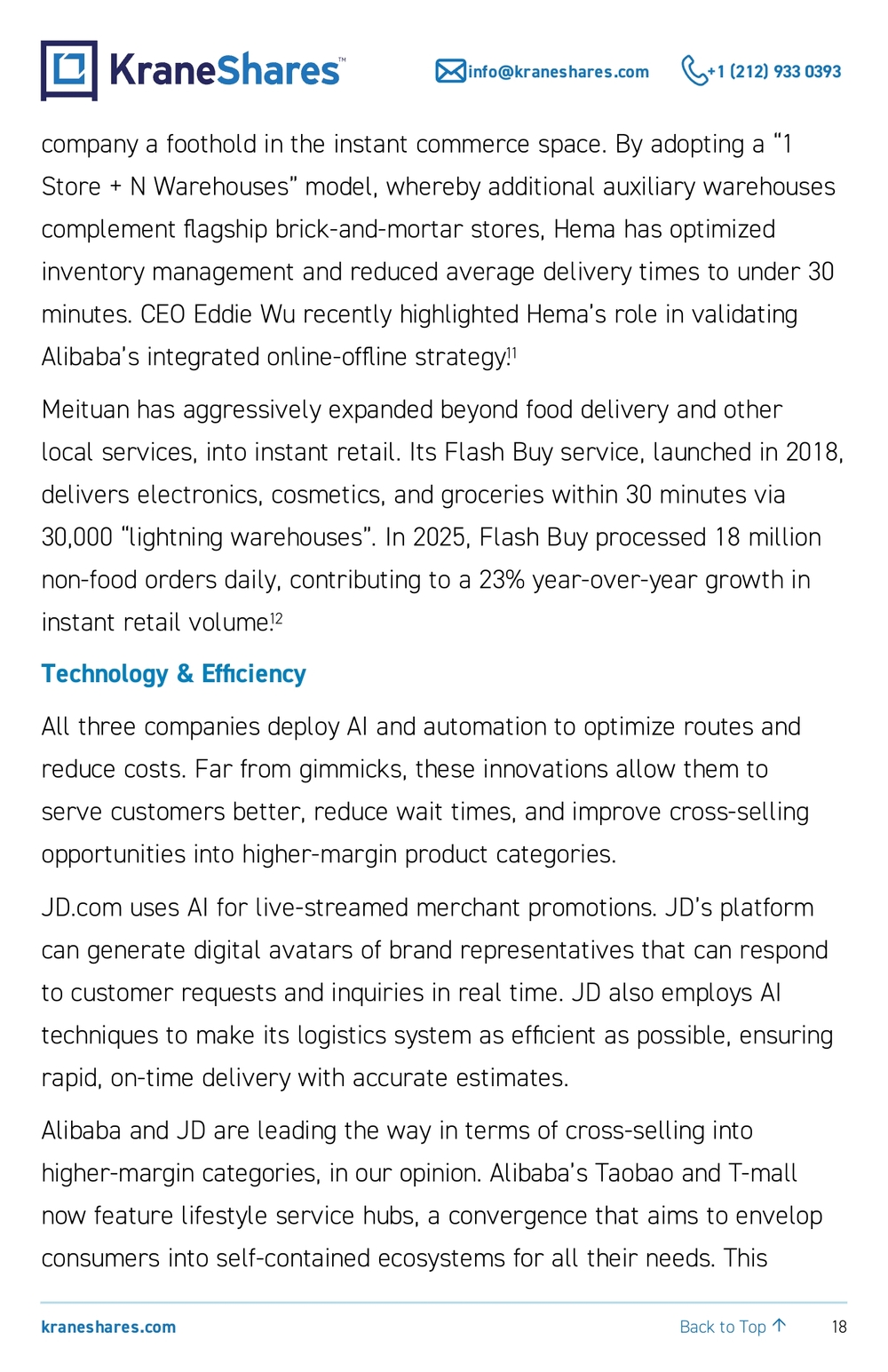
19 kraneshares.com info@kraneshares.com +1 (212) 933 0393 Back to Top ↑can increase the lifetime value extracted per consumer by increasing brand loyalty. Meituan also incorporates general E-Commerce into their singular app, but lacks JD’s and Alibaba’s breadth of choices, as the former are long-time specialists in goods retail. Meituan is not sitting idly by either; when it comes to technological innovation, it employs drones for rural and urban deliveries.13 In select cities, users can walk up to a Meituan-branded booth, usually located in a public park or square, on a sunny day, order a drink, meal, or snack, and have it delivered in no time with a drone. A Meituan drone pickup kiosk in Shenzhen. Credit: Xinhua
20 kraneshares.com info@kraneshares.com +1 (212) 933 0393 Back to Top ↑Geographical Expansion Leading to Growth With urban markets saturated, companies are also targeting rural areas in China and international destinations with instant commerce. Instant commerce is seen as a way to enter new markets where it does not exist yet or where the service is unreliable and coverage is spotty. This can help E-Commerce companies access markets with higher growth than those they are already in or ones with different economic cycles and drivers of consumer behavior. For example, Western China, which is being targeted by Meituan, Alibaba, and JD.com for instant delivery, experienced 30% growth in express delivery volumes in 2024,4 far outpacing the growth rates in tier-1 and tier-2 cities, which already have high adoption rates. Meituan is bridging urban-rural gaps by subsidizing shipping to remote villages and partnering with 4,600+ retail chains13 across Western China. Meituan is also the latest among the three to expand internationally, launching Keeta delivery in Saudi Arabia and other key overseas markets.14 Bringing China-born efficiencies to other markets is another important way these companies can maintain growth momentum in the face of a saturated market at home. Conclusion JD.com, Alibaba, and Meituan are redefining China’s retail landscape through instant delivery, uncovering a new growth driver in a market with high E-Commerce penetration. While subsidies and technological investments drive short-term growth, profitability hinges on operational efficiency and cross-selling higher-margin products. As this battle for the future of China’s E-Commerce ecosystem continues, we believe the
21 kraneshares.com info@kraneshares.com +1 (212) 933 0393 Back to Top ↑extreme competition will continue to drive strong growth for China’s internet sector. China’s internet sector overall is likely to be a leader in the battle for instant delivery dominance. KWEB Top 10 Holdings Earnings Update Sources: Bloomberg, CICC Research, company releases & filings, KraneShares. % changes are year-over-year unless otherwise indicated. Revenue figures are adjusted (non-GAAP). Alibaba Alibaba is a conglomerate primarily engaged in E-Commerce. The company operates an online marketplace offering a wide variety of consumer goods. The company has also expanded beyond E-Commerce and is now a consortium of six businesses covering cloud, domestic E-Commerce, global digital commerce, media, logistics, and local services. Alibaba By The Numbers (Q1 2025) •Revenue RMB 234.2 ($32.5B) •Net Income RMB 26.0B ($3.6) •Net Margin 11% •Earnings per Share RMB 10.8 ($1.5) Alibaba had a quarter of strong growth in key segments, though it thoroughly missed estimates on net income and top-line revenue. Alibaba may not have benefited as much as its peers, especially JD.com, from trade-in subsidies. Although Alibaba continues to reward its shareholders, buying back $11.9 billion worth of shares in the past year, directing capital toward shareholders and away from investments in technology for growth may have dented its top-line growth. Nonetheless,
22 kraneshares.com info@kraneshares.com +1 (212) 933 0393 Back to Top ↑cloud growth accelerated significantly to 18%, driven by strong adoption of AI models, especially Alibaba’s industry-leading Q-wen. Company executives have mentioned the immense cross-selling opportunities for Alibaba Cloud as demand for inference, i.e. large language models, rises. Alibaba continues to be a leader in AI development and is likely to continue to innovate and grow in this category. Alibaba may, in future quarters, devote more capital to R&D and investment in growth than in previous quarters. China commerce (Taobao & Tmall) revenue increased 9%, as 88VIP members, the high-spending category, have reached over 50 million. Alibaba currently intends to repurchase up to $22 billion worth of shares through March of 2027. Tencent Tencent is a diversi fied consumer technology company with businesses in social media, cloud services, payments, and online advertising. Tencent’s most well-known product is WeChat, one of China’s premier social media platforms with over one billion monthly active users (MAUs). Tencent By The Numbers (Q1 2025) •Revenue +13% to RMB 178.0 ($24.7B) •Net Income RMB 46.8 ($6.5B) •Net Margin 26% •Earnings per Share RMB 5.0 ($0.7) Tencent exceeded analyst expectations for revenue, net income, and earnings per share for the first quarter of 2025. The strong growth of value-added services (VAS), a catch-all term for non-core businesses,
23 kraneshares.com info@kraneshares.com +1 (212) 933 0393 Back to Top ↑including fintech, of 17%. Meanwhile, domestic games revenue increased +24%, benefiting from a low base in the same period last year. Profitability, in terms of adjusted net income, increased by over +20%, reflecting a healthy return of advertising demand in the quarter. Tencent repurchased approximately 43 million shares during the first quarter at a cost of $2.2 billion. Tencent currently intends to repurchase up to $60 billion worth of shares through May of 2026. PDD Holdings PDD is an innovative global E-Commerce platform focused on the user experience. It was one of the fi rst to embrace a social media-like model for online shopping. The company’s apps are known for their group- buying capabilities, inserting gaming into shopping and earning coupons, and rock-bottom prices for private-label goods. PDD is also famous for pioneering the lowering of overhead costs through an on-demand manufacturing model. PDD operates under the name “Pinduoduo” in China and “Temu” in the rest of the world. PDD By The Numbers (Q1 2025) •Revenue +10% to RMB 95.1B ($13.2B) •Net Income RMB 14.4B ($2.0B) •Net Margin 15% •Earnings per Share RMB 10.1 ($1.4) PDD’s results in the first quarter came short of analysts’ expectations for profit and overall revenue. The announcement of new tariffs on imports from China into the United States led PDD to switch US-bound orders to
24 kraneshares.com info@kraneshares.com +1 (212) 933 0393 Back to Top ↑local merchants and fulfillment only, which weighed on revenue and net income. Although PDD does not break out its revenue geographically, we estimate the US to represent approximately 15%. “In the first quarter, we made substantial investments in our platform ecosystem to support merchants and consumers amid rapid changes in the external environment,” said Mr. Lei Chen, Chairman and Co-Chief Executive Officer of PDD Holdings. Meanwhile, management noted significant investments into its platform centered around user experience and strengthening their capture of purchases driven by China’s trade-in subsidy program also may have weighed on net income. Meituan Meituan is an E-Commerce company that specializes in food delivery and other local services. The company operates many business lines, including general retail, restaurant booking, and travel booking services, and it serves over 600 million registered users. Meituan is one of China’s leading “super apps” that offer a wide variety of services, including from third parties. Meituan By The Numbers (Q1 2025) •Revenue +18% to RMB 85.7B ($11.9B) •Net Income RMB 8.7 ($1.2) •Net Margin 10% •Earnings per Share RMB 1.4 ($0.2) Meituan exceeded analyst expectations for both top-line revenue and net income in its first quarter results. During its earnings call, management addressed the recent RMB 10 billion worth of instant delivery subsidies
25 kraneshares.com info@kraneshares.com +1 (212) 933 0393 Back to Top ↑instituted by JD.com and Alibaba, stating that after ten years of competition, Meituan will " take whatever measure it takes to win the game.” The company has highlighted the recent success of Meituan's "Insta-shopping" in “3C home appliances, beauty, and personal care, mom and child, pet care, daily necessities, and apparel.” The company will invest RMB 100 billion in a promotion plan over the next three years to defend its position in the market. Meituan currently intends to repurchase $150 million worth of shares with no target completion date. Trip.com Trip.com is a travel booking site widely recognized as an international competitor to Expedia. It provides search and complete booking services for fl ights, hotels, trains, car rentals, and more. The company offers international and domestic travel booking services to Chinese and global customers. Trip.com By The Numbers (Q1 2025) •Revenue +5% to RMB 13.7B ($1.9B) •Net Income RMB 3.6B ($0.5B) •Net Margin 26% •Earnings per Share RMB 5.1 ($0.7) Trip.com was more profitable than expected in the first quarter of 2025, but its top-line revenue was lower than expected. Domestic hotel bookings were particularly strong, increasing 23% in the first quarter. Meanwhile, bookings for flights and hotels from China to international destinations saw a 30% increase during the Labor Day holiday in May.
26 kraneshares.com info@kraneshares.com +1 (212) 933 0393 Back to Top ↑Bookings from customers outside of China increased 60% in the second quarter, with Asian markets leading the pack. Trip.com currently intends to repurchase up to $100 million worth of shares with no target completion date. Kanzhun Founded in 2014, Kanzhun operates “BOSS Zhipin”, which has become the largest online recruitment platform in China, as measured by monthly active users. The platform connects enterprises and individual job seekers in a seamless and interactive manner through its mobile- first application. Kanzhun By The Numbers (Q1 2025) •Revenue +13% to RMB ($0.3B) •Net Income ($0.1) •Net Margin 33% •Earnings per Share RMB 0.7 ($0.1) Kanzhun experienced balanced recovery across white and blue-collar jobs and industries, while experiencing little impact from tariffs on job postings in export-driven industries. Growth continues to be led by the blue-collar segment, which accounted for 45% of new users and 39% of Q1 revenue. At the same time, white-collar roles in internet services, advertising, media, education, and professional services also performed well. Kanzhun currently intends to repurchase up to $140 million worth of shares through June of 2027.
27 kraneshares.com info@kraneshares.com +1 (212) 933 0393 Back to Top ↑Kuaishou Kuaishou is a short-video platform that listed shares publicly for the fi rst time on the Hong Kong Stock Exchange (HKEX) in 2021. The platform has been a long-term KWEB holding and has rapidly gained users and market share. A mix of YouTube and TikTok, Kuaishou, which translates literally as “quick hand”, has become a staple among China’s viewing public. Kuaishou By The Numbers (Q1 2025) •Revenue +11% to RMB 32.4B ($4.5B) •Net Income RMB 3.6B ($0.5B) •Net Margin 10% •Earnings per Share RMB 0.7 ($0.1) Kuaishou exceeded expectations for top-line revenue but missed estimates for net income. Management attributed Kuaishou’s strong top-line results to growth in its video generation tool, Kling AI. We noticed that the video generator has also gone international, with TikTok posts from prominent accounts noting that Kling has been used in their production. Kuaishou also benefited from stimulus-driven growth in its live streaming E-Commerce business. Heavy investments in AI and other initiatives likely weighed on profitability in the first quarter. Kuaishou currently intends to repurchase up to $140 million worth of shares through June of 2027.
28 kraneshares.com info@kraneshares.com +1 (212) 933 0393 Back to Top ↑Tencent Music Tencent Music Entertainment Group (TME) is China's largest online music and audio entertainment platform with over 500 million monthly active users (MAUs) across multiple streaming services, including QQ Music, Kugou Music, Kuwo Music, and the karaoke app WeSing. The company offers a comprehensive digital music ecosystem, providing music streaming, interactive karaoke, live streaming, and music-related video content to hundreds of millions of users. Tencent Music By The Numbers (Q1 2025) •Revenue +9% to RMB 7.2B ($1.0B) •Net Income 10.8B ($1.5B) •Net Margin 4% •Earnings per Share RMB 7.2 ($1.0) Tencent Music delivered a strong first quarter of 2025, exceeding most analysts' expectations and demonstrating robust user growth trends, especially in its premium music streaming business. Tencent Music is a rare member of the KWEB top 10, and its inclusion this quarter reflects its strong performance, driven by strong growth. Revenues from subscriptions increased +17% while the number of paying users increased by +9%. This substantially improved Tencent Music’s profitability quarter- over-quarter. Management credited its strong performance to continued investment in compelling content and innovative products, which drove higher user engagement and increased user lifetime value. Management issued a positive outlook for the rest of 2025, highlighting a robust music content pipeline and a continued consumer rebound.
29 kraneshares.com info@kraneshares.com +1 (212) 933 0393 Back to Top ↑Tencent Music currently intends to repurchase up to $1 billion worth of shares through March of 2027. JD.com JD.com is one of the largest E-Commerce platforms in China. JD owns a large and growing marketplace for various goods and offers its own logistics service. JD offers its services to over 500 million users. JD.com By The Numbers (Q1 2025) •Revenue +16% to RMB 298.3B ($41.4B) •Net Income ($1.5B) •Net Margin 4% •Earnings per Share RMB 1.4 ($0.2) JD.com exceeded analysts’ expectations for revenue, adjusted net income, and adjusted EPS in the second quarter. In particular, E-Commerce sales increased by +17.1%, powered by China’s government’s continuation of the trade-in tax rebate program. JD’s new food delivery business appears to be off to a strong start, partly thanks to consumer subsidies. For example, users reported paying RMB 5 for a coffee delivery, which means JD paid for the entire order after the delivery driver was paid RMB 4. Subsidies such as this have the potential to weigh on margins, and the profitability impact of these efforts will be reflected in JD’s second quarter report. JD.com currently intends to repurchase up to $4.4 billion worth of shares through 2027.
30 kraneshares.com info@kraneshares.com +1 (212) 933 0393 Back to Top ↑Full Truck Alliance Logistics app Full Truck Alliance, sometimes called the “Uber of trucking,” is leading the way in its fi eld with a mission of eliminating empty trucks from the roads. Its platform connects small-scale shippers with independent truckers who happen to have excess capacity on desired routes. The company went public on the New York Stock Exchange (NYSE) in June of 2021. Full Truck Alliance By The Numbers (Q1 2025) •Revenue +19% to 1.9B ($0.4B) •Net Income RMB 1.4B ($0.2B) •Net Margin 50% •Earnings per Share RMB 1.4 ($0.2) Full Truck Alliance achieved a significant margin improvement from last quarter, as net income increased by +47% due to the strong monetization of its online transaction business. Full Truck’s strong growth since its IPO is a testament to its own innovations and China’s economic rebound since 2021. However, according to CICC analysts, changing driver protection regulations could weigh on future earnings expectations. Full Truck stepped up its share repurchase program significantly during the period. Full Truck Alliance currently intends to repurchase up to $200 million worth of shares through March of 2026