BNDD Presentation
by Kraneshares
BNDD: The Quadratic Deflation ETF 1Q3 2026
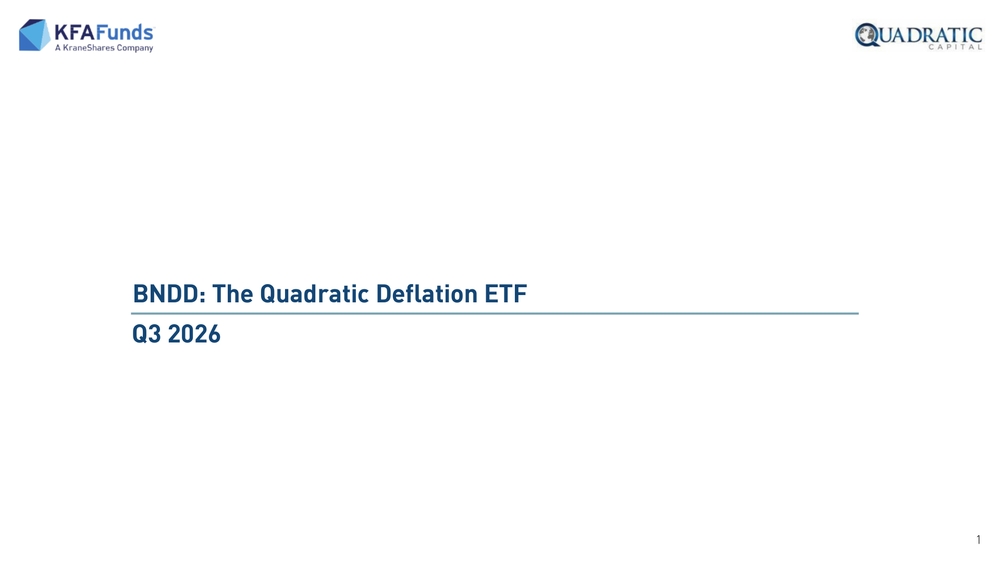
2Quadratic Capital Management
Quadratic Capital Management is an innovative asset management firm founded in
2013 by Nancy Davis. The firm has utilized its significant expertise in fixed income
and options markets to construct The Quadratic Deflation ETF (NYSE Ticker: BNDD).
Quadratic Capital Management serves as the Investment Sub -Adviser to the BNDD
ETF.
Krane Fund Advisors, LLC
Krane Funds was founded in 2013 by Jonathan Krane and manages approximately
$9 billion. The firm seeks to provide innovative, first to market strategies that have
been developed based on the firm and its partners’ deep knowledge of investing.
Krane Funds Advisors serves as the Investment Adviser to the BNDD ETF.
About Quadratic Capital Management and Krane Funds Advisors, LLC
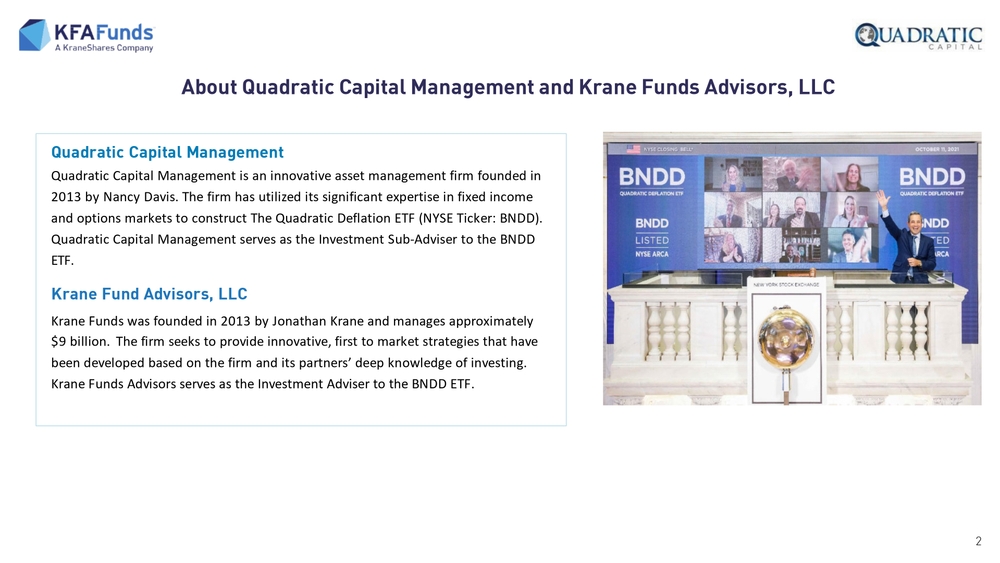
Nancy Davis named to inaugural
Barron’s "100 Most Influential
Women in U.S. Finance " listWall Street Journal profiled 6
investors’ market views and strategies
Select Quadratic Capital Highlights, Milestones, and Awards
3
Lloyd Blankfein
ex-CEO
Goldman Sachs
Paul Britton
Capstone
Investment
Advisors
Nancy Davis
Quadratic Capital
Management
Rick Rieder
BlackRock
Jeremy Grantham
Grantham Mayo
Van OtterlooRob Arnott
Research
AffiliatesForbes profiles Nancy Davis
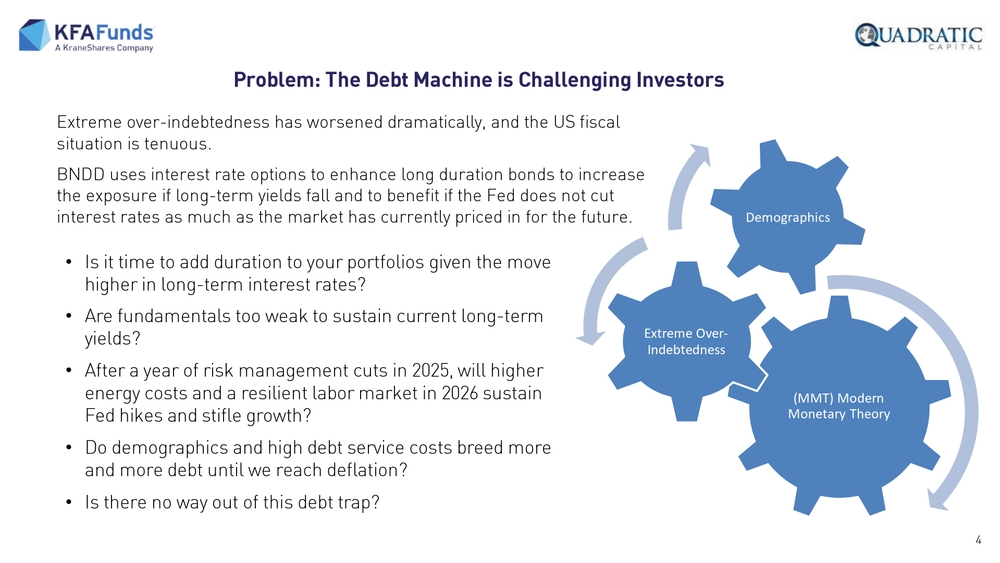
Problem: The Debt Machine is Challenging Investors 4(MMT) Modern Monetary TheoryExtreme Over - IndebtednessDemographics •Is it time to add duration to your portfolios given the move higher in long -term interest rates? •Are fundamentals too weak to sustain current long -term yields? •After a year of risk management cuts in 2025, will higher energy costs and a resilient labor market in 2026 sustain Fed hikes and stifle growth? •Do demographics and high debt service costs breed more and more debt until we reach deflation? •Is there no way out of this debt trap? Extreme over -indebtedness has worsened dramatically, and the US fiscal situation is tenuous. BNDD uses interest rate options to enhance long duration bonds to increase the exposure if long -term yields fall and to benefit if the Fed does not cut interest rates as much as the market has currently priced in for the future.
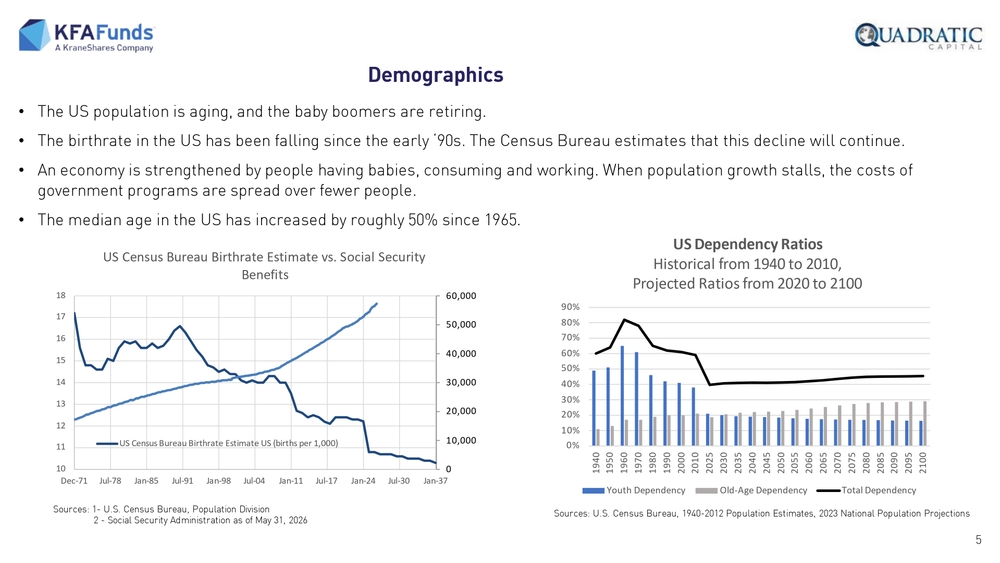
•The US population is aging, and the baby boomers are retiring.
•The birthrate in the US has been falling since the early ‘90s. The Census Bureau estimates that this decline will continue.
•An economy is strengthened by people having babies, consuming and working. When population growth stalls, the costs of
government programs are spread over fewer people.
•The median age in the US has increased by roughly 50% since 1965.Demographics
5Sources: 1 - U.S. Census Bureau, Population Division
2 - Social Security Administration as of May 31, 2026010,00020,00030,00040,00050,00060,000
101112131415161718
Dec-71 Jul-78 Jan-85 Jul-91 Jan-98 Jul-04 Jan-11 Jul-17 Jan-24 Jul-30 Jan-37US Census Bureau Birthrate Estimate vs. Social Security
Benefits
US Census Bureau Birthrate Estimate US (births per 1,000)
Sources: U.S. Census Bureau, 1940 -2012 Population Estimates , 2023 National Population Projections
0%10%20%30%40%50%60%70%80%90%
1940
1950
1960
1970
1980
1990
2000
2010
2025
2030
2035
2040
2045
2050
2055
2060
2065
2070
2075
2080
2085
2090
2095
2100US Dependency Ratios
Historical from 1940 to 2010,
Projected Ratios from 2020 to 2100
Youth Dependency Old-Age Dependency Total Dependency
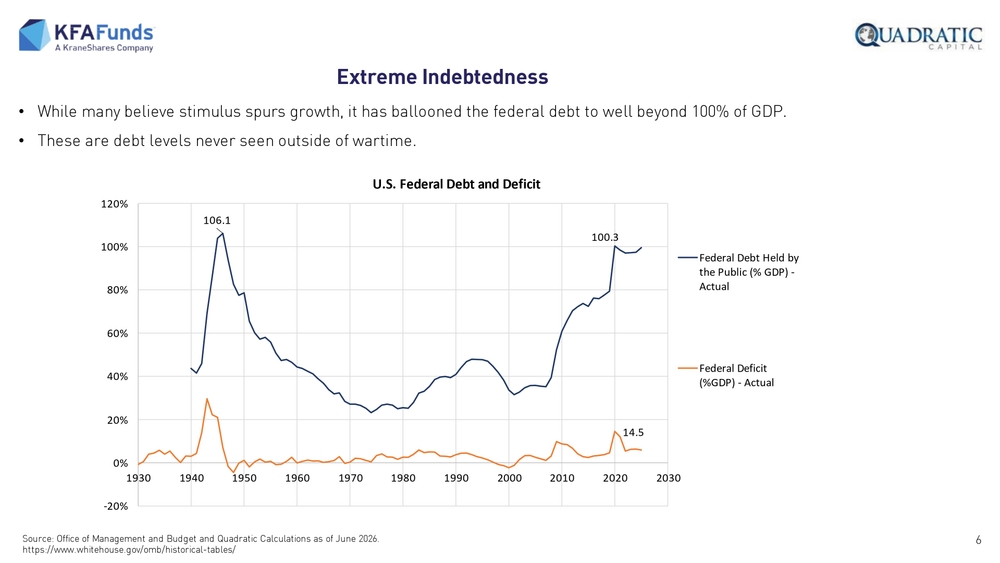
•While many believe stimulus spurs growth, it has ballooned the federal debt to well beyond 100% of GDP. •These are debt levels never seen outside of wartime. Extreme Indebtedness 6 Source: Office of Management and Budget and Quadratic Calculations as of June 2026. https://www.whitehouse.gov/omb/historical -tables/ 106.1 100.3 14.5 -20%0%20%40%60%80%100%120% 1930 1940 1950 1960 1970 1980 1990 2000 2010 2020 2030U.S. Federal Debt and Deficit Federal Debt Held by the Public (% GDP) - Actual Federal Deficit (%GDP) - Actual
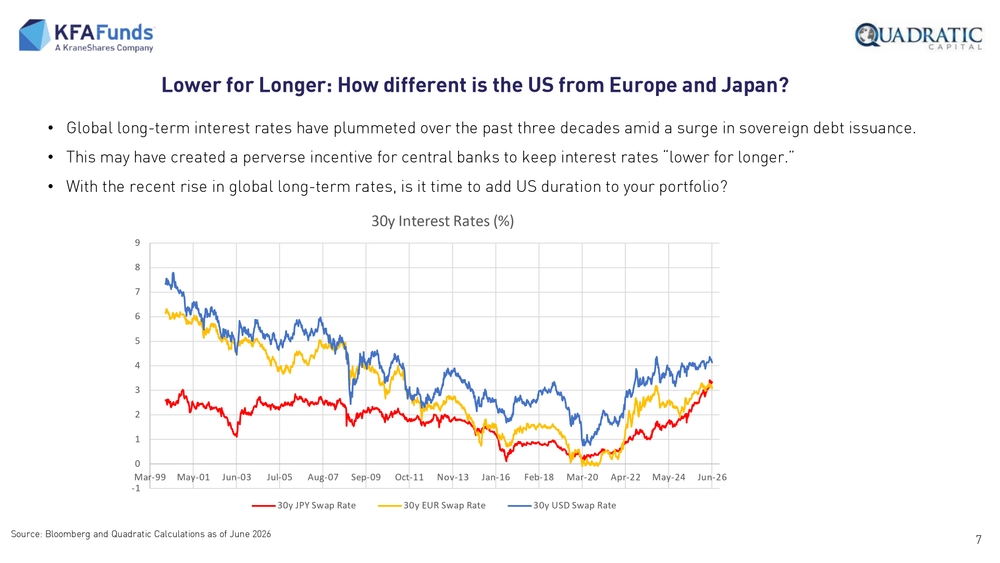
•Global long -term interest rates have plummeted over the past three decades amid a surge in sovereign debt issuance. •This may have created a perverse incentive for central banks to keep interest rates “lower for longer .” •With the recent rise in global long -term rates, is it time to add US duration to your portfolio?Lower for Longer: How different is the US from Europe and Japan? 7Source: Bloomberg and Quadratic Calculations as of June 2026 -10123456789 Mar-99 May-01 Jun-03 Jul-05 Aug-07 Sep-09 Oct-11 Nov-13 Jan-16 Feb-18 Mar-20 Apr-22 May-24 Jun-2630y Interest Rates (%) 30y JPY Swap Rate 30y EUR Swap Rate 30y USD Swap Rate
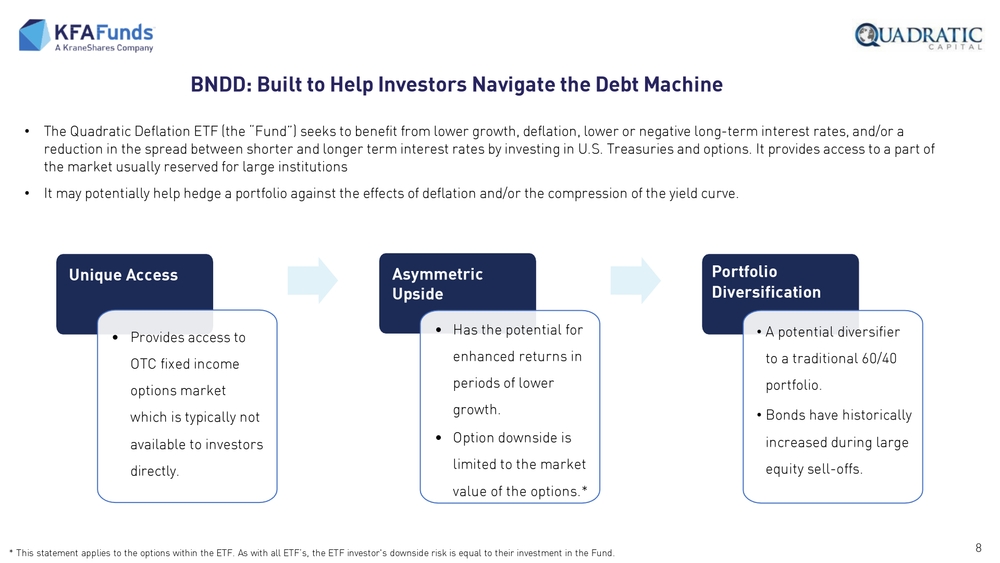
•The Quadratic Deflation ETF (the “Fund”) seeks to benefit from lower growth, deflation, lower or negative long -term interest rat es, and/or a reduction in the spread between shorter and longer term interest rates by investing in U.S. Treasuries and options. It provid es access to a part of the market usually reserved for large institutions •It may potentially help hedge a portfolio against the effects of deflation and/or the compression of the yield curve. BNDD: Built to Help Investors Navigate the Debt Machine Unique Access •Provides access to OTC fixed income options market which is typically not available to investors directly.Asymmetric Upside •Has the potential for enhanced returns in periods of lower growth. •Option downside is limited to the market value of the options. Portfolio Diversification •A potential diversifier to a traditional 60/40 portfolio. •Bonds have historically increased during large equity sell -offs. 8 This statement applies to the options within the ETF. As with all ETF’s, the ETF investor's downside risk is equal to their investment in the Fund.
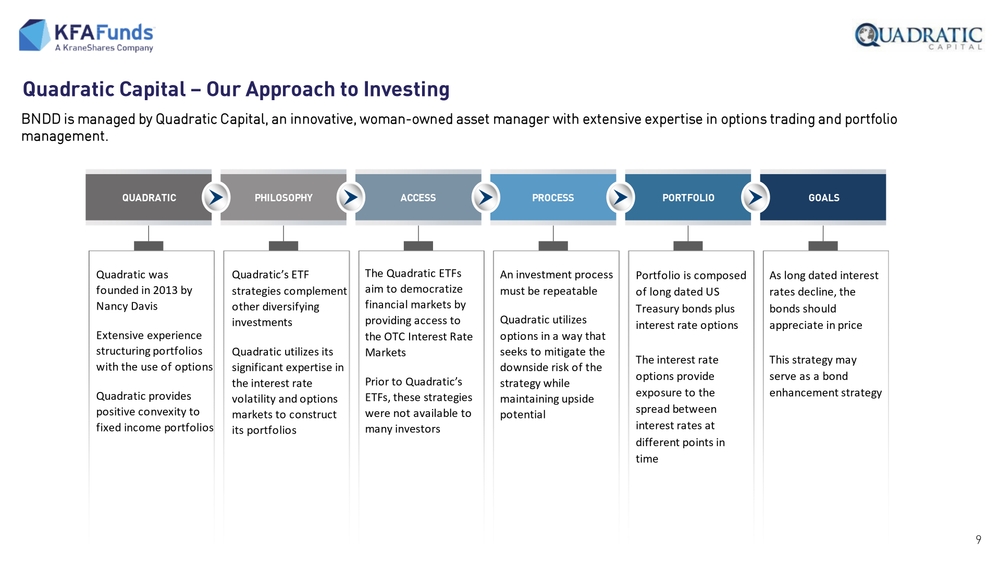
BNDD is managed by Quadratic Capital, an innovative, woman -owned asset manager with extensive expertise in options trading and p ortfolio management.Quadratic Capital – Our Approach to Investing 9 Quadratic was founded in 2013 by Nancy Davis Extensive experience structuring portfolios with the use of options Quadratic provides positive convexity to fixed income portfoliosThe Quadratic ETFs aim to democratize financial markets by providing access to theOTC Interest Rate Markets Prior to Quadratic’s ETFs, these strategies were not available to many investorsAn investment process must be repeatable Quadratic utilizes options in a way that seeks to mitigate the downside risk of the strategy while maintaining upside potentialPortfolio is composed of long dated US Treasury bonds plus interest rate options The interest rate options provide exposure to the spread between interest rates at different points in timeAs long dated interest rates decline, the bonds should appreciate in price This strategy may serve as a bond enhancement strategyQuadratic’s ETF strategies complement other diversifying investments Quadratic utilizes its significant expertise in the interest rate volatility and options markets to construct its portfoliosQUADRATIC PHILOSOPHY ACCESS PROCESS PORTFOLIO GOALS
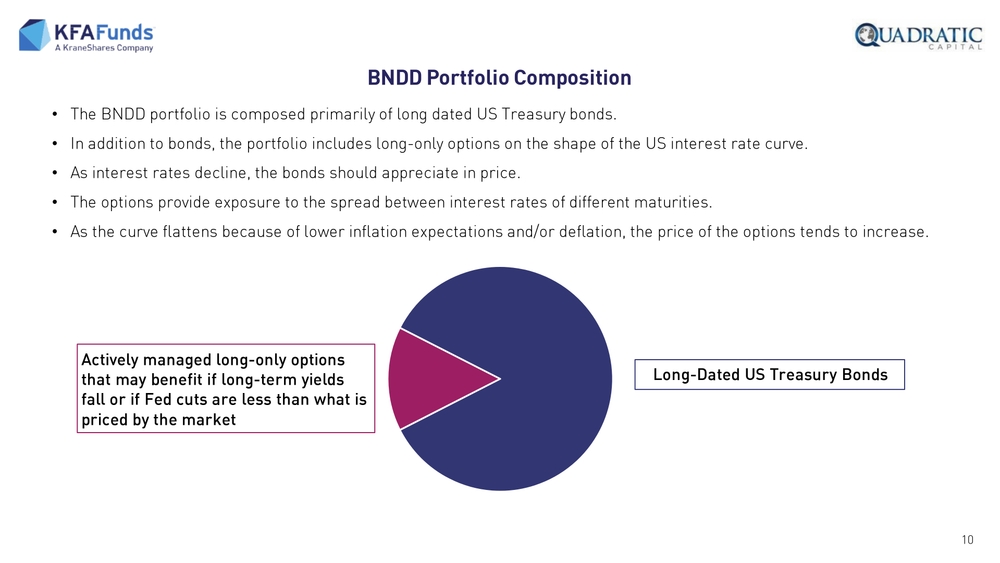
•The BNDD portfolio is composed primarily of long dated US Treasury bonds.
•In addition to bonds, the portfolio includes long -only options on the shape of the US interest rate curve.
•As interest rates decline, the bonds should appreciate in price.
•The options provide exposure to the spread between interest rates of different maturities.
•As the curve flattens because of lower inflation expectations and/or deflation, the price of the options tends to increase. BNDD Portfolio Composition
10
Actively managed long -only options
that may benefit if long -term yields
fall or if Fed cuts are less than what is
priced by the marketLong -Dated US Treasury Bonds
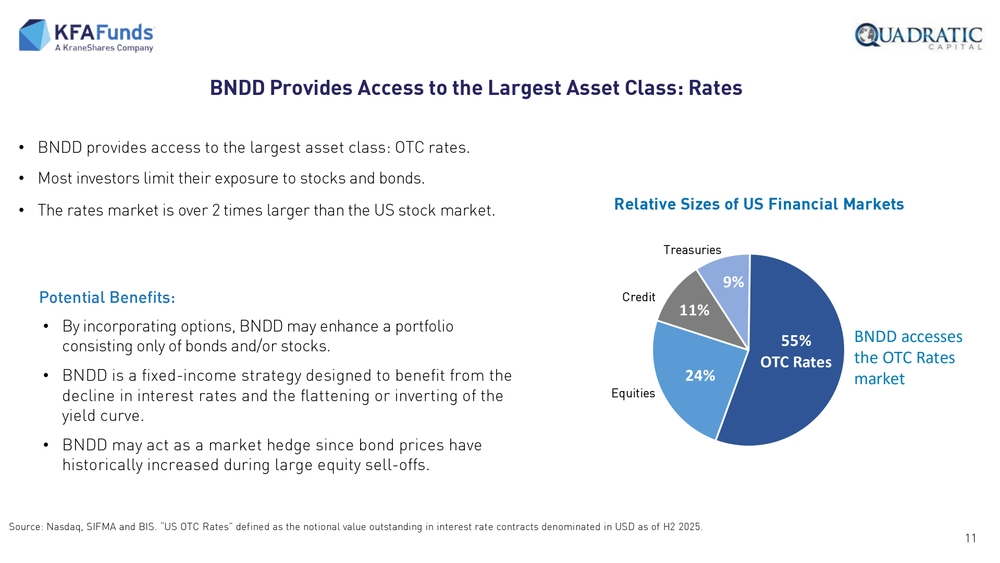
BNDD accesses the OTC Rates marketTreasuries Credit Equities•BNDD provides access to the largest asset class: OTC rates. •Most investors limit their exposure to stocks and bonds. •The rates market is over 2 times larger than the US stock market.BNDD Provides Access to the Largest Asset Class: Rates 11Potential Benefits : •By incorporating options, BNDD may enhance a portfolio consisting only of bonds and/or stocks. •BNDD is a fixed -income strategy designed to benefit from the decline in interest rates and the flattening or inverting of the yield curve. •BNDD may act as a market hedge since bond prices have historically increased during large equity sell -offs. Relative Sizes of US Financial Markets Source: Nasdaq, SIFMA and BIS. “US OTC Rates” defined as the notional value outstanding in interest rate contracts denominate d in USD as of H2 2025. 24%11%9% 55% OTC Rates
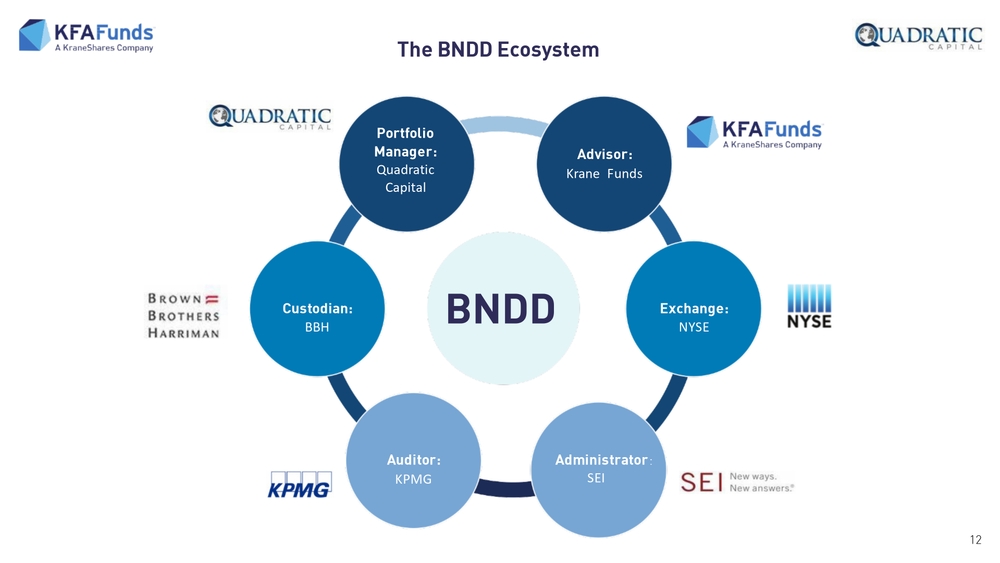
Portfolio
Manager:
Quadratic
CapitalAdvisor:
Krane Funds
Exchange:
NYSE
Administrator :
SEIAuditor:
KPMGCustodian:
BBH
The BNDD Ecosystem
12BNDD
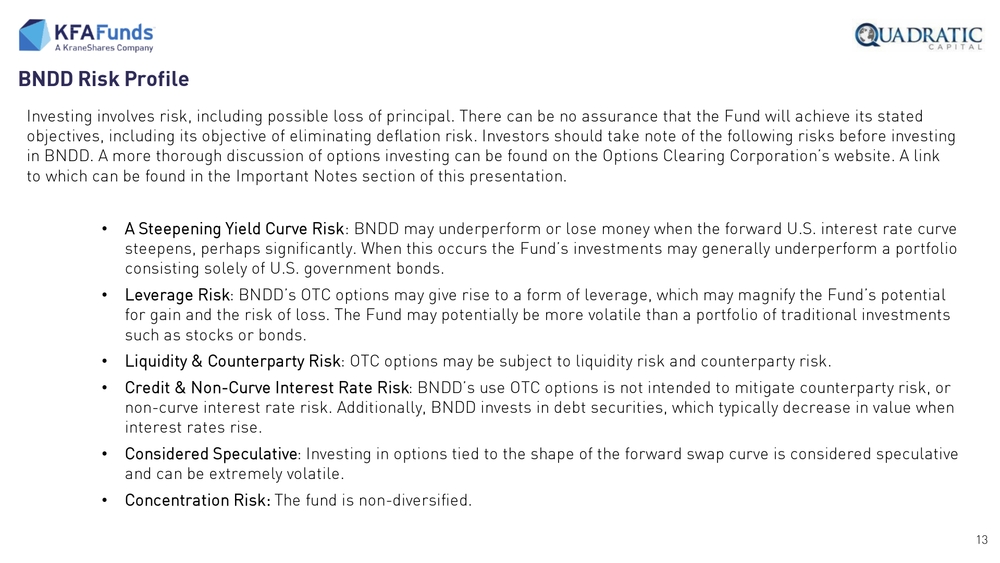
BNDD Risk Profile Investing involves risk, including possible loss of principal. There can be no assurance that the Fund will achieve its state d objectives, including its objective of eliminating deflation risk. Investors should take note of the following risks before i nvesting in BNDD. A more thorough discussion of options investing can be found on the Options Clearing Corporation’s website. A link to which can be found in the Important Notes section of this presentation. •A Steepening Yield Curve Risk : BNDD may underperform or lose money when the forward U.S. interest rate curve steepens, perhaps significantly. When this occurs the Fund’s investments may generally underperform a portfolio consisting solely of U.S. government bonds. •Leverage Risk : BNDD’s OTC options may give rise to a form of leverage, which may magnify the Fund’s potential for gain and the risk of loss. The Fund may potentially be more volatile than a portfolio of traditional investments such as stocks or bonds. •Liquidity & Counterparty Risk : OTC options may be subject to liquidity risk and counterparty risk. •Credit & Non -Curve Interest Rate Risk : BNDD’s use OTC options is not intended to mitigate counterparty risk, or non-curve interest rate risk. Additionally, BNDD invests in debt securities, which typically decrease in value when interest rates rise. •Considered Speculative : Investing in options tied to the shape of the forward swap curve is considered speculative and can be extremely volatile. •Concentration Risk: The fund is non -diversified. 13
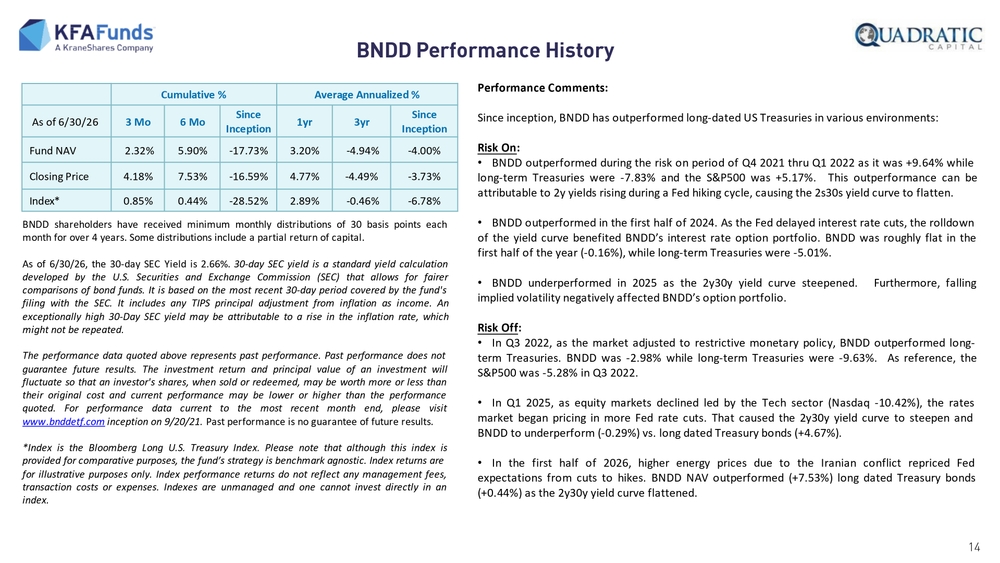
14BNDD shareholders have received minimum monthly distributions of 30 basis points each
month for over 4 years . Some distributions include a partial return of capital .
As of 6/30/26, the 30-day SEC Yield is 2.66%. 30-day SEC yield is a standard yield calculation
developed by the U.S. Securities and Exchange Commission (SEC) that allows for fairer
comparisons of bond funds . It is based on the most recent 30-day period covered by the fund's
filing with the SEC. It includes any TIPS principal adjustment from inflation as income . An
exceptionally high 30-Day SEC yield may be attributable to a rise in the inflation rate, which
might not be repeated .
The performance data quoted above represents past performance . Past performance does not
guarantee future results . The investment return and principal value of an investment will
fluctuate so that an investor's shares, when sold or redeemed, may be worth more or less than
their original cost and current performance may be lower or higher than the performance
quoted . For performance data current to the most recent month end, please visit
www .bnddetf .com inception on 9/20/21. Past performance is no guarantee of future results .
Index is the Bloomberg Long U.S. Treasury Index . Please note that although this index is
provided for comparative purposes, the fund’s strategy is benchmark agnostic . Index returns are
for illustrative purposes only. Index performance returns do not reflect any management fees,
transaction costs or expenses . Indexes are unmanaged and one cannot invest directly in an
index .Performance Comments :
Since inception, BNDD has outperformed long -dated US Treasuries in various environments :
Risk On:
•BNDD outperformed during the risk on period of Q4 2021 thru Q1 2022 as it was +9.64% while
long -term Treasuries were -7.83% and the S&P500 was +5.17%. This outperformance can be
attributable to 2y yields rising during a Fed hiking cycle, causing the 2s30s yield curve to flatten .
•BNDD outperformed in the first half of 2024 . As the Fed delayed interest rate cuts, the rolldown
of the yield curve benefited BNDD’s interest rate option portfolio . BNDD was roughly flat in the
first half of the year (-0.16%), while long -term Treasuries were -5.01%.
•BNDD underperformed in 2025 as the 2y30y yield curve steepened . Furthermore, falling
implied volatility negatively affected BNDD’s option portfolio .
Risk Off:
•In Q3 2022 , as the market adjusted to restrictive monetary policy, BNDD outperformed long -
term Treasuries . BNDD was -2.98% while long -term Treasuries were -9.63%. As reference, the
S&P500 was -5.28% in Q3 2022 .
•In Q1 2025 , as equity markets declined led by the Tech sector (Nasdaq -10.42%), the rates
market began pricing in more Fed rate cuts. That caused the 2y30y yield curve to steepen and
BNDD to underperform (-0.29%) vs. long dated Treasury bonds (+4.67%).
•In the first half of 2026 , higher energy prices due to the Iranian conflict repriced Fed
expectations from cuts to hikes . BNDD NAV outperformed (+7.53%) long dated Treasury bonds
(+0.44%) as the 2y30y yield curve flattened .Cumulative % Average Annualized %
As of 6/30/26 3 Mo 6 MoSince
Inception1yr 3yrSince
Inception
Fund NAV 2.32% 5.90% -17.73% 3.20% -4.94% -4.00%
Closing Price 4.18% 7.53% -16.59% 4.77% -4.49% -3.73%
Index 0.85% 0.44% -28.52% 2.89% -0.46% -6.78%BNDD Performance History
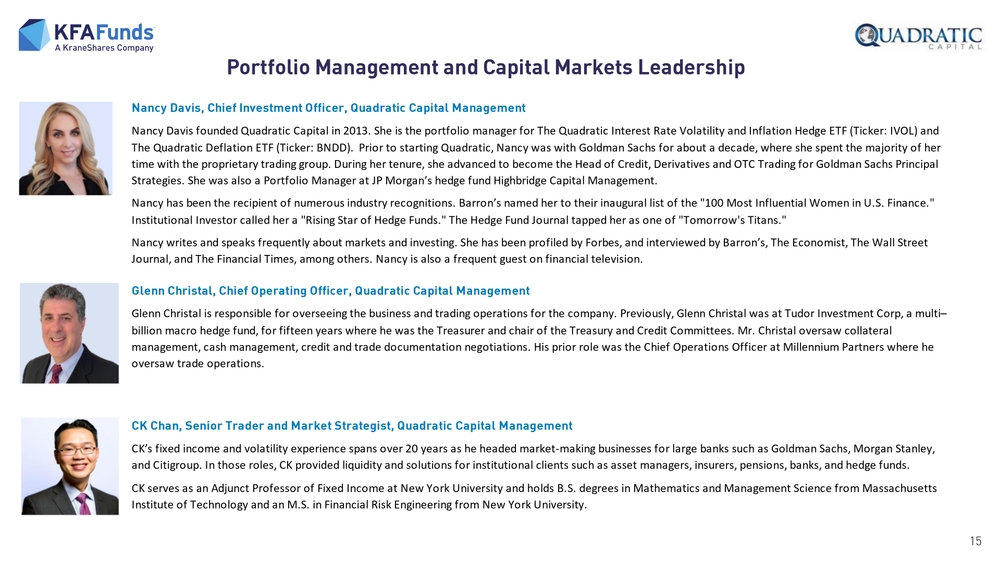
CK Chan, Senior Trader and Market Strategist, Quadratic Capital Management CK’s fixed income and volatility experience spans over 20 years as he headed market -making businesses for large banks such as Go ldman Sachs, Morgan Stanley, and Citigroup. In those roles, CK provided liquidity and solutions for institutional clients such as asset managers, insurers , pensions, banks, and hedge funds. CK serves as an Adjunct Professor of Fixed Income at New York University and holds B.S. degrees in Mathematics and Management Science from Massachusetts Institute of Technology and an M.S. in Financial Risk Engineering from New York University. Nancy Davis, Chief Investment Officer, Quadratic Capital Management Nancy Davis founded Quadratic Capital in 2013. She is the portfolio manager for The Quadratic Interest Rate Volatility and In flation Hedge ETF (Ticker: IVOL) and The Quadratic Deflation ETF (Ticker: BNDD). Prior to starting Quadratic, Nancy was with Goldman Sachs for about a decade, wh ere she spent the majority of her time with the proprietary trading group. During her tenure, she advanced to become the Head of Credit, Derivatives and OTC Tr ading for Goldman Sachs Principal Strategies. She was also a Portfolio Manager at JP Morgan’s hedge fund Highbridge Capital Management. Nancy has been the recipient of numerous industry recognitions. Barron’s named her to their inaugural list of the "100 Most I nfluential Women in U.S. Finance." Institutional Investor called her a "Rising Star of Hedge Funds." The Hedge Fund Journal tapped her as one of "Tomorrow's Tit ans." Nancy writes and speaks frequently about markets and investing. She has been profiled by Forbes, and interviewed by Barron’s, The Economist, The Wall Street Journal, and The Financial Times, among others. Nancy is also a frequent guest on financial television. Glenn Christal, Chief Operating Officer, Quadratic Capital Management Glenn Christal is responsible for overseeing the business and trading operations for the company. Previously, Glenn Christal was at Tudor Investment Corp, a multi – billion macro hedge fund, for fifteen years where he was the Treasurer and chair of the Treasury and Credit Committees. Mr. C hristal oversaw collateral management, cash management, credit and trade documentation negotiations. His prior role was the Chief Operations Officer at Millennium Partners where he oversaw trade operations. 15 Portfolio Management and Capital Markets Leadership
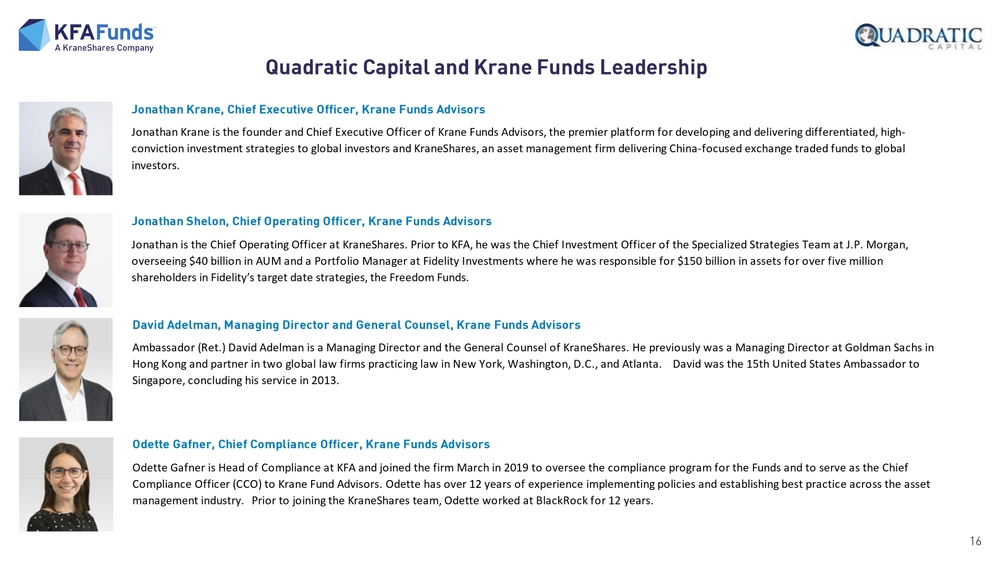
16Jonathan Shelon , Chief Operating Officer, Krane Funds Advisors Jonathan is the Chief Operating Officer at KraneShares. Prior to KFA, he was the Chief Investment Officer of the Specialized Strategies Team at J.P . Morgan, overseeing $40 billion in AUM and a Portfolio Manager at Fidelity Investments where he was responsible for $150 billion in as sets for over five million shareholders in Fidelity’s target date strategies, the Freedom Funds. David Adelman, Managing Director and General Counsel, Krane Funds Advisors Ambassador (Ret.) David Adelman is a Managing Director and the General Counsel of KraneShares. He previously was a Managing D irector at Goldman Sachs in Hong Kong and partner in two global law firms practicing law in New York, Washington, D.C., and Atlanta. David was the 15th United States Ambassador to Singapore, concluding his service in 2013.Jonathan Krane, Chief Executive Officer, Krane Funds Advisors Jonathan Krane is the founder and Chief Executive Officer of Krane Funds Advisors, the premier platform for developing and de livering differentiated, high - conviction investment strategies to global investors and KraneShares, an asset management firm delivering China -focused exchange traded funds to global investors. Quadratic Capital and Krane Funds Leadership Odette Gafner , Chief Compliance Officer, Krane Funds Advisors Odette Gafner is Head of Compliance at KFA and joined the firm March in 2019 to oversee the compliance program for the Funds and to serve a s the Chief Compliance Officer (CCO) to Krane Fund Advisors. Odette has over 12 years of experience implementing policies and establishin g best practice across the asset management industry. Prior to joining the KraneShares team, Odette worked at BlackRock for 12 years.
17
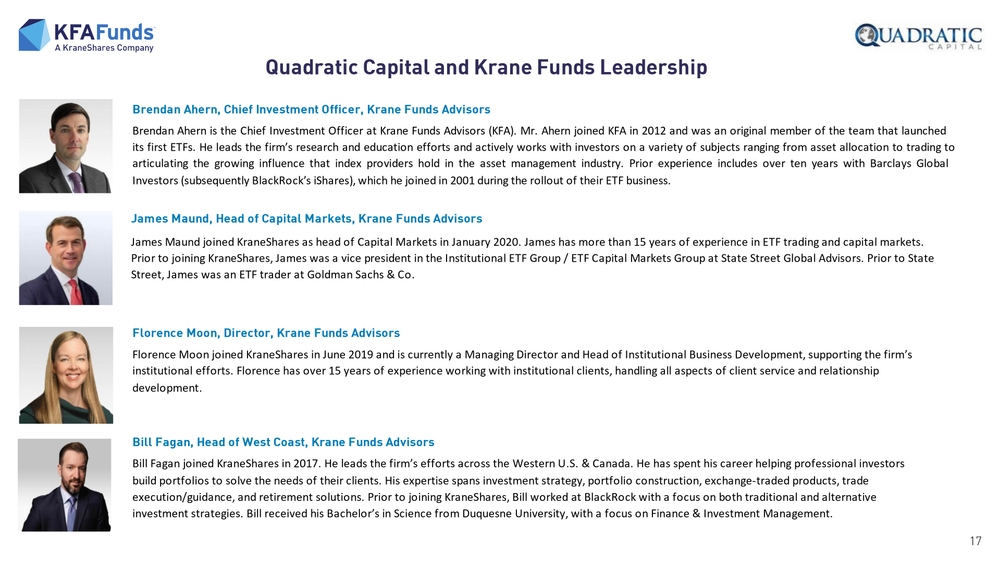
James Maund , Head of Capital Markets, Krane Funds Advisors
James Maund joined KraneShares as head of Capital Markets in January 2020. James has more than 15 years of experience in ETF trading and capital markets.
Prior to joining KraneShares, James was a vice president in the Institutional ETF Group / ETF Capital Markets Group at State Street Global Advisors. Prior to State
Street, James was an ETF trader at Goldman Sachs & Co. Quadratic Capital and Krane Funds Leadership
Brendan Ahern, Chief Investment Officer, Krane Funds Advisors
Brendan Ahern istheChief Investment Officer atKrane Funds Advisors (KFA) .Mr.Ahern joined KFA in2012 and was anoriginal member oftheteam that launched
itsfirst ETFs .Heleads thefirm’s research and education efforts and actively works with investors onavariety ofsubjects ranging from asset allocation totrading to
articulating the growing influence that index providers hold inthe asset management industry .Prior experience includes over ten years with Barclays Global
Investors (subsequently BlackRock’s iShares), which hejoined in2001 during therollout oftheir ETFbusiness .
Florence Moon, Director, Krane Funds Advisors
Florence Moon joined KraneShares in June 2019 and is currently a Managing Director and Head of Institutional Business Develop men t, supporting the firm’s
institutional efforts. Florence has over 15 years of experience working with institutional clients, handling all aspects of c lient service and relationship
development.
Bill Fagan, Head of West Coast ,Krane Funds Advisors
Bill Fagan joined KraneShares in 2017. He leads the firm’s efforts across the Western U.S. & Canada. He has spent his career helping professional investors
build portfolios to solve the needs of their clients. His expertise spans investment strategy, portfolio construction, exchan ge-traded products, trade
execution/guidance, and retirement solutions. Prior to joining KraneShares, Bill worked at BlackRock with a focus on both tra ditional and alternative
investment strategies. Bill received his Bachelor’s in Science from Duquesne University, with a focus on Finance & Investment Management.
18Quadratic Capital and Krane Funds Leadership
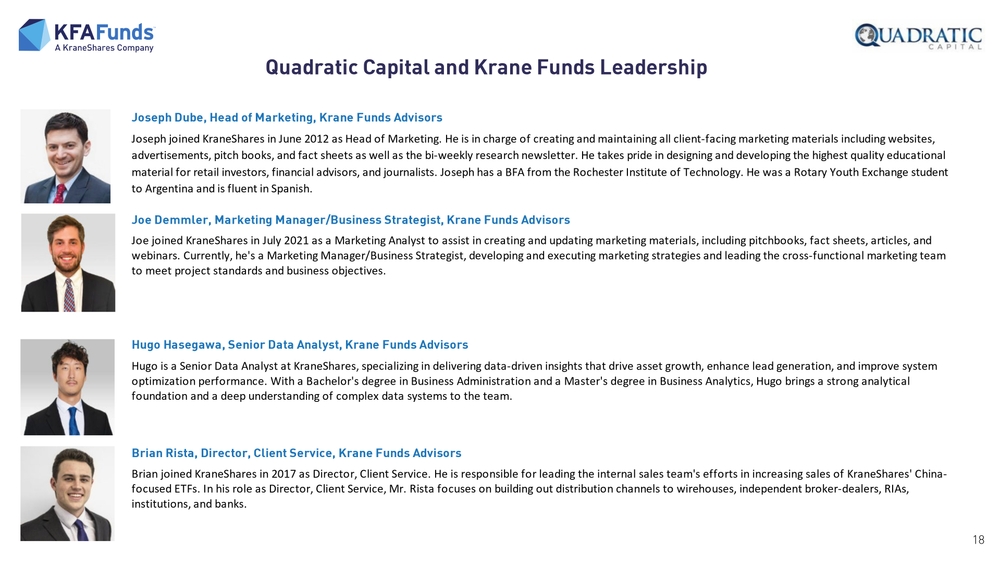
Joe Demmler, Marketing Manager/Business Strategist, Krane Funds Advisors
Joe joined KraneShares in July 2021 as a Marketing Analyst to assist in creating and updating marketing materials, including pitchbooks, fact sheets, articles, and
webinars. Currently, he's a Marketing Manager/Business Strategist, developing and executing marketing strategies and leading the cross -functional marketing team
to meet project standards and business objectives.
Joseph Dube, Head of Marketing, Krane Funds Advisors
Joseph joined KraneShares in June 2012 as Head of Marketing. He is in charge of creating and maintaining all client -facing marketing materials including websites,
advertisements, pitch books, and fact sheets as well as the bi-weekly research newsletter . He takes pride in designing and developing the highest quality educational
material for retail investors, financial advisors, and journalists. Joseph has a BFA from the Rochester Institute of Technology. He was a Rotary Youth Exchange student
to Argentina and is fluent in Spanish.
Hugo Hasegawa, Senior Data Analyst, Krane Funds Advisors
Hugo is a Senior Data Analyst at KraneShares, specializing in delivering data -driven insights that drive asset growth, enhance l ead generation, and improve system
optimization performance. With a Bachelor's degree in Business Administration and a Master's degree in Business Analytics, Hu go brings a strong analytical
foundation and a deep understanding of complex data systems to the team.
Brian Rista, Director, Client Service, Krane Funds Advisors
Brian joined KraneShares in 2017 as Director, Client Service. He is responsible for leading the internal sales team's efforts in increasing sales of KraneShares' China -
focused ETFs. In his role as Director, Client Service, Mr. Rista focuses on building out distribution channels to wirehouses , independent broker -dealers, RIAs,
institutions, and banks.
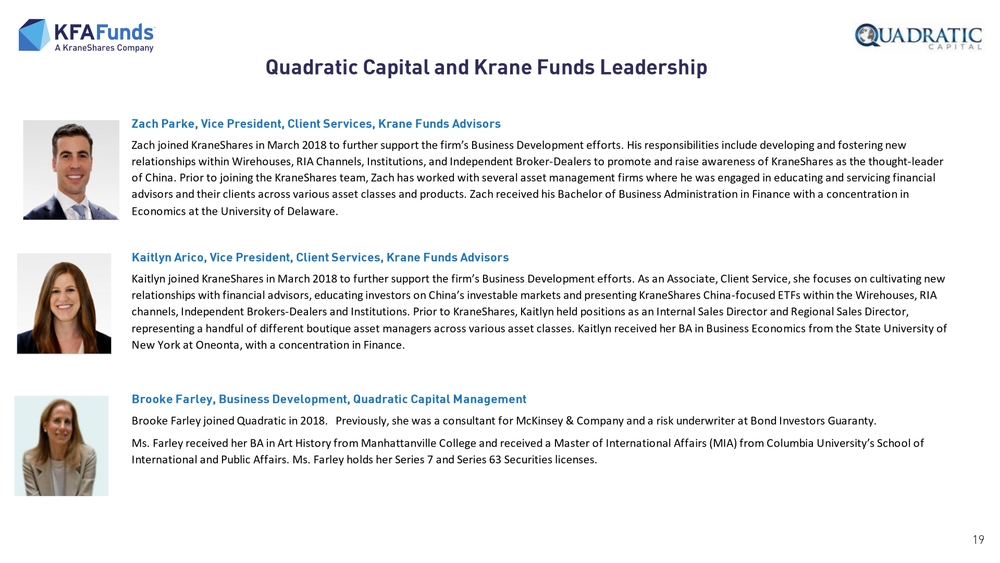
19Zach Parke, Vice President, Client Services, Krane Funds Advisors
Zach joined KraneShares in March 2018 to further support the firm’s Business Development efforts. His responsibilities includ e developing and fostering new
relationships within Wirehouses , RIA Channels, Institutions, and Independent Broker -Dealers to promote and raise awareness of KraneShares as the thought -leader
of China. Prior to joining the KraneShares team, Zach has worked with several asset management firms where he was engaged in educating and servicing financial
advisors and their clients across various asset classes and products. Zach received his Bachelor of Business Administration i n Finance with a concentration in
Economics at the University of Delaware.
Kaitlyn Arico, Vice President, Client Services, Krane Funds Advisors
Kaitlyn joined KraneShares in March 2018 to further support the firm’s Business Development efforts. As an Associate, Client Service, she focuses on cultivating new
relationships with financial advisors, educating investors on China’s investable markets and presenting KraneShares China -focuse d ETFs within the Wirehouses , RIA
channels, Independent Brokers -Dealers and Institutions. Prior to KraneShares, Kaitlyn held positions as an Internal Sales Direct or and Regional Sales Director,
representing a handful of different boutique asset managers across various asset classes. Kaitlyn received her BA in Business Economics from the State University of
New York at Oneonta, with a concentration in Finance.
Brooke Farley, Business Development, Quadratic Capital Management
Brooke Farley joined Quadratic in 2018. Previously, she was a consultant for McKinsey & Company and a risk underwriter at Bo nd Investors Guaranty.
Ms. Farley received her BA in Art History from Manhattanville College and received a Master of International Affairs (MIA) fr om Columbia University’s School of
International and Public Affairs. Ms. Farley holds her Series 7 and Series 63 Securities licenses.
Quadratic Capital and Krane Funds Leadership
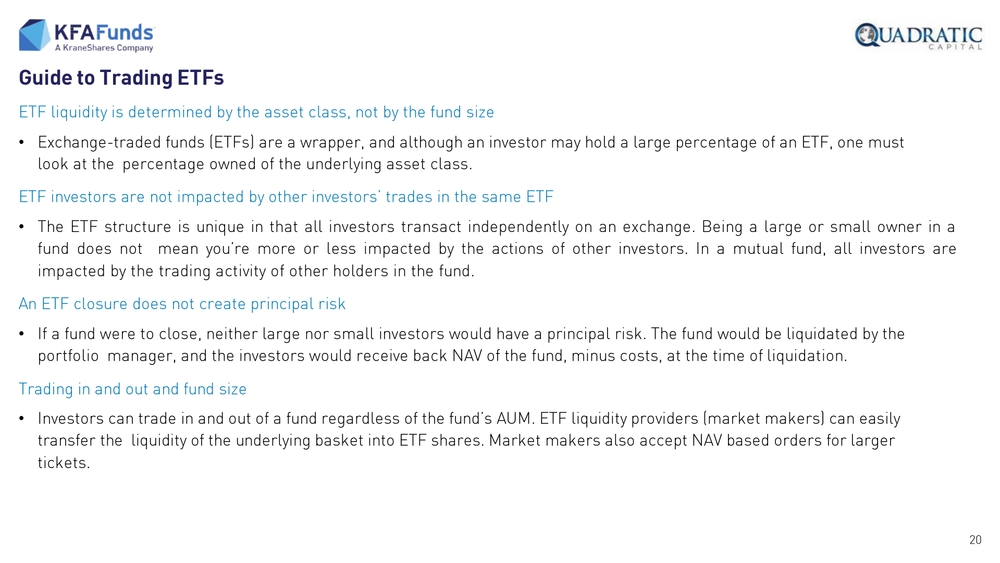
ETF liquidity isdetermined bytheasset class, notbythefund size •Exchange -traded funds (ETFs) are a wrapper, and although an investor may hold a large percentage of an ETF, one must look at the percentage owned of the underlying asset class. ETF investors arenotimpacted byother investors’ trades inthesame ETF •The ETF structure isunique inthat allinvestors transact independently onanexchange .Being alarge orsmall owner ina fund does not mean you’re more orless impacted bytheactions ofother investors .Inamutual fund, allinvestors are impacted bythetrading activity ofother holders inthefund . AnETF closure does notcreate principal risk •If a fund were to close, neither large nor small investors would have a principal risk. The fund would be liquidated by the portfolio manager, and the investors would receive back NAV of the fund, minus costs, at the time of liquidation. Trading inandoutandfund size •Investors can trade in and out of a fund regardless of the fund’s AUM. ETF liquidity providers (market makers) can easily transfer the liquidity of the underlying basket into ETF shares. Market makers also accept NAV based orders for larger tickets. 20Guide to Trading ETFs
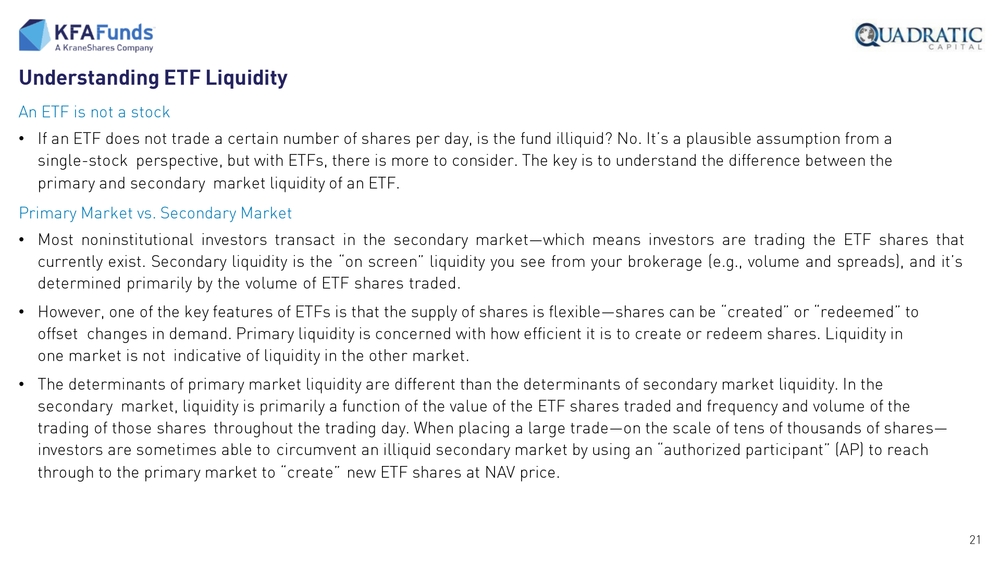
An ETF is not astock •If an ETF does not trade a certain number of shares per day, is the fund illiquid? No. It’s a plausible assumption from a single -stock perspective, but with ETFs, there is more to consider . The key is to understand the difference between the primary and secondary market liquidity of an ETF. Primary Market vs. Secondary Market •Most noninstitutional investors transact inthesecondary market —which means investors aretrading theETF shares that currently exist .Secondary liquidity isthe“onscreen” liquidity youseefrom your brokerage (e.g.,volume and spreads), and it’s determined primarily bythevolume ofETF shares traded . •However, one of the key features of ETFs is that the supply of shares is flexible —shares can be “created” or “redeemed” to offset changes in demand. Primary liquidity is concerned with how efficient it is to create or redeem shares. Liquidity in one market is not indicative of liquidity in the other market. •The determinants of primary market liquidity are different than the determinants of secondary market liquidity. In the secondary market, liquidity is primarily a function of the value of the ETF shares traded and frequency and volume of the trading of those shares throughout the trading day. When placing a large trade —on the scale of tens of thousands of shares — investors are sometimes able to circumvent an illiquid secondary market by using an “authorized participant” (AP) to reach through to the primary market to “create” new ETF shares at NAV price. 21Understanding ETF Liquidity
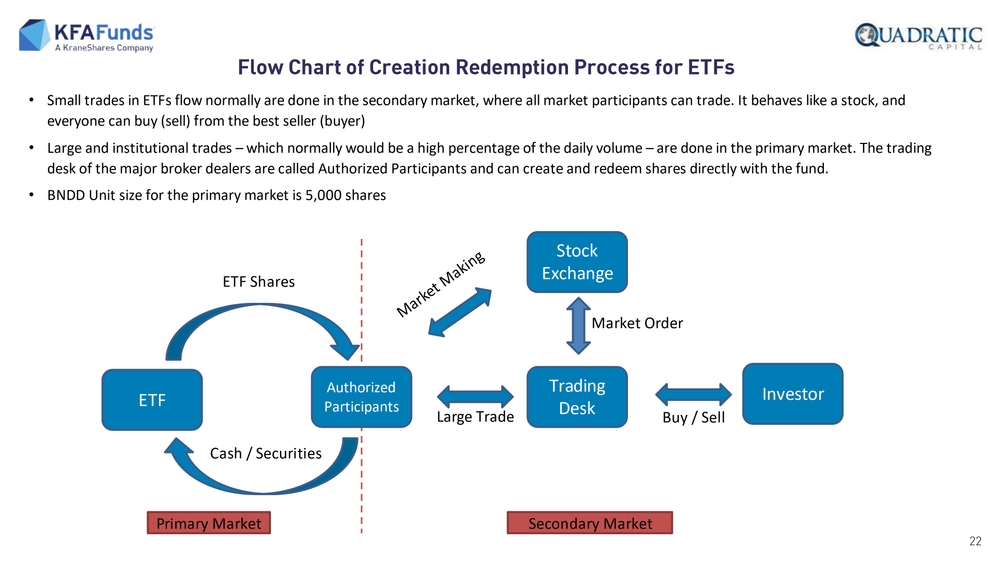
22•Small trades in ETFs flow normally are done in the secondary market, where all market participants can trade. It behaves like a stock, and everyone can buy (sell) from the best seller (buyer) •Large and institutional trades – which normally would be a high percentage of the daily volume – are done in the primary market. The trading desk of the major broker dealers are called Authorized Participants and can create and redeem shares directly with the fund. •BNDD Unit size for the primary market is 5,000 shares ETFAuthorized ParticipantsTrading DeskStock Exchange Investor Primary Market Secondary MarketETF Shares Cash / SecuritiesLarge TradeMarket Order Buy / SellFlow Chart of Creation Redemption Process for ETFs
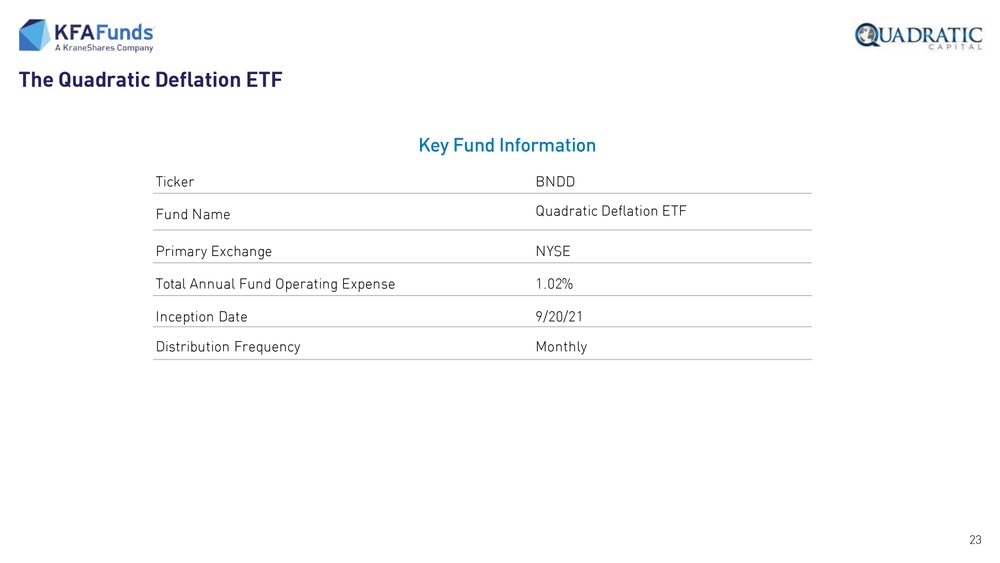
The Quadratic Deflation ETF 23Ticker BNDD Fund Name Quadratic Deflation ETF Primary Exchange NYSE Total Annual Fund Operating Expense 1.02% Inception Date 9/20/21 Distribution Frequency MonthlyKey Fund Information
Important Notes
Carefully consider the Funds’ investment objectives, risk factors, charges and expenses before investing. This and additional information can be found in the Funds' full and summary
prospectus, which may be obtained by visiting www.kfafunds.com. Read the prospectus carefully before investing.
Investing involves risk, including possible loss of principal. There can be no assurance that a Fund will achieve its stated investment objectives. The Fund does not seek to mitigate credit risk,
non-curve interest rate risk, or other factors influencing the price of U.S. government bonds, which factors may have a greater impact on the bonds’ returns than the U.S. interest rate curve or
deflation. There is no guarantee that the Fund’s investments will eliminate or mitigate curve risk, or deflation risk on long positions in U.S. government bonds. In addition, when the forward U.S.
interest rate curve steepens, the Fund’s investments will generally underperform a portfolio comprised solely of the U.S. gov ernment bonds. In a steepening curve environment (increase in the
spread between shorter and longer term interest rates), the Fund’s strategy could result in disproportionately larger losses in the Fund’s options as compared to gains or losses in the U.S.
government bond positions. The Fund’s exposure to options subjects the Fund to greater volatility than investments in traditi onal securities and may magnify the Funds’ gains or losses. The
Fund is non -diversified and therefore has concentration risk.
ETF shares are not redeemable with the issuing fund other than in large Creation Unit aggregations. Shares of any ETF are bought and sold at market price (not NAV) and are not individually
redeemed from the Fund. The returns shown do not represent the returns you would receive if you traded shares at other times. Brokerage commissions will reduce returns. Market price
returns are based on the official closing price of an ETF share or, if the official closing price isn't available, the midpoint between the national best bid and national best offer ("NBBO") as of the
time the ETF calculates current NAV per share.
There is no guarantee by the Fund will declare distributions in the future or that, if declared, such distributions will remain at current levels or increase over time. The Fund is non-diversified.
The Funds may invest in derivatives, which are often more volatile than other investments and may magnify the Funds’ gains or losses.
There are risks involved with investing in options including total loss of principal. Options investing is not suitable for all investors. This fund utilizes sophisticated options strategies which may
not be suitable for all investors. For a more comprehensive discussion of the risks involved in options investing, please review Characterizations and Risks of Standardized Options available at
http://www.theocc.com/about/publications/character -risks.jsp or contact the Options Clearing Corporation directly at 1 N. Wacker Dr., Suite 500, Chicago, IL 60606. (1 -888-678-4667)
The KFA ETFs are distributed by SEI Investments Distribution Company (SIDCO), 1 Freedom Valley Drive, Oaks, PA 19456, which is not affiliated with Krane Funds Advisors, LLC, the Investment
Adviser for the Fund. [R_US_KS_SEI] or Quadratic Capital Management LLC (Quadratic), the Fund’s subadvisor.
Please carefully read the BNDD prospectus . Investors should read it carefully before investing or sending money .
BNDD is distributed by SEI Investments Distribution Co. (SIDCO), 1 Freedom Valley Drive, Oaks, PA 19456. The Fund's sub -adviser is Quadratic Capital Management LLC (Quadratic). The Fund’s
advisor is Krane Fund Advisors LLC (Krane). SIDCO is not affiliated with Quadratic or Krane. Neither Quadratic, Krane nor SI DCO or their affiliates provide tax advice. Please note that (i) any
discussion of U.S. tax matters contained in this communication cannot be used by you for the purpose of avoiding tax penaltie s; (ii) this communication was written to support the promotion or
marketing of the matters addressed herein; and (iii) you should seek advice based on your particular circumstances from an in dependent tax advisor.
24