2025_spring_internet_report_eu
by Kraneshares
europe@kraneshares.com +1 (212) 933 0393 europe@kraneshares.com +1 (212) 933 0393Spring 2025 China Internet Quarterly Earnings Report Spotlight on AI Trends in China Internet This is a marketing communication. Please refer to the prospectus, the KIID, and the PRIIP before making any final investment decisions.
2 kraneshares.eu Back to Top ↑ europe@kraneshares.com +1 (212) 933 0393 Table of Contents China Internet Recent Highlights 4 KWEB Performance 5 KWEB Top 10 Holdings Financials Summary 6 KWEB Key Metrics 7 Subsector Analysis 9 Theme Highlight – Spotlight On AI Trends In China 13 Top 10 KWEB Holdings: Quarterly Earnings Update 23 Tencent 23 Alibaba 25 Meituan 26 PDD 27 Trip.com 28 Baidu 29 NetEase 30 Full Truck Alliance 31 JD.com 32 KE Holdings 33 Citations 34 Definitions 35 Disclosures 36
3 kraneshares.eu Back to Top ↑ europe@kraneshares.com +1 (212) 933 0393 China Internet Recent Highlights •China’s top internet companies had a mostly positive fourth quarter as eight out of KWEB’s top ten holdings beat estimates on earnings per share (EPS). •KWEB outperformed US equities in the first quarter of 2025, returning +18.42% compared to the S&P 500 Index’s decline of -4.28% and the Nasdaq 100’s decline of -8.07%.1 •China internet equities experienced a downdraft following US President Trump’s “Liberation Day” tariff announcements, as less than 2% of KWEB companies’ revenue is generated in the United States.2 •KWEB’s holdings still trade at only 15 times earnings, on average, compared to 30 times for US internet companies.3 •KWEB holdings continue to pursue shareholder-friendly policies despite price improvements in their shares. Alibaba repurchased $11.9 billion worth of US-listed shares in the 12 months ended March 31, 2025. Meanwhile, Baidu offered $2 billion in convertible bonds to finance share repurchases and make new investments in AI initiatives. However, share repurchases could decline as the AI arms race takes hold for China’s internet giants.
4 kraneshares.eu Back to Top ↑ europe@kraneshares.com +1 (212) 933 0393 •Baidu will launch its first Apollo Go robotaxi program outside of China later this year in Dubai. The company told KraneShares that moving into new markets could significantly improve the profit margins for Apollo Go, which currently only breaks even in China. •Short-video platform has rolled out a variety of groundbreaking AI tools for video editing. To learn more about how often-overlooked China internet companies are innovating with AI and the investment implications of these strong moves from underdogs in the space, check out this edition’s theme highlight. •NetEase has created hyper-realistic in-game non-player characters (NPCs) using AI in its new game Cygnus Enterprises. Discover more on this in this edition’s theme highlight.
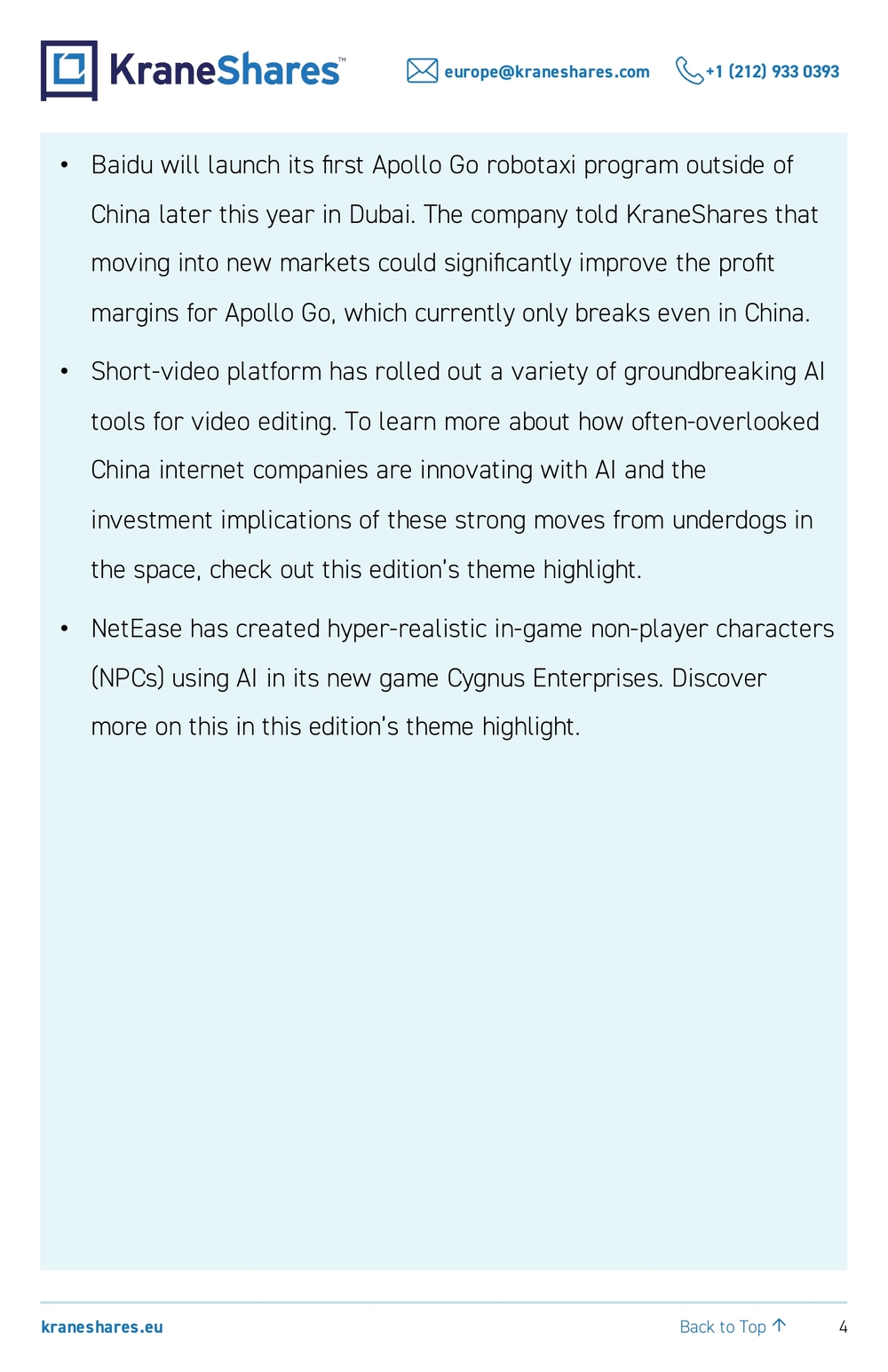
5 kraneshares.eu Back to Top ↑ europe@kraneshares.com +1 (212) 933 0393 KraneShares CSI China Internet UCITS ETF (Ticker: KWEB) Performance Cumulative % Data for USD share class as of: 30/Apr/2025 Fund NAV Underlying Index 1 Month -7.15% -7.47% 3 Month 4.22% 4.68% 6 Month 4.41% 3.80% YTD 10.16% 9.93% Since Inception -8.08% -6.97% Avg Annualized % Data for USD share class as of month end: 30/Apr/2025 Fund NAV Underlying Index 1 Year 18.82% 17.62% 3 Year 5.43% 5.00% 5 Year -5.47% -5.39% Since Inception -1.30% -1.11% KWEB’s Total Annual Fund Operating Expense is 0.75%. Inception Date: 20/Nov/2018. KWEB Index is the CSI Overseas China Internet Index. The performance data quoted represents past performance. Past performance does not guarantee future results. The investment return and principal value of an investment will fluctuate so that an investor’s shares, when sold or redeemed, may be worth more or less than their original cost, and current performance may be lower or higher than the performance quoted. For performance data current to the most recent month end, please call +(1) 855 8KRANE8 or visit our website at www. kraneshares.eu/kwebln .
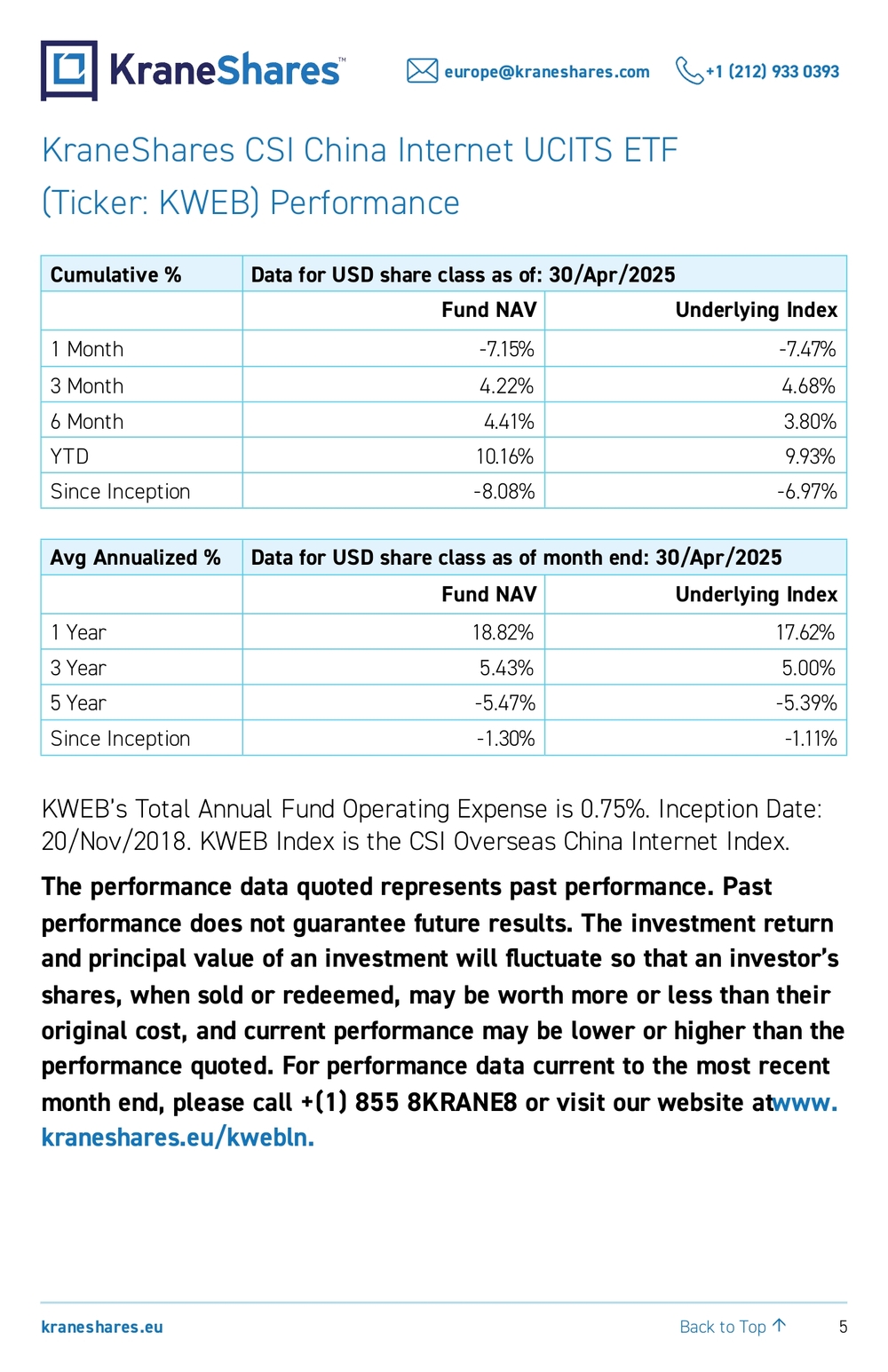
6 kraneshares.eu Back to Top ↑ europe@kraneshares.com +1 (212) 933 0393 KWEB Top 10 Holdings Financials Summary Top 10 KWEB HoldingsKWEB Weight (%)Revenue ($ B)Net Income ($ B)Revenue Growth (%)Net Margin (%)Earnings per Share ($) TENCENT HOLDINGS LTD10.79 23.9 6.4 11 27 0.7 ALIBABA GROUP HOLDING LTD9.18 38.9 4.2 8 11 1.8 MEITUAN- CLASS B7.68 12.3 0.9 20 7 0.2 PDD HOLDINGS INC6.68 1.8 0.4 23 22 0.5 TRIP.COM GROUP LTD5.91 15.4 3.8 24 25 0.6 BAIDU INC- CLASS A4.07 4.3 0.1 54 2 0.1 NETEASE INC 3.98 4.7 0.7 -2 15 1.9 FULL TRUCK A-ADR3.96 0.4 0.1 32 25 0.1 JD.COM INC- CLASS A3.96 3.7 1.3 -1 35 2 KE HOLDINGS INC-ADR3.84 0.3 0.1 15 40 0.1 Total Weighted Average Total 60.05 105.65 18.0 13 20 8.0 Data as of 31/Dec/2024. Please see the end of the report for definitions. Figures are adjusted (non-GAAP) and % changes are year-over-year (YoY) unless otherwise indicated. Holdings are subject to change. Please see the end of the report for definitions and KWEB’s top ten holdings as of the most recent quarter-end.
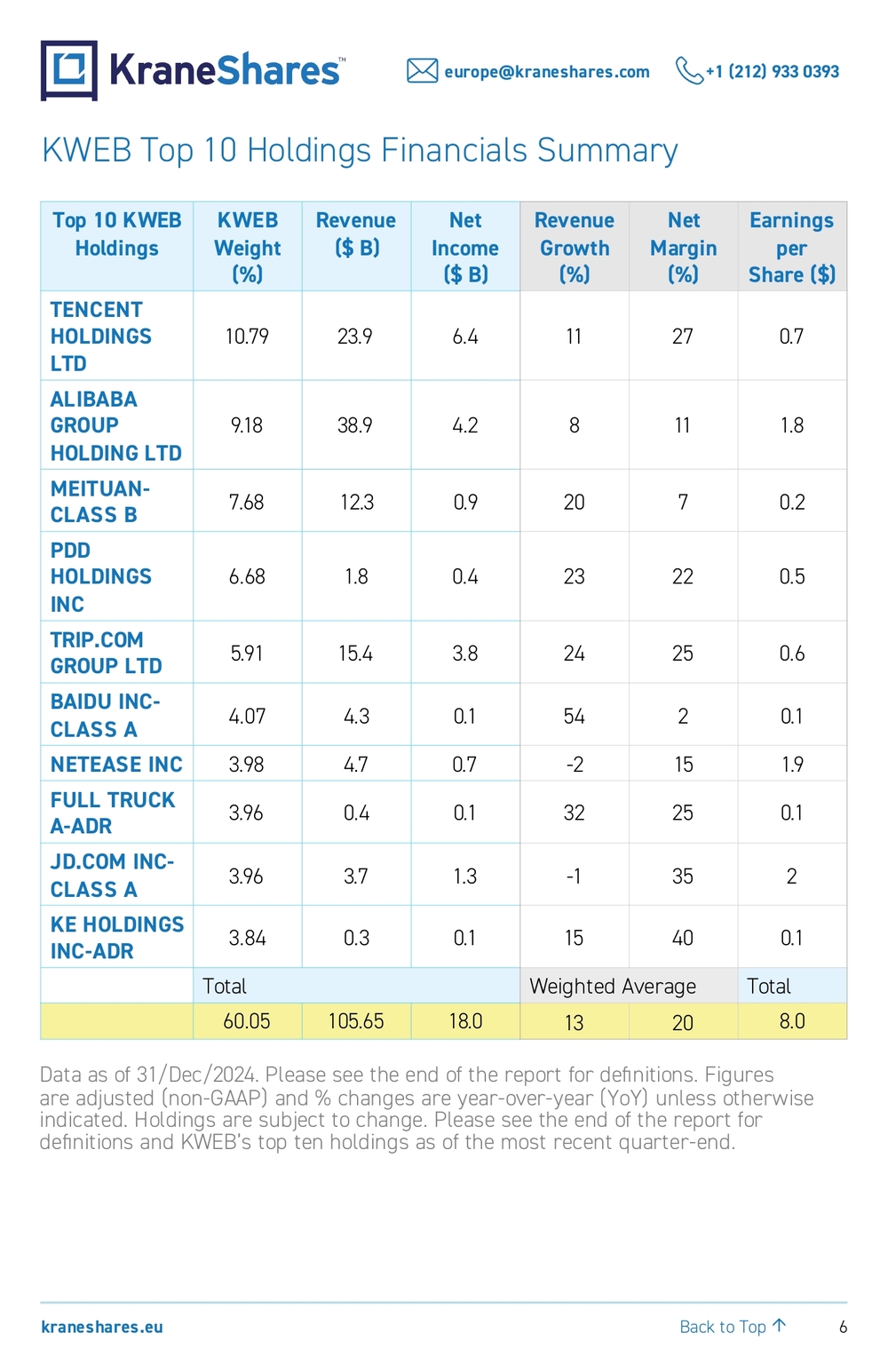
7 kraneshares.eu Back to Top ↑ europe@kraneshares.com +1 (212) 933 0393 KWEB Key Metrics -20-10010203040506070 Education RealEstate Logistics Travel Cloud Recruitment Healthcare E-Commerce FinTech Social/ Online Ads Entertainment Gaming Search Autos &Transportation LiveStreamingAverage % Change Year -over-Year (YoY)Subsector Revenue Growth Data from Bloomberg as of 31/Dec/2024. Please see the end of the report for definitions. -20-1001020304050607080 Logistics Cloud FinTech RealEstate Healthcare Social/ Online Ads E-Commerce Entertainment Education Travel Gaming Autos &Transportation Recruitment LiveStreaming Search% ChangeSubsector Performance (12 Month) Data from Bloomberg as of 2/Apr/2025.
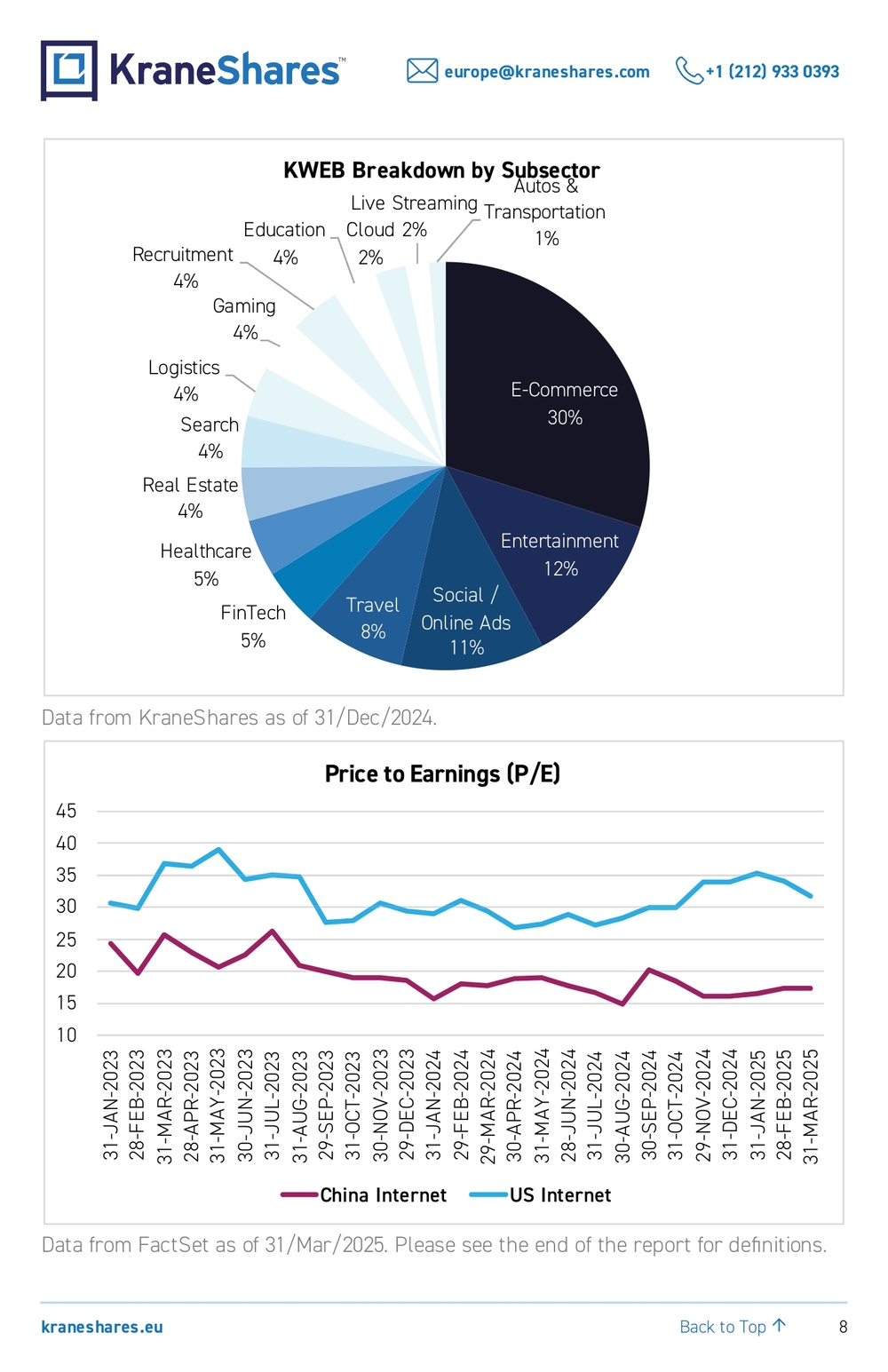
8 kraneshares.eu Back to Top ↑ europe@kraneshares.com +1 (212) 933 0393 E-Commerce 30% Entertainment 12% Social / Online Ads 11%Travel 8%FinTech 5%Healthcare 5%Real Estate 4%Search 4%Logistics 4%Gaming 4%Recruitment 4%Education 4%Cloud 2%Live Streaming 2%Autos & Transportation 1%KWEB Breakdown by Subsector Data from KraneShares as of 31/Dec/2024. 1015202530354045 31-JAN-2023 28-FEB-2023 31-MAR-2023 28-APR-2023 31-MAY-2023 30-JUN-2023 31-JUL-2023 31-AUG-2023 29-SEP-2023 31-OCT-2023 30-NOV-2023 29-DEC-2023 31-JAN-2024 29-FEB-2024 29-MAR-2024 30-APR-2024 31-MAY-2024 28-JUN-2024 31-JUL-2024 30-AUG-2024 30-SEP-2024 31-OCT-2024 29-NOV-2024 31-DEC-2024 31-JAN-2025 28-FEB-2025 31-MAR-2025Price to Earnings (P/E) ChinaInternet USInternet Data from FactSet as of 31/Mar/2025. Please see the end of the report for definitions.
9 kraneshares.eu Back to Top ↑ europe@kraneshares.com +1 (212) 933 0393 Subsector Analysis Sources: Bloomberg, CICC Research, The Benchmark Company, KraneShares. All % changes are year-over-year as of the second quarter of 2024, unless otherwise indicated. Education technology provider and tutoring platform TAL Education increased revenue by +62% in the fourth quarter of 2024. In mid-2024, China’s government significantly relaxed restrictions on for-profit tutoring, which factored into the platform’s revenue increase. Despite costs rising, TAL also improved its profitability. Meanwhile, promotional campaigns for TAL ’s AI-powered educational devices, Xpad and Xbook, during the Singles’ Day shopping festival were said to increase sales. Real Estate platform KE Holdings increased revenue by +54%. The platform benefitted from an uptick in real estate prices and sales volume, especially in first- and second-tier cities. Gross transaction volume reached a record quarterly high. Meanwhile, operational efficiency gains offset declining profitability in the home decoration business, which saw increased competition from homeowners purchasing furnishings directly from suppliers to take advantage of consumption subsidies. Logistics platform Full Truck Alliance increased revenue by +32%. Shipper users surged on the platform, likely stemming from increased consumer demand from the government’s subsidy program. Travel platforms Trip.com and Tongcheng Elong both saw solid growth, with revenue up +20% on average. Trip.com benefitted from a greater presence abroad as well as increasing demand from Chinese travelers for international destinations.
10 kraneshares.eu Back to Top ↑ europe@kraneshares.com +1 (212) 933 0393 Cloud computing providers benefitted from increased demand for computing power from AI applications and increased revenue by +21%, on average. The companies in this subsector include Kingsoft Cloud, a provider of private cloud solutions, which is likely to be chosen as Xiaomi’s official partner for its cloud network, according to industry insiders. Private cloud networks are quickly becoming the preferred computing option for larger corporations with sensitive data. Recruitment platform Kanzhun increased revenue by +15%. The platform continues to be important to the government’s efforts to boost employment and, thereby, consumption. Healthcare platforms Ali Health and JD Health increased their revenue by +12%, on average, in the second half of 2023. Both companies cited the improving regulatory posture toward their industry as a potential key driver of revenue and profitability in the coming years. Health industry overseers recently completed a campaign to reduce excess in public hospital drug procurement and have placed more emphasis on funding for biotech as well as private players in the space. E-Commerce companies increased their revenues by +11%, on average. PDD continues to lead in terms of growth, though its astronomical growth rate in recent quarters has leveled off and the company will now have to contend with the potential for trade disruption due to protectionism. Meanwhile, Alibaba, Meituan, JD.com, and Vipshop all beat earnings per share expectations in the fourth quarter. FinTech companies saw decent growth in the fourth quarter, increasing revenue by +8%, on average. Zhong An Online Insurance saw the highest year-over-year revenue growth on the expansion of its auto insurance coverage and downstream benefits from national reforms to health
11 kraneshares.eu Back to Top ↑ europe@kraneshares.com +1 (212) 933 0393 insurance. Meanwhile, Qifu Technology continues to see healthy loan growth with credit quality remaining stable. Qifu has also integrated DeepSeek’s large language model into its customer tools and loan origination decisions. Social / Online Ads companies increased revenues by +5%, on average, in the fourth quarter. Tencent had better results than Weibo due to its multiple revenue streams, including AI tools and services. Advertising revenues have been hit with the one-two punch of a macroeconomic slowdown, followed by general disruption from AI. Entertainment platforms increased their revenue by +5%. Kuaishou had positive results in the fourth quarter, boosted by its new AI tools and an increase in user engagement. Meanwhile, iQiyi struggled during the quarter, as both revenue and paying subscribers declined. However, CICC analysts believe that iQiyi is about to experience a turnaround as the commercialization of mini dramas could improve and its content available remains robust. Gaming giant NetEase saw its revenue decline by -1% but beat market expectations. PC games outperformed console and mobile games. Margins were slightly lower as NetEase is once again licensing games from Blizzard (Microsoft) in China after they renewed their partnership. The company has a strong pipeline of content that should boost growth in coming quarters. Search engine Baidu’s revenue decreased by -2%. In recent years, Baidu has dramatically changed its business model to focus on cloud computing, AI, and autonomous vehicles. Search traffic continues to be re-routed by AI chatbot functionalities from other vendors.
12 kraneshares.eu Back to Top ↑ europe@kraneshares.com +1 (212) 933 0393 Auto marketplace Autohome saw revenues decline by -7% in the fourth quarter. However, the company is on the verge of closing a deal for Ping An to sell its over 40% stake in the company to home appliance giant Haier. The alliance will allow Autohome to repurchase more stock, as previously it was restricted due to Ping An being regulated as a financial entity and engage with Haier to create a super app for home and auto needs. Live Streaming companies’ revenues decreased by -7%, on average, in the fourth quarter. Joyy saw significant progress in its international expansion efforts. Meanwhile, East Buy Holdings, which focuses on live- streaming E-Commerce, saw revenue decline more significantly, mostly owing to expenses related to the departure of famed live streamer Yuhui.
13 kraneshares.eu Back to Top ↑ europe@kraneshares.com +1 (212) 933 0393 Theme Highlight – Spotlight On AI Trends in China Internet DeepSeek put China’s internet sector on the global map as a source of AI innovation. This led to an AI “domino effect”: Shortly after the release of DeepSeek’s R1 model, which was built using significantly fewer chips compared to OpenAI’s Chat GPT, Alibaba released an update to its Qwen large language model (LLM) that the company said surpassed DeepSeek’s R1. Then, China-based startup Manus released one of the most sophisticated AI agents in the world.6 The consensus so far has been that Alibaba could be the undisputed AI leader among the publicly listed universe of China internet companies. This has caused its stock to outperform China’s internet sector so far this year. However, many other Chinese internet companies are also innovating in AI and using LLMs to enhance the features and tools they can offer customers. Outside of DeepSeek’s open-source LLM and Manus’ novel AI agents’ concept, we believe incumbent internet companies will lead most of the development of China’s AI ecosystem. As such, we believe the KraneShares CSI China Internet UCITS ETF (Ticker: KWEB) is highly representative of the space.
14 kraneshares.eu Back to Top ↑ europe@kraneshares.com +1 (212) 933 0393 This year, many of KWEB’s holdings have been on an AI innovation streak, strongly influencing how AI touches their customers’ lives. LLMs are being offered at an extremely low cost by the likes of Alibaba, Baidu, and Tencent, to the consumer’s benefit, which is driving demand for cloud computing. Meanwhile, platform-specific AI tools, such as Kuaishou’s Kling AI, are making technical fields like video animation user-friendly, generating new opportunities for self-expression and media production. Also, non-human agents in video games and elsewhere could begin to appear eerily like humans in their interactions with customers, with the potential to upgrade customer service and digital experiences significantly. Finally, Alibaba, Baidu, and other companies are merging our experiences and identities in the online and physical worlds with the help of AI. LLMs: Economical For Consumers, Lucrative For Cloud Services Providers As a true internet giant, Alibaba’s large language models (LLMs), especially the latest version of Qwen, see broad use cases. They serve as the foundational models for other AI services and tools offered under Alibaba’s umbrella, such as Alibaba.com’s international AI sourcing agent for businesses. In other cases, they are being utilized as the basis for AI tools and services offered by other businesses, including startups and medium-sized enterprises (SMEs), or used internally. Qwen is consistently neck-and-neck with DeepSeek’s transformational and open-source R1 model in the rankings for China’s most popular LLM for developers, according to downloads from LLM exchange Hugging Face. These two models are likely to be the foundations for private
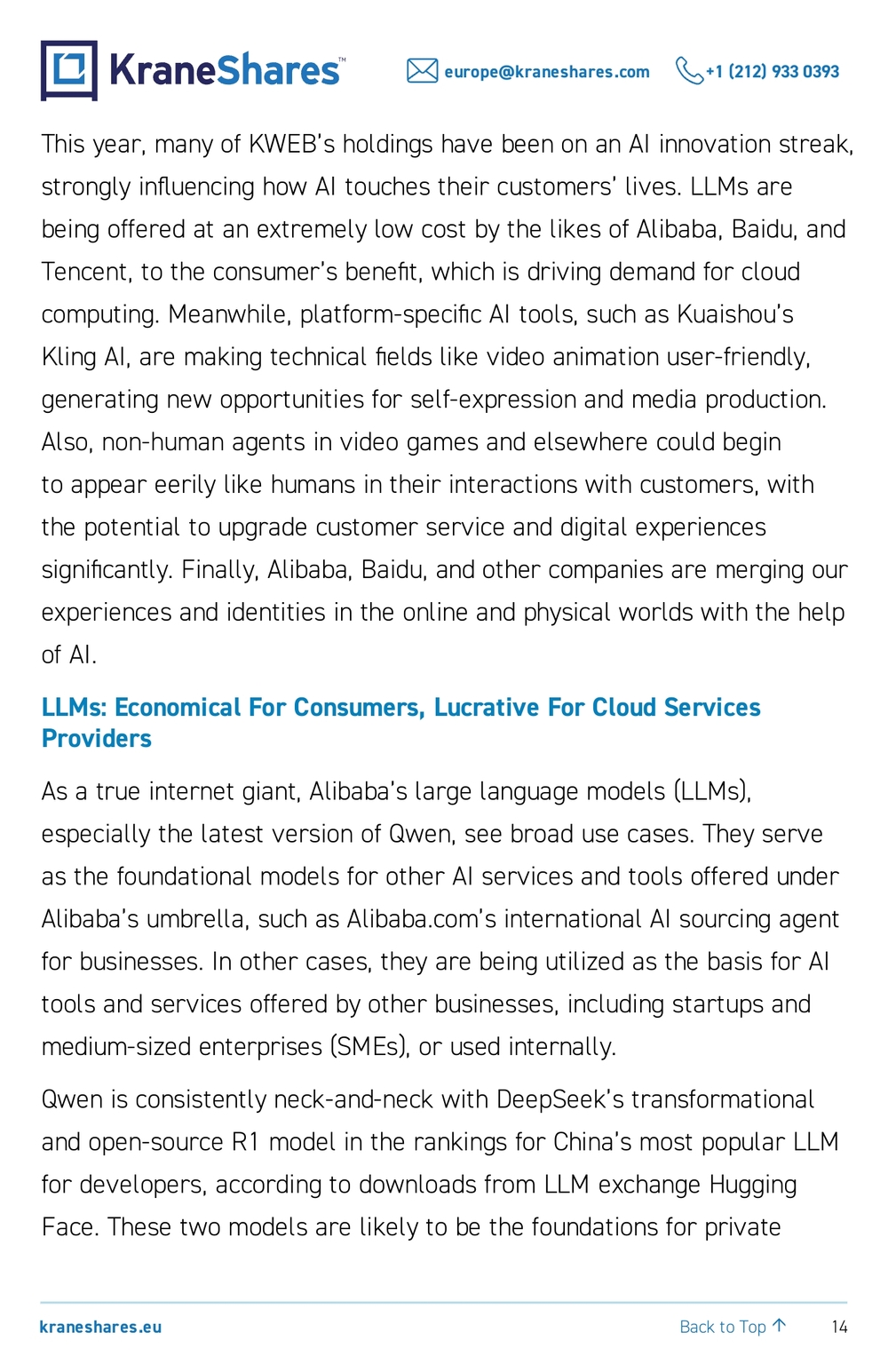
15 kraneshares.eu Back to Top ↑ europe@kraneshares.com +1 (212) 933 0393 offerings and use cases for businesses across China for the foreseeable future. Alibaba’s achievement here demonstrates the giant’s ability to innovate. Alibaba’s significant re-rating so far this year reflects the market’s recognition of this feat, among other factors. -5.410.1524.99 -10-5051015202530 BaiduK uaishouA libabaYear-to-Date Share Price % Change Data from Bloomberg as of 7/Apr/2025. Past performance does not guarantee future results. Please see the end of the report for these stocks’ respective weights in KWEB. China’s LLMs are currently in a price war as innovators compete to saturate themselves in a dynamic marketplace. Alibaba’s Qwen has a highly competitive pricing model. Some models, such as Qwen VL, are priced as low as RMB 0.003 per one thousand input tokens. This rate represents an 85% reduction from last year’s rate and was specifically chosen to compete with a similar audio-visual model offered by Bytedance.4 But, if it is so cheap, how does Alibaba’s Qwen model add to the
16 kraneshares.eu Back to Top ↑ europe@kraneshares.com +1 (212) 933 0393 company’s bottom line? The answer is that it drives demand for cloud computing to Alibaba Cloud. We expect to see more integration of product offerings between the model itself and cloud computing services to run it, creating greater synergy between the product lines. This “LLM-to-cloud” or “freemium” business model could become the standard in the space. Tencent and Baidu, which also offer comprehensive public cloud computing services, will likely adopt this pricing technique to compete with Alibaba. For consumers, this ensures LLMs will continue to be available at a low cost. Meanwhile, developers benefit from simple pricing primarily based on their computing needs. Although the price war could pick some winners, the industry will likely continue to have multiple leaders as providers cultivate specialties. Reinventing Video Animation With Kuaishou’s Kling AI Fields that used to require deep technical skills are rapidly becoming accessible to the masses. Video animation is the first target of AI developers. But this trend can easily spread to other fields and quickly. Kuaishou is a short-video platform that listed shares publicly for the first time on the Hong Kong Stock Exchange (HKEX) in 2021. The platform has been a long-term KWEB holding and has rapidly gained users and market share. A mix of YouTube and TikTok, Kuaishou, which translates literally as “quick hand”, has become a staple among China’s viewing public. Recently, Kuaishou released its Kling AI model, which is geared towards helping creators generate video content. Kling AI now incorporates DeepSeek’s R1 model to provide additional optionality and efficiency for users. Following in Alibaba’s footsteps, incorporating DeepSeek’s
17 kraneshares.eu Back to Top ↑ europe@kraneshares.com +1 (212) 933 0393 open-source R1 generates hype around its AI services and promotes its versatility and commitment to open architecture, generating user trust. Kuaishou’s masterstroke here is making video animation exceedingly user-friendly. Using Kling AI’s new tools, even the most inexperienced users can create videos that maintain visual and characteristic coherence, giving potentially even Hollywood studios a run for their money. Kling AI’s latest features include an Inspiration Word Bank, Multi-Image Referencing, and Enhanced Video Quality. Inspiration Word Bank: With a few simple phrases, users can exert granular control over elements of the production, including scenes, lighting, and atmosphere. This improves users’ ability to express their unique and precise visions and increases the platform’s accessibility by softening the learning curve for new users to produce high-quality videos. Multi-Image Referencing: Users can upload multiple images of a subject (e.g., a person or object) and generate videos with consistent styles across scenes. By referencing multiple images of the subject, the model can ensure visual coherence and continuity.
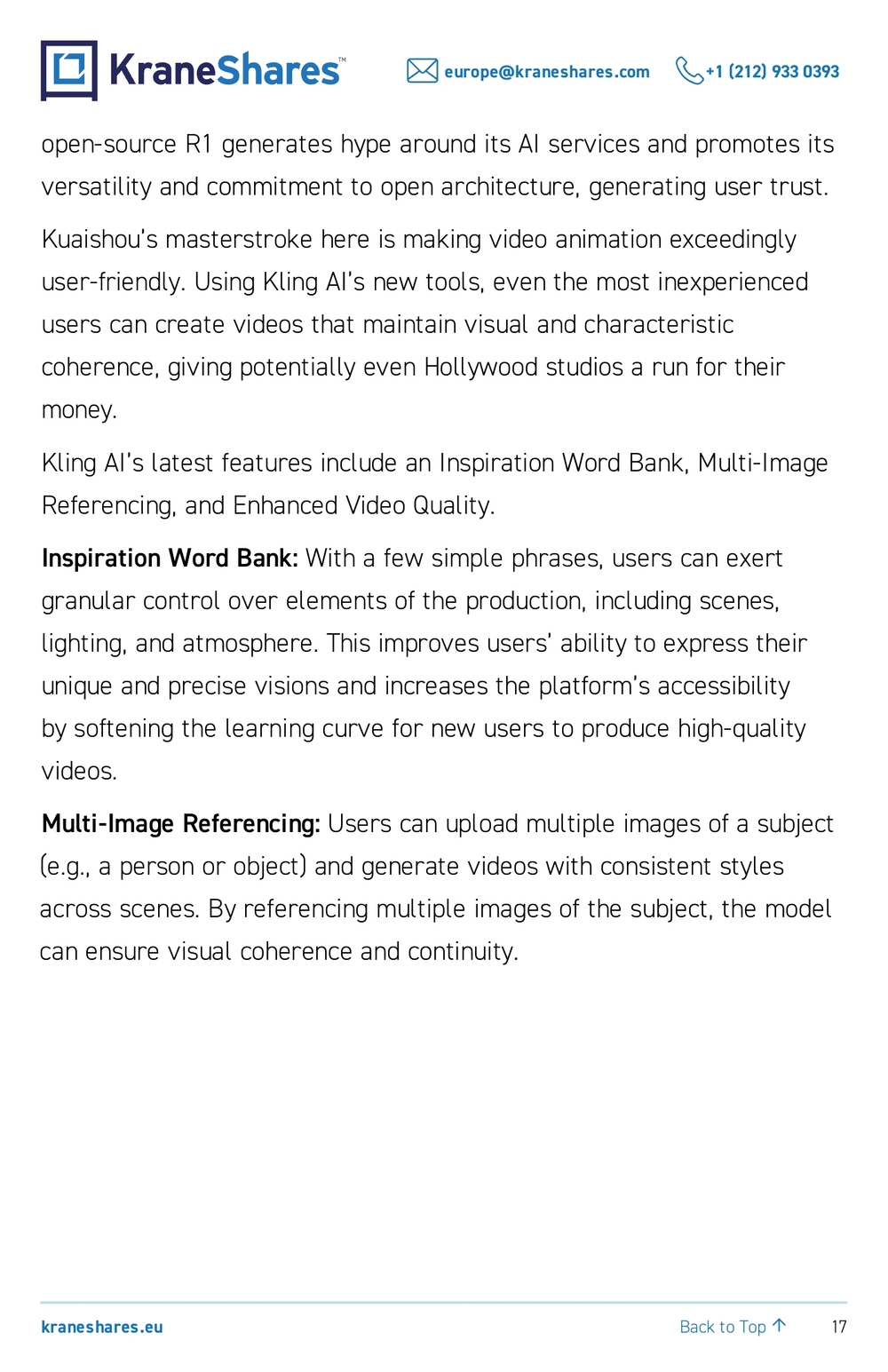
18 kraneshares.eu Back to Top ↑ europe@kraneshares.com +1 (212) 933 0393 Above, multiple images are loaded into Kling, and Kling is asked to mold them together into a cohesive character that remains consistent across scenes. Enhanced Video Quality: The Kling AI 1.6 model offers improved video generation capabilities, including 1080p resolution at 30 frames per second, realistic physics, and advanced 3D face/body reconstruction. Video-to-Video Extension: Users can transform static images into videos or extend existing videos by up to 4.5 seconds, with dynamic transitions, offering more flexibility in content creation. AI Taking On A Life of Its Own? Have you ever dialed “0” repeatedly when on a phone call with a business in a desperate attempt to get a human on the line? With the help of AI, inadequacies in automated operators could become a thing of the past. We already know that LLMs dramatically improve data referencing capabilities, which is the first piece of the puzzle. Now, AI-powered agents need to be able to make inferences and take context clues from customer speech to address needs more effectively.
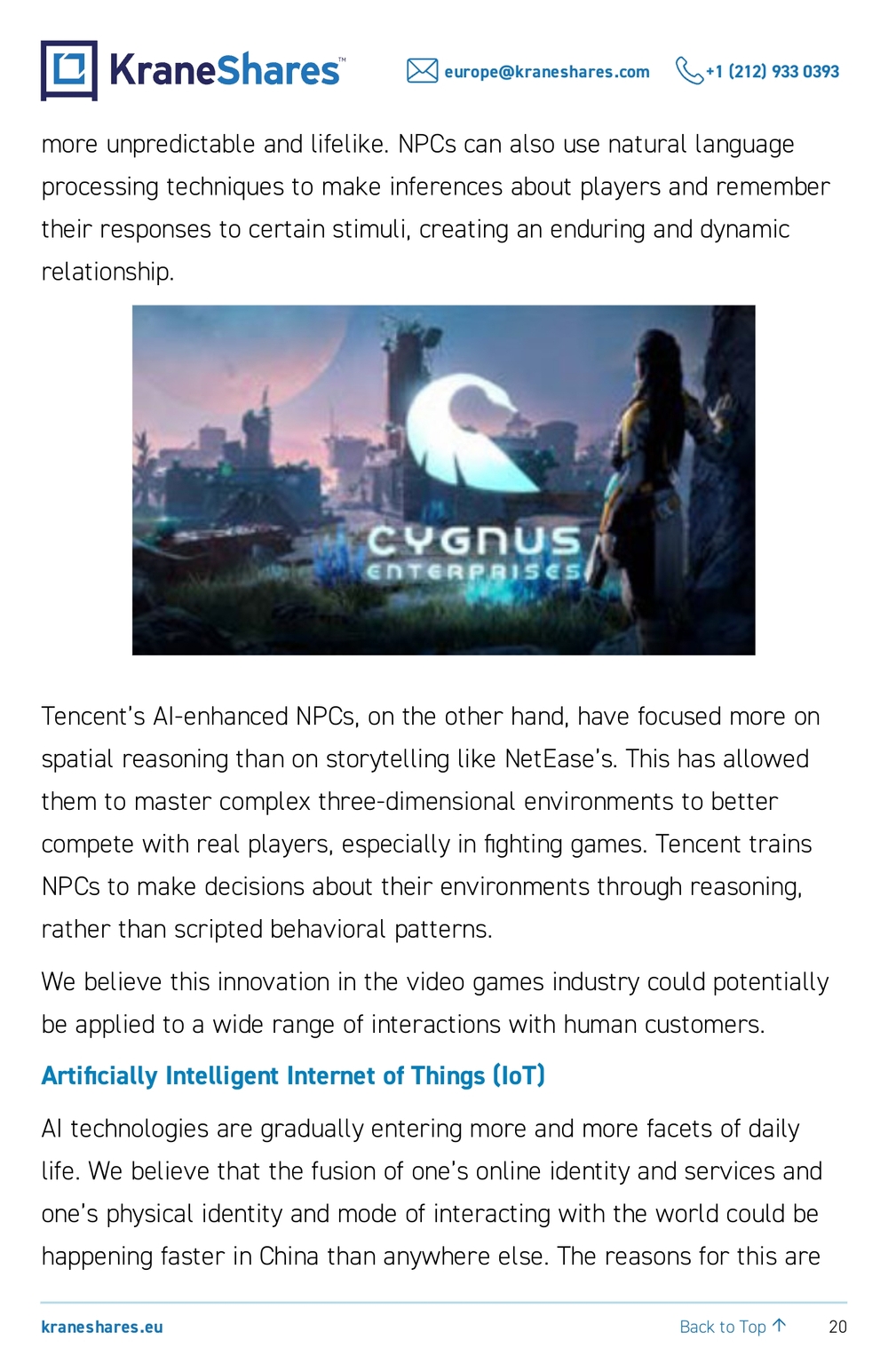
19 kraneshares.eu Back to Top ↑ europe@kraneshares.com +1 (212) 933 0393 Manus AI, developed by China-based startup Butterfly Effect, is a trailblazer in the cutting-edge field of AI agents. Manus’ AI agents are designed to execute complex tasks without continuous human guidance. Launched in March, it represents a significant leap in AI technology, focusing on real-world problem-solving across domains like software development, data analysis, and content creation. Meanwhile, KWEB holding NetEase has made great strides in harnessing AI technology to make its coded-in game characters appear more lifelike. What they have been able to do with video games could translate into other fields of engagement with customers and users. In the video gaming industry, coded in-game characters are known as non-player characters (NPCs). They are notorious for being dull and responding only to certain stimuli. NetEase and Tencent have both introduced AI-enhanced NPCs into their video games. NetEase is enhancing the realism of NPCs through several innovative AI-driven techniques. Their game Cygnus Enterprises uses AI to enable NPCs to exhibit more natural, engaging, and context-aware behaviors. This integration allows NPCs to appear aware of their surroundings by using scene-specific descriptive information and game event triggers, which helps them react dynamically to gameplay situations and player interactions. Furthermore, NetEase employs custom solutions such as scene management to ensure NPCs acquire and retain relevant knowledge over time, based on their location and the current game context. This approach prevents NPCs from breaking immersion and allows them to display consistent personalities and behaviors, making interactions
20 kraneshares.eu Back to Top ↑ europe@kraneshares.com +1 (212) 933 0393 more unpredictable and lifelike. NPCs can also use natural language processing techniques to make inferences about players and remember their responses to certain stimuli, creating an enduring and dynamic relationship. Tencent’s AI-enhanced NPCs, on the other hand, have focused more on spatial reasoning than on storytelling like NetEase’s. This has allowed them to master complex three-dimensional environments to better compete with real players, especially in fighting games. Tencent trains NPCs to make decisions about their environments through reasoning, rather than scripted behavioral patterns. We believe this innovation in the video games industry could potentially be applied to a wide range of interactions with human customers. Artificially Intelligent Internet of Things (IoT) AI technologies are gradually entering more and more facets of daily life. We believe that the fusion of one’s online identity and services and one’s physical identity and mode of interacting with the world could be happening faster in China than anywhere else. The reasons for this are
21 kraneshares.eu Back to Top ↑ europe@kraneshares.com +1 (212) 933 0393 twofold: cultural differences with the West that lead to less concern about personal privacy and unique innovations native to the country. While Apple did not get past the ideation phase of creating a truly connected vehicle, China’s Xiaomi and NIO have created some of the most connected vehicles on earth, complete with access to LLMs right from the dashboard. These vehicles will soon be able to connect the user with home devices, too. They are not the only ones involved in the space. We believe KWEB holdings Alibaba and Baidu are also going to be heavily involved in bringing AI on the road. BMW recently expanded its strategic partnership with Alibaba on the adoption of in-vehicle digital assistants, powered by large language models (LLMs).5 Meanwhile, Baidu’s robotaxis are expanding internationally, starting with Dubai, after breaking even in multiple cities in China. Robotaxis from Baidu’s Apollo Go are available via an app that could be fused with other online accounts to learn from user behavior, adjust to preferences, and offer additional products and services. Bottom Line China’s AI ecosystem is evolving rapidly and provides a glimpse into what a fully AI-enabled world could eventually look like. Unlike in the United States, where chipmakers and privately held companies are leading the charge, China’s AI revolution is predominantly being led by its publicly listed internet giants. For this reason, we believe the KraneShares CSI China Internet ETF (Ticker: KWEB) provides ample exposure to this theme in China.
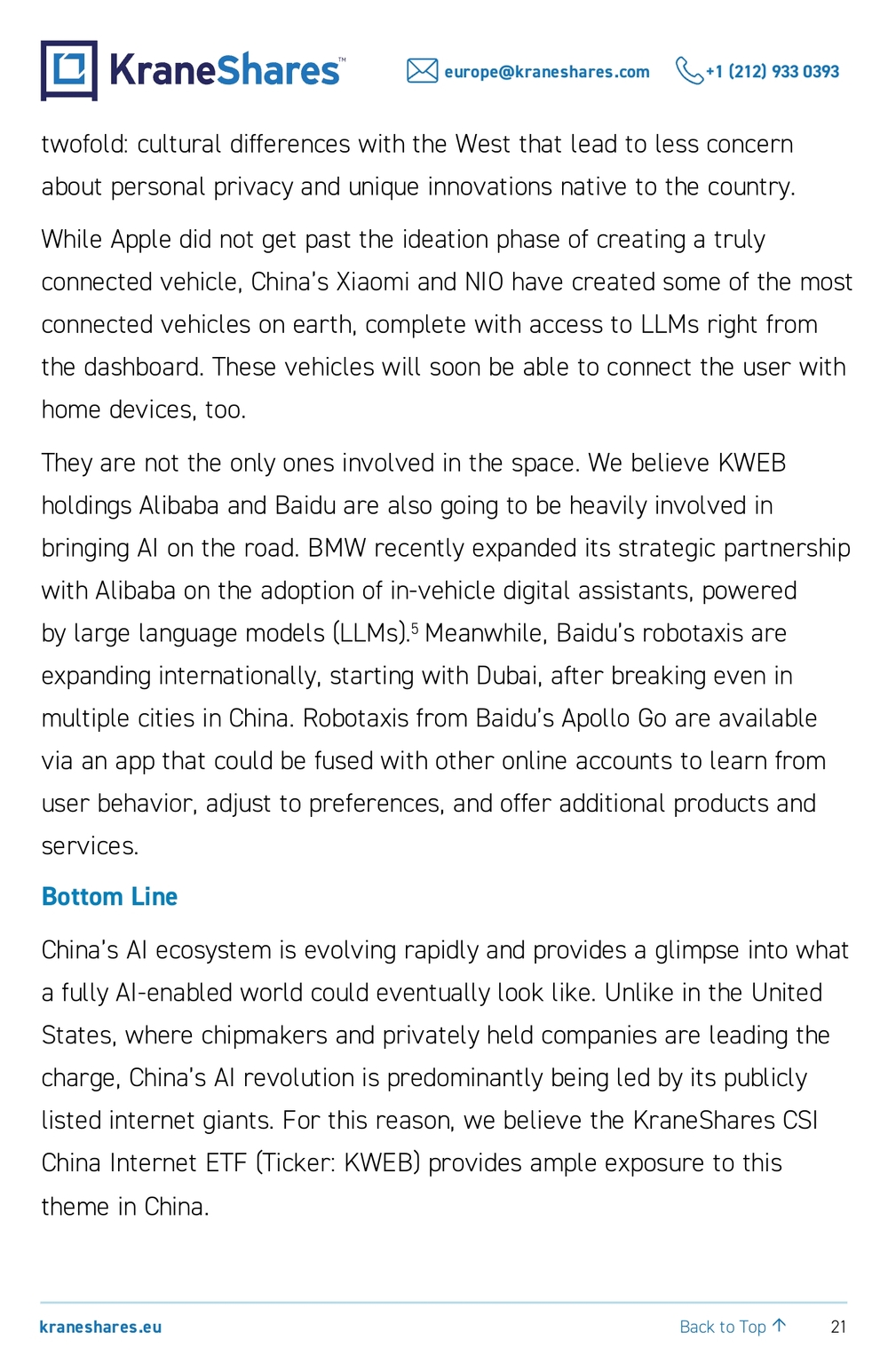
22 kraneshares.eu Back to Top ↑ europe@kraneshares.com +1 (212) 933 0393 Furthermore, many of these companies are relatively undervalued compared to their US counterparts, despite recent strong share price performance, as we mentioned at the beginning of the report. However, we believe some true AI innovators are still dramatically undervalued and flush with cash. While Alibaba’s shares have enjoyed a significant re- rating this year, Baidu still has a market capitalization that is only slightly higher than its cash balance. Meanwhile, both Kuaishou’s and Baidu’s earnings multiples are significantly below Alibaba’s, which is near the average for China’s internet sector. 0246810121416 0%10%20%30%40%50%60%70%80%90%100% BaiduA libaba KuaishouCash to Market Cap & P/E Cashas%ofMarketCap(LeftAxis) PricetoEarnings(P/E)(RightAxis) Data from Bloomberg as of 8/Apr/2025. Please see the end of the report for definitions. Moreover, many of these innovations are happening in China first. Allocating to KWEB could help investors ensure they are exposed to the latest trends in the global AI landscape.
23 kraneshares.eu Back to Top ↑ europe@kraneshares.com +1 (212) 933 0393 Conclusion As the future of AI adoption takes shape, we believe China’s internet sector provides a glimpse into what that future holds. Based on China’s experience so far, AI is poised to make our lives more convenient through proliferating economical LLMs, make previously inaccessible fields and forms of communication accessible to the public, become more lifelike in games and other online environments, and inject smarter-and-smarter features into connected devices, including cars and home appliances. China, specifically the internet sector, has proven that its innovation engine in AI is up and running with the surfacing of these trends in the country. Thus, we believe the KraneShares CSI China Internet ETF (Ticker: KWEB) could be an effective tool for investors to invest in technologies that will define the future today. KWEB Top 10 Holdings Earnings Update Sources: Bloomberg, CICC Research, company releases & filings, KraneShares. % changes are year-over-year unless otherwise indicated. Revenue figures are adjusted (non-GAAP). Tencent Tencent is a diversi fied consumer technology company with businesses in social media, cloud services, payments, and online advertising. Tencent’s most well-known product is WeChat, one of China’s premier social media platforms with over one billion monthly active users (MAUs). Tencent By The Numbers (Q4 2024) •Revenue +11% to RMB 172.7B ($23.9B) •Net Income RMB 46.3B ($6.4B) •Net Margin 27%
24 kraneshares.eu Back to Top ↑ europe@kraneshares.com +1 (212) 933 0393 •Earnings per Share RMB 5.1 ($0.7) Tencent’s solid quarter was driven by AI-enhancements to their advertising platform. They emphasized AI in their press release, which included a quote from Founder, Chairman, & CEO Ma “Pony” Huateng, saying, “We have re-organized our AI teams to sharpen focus on both fast product innovation and deep model research, increased our AI-related capital expenditures, and increased our R&D and marketing efforts for our AI-native products.” The Q4 earnings presentation dedicated an entire section to AI, noting the company spent $10.7 billion on AI in 2024, representing a capex of 12% of revenue, up from 2023’s $3.4 billion when capex accounted for 4% of revenue. In a good sign for the company and China’s economy, the company noted, “Advertising spending rose across most major categories during the quarter.” After all, advertisers do not increase their spending if they believe the economy is collapsing. Revenue from non-core usinesses including gaming, content, and financial technologies, increased by +14% to RMB 79 billion (social networks up +6%, domestic games up +23%, international games up +15%). Marketing Services revenue increased by +17% to RMB 35 billion. Meanwhile, Fintech and Business Services revenue increased +3% to RMB 56.1 billion. In 2024, the Company repurchased approximately 307 million shares on the Hong Kong Stock Exchange for HKD 112 billion. For 2025, Tencent will increase its annual dividend by 32% to HKD 4.50 per share (equivalent to approximately HKD 41 billion) and repurchase at least HKD 80 billion worth of shares.
25 kraneshares.eu Back to Top ↑ europe@kraneshares.com +1 (212) 933 0393 Alibaba Alibaba is a conglomerate primarily engaged in E-Commerce. The company operates an online marketplace offering a wide variety of consumer goods. The company has also expanded beyond E-Commerce and is now a consortium of six businesses covering cloud, domestic E-Commerce, global digital commerce, media, logistics, and local services. Alibaba By The Numbers (Q4 2024) •Revenue +8% to RMB 281.6B ($38.9B) •Net Income RMB 30.4B ($4.2B) •Net Margin 11% •Earnings per Share RMB 13.0 ($1.8) Alibaba had a solid fourth quarter, exceeding most expectations on revenue and net income. China E-Commerce, International E-Commerce, and Cloud units all experienced growth. Meanwhile, Alibaba founder Jack Ma’s attendance at President Xi’s entrepreneur meeting in February was a positive indication of the company’s elevated status in the country. His presence at the meeting led some to speculate that an initial public offering (IPO) of the company’s financial services business, in which it maintains a one-third stake, could be back on the table. Ant Group added $618 million to Alibaba’s bottom line in the fourth quarter. The company became “lighter” in the fourth quarter as it sold out of its physical stores, Intime and Sun Art Retail. This helped keep margins stable despite new capex spending on AI initiatives. Analysts focused on AI during the earnings call. CEO Eddie Wu stated,
26 kraneshares.eu Back to Top ↑ europe@kraneshares.com +1 (212) 933 0393 “The AI era presents a clear and massive demand for infrastructure.” Wu also stated that he is fully confident that US chip export restrictions will no longer pose a risk to the long-term development of the company’s cloud services business, which includes AI initiatives. Increased investment in cloud services following the launch of DeepSeek led to a nearly -30 % decline in free cash flow, which will likely reduce the firm’s share repurchases in the future. However, we believe it is worth noting that the company still has about $85 billion worth of cash on the books. Meituan Meituan is an E-Commerce company that specializes in food delivery and other local services. The company operates many business lines, including general retail, restaurant booking, and travel booking services, and it serves over 600 million registered users. Meituan is one of China’s leading “super apps” that offer a wide variety of services, including from third parties. Meituan By The Numbers (Q4 2024) •Revenue +20% to RMB 89.2B ($12.3B) •Net Income RMB 6.5B ($0.9B) •Net Margin 7% •Earnings per Share RMB 1.5 ($0.2) Meituan beat analyst estimates on both top-line revenue and bottom- line net income in the fourth quarter of 2024. Meituan’s profitability has improved substantially since departing from intense promotions
27 kraneshares.eu Back to Top ↑ europe@kraneshares.com +1 (212) 933 0393 and discounts on the platform to gain market share and has more than doubled its earnings per share (EPS) over the past year. The company’s press release provides an insight into China’s economy, noting that “thanks to further online penetration and strong consumer demand,” the “on-demand delivery business experienced steady growth.” During the earnings call, management said they would invest in heavily AI, drone delivery, and self-driving trucks. Chairman & CEO Xing Wang explained that their in-house large language model has improved customer service. Meanwhile, Meituan successfully launched Keeta, a food delivery service in Saudi Arabia, during the fourth quarter. Meituan spent $3.6 billion to repurchase over 261 million shares in 2024. Since 2021, the company has nearly doubled its revenue and become profitable. Nonetheless, its stock price is still nearly -25% lower than at the end of 2021. PDD PDD is an innovative global E-Commerce platform focused on the user experience and was one of the fi rst to embrace a social media-like model for online shopping. The company’s apps are known for their group-buying capabilities, inserting gaming into shopping and earning coupons, and rock-bottom prices for private-label goods. PDD is also famous for pioneering to lower overhead costs through an on-demand manufacturing model. PDD operates under the name “Pinduoduo” in China and “Temu” in the rest of the world. PDD By The Numbers (Q4 2024) •Revenue +24% to RMB 111.6B ($15.4B)
28 kraneshares.eu Back to Top ↑ europe@kraneshares.com +1 (212) 933 0393 •Net Income ($3.8B) •Net Margin 25% •Earnings per Share RMB 4.4 ($0.6) Although PDD’s top-line revenue fell short of expectations, the company was more profitable than expected. A decline in marketing spending in Temu did not result in significant user loss, leading the company’s margins to be more stable than expected. Meanwhile, consumer trade-in subsidies boosted the China commerce segment somewhat. With approximately 30% of its sales coming from abroad, developed world trade protectionism can be an important factor for PDD. When asked about potential changes to US import rules, especially the potential repeal of the de minimis rule, management stated matter-of-factly that this was outside of their control and could present challenges for the business. Fortunately, PDD has been investing in local supply chains in the US that currently complement imports. Trip.com Trip.com is a travel booking site widely recognized as an international competitor to Expedia. It provides search and complete booking services for fl ights, hotels, trains, car rentals, and more. The company offers international and domestic travel booking services to Chinese and global customers. Trip.com By The Numbers (Q4 2024) •Revenue +23% to RMB 13.0B ($1.8B) •Net Income RMB 2.9B ($0.4B) •Net Margin 22%
29 kraneshares.eu Back to Top ↑ europe@kraneshares.com +1 (212) 933 0393 •Earnings per Share RMB 3.6 ($0.5) Trip.com had a stellar fourth quarter and is now generating more revenue than it did prior to the pandemic. Its revenue was RMB 35.6 billion in 2019, which then fell to RMB 18.3 billion in 2020, and subsequently more than rebounded by 2024 to RMB 53.3 billion ($7.3 billion) for the year. Bookings for international travel, a key growth segment for Trip, increased +20% year-over-year during Lunar New Year, which was lower than expected. Meanwhile, Trip.com continues to invest heavily in its offerings to overseas clients, which CICC analysts believe could lead to margin contraction in the medium term. Trip.com announced a new $400 million stock repurchase program and a $0.30 per share dividend. Baidu Baidu is a technology company with substantial businesses in arti ficial intelligence, search engines, cloud computing, mobility solutions, and more. Baidu operates China’s most popular search engine. Meanwhile, Baidu’s ERNIE AI chatbot has over 100 million users, and its Apollo program operates the world’s largest fl eet of robo-taxis. Baidu By The Numbers (Q4 2024) •Revenue -2% to RMB 34.0B ($4.7B) •Net Income RMB 5.1B ($0.7B) •Net Margin 15% •Earnings per Share RMB 13.8 ($1.9) Baidu’s Q4 results exceeded low expectations. Baidu’s core business depends on advertisers, whose budgets have yet to fully recover from
30 kraneshares.eu Back to Top ↑ europe@kraneshares.com +1 (212) 933 0393 the pandemic, and, more recently, real estate’s effect on consumption and increased competition in app ecosystems. We believe Baidu receives little credit from investors for its AI, Cloud, ERNIE large language model (LMM), and Apollo Go (robotaxi) programs. Baidu’s Apollo Go robotaxi program has been successful so far, completing over 9 million cumulative rides and achieving fully driverless status. Meanwhile, after having reached the break-even point in Wuhan, the company is now looking to expand internationally, with its sights on Dubai. This move, along with expansion into Shanghai and other tier-1 cities in China, could help Apollo turn profitable, helping Baidu’s bottom line and picking up some of the slack from slowing advertising revenue. NetEase NetEase is a consumer information technology company that primarily produces online, PC, and mobile games. It is one of the largest gaming companies in the world, and its titles include Knives Out and Naraka: Bladepoint. NetEase also distributes games from Blizzard (Microsoft) in China, through an exclusive partnership with the American game maker. NetEase By The Numbers (Q4 2024) •Revenue -1% to RMB 26.8B ($3.7B) •Net Income RMB 9.4B ($1.3B) •Net Margin 35% •Earnings per Share RMB 14.5 ($2.0) NetEase revenue decline was less than analysts had expected in the face of a challenging macroeconomic environment. PC games outperformed console and mobile games. Margins were slightly lower as NetEase