KRBN: Global Carbon Credits ETC | KraneShares
by Kraneshares
For select intermediaries only for the purpose of product discussions only KraneShares ETC Securities Programme Investing in the Global Carbon Credit Markets europe@kraneshares.com For select intermediaries only for the purpose of product discussions only30/Jun/2026
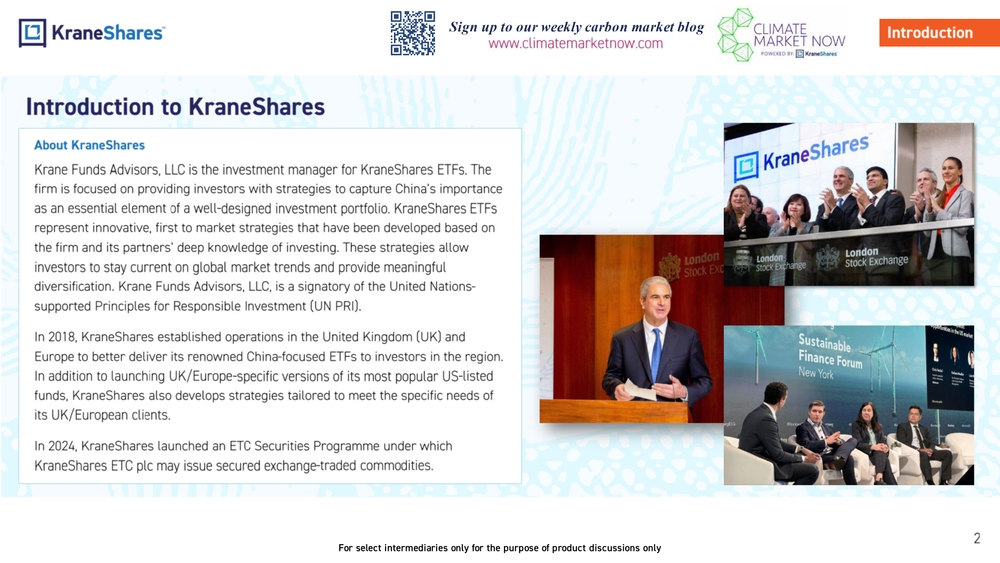
For select intermediaries only for the purpose of product discussions only Introduction to KraneShares About KraneShares Krane Funds Advisors, LLC is the investment manager for KraneShares ETFs. The firm is focused on providing investors with strategies to capture China’s importance as an essential element of a well
designed investment portfolio. KraneShares ETFs represent innovative, first to market strategies that have been developed based on the firm and its partners’ deep knowledge of investing. These strategies allow investors to stay current on global market trends and provide meaningful diversification. Krane Funds Advisors, LLC, is a signatory of the United Nations
supported Principles for Responsible Investment (UN PRI). In 2018, KraneShares established operations in the United Kingdom (UK) and Europe to better deliver its renowned China
focused ETFs to investors in the region. In addition to launching UK/Europe
specific versions of its most popular US
listed funds, KraneShares also develops strategies tailored to meet the specific needs of its UK/European clients. In 2024, KraneShares launched an ETC Securities Programme under which KraneShares ETC plc may issue secured exchange
traded commodities. Introduction Sign up to our weekly carbon market blog www.climatemarketnow.com 2
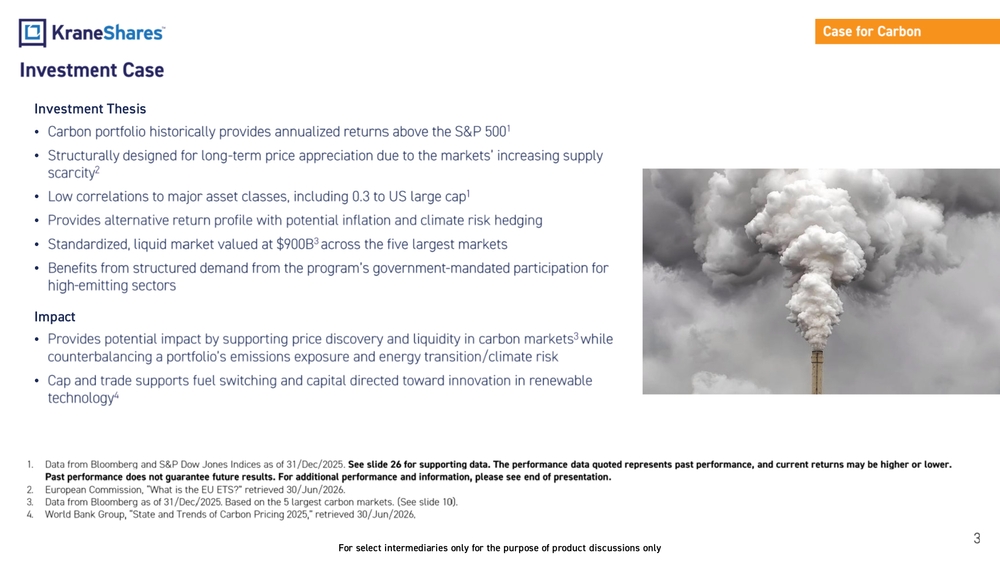
For select intermediaries only for the purpose of product discussions only Investment Case Case for Carbon 3Investment Thesis • Carbon portfolio historically provides annualized returns above the S&P 500 1 • Structurally designed for long
term price appreciation due to the markets’ increasing supply scarcity 2 • Low correlations to major asset classes, including 0.3 to US large cap 1 • Provides alternative return profile with potential inflation and climate risk hedging • Standardized, liquid market valued at $900B 3 across the five largest markets • Benefits from structured demand from the program’s government
mandated participation for high
emitting sectors Impact • Provides potential impact by supporting price discovery and liquidity in carbon markets 3 while counterbalancing a portfolio’s emissions exposure and energy transition/climate risk • Cap and trade supports fuel switching and capital directed toward innovation in renewable technology 4 1. Data from Bloomberg and S&P Dow Jones Indices as of 31/Dec/2025 . See slide 2 6 for supporting data. The performance data quoted represents past performance, and current returns may be higher or lower. Past performance does not guarantee future results. For additional performance and information, please see end of presentation . 2. European Commission, “What is the EU ETS?” retrieved 30/Jun/2026. 3. Data from Bloomberg as of 31/Dec/2025 . Based on the 5 largest carbon markets. (See slide 1 0 ). 4. World Bank Group, “State and Trends of Carbon Pricing 2025,” retrieved 30/Jun/2026 .
For select intermediaries only for the purpose of product discussions only Growing Institutional Interest 4 LO CFA Institute Research & Policy Center Cambridge Associates #1 New release in Sustainable Business Development

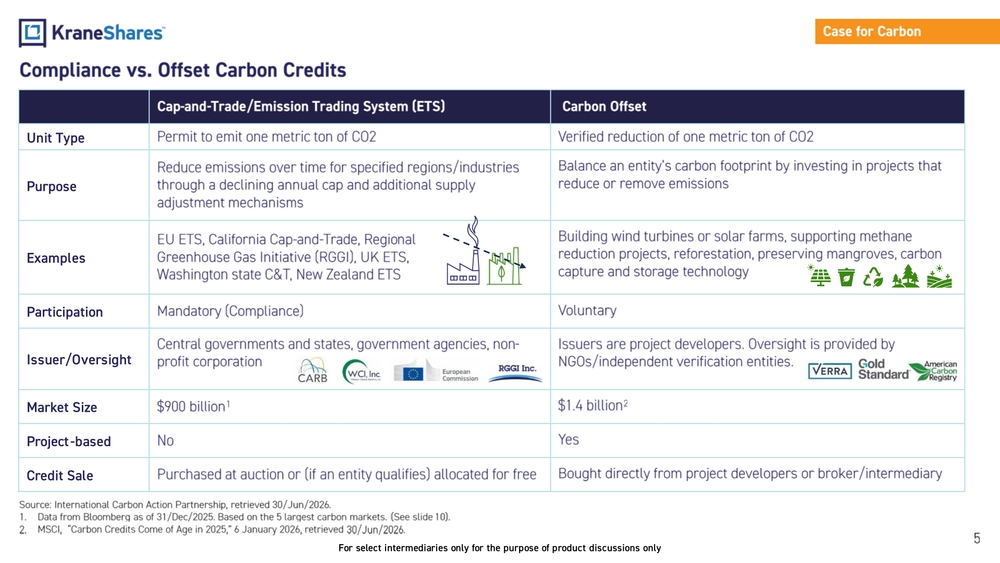
For select intermediaries only for the purpose of product discussions only Compliance vs. Offset Carbon Credits 5 Source: International Carbon Action Partnershi p, retrieved 30/Jun/2026 . 1. Data from Bloomberg as of 31/Dec/2025. Based on the 5 largest carbon markets. (See slide 1 0 ). 2. MSCI, “Carbon Credits Come of Age in 2025,” 6 January 2026, retrieved 30/Jun/2026 . Case for Carbon Cap
and
Trade/Emission Trading System (ETS) Carbon Offset Unit Type Permit to emit one metric ton of CO2 Verified reduction of one metric ton of CO2 Purpose Reduce emissions over time for specified regions/industries through a declining annual cap and additional supply adjustment mechanisms Balance an entity’s carbon footprint by investing in projects that reduce or remove emissions Examples EU ETS, California Cap
and
Trade, Regional Greenhouse Gas Initiative (RGGI), UK ETS, Washington state C&T, New Zealand ETS Building wind turbines or solar farms, supporting methane reduction projects, reforestation, preserving mangroves, carbon capture and storage technology Participation Mandatory (Compliance) Voluntary Issuer/Oversight Central governments and states, government agencies, non
profit corporation Issuers are project developers. Oversight is provided by NGOs/independent verification entities. Market Size $900 billion 1 $1.4 billion 2 Project -based No Yes Credit Sale Purchased at auction or (if an entity qualifies) allocated for free Bought directly from project developers or broker/intermediary
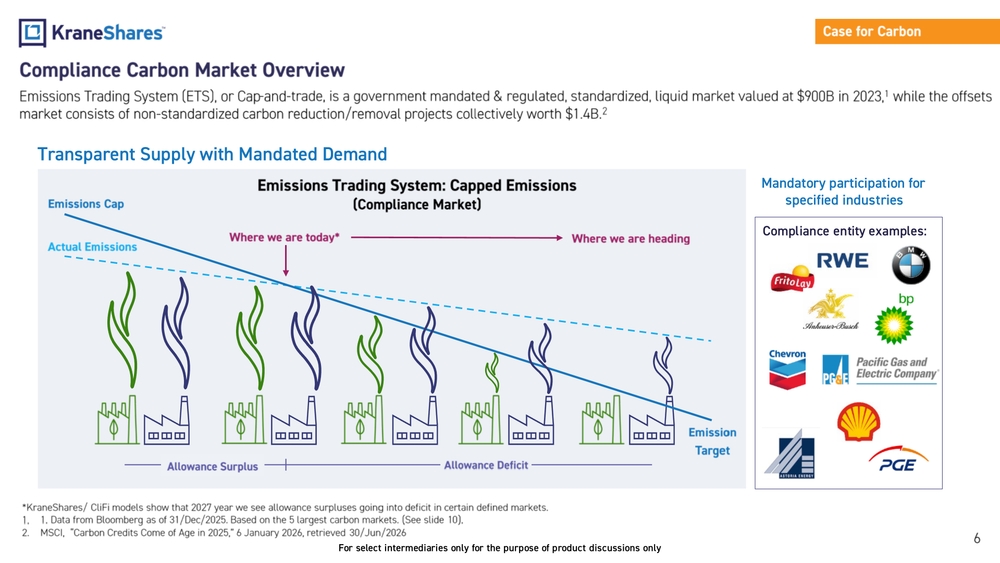
For select intermediaries only for the purpose of product discussions only Compliance Carbon Market Overview 6 Emissions Trading System (ETS), or Cap
and
trade, is a government mandated & regulated, standardized, liquid market valued at $9 00B in 2023, 1 while the offsets market consists of non
standardized carbon reduction/removal projects collectively worth $1.4B.
2
Emissions Trading System: Capped Emissions
(Compliance Market)
Emissions Cap
Where we are today*
Actual Emissions
Emission
Target
Allowance Deficit
Allowance Surplus
Where we are headingCompliance entity examples:
Case for Carbon
Transparent Supply with Mandated Demand
Mandatory participation for
specified industries
*KraneShares/
CliFi
models show that
20
27 year we see allowance surpluses going into deficit in certain defined markets.
1.
1.
Data from Bloomberg as of 31/Dec/2025. Based on the 5 largest carbon markets. (See slide
1
0
).
2.
MSCI, “Carbon Credits Come of Age in 2025,” 6 January 2026, retrieved
30/Jun/2026
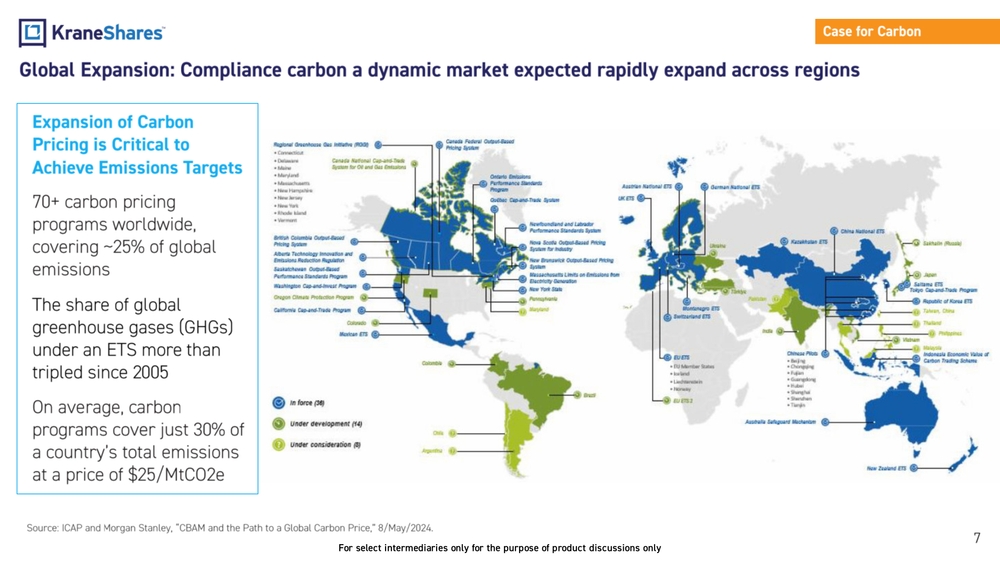
For select intermediaries only for the purpose of product discussions only Global Expansion: Compliance carbon a dynamic market expected rapidly expand across regions 7 Expansion of Carbon Pricing is Critical to Achieve Emissions Targets 70+ carbon pricing programs worldwide, covering ~25% of global emissions The share of global greenhouse gases (GHGs) under an ETS more than tripled since 2005 On ave rage, c arbon pro grams cover just 30% of a country’s total emissions at a price of $25/MtCO2e Case for Carbon Source: ICAP and Morgan Stanley, “ CBAM and the Path to a Global Carbon Price,” 8/May/2024.
For select intermediaries only for the purpose of product discussions only
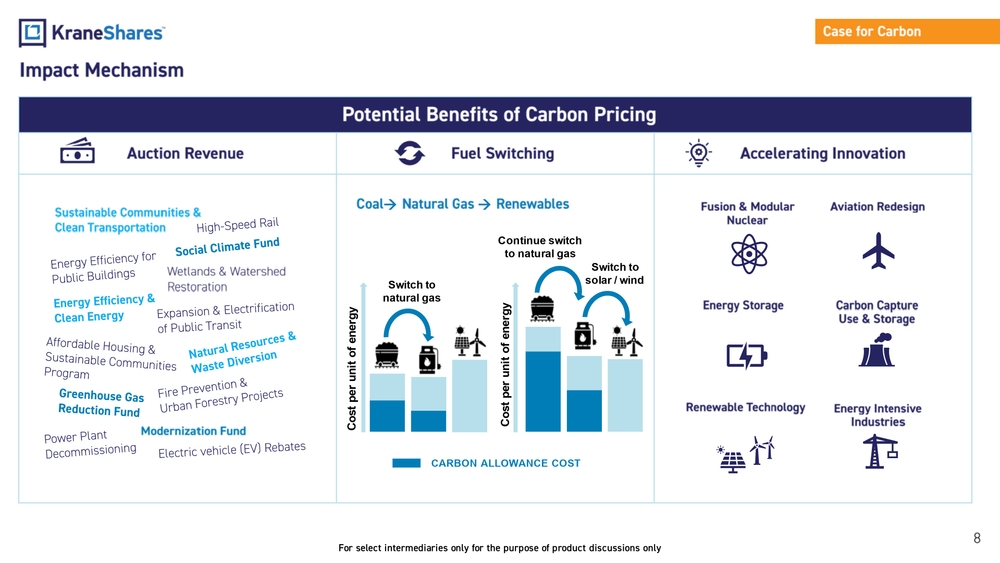
Potential Benefits of Carbon Pricing
Auction Revenue
Fuel Switching
Accelerating Innovation
Impact Mechanism
8
CARBON ALLOWANCE COST
Cost per unit of energy
Cost per unit of energySwitch to
natural gasSwitch to
solar / windContinue switch
to natural gas
C
oal→
N
atural Gas →
Re
newables
Energy Intensive
Industries
Renewable Technology
Energy Storage
Carbon Capture
Use & Storage
Fusion & Modular
Nuclear
Aviation Redesign
Sustainable Communities &
Clean Transportation
Wetlands & Watershed
Restoration
Case for Carbon
Modernization Fund
For select intermediaries only for the purpose of product discussions only
9
Source: Goldman Sachs, “
Carbonomics
2025, Updated cost curve shows diverging trends between power and transport,” 25 February 2025,
retrieved
30/Jun/2026
.
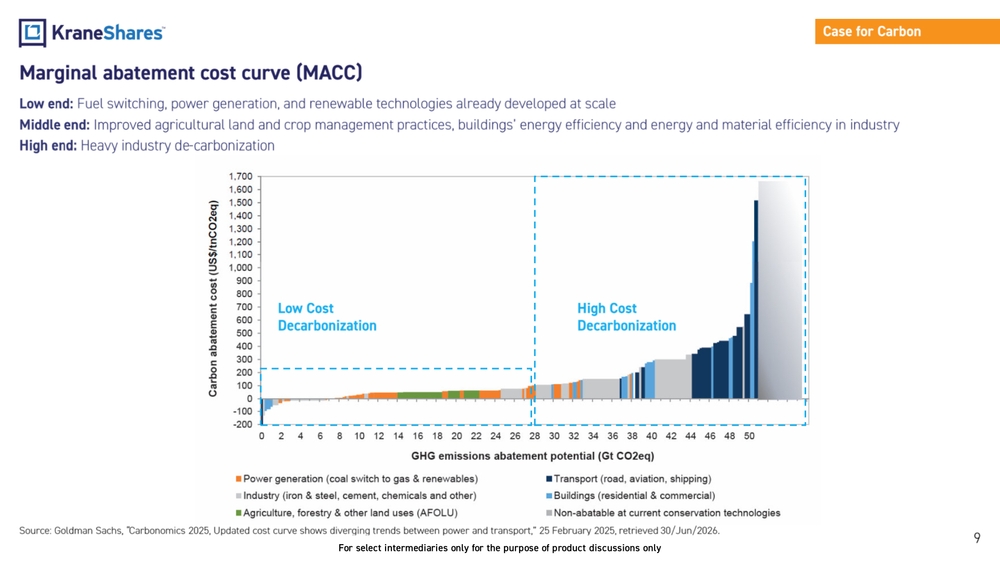
Marginal abatement cost curve (MACC)
Low end:
Fuel switching, power generation, and renewable technologies already developed at scale
Middle end:
Improved
agricultural land and crop management practices, buildings’ energy efficiency and energy and material efficiency in industry
High end:
Heavy industry de
carbonization
High Cost
Decarbonization
Low Cost
Decarbonization
Case for Carbon
For select intermediaries only for the purpose of product discussions only
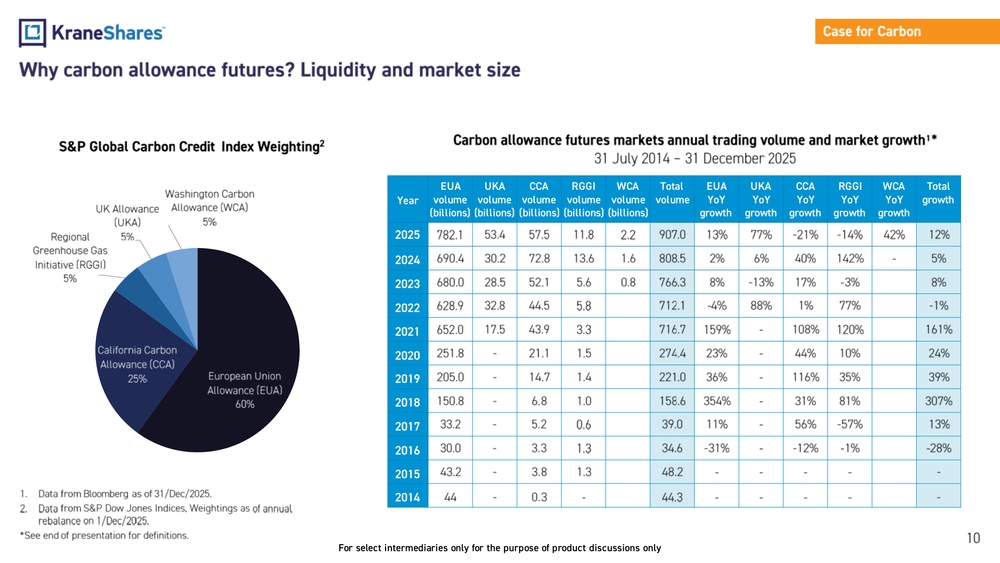
Why carbon allowance futures? Liquidity and market size
10
Carbon allowance futures markets annual trading volume and market growth
1
*
31 July 2014
–
31 December 2025
1.
Data
from
Bloomberg
as
of
31/Dec/2025.
2.
Data
from
S&P Dow Jones Indices
.
Weightings as
of
annual
rebalance
on
1/Dec/2025.
*See
end
of
presentation
for
definitions.
European Union
Allowance (EUA)
60%
California Carbon
Allowance (CCA)
25%
Regional
Greenhouse Gas
Initiative (RGGI)
5%
UK Allowance
(UKA)
5%
Washington Carbon
Allowance (WCA)
5%
S&P Global
Carbon
Credit
Index Weighting
2
Case for Carbon
YearEUA
volume
(billions)UKA
volume
(billions)CCA
volume
(billions)RGGI
volume
(billions)WCA
volume
(billions)Total
volumeEUA
YoY
growthUKA
YoY
growthCCA
YoY
growthRGGI
YoY
growthWCA
YoY
growthTotal
growth
2025
782.1
53.4
57.5
11.8
2.2
907.0
13%
77%
21%
14% 42% 12% 2024 690.4 30.2 72.8 13.6 1.6 808.5 2% 6% 40% 142%
5% 2023 680.0 28.5 52.1 5.6 0.8 766.3 8%
13% 17%
3% 8% 2022 628.9 32.8 44.5 5.8 712.1
4% 88% 1% 77%
1% 2021 652.0 17.5 43.9 3.3 716.7 159%
108% 120% 161% 2020 251.8
21.1 1.5 274.4 23%
44% 10% 24% 2019 205.0
14.7 1.4 221.0 36%
116% 35% 39% 2018 150.8
6.8 1.0 158.6 354%
31% 81% 307% 2017 33.2
5.2 0.6 39.0 11%
56%
57% 13% 2016 30.0
3.3 1.3 34.6
31%
12%
1%
28% 2015 43.2
3.8 1.3 48.2
2014 44
0.3
44.3
For select intermediaries only for the purpose of product discussions only
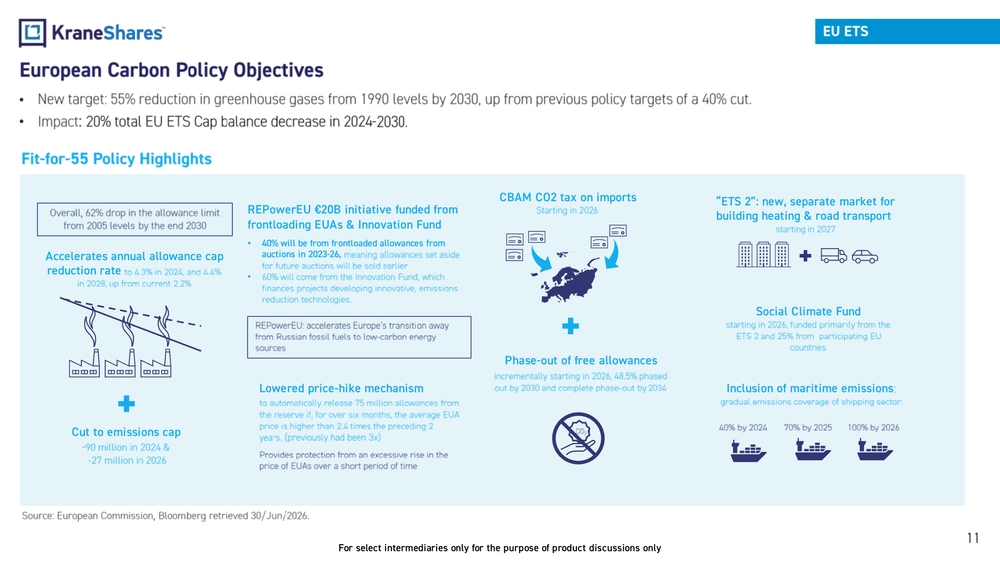
European Carbon Policy Objectives
11•
New target:
55% reduction in greenhouse gases from 1990 levels by 2030, up from
previous policy targets of a
40% cut.
•
Impact
:
20% total EU ETS Cap balance decrease in 2024
Fit
for
55 Policy Highlights CBAM CO2 tax on imports Starting in 2026 Accelerates annual allowance cap reduction rate to 4.3% in 2024, and 4.4% in 2028, up from current 2.2% Cut to emissions cap
90 million in 2024 &
27 million in 2026
Overall, 62% drop in the allowance limit
from 2005 levels by the end 2030
CO
2Phase -out of free allowances
incrementally
starting in 2026, 48.5% phased
out by 2030 and complete phase
out by 2034“ETS 2”: new, separate market for building heating & road transport starting in 2027 Social Climate Fund starting in 2026, funded primarily from the ETS 2 and 25% from participating EU countries Lowered price -hike mechanism to automatically release 75 million allowances from the reserve if, for over six months, the average EUA price is higher than 2.4 times the preceding 2 years. (previously had been 3x) Provides protection from an excessive rise in the price of EUAs over a short period of time REPowerEU €20B initiative funded from frontloading EUAs & Innovation Fund •40% will be from frontloaded allowances from auctions in 2023 -26, meaning allowances set aside for future auctions will be sold earlier • 60% will come from the Innovation Fund, which finances projects developing innovative, emissions reduction technologies. REPowerEU: accelerates Europe’s transition away from Russian fossil fuels to low
carbon energy sources Inclusion of maritime emissions : gradual emissions coverage of shipping sector: 40% by 2024 70% by 2025 100% by 2026 Source: European Commission, Bloomber g retrieved 30/Jun/2026. EU ETS
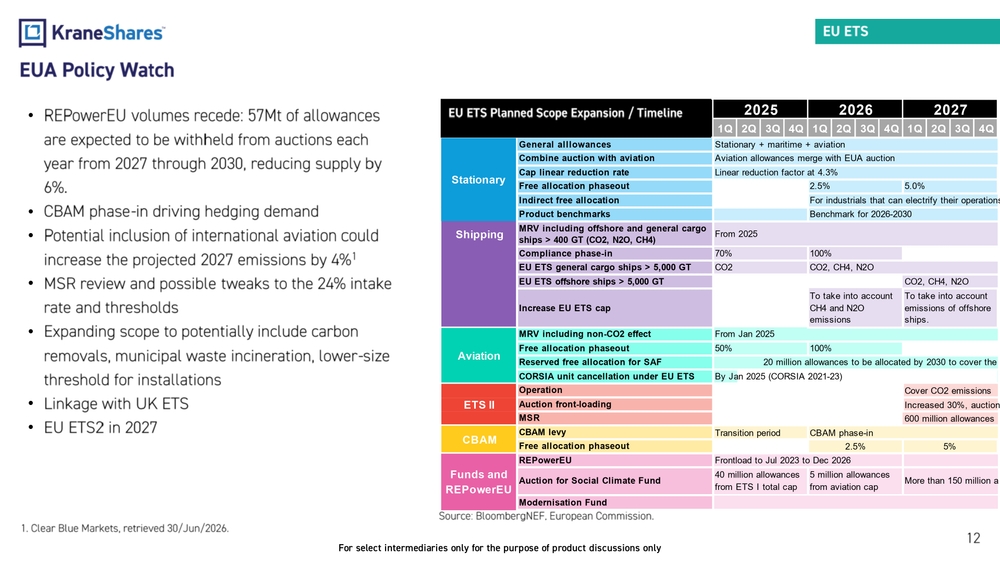
For select intermediaries only for the purpose of product discussions only EUA Policy Watch 12 EU ETS 1Q 2Q 3Q 4Q 1Q 2Q 3Q 4Q 1Q 2Q 3Q 4Q 1Q 2Q 3Q 4Q 1Q 2Q 3Q 4Q 1Q 2Q 3Q 4Q General alllowances Combine auction with aviation Cap linear reduction rate Linear reduction factor at 4.3% Free allocation phaseout Indirect free allocation Product benchmarks ShippingMRV including offshore and general cargo ships > 400 GT (CO2, N2O, CH4)From 2025 Compliance phase-in EU ETS general cargo ships > 5,000 GT CO2 EU ETS offshore ships > 5,000 GT CO2, CH4, N2O Increase EU ETS cap MRV including non-CO2 effect Free allocation phaseout Reserved free allocation for SAF CORSIA unit cancellation under EU ETS By Jan 2025 (CORSIA 2021-23) By Jan 2028 (CORSIA 2024-26) Operation Auction front-loading Increased 30%, auctioned until May 2028 Taken out from 2029-2031 MSR 600 million allowances put into MSR CBAM levy Transition period Free allocation phaseout REPowerEU Frontload to Jul 2023 to Dec 2026 Auction for Social Climate Fund More than 150 million allowances auctioned from ETS II, used until 2032 Modernisation FundEU ETS planed scope expansion / timeline For industrials that can electrify their operations Benchmark for 2026-2030Stationary + maritime + aviation Aviation allowances merge with EUA auction Linear reduction factor at 4.4% 2.5% 5.0%2025 2026 2027 2028 2029 2030 70% 100% CO2, CH4, N2O To take into account CH4 and N2O emissionsTo take into account emissions of offshore ships. Modernisation Fund end on Dec 31, 2030ETS IICover CO2 emissions CBAMCBAM phase-in 2.5% 5% 10% 22.5% 48.5%Stationary Funds and REPowerEU20 million allowances to be allocated by 2030 to cover the price difference between fossil kerosene and eligible SAFs Taken our from Jan 2027 - Dec 2030 40 million allowances from ETS I total cap5 million allowances from aviation capAviationFrom Jan 2025 50% 100%10.0% 22.5% 48.5% Source: BloombergNEF, European Commission.• REPowerEU volumes recede: 57Mt of allowances are expected to be withheld from auctions each year from 2027 through 2030, reducing supply by 6%. • CBAM phase
in driving hedging demand • Potential inclusion of international aviation could increase the projected 2027 emissions by 4% 1 • MSR review and possible tweaks to the 24% intake rate and thresholds • Expanding scope to potentially include carbon removals, municipal waste incineration, lower
size threshold for installations • Linkage with UK ETS • EU ETS2 in 2027
- Clear Blue Markets, retrieved 30/Jun/2026. EU ETS Planned Scope Expansion / Timeline
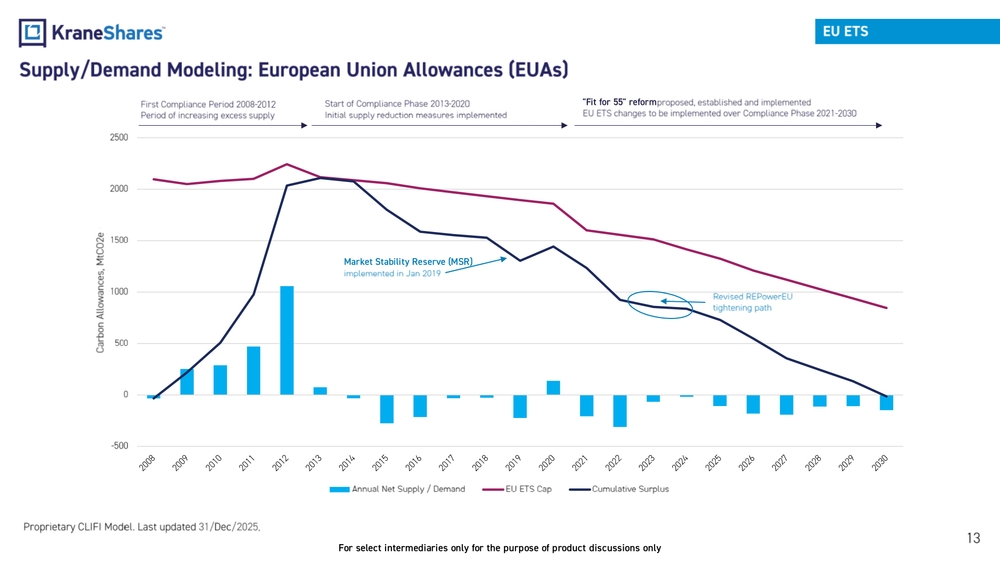
For select intermediaries only for the purpose of product discussions only Proprietary CLIFI Model. Last updated 31/ Dec /2025 . Supply/Demand Modeling: European Union Allowances (EUAs) 13 EU ETS -500 0 500 1000 1500 2000 2500 Carbon Allowances, MtCO2e Annual Net Supply / Demand EU ETS Cap Cumulative Surplus Revised REPowerEU tightening path First Compliance Period 2008
2012 Period of increasing excess supply Start of Compliance Phase 2013
2020
Initial supply reduction measures implemented"Fit for 55" reform
proposed, established and implemented
EU ETS changes to be implemented over Compliance Phase 2021
2030 Market Stability Reserve (MSR) implemented in Jan 2019
For select intermediaries only for the purpose of product discussions only
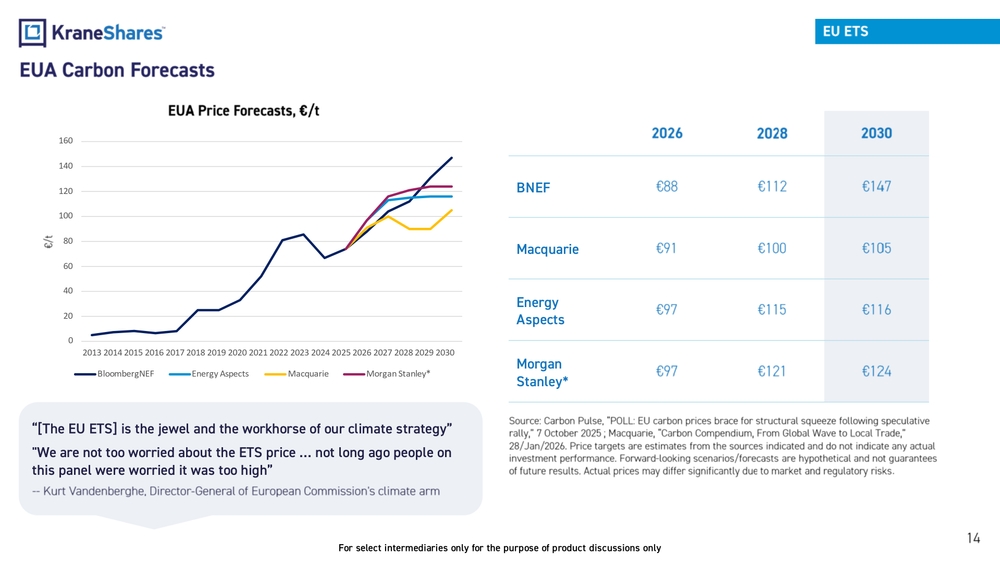
EUA Carbon Forecasts
14
2026
2028
2030
BNEF
€88
€112
€147
Macquarie
€91
€100
€105
Energy
Aspects
€97
€115
€116
Morgan
Stanley*
€97
€121
€124
EUA Price Forecasts,
€/t
Source: Carbon Pulse, “POLL: EU carbon prices brace for structural squeeze following speculative
rally,” 7 October 2025 ; Macquarie, “Carbon Compendium, From Global Wave to Local Trade,”
28/Jan/2026.
Price targets are estimates from the sources indicated and do not indicate any actual
investment performance.
Forward
looking scenarios/forecasts are hypothetical and not guarantees of future results. Actual prices may differ significantly due to market and regulatory risks .“[The EU ETS] is the jewel and the workhorse of our climate strategy” "We are not too worried about the ETS price … not long ago people on this panel were worried it was too high”
Kurt Vandenberghe , Director
General of European Commission's climate arm EU ETS 020406080100120140160 2013 2014 2015 2016 2017 2018 2019 2020 2021 2022 2023 2024 2025 2026 2027 2028 2029 2030 €/t BloombergNEF Energy Aspects Macquarie Morgan Stanley*
For select intermediaries only for the purpose of product discussions only
EU ETS
15
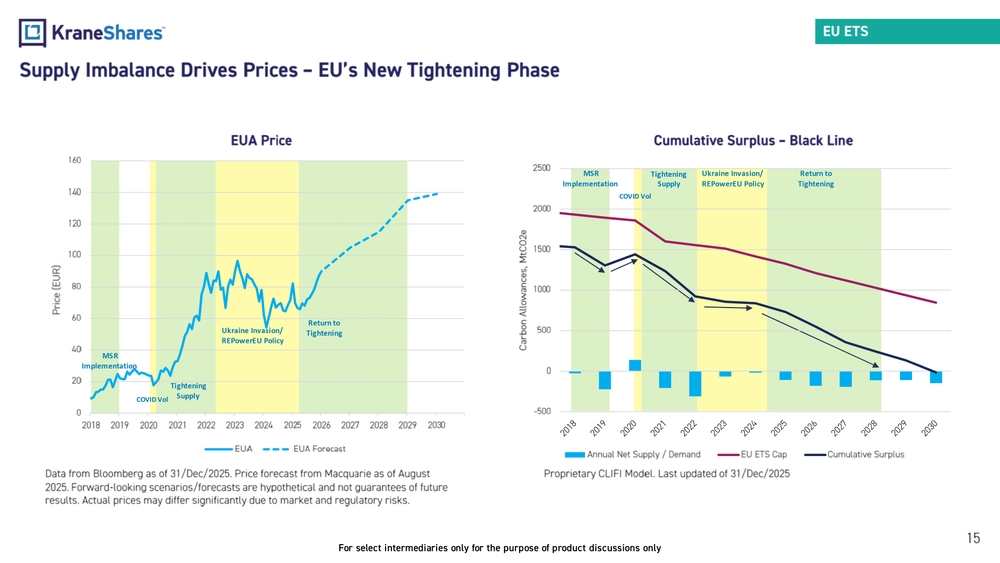
Supply Imbalance Drives Prices
–
EU’s New Tightening Phase
Proprietary CLIFI Model. Last updated
of 31/Dec/2025
Cumulative Surplus
–
Black Line
EUA Price
Data from Bloomberg as of 31/Dec/2025. Price forecast from Macquarie as of August
2025.
Forward
looking scenarios/forecasts are hypothetical and not guarantees of future
results. Actual prices may differ significantly due to market and regulatory risks.Return to
Tightening Ukraine Invasion/
REPowerEU Policy
Tightening
SupplyCOVID VolReturn to
TighteningUkraine Invasion/
REPowerEU PolicyTightening
Supply
COVID Vol
MSR
ImplementationMSR
Implementation
0
20
40
60
80
100
120
140
160
2018
2019
2020
2021
2022
2023
2024
2025
2026
2027
2028
2029
2030
Price (EUR)
EUA
EUA Forecast
-500
0
500
1000
1500
2000
2500
Carbon Allowances, MtCO2e
Annual Net Supply / Demand
EU ETS Cap
Cumulative Surplus
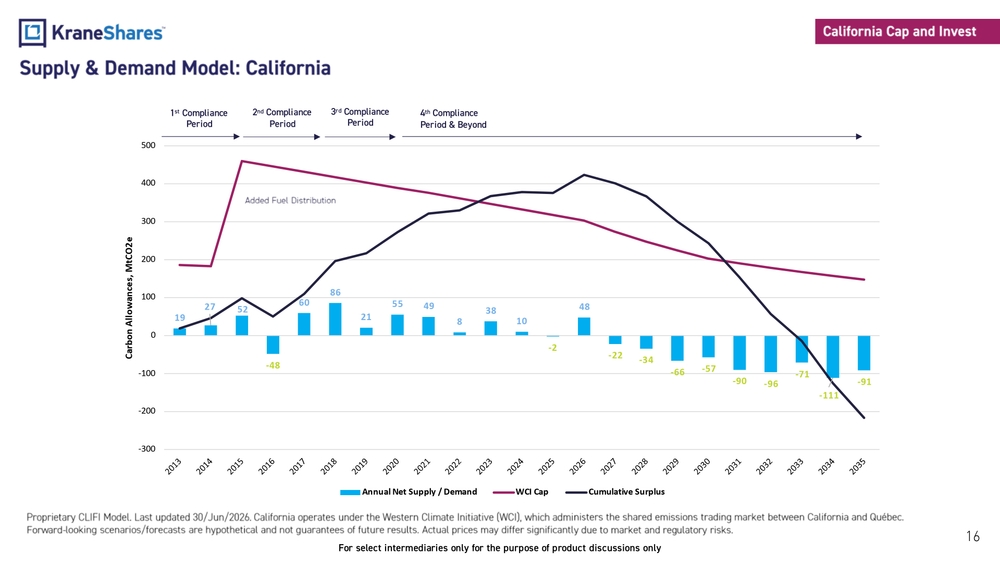
For select intermediaries only for the purpose of product discussions only1927 52 -486086 2155 49 838 10 -248 -22-34 -66-57 -90 -96-71 -111-91 -300-200-1000100200300400500Carbon Allowances, MtCO2e Annual Net Supply / Demand WCI Cap Cumulative Surplus Supply & Demand Model: California 16 California Cap and Invest 1stCompliance Period2ndCompliance Period3rdCompliance Period4thCompliance Period & Beyond Added Fuel Distribution Proprietary CLIFI Model. Last updated 30/Jun/2026. California operates under the Western Climate Initiative (WCI), which admi nis ters the shared emissions trading market between California and Québec. Forward
looking scenarios/forecasts are hypothetical and not guarantees of future results. Actual prices may differ significantl y due to market and regulatory risks.
For select intermediaries only for the purpose of product discussions only
Data
from
Bloomberg and CARB
as
of
30/Jun/2026
. Past performance does not guarantee future results.
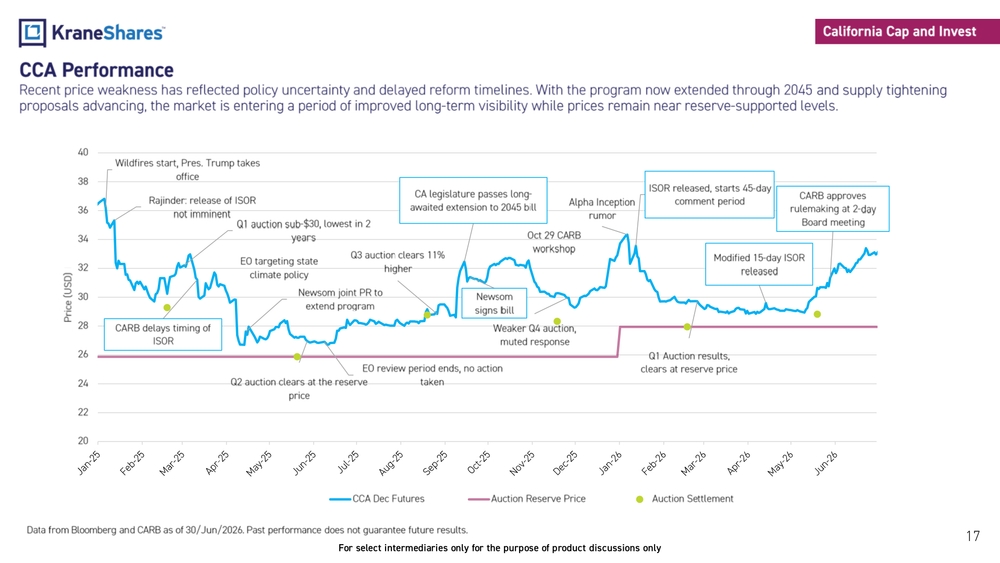
CCA Performance
Recent price weakness has reflected policy uncertainty and delayed reform timelines. With the program now extended through 20
45
and supply tightening
proposals advancing, the market is entering a period of improved long
term visibility while prices remain near reserve
supported
levels.
17
California Cap and Invest
Wildfires start, Pres. Trump takes
office
Rajinder: release of ISOR
not imminent
Q1 auction sub
$30, lowest in 2 years CARB delays timing of ISOR EO targeting state climate policy Newsom joint PR to extend program Q2 auction clears at the reserve price EO review period ends, no action taken Q3 auction clears 11% higher CA legislature passes long
awaited extension to 2045 bill Newsom signs bill Oct 29 CARB workshop Weaker Q4 auction, muted response Alpha Inception rumor ISOR released, starts 45
day comment period Q1 Auction results, clears at reserve price Modified 15
day ISOR released CARB approves rulemaking at 2
day Board meeting 20 22 24 26 28 30 32 34 36 38 40 Price (USD) CCA Dec Futures Auction Reserve Price Auction Settlement
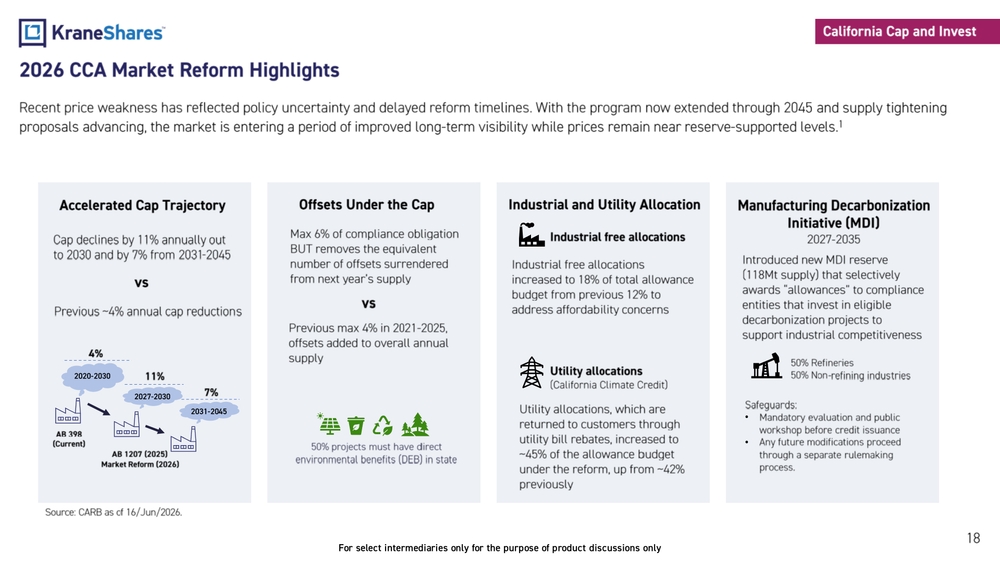
For select intermediaries only for the purpose of product discussions only 2026 CCA Market Reform Highlights 18 Accelerated Cap Trajectory Cap declines by 11% annually out to 2030 and by 7% from 2031
2045 Offsets Under the Cap Industrial and Utility Allocation Manufacturing Decarbonization Initiative (MDI) 2027
2035 Max 6% of compliance obligation BUT removes the equivalent number of offsets surrendered from next year’s supply Introduced new MDI reserve (118Mt supply) that selectively awards “allowances” to compliance entities that invest in eligible decarbonization projects to support industrial competitiveness Industrial free allocations increased to 18% of total allowance budget from previous 12% to address affordability concerns Previous ~4% annual cap reductions vs Previous max 4% in 2021
2025, offsets added to overall annual supply vs 4% 11% 2020 -2030 2027 -2030 7% 2031 -2045 AB 398 (Current) AB 1207 (2025) Market Reform (2026) Recent price weakness has reflected policy uncertainty and delayed reform timelines. With the program now extended through 20 45 and supply tightening proposals advancing, the market is entering a period of improved long
term visibility while prices remain near reserve
supported
levels.
1
50% projects must have direct
environmental benefits (DEB) in state
Safeguards:
•
Mandatory evaluation and public
workshop before credit issuance
•
Any future modifications proceed
through a separate rulemaking
process.
Utility allocations, which are
returned to customers through
utility bill rebates, increased to
~45% of the allowance budget
under the reform, up from ~42%
previously
50% Refineries
50% Non
refining industries Industrial free allocations Utility allocations (California Climate Credit) Source: CARB as of 16/Jun/2026. California Cap and Invest
For select intermediaries only for the purpose of product discussions only020406080100120140
2019 2020 2021 2022 2023 2024 2025 2026 2027 2028 2029 2030CCA Price Trajectories
CCA Futures Current Auction Settlement Price
Auction Reserve Price / Floor Price Ceiling
Tier 1 Tier 2
Data
from
Bloomberg and KraneShares analysis,
as
of
30/Jun/2026
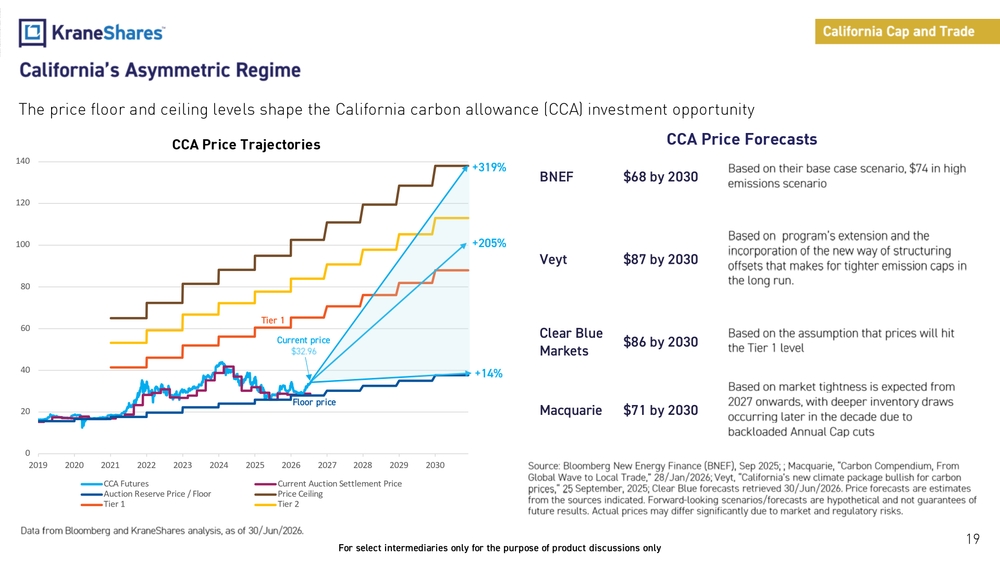
.The price floor and ceiling levels shape the California carbon allowance (CCA) investment opportunity
19CCA Price Forecasts
California’s Asymmetric Regime
Source: Bloomberg New Energy Finance (BNEF), Sep 2025; ; Macquarie, “Carbon Compendium, From
Global Wave to Local Trade,” 28/Jan/2026;
Veyt
, “California’s new climate package bullish for carbon
prices,“ 25
September,
2025; Clear Blue forecasts retrieved 30/Jun/2026. Price forecasts are estimates
from the sources indicated. Forward
looking scenarios/forecasts are hypothetical and not guarantees of future results. Actual prices may differ significantly due to market and regulatory risks.LO California Cap and Trade BNEF $68 by 2030 Based on their base case scenario, $74 in high emissions scenario Veyt $87 by 2030 Based on program’s extension and the incorporation of the new way of structuring offsets that makes for tighter emission caps in the long run. Clear Blue Markets$86 by 2030 Based on the assumption that prices will hit the Tier 1 level Macquarie $71 by 2030 Based on market tightness is expected from 2027 onwards, with deeper inventory draws occurring later in the decade due to backloaded Annual Cap cutsA D M A S T E R
S T A M P ! 2 0 2 3 0 9 2 6
3 0 9 6 9 8 6
9 9 3 9 5 5 4 Tier 1 Floor priceCurrent price $32.96+319% +205% +14%
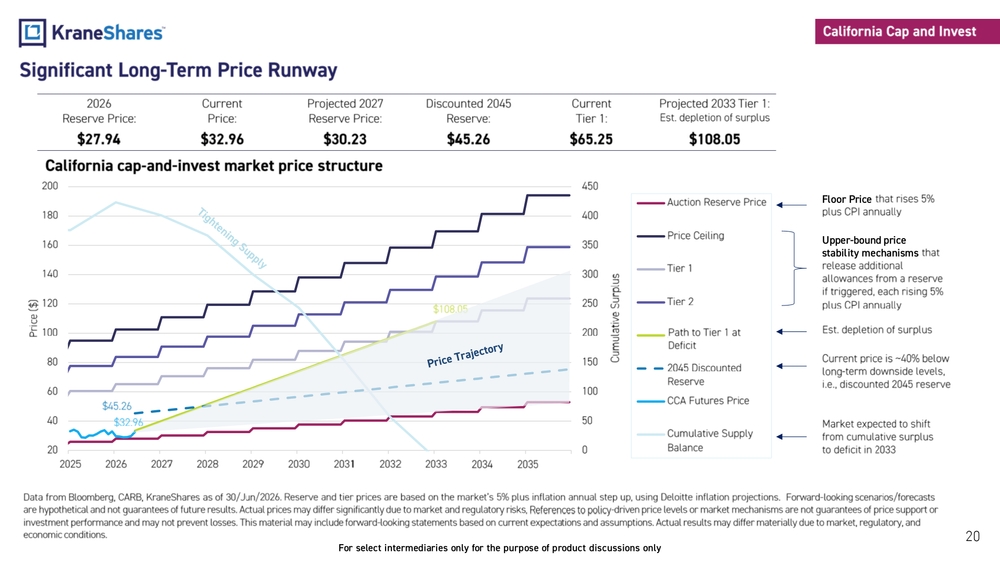
For select intermediaries only for the purpose of product discussions only $32.96 $108.05 $45.26 0 50 100 150 200 250 300 350 400 450 20 40 60 80 100 120 140 160 180 200 2025 2026 2027 2028 2029 2030 2031 2032 2033 2034 2035 Cumulative Surplus Price ($) Auction Reserve Price Price Ceiling Tier 1 Tier 2 2033 Deficit 2045 Discounted Reserve CCA Futures Price Cumulative Supply Balance California cap
and
invest market price structure
Data from
Bloomberg, CARB, KraneShares
as
of
30/Jun
/2026. Reserve and tier prices are based on the market’s 5% plus inflation annual step up, using Deloitte inflation projectio
ns.
Forward
looking scenarios/forecasts are hypothetical and not guarantees of future results. Actual prices may differ significantly due to market and regulatory ri sks . References to policy
driven price levels or market mechanisms are not guarantees of price support or investment performance and may not prevent losses. This material may include forward
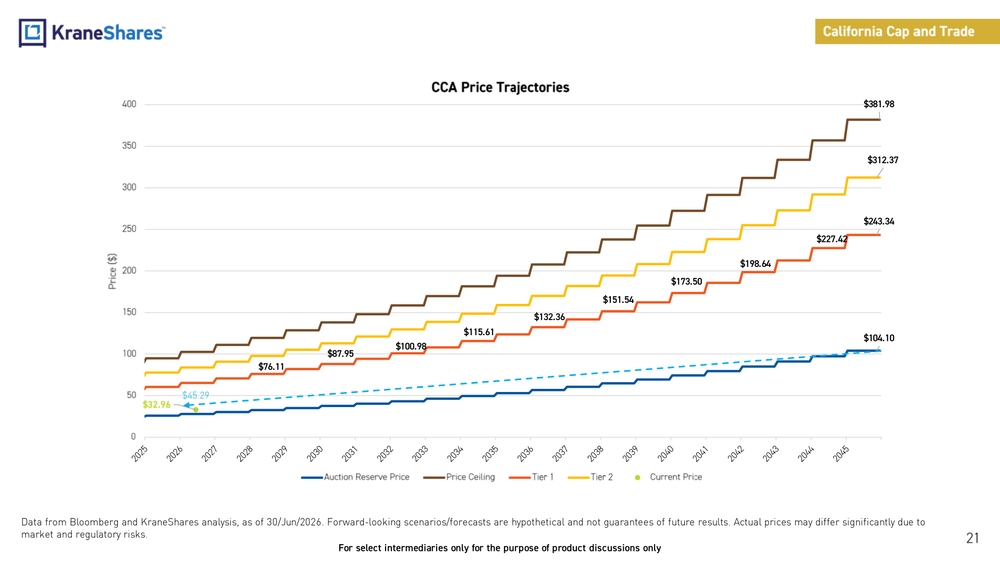
looking statements based on current expecta tions and assumptions. Actual results may differ materially due to market, regulatory, and economic conditions. 2026 Reserve Price : Current Price: Projected 2027 Reserve Price: Discounted 2045 Reserve: Current Tier 1: Projected 2033 Tier 1: Est. depletion of surplus $27.94 $32.96 $30.23 $45.26 $65.25 $108.05 Floor Price that rises 5% plus CPI annually Upper -bound price stability mechanisms that release additional allowances from a reserve if triggered, each rising 5% plus CPI annually Est. depletion of surplus Market expected to shift from cumulative surplus to deficit in 2033 Current price is ~40% below long
term downside levels, i.e., discounted 2045 reserve Significant Long
Term Price Runway California Cap and Invest 20 Path to Tier 1 at Deficit
For select intermediaries only for the purpose of product discussions only$104.10$381.98 $76.11$87.95$100.98$115.61$132.36$151.54$173.50$198.64$227.42$243.34$312.37 $ 32.96 0 50 100 150 200 250 300 350 400 Price ($) CCA Price Trajectories Auction Reserve Price Price Ceiling Tier 1 Tier 2 Current Price 21Data from Bloomberg and KraneShares analysis, as of 30/Jun/2026 . Forward -looking scenarios/forecasts are hypothetical and not guarantees of future results. Actual prices may differ significan tly due to market and regulatory risks. California Cap and Trade $45.29
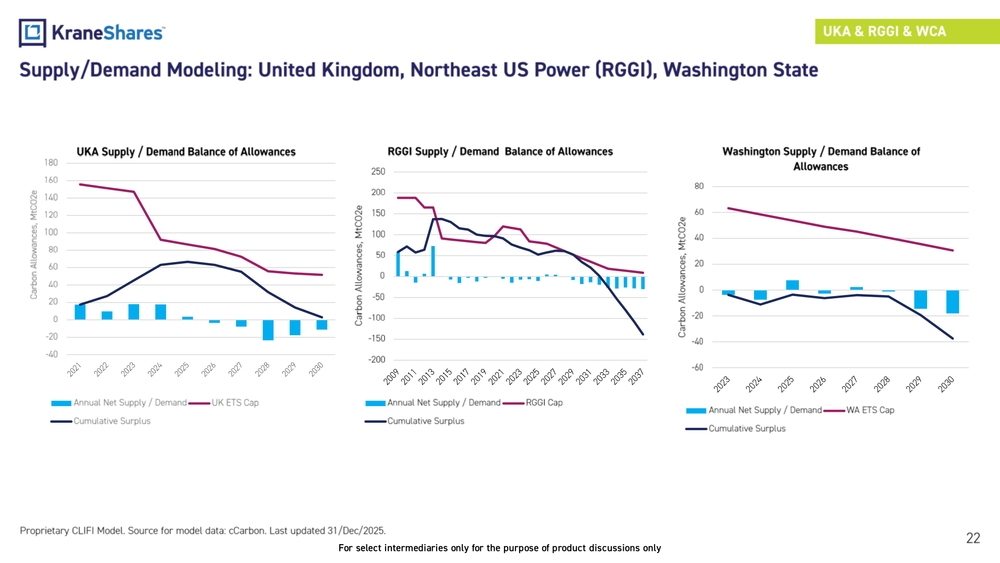
For select intermediaries only for the purpose of product discussions only Supply/Demand Modeling: United Kingdom, Northeast US Power (RGGI), Washington State Proprietary CLIFI Model. Source for model data: cCarbon. Last updated 31/Dec /2025. UKA & RGGI & WCA 22 -40 -20 0 20 40 60 80 100 120 140 160 180 Carbon Allowances, MtCO2e UKA Supply / Demand Balance of Allowances Annual Net Supply / Demand UK ETS Cap Cumulative Surplus -200 -150 -100 -50 0 50 100 150 200 250 Carbon Allowances, MtCO2e RGGI Supply / Demand Balance of Allowances Annual Net Supply / Demand RGGI Cap Cumulative Surplus -60 -40 -20 0 20 40 60 80 Carbon Allowances, MtCO2e Washington Supply / Demand Balance of Allowances Annual Net Supply / Demand WA ETS Cap Cumulative Surplus
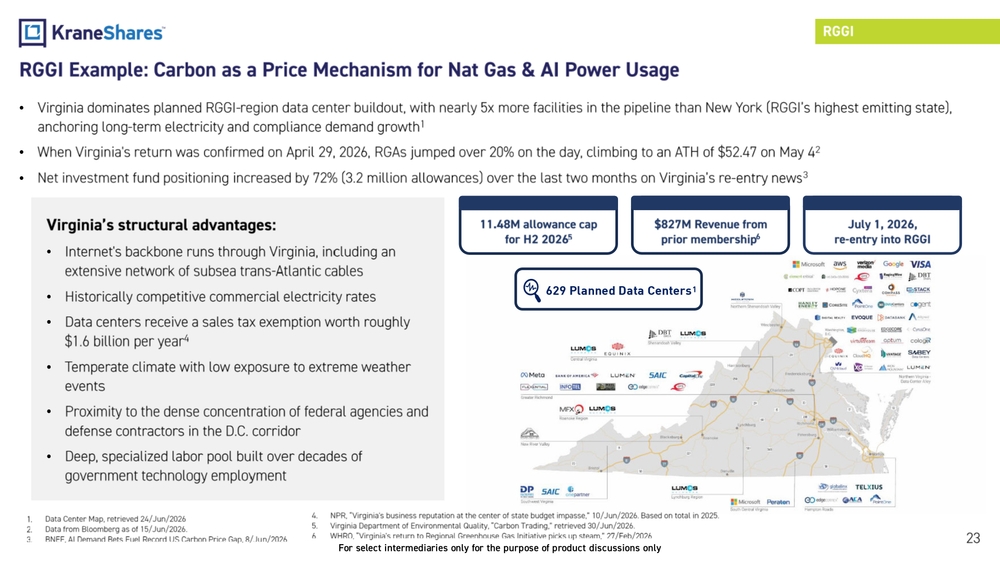
For select intermediaries only for the purpose of product discussions only Virginia’s structural advantages: • Internet's backbone runs through Virginia, including an extensive network of subsea trans
Atlantic cables
•
Historically competitive commercial electricity rates
•
Data centers receive a sales tax exemption worth roughly
$1.6 billion per year
4
•
Temperate climate with low exposure to extreme weather
events
•
Proximity to the dense concentration of federal agencies and
defense contractors in the D.C. corridor
•
Deep, specialized labor pool built over decades of
government technology employment
RGGI Example: Carbon as a Price Mechanism for Nat Gas & AI Power Usage
23•
Virginia dominates planned RGGI
region data center buildout, with nearly 5x more facilities in the pipeline than New York (RGGI’ s highest emitting state), anchoring long
term electricity and compliance demand growth 1 • When Virginia's return was confirmed on April 29, 2026, RGAs jumped over 20% on the day, climbing to an ATH of $52.47 on May 4 2 • Net investment fund positioning increased by 72% (3.2 million allowances) over the last two months on Virginia’s re
entry news 3 July 1, 2026, re
entry into RGGI 11.48M allowance cap for H2 2026 5 $827M Revenue from prior membership 6 629 Planned Data Centers1
RGGI 1. Data Center Map, retrieved 24/Jun/2026 2. Data from Bloomberg as of 15/Jun/2026. 3. BNEF, AI Demand Bets Fuel Record US Carbon Price Gap, 8/Jun/2026. 4. NPR, “Virginia's business reputation at the center of state budget impasse,” 10/Jun/2026. Based on total in 2025. 5. Virginia Department of Environmental Quality, “Carbon Trading,” retrieved 30/Jun/2026. 6. WHRO, “Virginia's return to Regional Greenhouse Gas Initiative picks up steam,” 27/Feb/2026
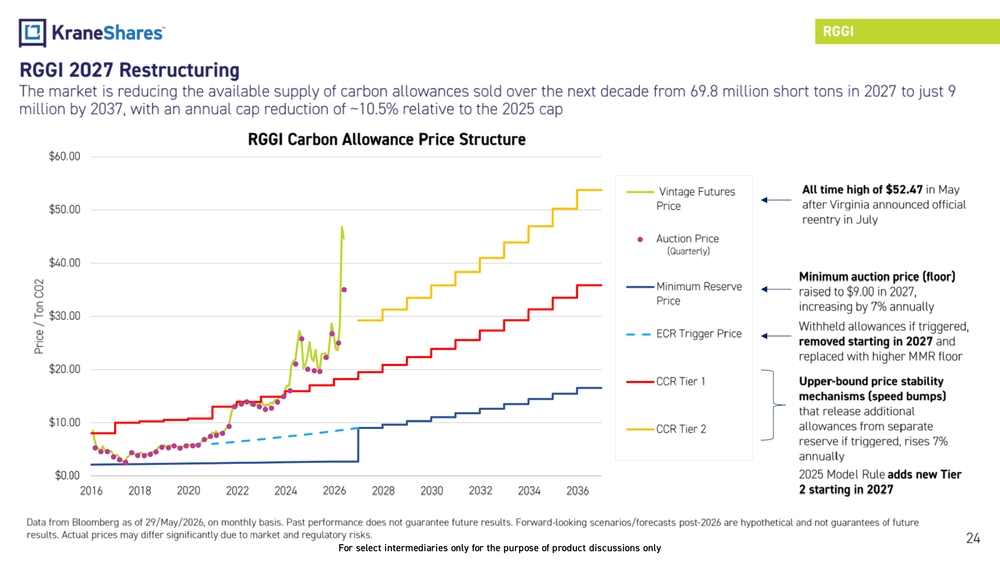
For select intermediaries only for the purpose of product discussions only RGGI 2027 Restructuring The market is reducing the available supply of carbon allowances sold over the next decade from 69.8 million short tons in 20 27 to just 9 million by 2037, with an annual cap reduction of ~10.5% relative to the 2025 cap 24 $0.00 $10.00 $20.00 $30.00 $40.00 $50.00 $60.00 2016 2018 2020 2022 2024 2026 2028 2030 2032 2034 2036 Price / Ton CO2 RGGI Carbon Allowance Price Structure Vintage Futures Price Auction Price Minimum Reserve Price ECR Trigger Price CCR Tier 1 CCR Tier 2 Withheld allowances if triggered, removed starting in 2027 and replaced with higher MMR floor Minimum auction price (floor) raised to $9.00 in 2027, increasing by 7% annually Upper
bound price stability mechanisms (speed bumps) that release additional allowances from separate reserve if triggered, rises 7% annually 2025 Model Rule adds new Tier 2 starting in 2027 All time high of $52.47 in May after Virginia announced official reentry in July Data from Bloomberg as of 29/May/2026, on monthly basis. Past performance does not guarantee future results. Forward
looking sce narios/forecasts post
2026 are hypothetical and not guarantees of future results. Actual prices may differ significantly due to market and regulatory risks. (Quarterly) RGGI
For select intermediaries only for the purpose of product discussions only
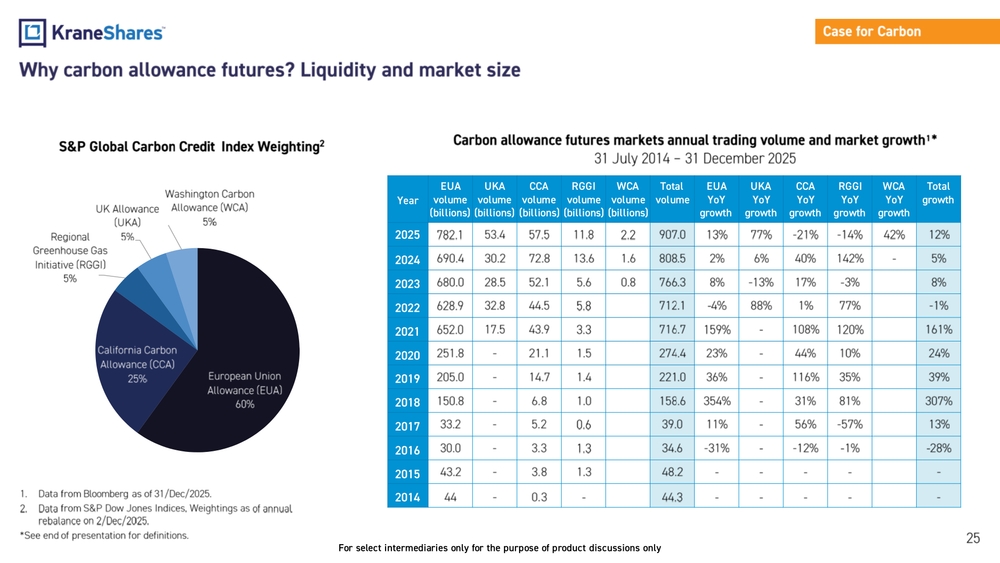
Why carbon allowance futures? Liquidity and market size
25
Carbon allowance futures markets annual trading volume and market growth
1
*
31 July 2014
–
31 December 2025
1.
Data
from
Bloomberg
as
of
31/Dec/2025.
2.
Data
from
S&P Dow Jones Indices
.
Weightings as
of
annual
rebalance
on
2/Dec/2025.
*See
end
of
presentation
for
definitions.
European Union
Allowance (EUA)
60%
California Carbon
Allowance (CCA)
25%
Regional
Greenhouse Gas
Initiative (RGGI)
5%
UK Allowance
(UKA)
5%
Washington Carbon
Allowance (WCA)
5%
S&P Global
Carbon
Credit
Index Weighting
2
Case for Carbon
YearEUA
volume
(billions)UKA
volume
(billions)CCA
volume
(billions)RGGI
volume
(billions)WCA
volume
(billions)Total
volumeEUA
YoY
growthUKA
YoY
growthCCA
YoY
growthRGGI
YoY
growthWCA
YoY
growthTotal
growth
2025
782.1
53.4
57.5
11.8
2.2
907.0
13%
77%
21%
14% 42% 12% 2024 690.4 30.2 72.8 13.6 1.6 808.5 2% 6% 40% 142%
5% 2023 680.0 28.5 52.1 5.6 0.8 766.3 8%
13% 17%
3% 8% 2022 628.9 32.8 44.5 5.8 712.1
4% 88% 1% 77%
1% 2021 652.0 17.5 43.9 3.3 716.7 159%
108% 120% 161% 2020 251.8
21.1 1.5 274.4 23%
44% 10% 24% 2019 205.0
14.7 1.4 221.0 36%
116% 35% 39% 2018 150.8
6.8 1.0 158.6 354%
31% 81% 307% 2017 33.2
5.2 0.6 39.0 11%
56%
57% 13% 2016 30.0
3.3 1.3 34.6
31%
12%
1%
28% 2015 43.2
3.8 1.3 48.2
2014 44
0.3
44.3
For select intermediaries only for the purpose of product discussions only
- Data from Bloomberg and S&P Indices as of 31/Aug/2014
30/Jun/2026
.*
Carbon allowances: top five carbon allowance markets (weighted by volume) versus major asset classes. See end of presentation
fo
r material
differences between asset types and definitions; Equities: S&P
500
; Bonds:
The Agg
; Commodities:
The S&P GSCI
; Real Estate:
MSCI US REIT Index; Gold: LBMA Gold Price PM, Oil; S&P GSCI Crude Oil Index.
Index returns
are for illustrative purposes only and do not represent actual
investment
performance
. Index returns do not reflect any management fees, transaction costs or expenses. Indexes are unmanaged and one cannot inves
t
directly in an index. Past performance does not guarantee future results. 2.
Source: CLIFI and ICE as of 31/Dec/2025.
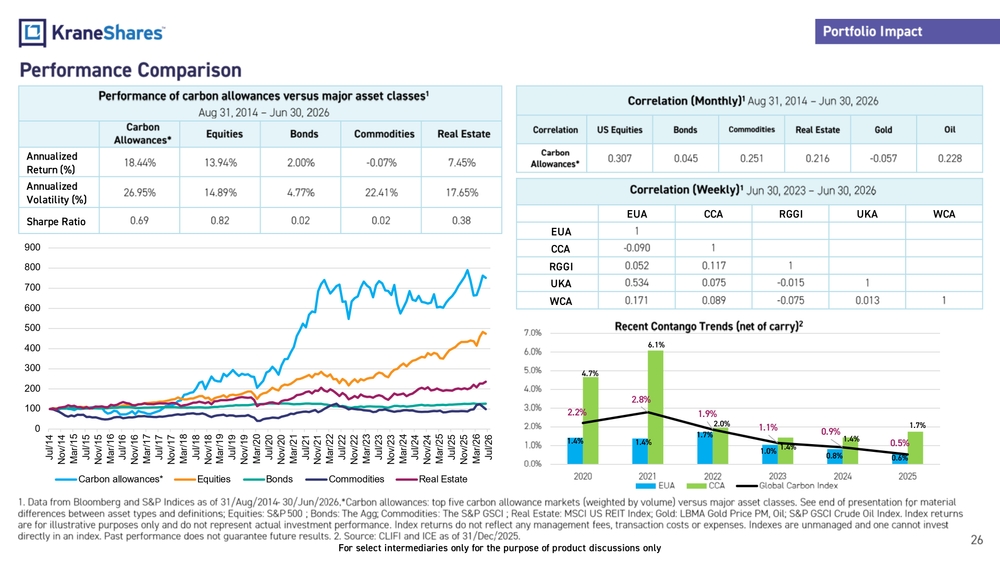
Portfolio Impact
Performance of carbon allowances versus major asset classes
1
Aug 31, 2014
–
Jun 30, 2026
Carbon
Allowances*
Equities
Bonds
Commodities
Real Estate
Annualized
Return (%)
18.44%
13.94%
2.00%
0.07% 7.45% Annualized Volatility (%) 26.95% 14.89% 4.77% 22.41% 17.65% Sharpe Ratio 0.69 0.82 0.02 0.02 0.38 Correlation (Monthly) 1 Aug 31, 2014 – Jun 30, 2026 Correlation US Equities Bonds Commodities Real Estate Gold Oil Carbon Allowances* 0.307 0.045 0.251 0.216
0.057 0.228 26 Performance Comparison Correlation (Weekly) 1 Jun 30, 2023 – Jun 30, 202 6 EUA CCA RGGI UKA WCA EUA 1 CCA
0.090 1 RGGI 0.052 0.117 1 UKA 0.534 0.075
0.015 1 WCA 0.171 0.089
0.075 0.013 1 1.4% 1.4%1.7% 1.0%0.8% 0.6%4.7%6.1% 2.0% 1.4%1.4%1.7%2.2%2.8% 1.9% 1.1%0.9% 0.5% 0.0% 1.0% 2.0% 3.0% 4.0% 5.0% 6.0% 7.0% 2020 2021 2022 2023 2024 2025 Recent Contango Trends (net of carry) 2
EUA CCA Global Carbon Index0100200300400500600700800900 Jul/14 Nov/14 Mar/15 Jul/15 Nov/15 Mar/16 Jul/16 Nov/16 Mar/17 Jul/17 Nov/17 Mar/18 Jul/18 Nov/18 Mar/19 Jul/19 Nov/19 Mar/20 Jul/20 Nov/20 Mar/21 Jul/21 Nov/21 Mar/22 Jul/22 Nov/22 Mar/23 Jul/23 Nov/23 Mar/24 Jul/24 Nov/24 Mar/25 Jul/25 Nov/25 Mar/26 Jul/26 Carbon allowances* Equities Bonds Commodities Real Estate
For select intermediaries only for the purpose of product discussions only
27
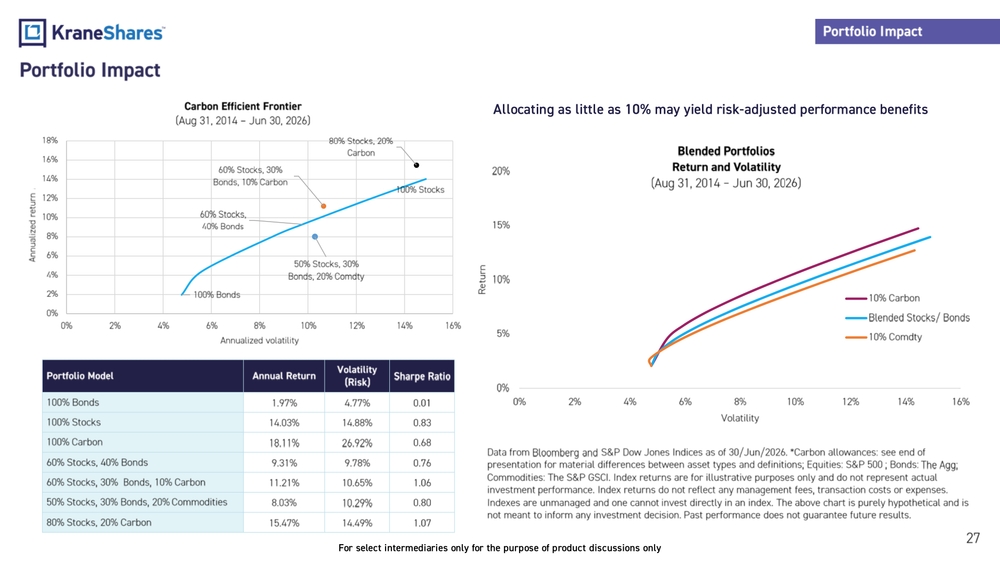
Portfolio Model
Annual Return
Volatility
(Risk)
Sharpe Ratio
100% Bonds
1.97%
4.77%
0.01
100% Stocks
14.03%
14.88%
0.83
100% Carbon
18.11%
26.92%
0.68
60% Stocks, 40% Bonds
9.31%
9.78%
0.76
60% Stocks, 30% Bonds, 10% Carbon
11.21%
10.65%
1.06
50% Stocks, 30% Bonds, 20% Commodities
8.03%
10.29%
0.80
80% Stocks, 20% Carbon
15.47%
14.49%
1.07
Data from
Bloomberg and
S&P Dow Jones Indices as of 30/Jun/2026. *
Carbon allowances: see end of
presentation for material differences between asset types and definitions; Equities: S&P 500 ; Bonds:
The Agg;
Commodities:
The S&P GSCI.
Index returns are for illustrative purposes only and do not represent actual
investment
performance. Index returns do not reflect any management fees, transaction costs or expenses.
Indexes are unmanaged and one cannot invest directly in an index.
The above chart is purely hypothetical and is
not meant to inform any investment decision.
Past performance does not guarantee future results.
Portfolio Impact
Allocating as little as 10% may yield risk -adjusted performance benefits
Portfolio Impact
0%
5%
10%
15%
20%
0%
2%
4%
6%
8%
10%
12%
14%
16%
Return
Volatility
Blended Portfolios
Return and Volatility
(Aug 31, 2014
–
Jun 30,
202
6
)
10% Carbon
Blended Stocks/ Bonds
10% Comdty
100% Stocks
60% Stocks,
40% Bonds
100% Bonds
60% Stocks, 30%
Bonds, 10% Carbon
50% Stocks, 30%
Bonds, 20% Comdty
80% Stocks, 20%
Carbon
0%
2%
4%
6%
8%
10%
12%
14%
16%
18%
0%
2%
4%
6%
8%
10%
12%
14%
16%
Annualized return
Annualized volatility
Carbon Efficient Frontier
(Aug 31, 2014
–
Jun 30, 2026)
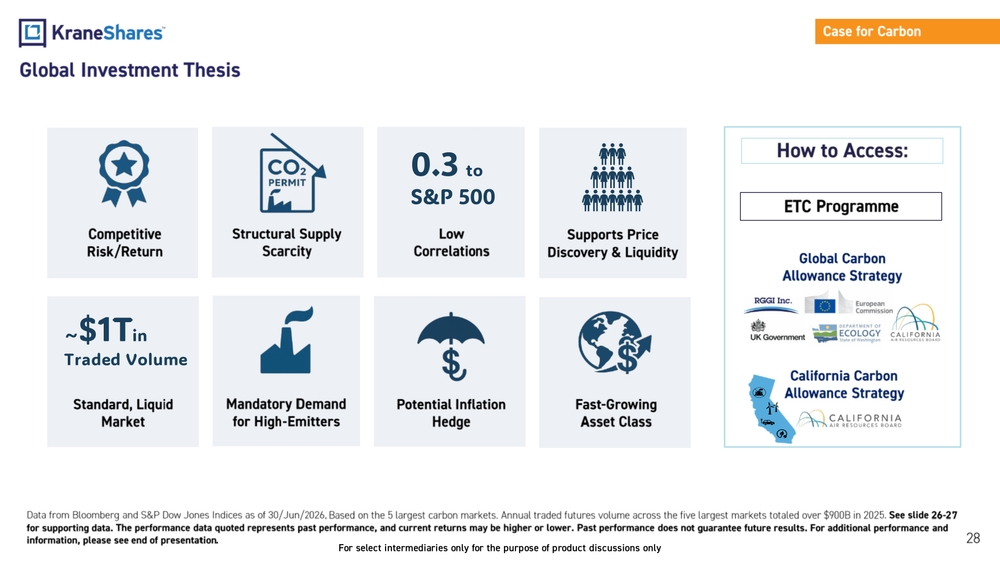
For select intermediaries only for the purpose of product discussions only Global Investment Thesis 28 Data from Bloomberg and S&P Dow Jones Indices as of 30/Jun/2026 . Based on the 5 largest carbon markets. Annual traded futures volume across the five largest markets totaled over $900B in 202 5. See slide 2 6
2 7 for supporting data. The performance data quoted represents past performance, and current returns may be higher or lower. Past performance does no t g uarantee future results. For additional performance and information, please see end of presentation . Global Carbon Allowance Strategy California Carbon Allowance Strategy How to Access: Case for Carbon Competitive Risk/Return Structural Supply Scarcity Low Correlations0.3 to S&P 500 Mandatory Demand for High
Emitters Supports Price Discovery & Liquidity Fast
Growing Asset Class Standard, Liquid Market~$1T in Traded Volume Potential Inflation Hedge ETC Programme
For select intermediaries only for the purpose of product discussions only
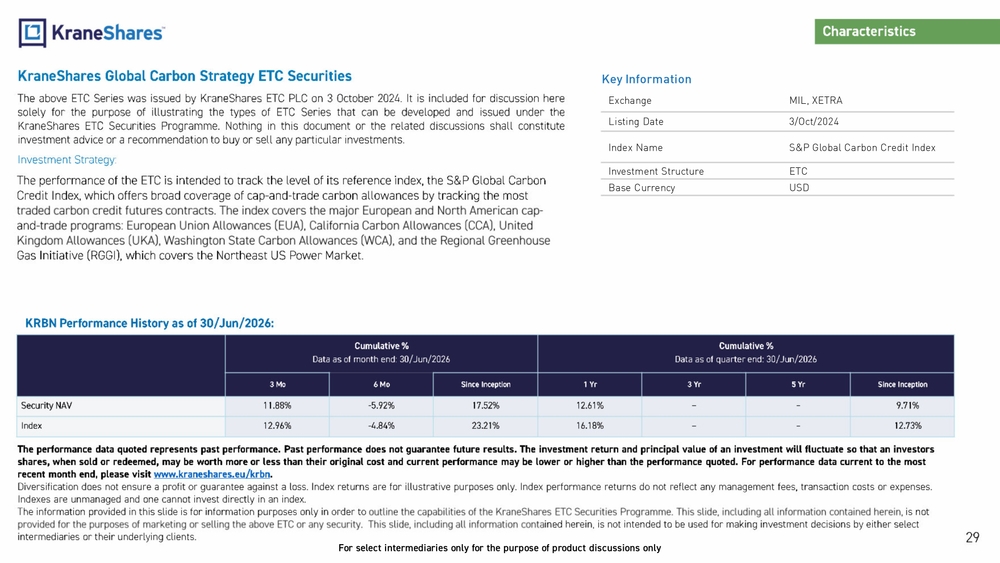
KraneShares
Global
Carbon
Strategy
ETC
Securities
The
above
ETC
Series
was
issued
by
KraneShares
ETC
PLC
on
3
October
2024
.
It
is
included
for
discussion
here
solely
for
the
purpose
of
illustrating
the
types
of
ETC
Series
that
can
be
developed
and
issued
under
the
KraneShares
ETC
Securities
Programme
.
Nothing
in
this
document
or
the
related
discussions
shall
constitute
investment
advice
or
a
recommendation
to
buy
or
sell
any
particular
investments
.
Investment
Strategy
:
The performance of the ETC
is intended to track the level of its reference index, the S&P Global Carbon
Credit Index, which offers broad coverage of cap
and
trade carbon allowances by tracking the most traded carbon credit futures contracts. The index covers the major European and North American cap
and
trade programs: European Union Allowances (EUA), California Carbon Allowances (CCA), United
Kingdom Allowances (UKA), Washington State Carbon Allowances (WCA), and the Regional Greenhouse
Gas Initiative (RGGI), which covers the Northeast US Power Market.
The
performance
data
quoted
represents
past
performance.
Past
performance
does
not
guarantee
future
results.
The
investment
return
and
principal
value
of
an
investment
will
fluctuate
so
that
an
investors
shares,
when
sold
or
redeemed,
may
be
worth
more
or
less
than
their
original
cost
and
current
performance
may
be
lower
or
higher
than
the
performance
quoted.
For
performance
data
current
to
the
most
recent
month
end,
please
visit
www.kraneshares.eu/krbn
.
Diversification
does
not
ensure
a
profit
or
guarantee
against
a
loss.
Index
returns
are
for
illustrative
purposes
only.
Index
performance
returns
do
not
reflect
any
management
fees,
transaction
costs
or
expenses.
Indexes
are
unmanaged
and
one
cannot
invest
directly
in
an
index.
The information provided in this slide is for information purposes only
in order to
outline the capabilities of the KraneShares ETC Securities Programme. This slide, including all information contained herein,
i
s not
provided for the purposes of marketing or selling the above ETC or any security. This slide, including all information conta
ine
d herein, is not intended to be used for making investment decisions by either select
intermediaries or their underlying clients.
KRBN
Performance
History
as
of
30
/Jun/
2026
:
Characteristics
29Exchange MIL, XETRA
Listing Date 3/Oct/2024
Index Name S&P Global Carbon Credit Index
Investment Structure ETC
Base Currency USDKey Information
Cumulative
%
Data
as
of
month
end:
3
0
/
Jun
/202
6
Cumulative
%
Data
as
of
quarter
end:
3
0
/
Jun
/202
6
3
Mo
6 Mo
Since
Inception
1
Yr
3
Yr
5
Yr
Since
Inception
Security
NAV
11.88%
5.92% 17.52% 12.61% – – 9.71% Index 12.96%
4.84% 23.21% 16.18% – – 12.73%
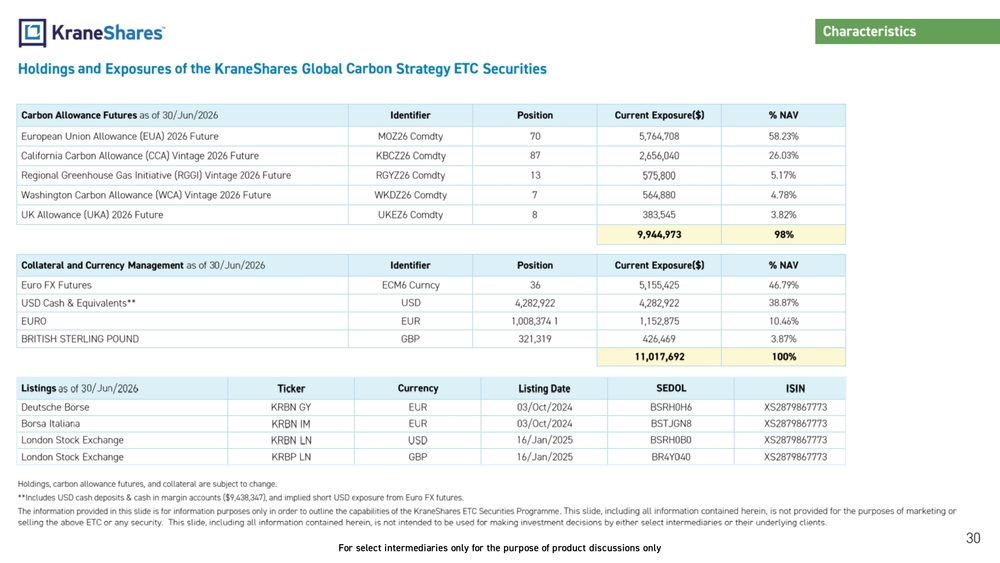
For select intermediaries only for the purpose of product discussions only Holdings and Exposures of the KraneShares Global Carbon Strategy ETC Securities Holdings, carbon allowance futures, and collateral are subject to change. Includes USD cash deposits & cash in margin accounts ($ 9,438,347), and implied short USD exposure from Euro FX futures. The information provided in this slide is for information purposes only in order to outline the capabilities of the KraneShar es ETC Securities Programme . This slide, including all information contained herein, is not provided for the purposes of marketing or selling the above ETC or any security. This slide, including all information contained herein, is not intended to be used fo r m aking investment decisions by either select intermediaries or their underlying clients. Characteristics 30 Carbon Allowance Futures as of 3 0 / Jun /202 6 Identifier Position Current Exposure($) % NAV European Union Allowance (EUA) 2026 Future MOZ26 Comdty 70 5,764,708 58.23% California Carbon Allowance (CCA) Vintage 2026 Future KBCZ26 Comdty 87 2,656,040 26.03% Regional Greenhouse Gas Initiative (RGGI) Vintage 2026 Future RGYZ26 Comdty 13 575,800 5.17% Washington Carbon Allowance (WCA) Vintage 2026 Future WKDZ26 Comdty 7 564,880 4.78% UK Allowance (UKA) 2026 Future UKEZ6 Comdty 8 383,545 3.82% 9,944,973 98% Collateral and Currency Management as of 3 0 / Jun /202 6 Identifier Position Current Exposure($) % NAV Euro FX Futures ECM6 Curncy 36 5,155,425 46.79% USD Cash & Equivalents USD 4,282,922 4,282,922 38.87% EURO EUR 1,008,374 1 1,152,875 10.46% BRITISH STERLING POUND GBP 321,319 426,469 3.87% 11,017,692 100% Listings as of 3 0 / Jun /2026 Ticker Currency Listing Date SEDOL ISIN Deutsche Börse KRBN GY EUR 03/Oct/2024 BSRH0H6 XS2879867773 Borsa Italiana KRBN IM EUR 03/Oct/2024 BSTJGN8 XS2879867773 London Stock Exchange KRBN LN USD 16/Jan/2025 BSRH0B0 XS2879867773 London Stock Exchange KRBP LN GBP 16/Jan/2025 BR4Y040 XS2879867773