KGRN ETF: China Clean Tech ETF | Renewable Energy
by Kraneshares
info@kraneshares.comKGRN 6/30/2026 1 Opportunities from China's Environmental Renaissance Overview of the KraneShares MSCI China Clean Technology Index ETF (Ticker: KGRN)
Investment Strategy: The KraneShares MSCI China Clean Technology Index ETF (KGRN) seeks to track the performance of the MSCI China IMI Environment 10/40 Index. The Index comprises securities that derive at least 50% of their revenues from renewable energy and clean technology products and services. The index is based on four key clean technology and renewable energy themes: Energy Efficiency, Alternative Energy, Sustainable W ater, and Pollution Prevention. The index aims to serve as a benchmark for investors seeking exposure to Chinese companies that are poised to exp erience increased demand stemming from the global energy transition. China’s Environmental Protection Highlights: •The renewable energy sector has become a transformative force in China’s economy, playing a crucial role in shaping its inves tment landscape and growth trajectory.1 •In 2025, clean energy technologies contributed 15.4 trillion yuan ($2.1 trillion) to China’s economy, accounting for 11.4% of GDP, with the sector continuing to drive more than one -third of economic growth.2 •As part of its commitment to peak carbon emissions before 2030 and reach carbon neutrality by 2060, China will roll out a pac kage of major climate initiatives. These include the development of offshore wind farms and the rapid construction of large -scale renewable en ergy bases in its desert regions, the National Development and Reform Commission announced.3 •Historically, China has a proven track record of achieving ambitious long -term renewable energy goals set forth within The Five -Year Plan. KGRN Features: •Access to China’s fast -growing environmental protection industry that has rapidly become the largest renewable energy market in the world1. •Exposure to companies that stand to benefit from China’s increased focus and spending on clean energy technologies. •Exposure to companies that stand to benefit from the energy transition globally.KGRN KraneShares MSCI China Clean Technology Index ETF 21.CREA . “Analysis: Clean energy contributed a record 10% of China’s GDP in 2024,” February 2025. 2.Carbon Brief,” Analysis: Clean energy drove more than a third of China’s GDP growth in 2025,” February 2026. 3.Reuters, “China announces plans for major renewable projects to tackle climate change, March 6, 2025.
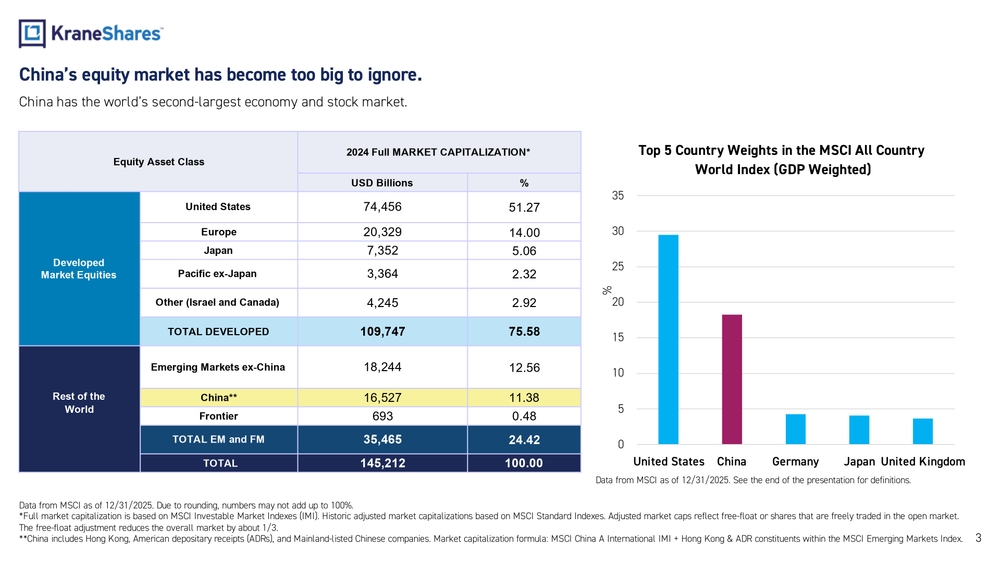
China’ s equity market has become too big to ignore. China has the world’s second -largest economy and stock market. Data from MSCI as of 12/31/2025. Due to rounding, numbers may not add up to 100%. Full market capitalization is based on MSCI Investable Market Indexes (IMI). Historic adjusted market capitalizations based on MSCI Standard Indexes. Adjusted market caps reflect free -float or shares that are freely traded in the open market. The free -float adjustment reduces the overall market by about 1/3. China includes Hong Kong, American depositary receipts (ADRs), and Mainland -listed Chinese companies. Market capitalization fo rmula: MSCI China A International IMI + Hong Kong & ADR constituents within the MSCI Emerging Markets Index. 3Equity Asset Class2024 Full MARKET CAPITALIZATION USD Billions % Developed Market EquitiesUnited States 74,456 51.27 Europe 20,329 14.00 Japan 7,352 5.06 Pacific ex -Japan 3,364 2.32 Other (Israel and Canada) 4,245 2.92 TOTAL DEVELOPED 109,747 75.58 Rest of the WorldEmerging Markets ex -China 18,244 12.56 China 16,527 11.38 Frontier 693 0.48 TOTAL EM and FM 35,465 24.42 TOTAL 145,212 100.00 Data from MSCI as of 12 /31/2025 . See the end of the presentation for definitions.05101520253035 United States China Germany Japan United KingdomTop 5 Country Weights in the MSCI All Country World Index (GDP Weighted)%
4China’s economic growth has been accompanied by increases in automobile ownership, construction projects, and energy consumption, particularly coal consumption. Data from the National Bureau of Statistics of China as of 12/31/2025. 024681012141618Increase in Automobile Ownership 0.00%200.00%400.00%600.00%800.00%1000.00%1200.00%1400.00%Total Investment in Fixed Assets 0%50%100%150%200%250%300%Annual Increase in Energy Consumption
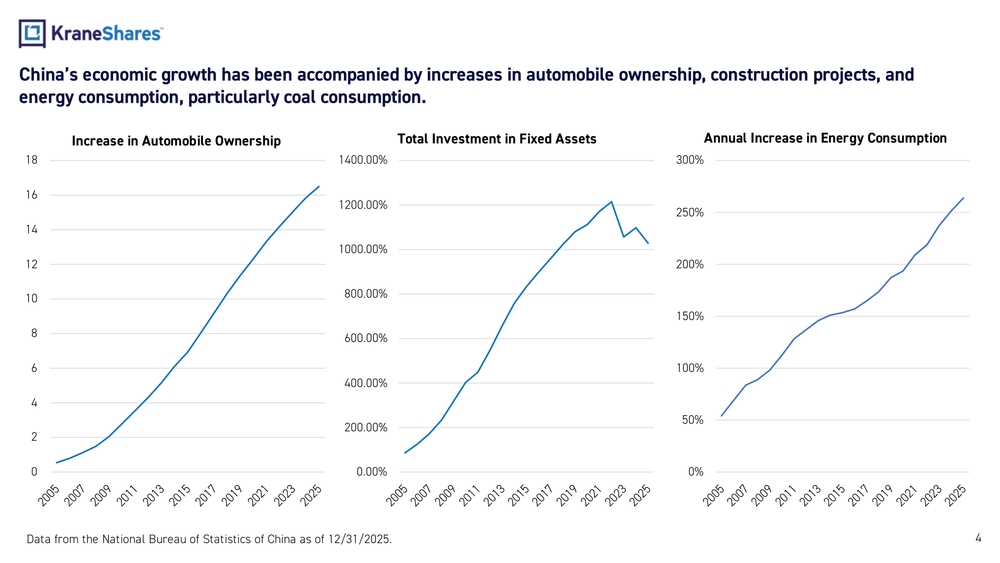
5This rapid development has impacted the environment. Data from OECD, CREA, WHO, and IQ Air as of 12/31/202 5. Data for France (EU) is for the entire European Union until 2017 and for France only from 2018 onward.0102030405060 2015 2016 2017 2018 2019 2020 2021 2022 2023 2024 2025Particulate Matter 2.5 µg/m3)Annual Exposure to PM 2.5 Air Pollution China United States France (EU) Recommended Level
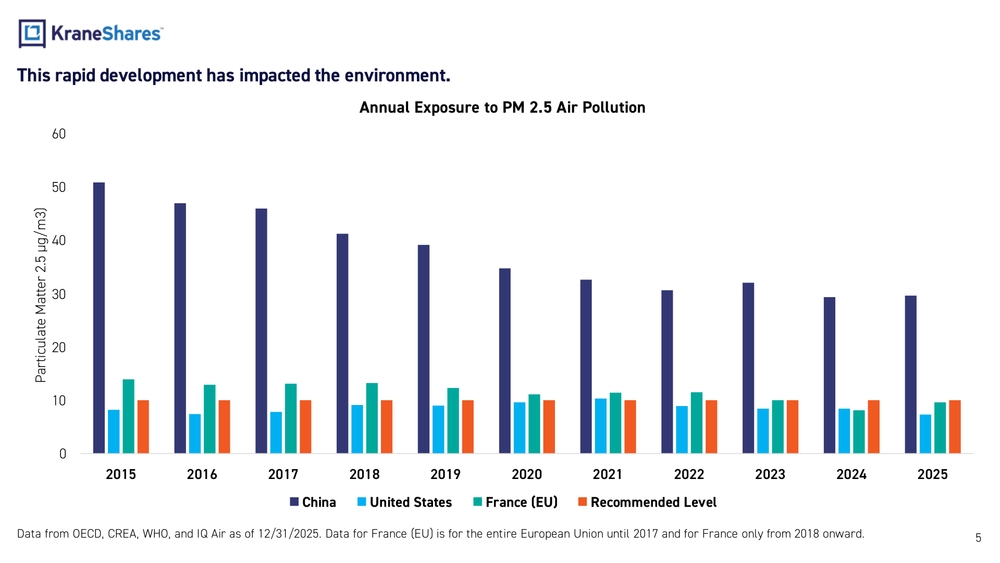
6China has a model for successfully addressing environmental concerns. Many cities have encountered pollution during their development and have subsequently taken action to reduce it.
- Bell, M.; Davis, D & Fletcher, T. (2004). A Retrospective Assessment of Mortality from the London Smog Episode of 1952: Th e Role of Influenza and Pollution. Environ Health Perspect . 112: 6 –8.
- China Law and Policy, Beijing Air Pollution - A Silver Lining on the Smog Cloud. Jan. 13, 2013.1952 Great Smog of London 1966 New York City’s “Killer Smog” •Due to the burning of coal during the early 1950’s, smog was common in London. However, in December 1952, an anticyclone created an inversion – trapping the pollution and blanketing the capital for the next five days. •May have killed as many as 12,000 people in London due to sickness1. •Four years later, the Clean Air Act banned the burning of polluting fuels and was considered an environmental turning point across the UK. •A large mass of stagnant air trapped pollutants in NYC for three days in
•This was the third harmful smog incident in NYC within 15 years. •The smog served as a catalyst for greater national awareness of air pollution, and the 1967 Air Quality Act and 1970 Clean Air Act were issued as a result. Experts Believe China Is Not So Different: Elizabeth M. Lynch, a legal scholar and founder of China Law and Policy , said that images of visible air pollution in Beijing from 2012, “aren’t that much different from pictures of New York City in the 1950s and 1960s, or London during the same time.” 2
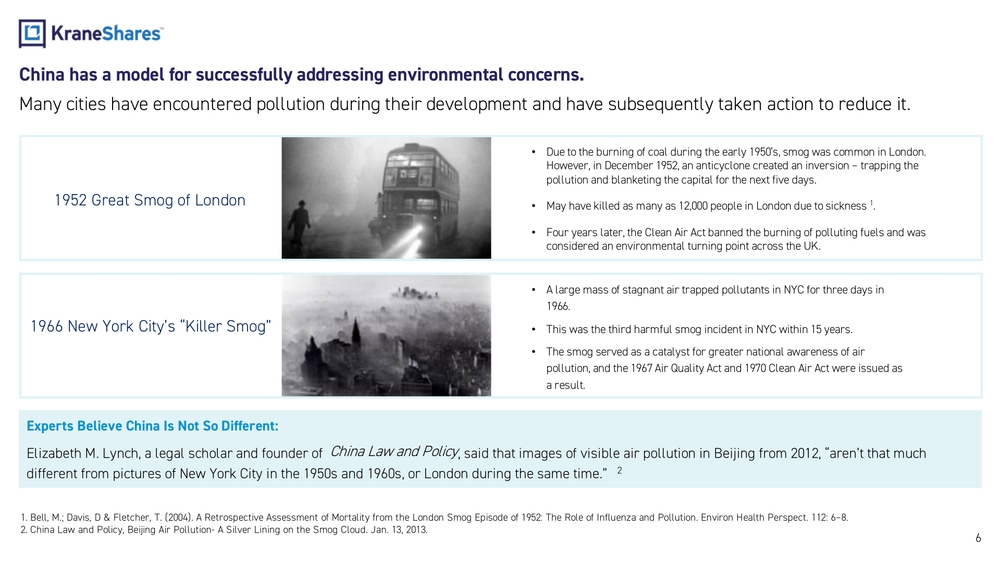
7As China’s economy has shifted away from its dependency on manufacturing, it is now better equipped to deal with environmental concerns. •China’s economy has become more balanced in recent years as services surpassed industrials as the largest contributor to GDP. •The US underwent a similar shift from the 1950’s to the 1970’s, and today the percentage of US GDP generated from services far exceeds that of industrials. •With a more balanced economy, China has become better equipped to tackle pollution issues generated from its industrial sector. Data from U.S. Bureau of Economic Analysis (excludes government sector) as of 12/31/2025.Data from the World Bank as of 12/31/2025. 0%10%20%30%40%50%60%70%80%90%USA GDP Breakdown (1980 - 2025) Agricultual Industrial Services0%10%20%30%40%50%60%70%China GDP Breakdown (2013 - 2025) Agricultural Industrial Services
China’s focus on environmental protection has strengthened following the formation of the Ministry of Environmental Protection in July 2008. 8 Please see page 20 for a complete list of citations. Mar 2025 Environment al Protection team upgraded to the Environment al Protection Agency2.19704Oct 1974China’s first Environmenta l Protection team was officially established1.Jul 1988The first Energy Conservation Law was adopted by the People’s Republic of China3.Nov 1997 The Ministry of Environmental Protection was founded, setting environmental protection at the highest level of Chinese government4.Jul 2008 Renewable electric energy investment exceeds fossil fuel and nuclear for the first time9.Jan 2015“New Type Urbanization Plan” requires 50% of new construction to be green by 20208.Mar 2014 The goal of the Chinese government is to achieve 50% commercial green building certification by 2020. If met, China will represent half of the world’s green building floor space3. Today NPC ratifies China’s 13th Five Year Plan with Environment as a critical focus11.Mar 2016Central Government aims to spend $360 billion on renewable energy by 202013.Jan 2017China’s new Environmental Protection Tax Law is the first taxation system which promotes green development5.Jan 2018Ministry of Science targets 5 million electric cars by 202010.Feb 2015China signs the 2016 Paris Agreement on climate change12.Apr 2016 In signing the 2016 Paris Agreement, China promised to install 800 to 1,000 gigawatts of new renewable energy capacity by 2030, about the same energy capacity as the entire U.S. electricity system1. China’s first law addressing soil pollution takes effect, creating a comprehensive legal framework for preventing and cleaning up soil pollution15.Jan 2019 National Development and Reform Commission announced sweeping reform to phase out single use plastic by 2025.17Jan 2020 The Chinese government is spending billions of dollars in subsidizing electric car manufacturers to stimulate growth and ensure that electric cars are affordable to average Chinese citizens2.Jan 2021China, home to the world’s largest carbon market, launches the China National Emissions Trading Scheme (ETS),19 The Shanghai Stock Exchange and Shenzhen Stock Exchange listing rules require companies in certain industries to publish a CSR or ESG reports and disclose the standard/criteria used for the disclosure.20Jan 2022 Jun 2023China extended tax breaks for new energy vehicle purchases through 2027, estimated to be worth $72 billion.21President Xi Jinping announces China’s goal to reach carbon neutrality by 2060 at the 2020 Climate Ambition Summit.18 China's State Council has unveiled a 2024 - 2025 action plan to accelerate energy saving and carbon reduction efforts, targeting a 13.5% reduction in energy consumption per unit of GDP by 2025 compared to 2020 levels, in line with the 14th Five - Year Plan. 22May 2024In March 2025 (March 6), China completed the first issuance of domestic voluntary carbon credits (CCERs), with total issuance of 9.5 million tonnes CO₂e from initial projects, marking a breakthrough in the market -based carbon reduction mechanism.23 China released its 15th Five -Year Plan for Carbon Emissions Reduction (2026 – 2030), expanding the national carbon market and setting new carbon intensity and non - fossil energy targets through 2030.Jul 2026 China hosts 2022 Winter Olympics
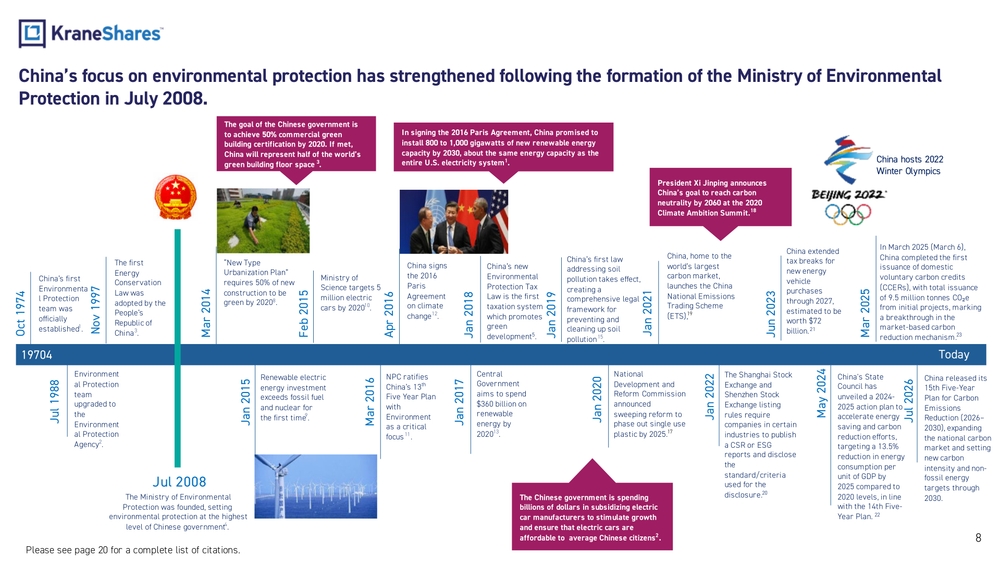
9China has been a global leader in electric vehicle adoption. •China is the world’s largest electric vehicle (EV) market with 44 million EVs on the road in 2025 which is nearly 6x more than in the US. •In 2025, China had 4.7 million publicly available EV charging stations compared to 0.2 million charging stations in the US.1 •The Chinese government has extended its subsidy program for new energy vehicles, one of the most generous and comprehensive in the world, through 2027. 2 China Electric Vehicle Company Highlights Nio is a Chinese automobile company that designs and manufactures premium EVs. Unlike other major EV manufacturers, Nio offers a battery -as-a-lease model which generates a significant long term revenue opportunity through monthly subscriptions. Additionally, NIO has a growing battery swapping and recharging station network, with a goal of having 4,000 stations in place by 2025.7 BYD Co. Ltd. is among the top global electric vehicle producers, with a total of 30 industrial units stationed around the world. Recently, the company has been securing large e -bus orders from the United States and Europe, further expanding its global market share.8 Beyond electric car manufacturing, BYD is the world’s leading producer of rechargeable batteries. Founded in 2014, XPeng is a top EV maker within China, and quickly gained market share due to its affordable pricing on its electric SUVs and sedans. Unlike some of its competitors that outsource production to a third party, XPeng has established several manufacturing plants within China, which provides a pricing advantage and ability to increase its margins.10Li Auto exclusively sells the Li ONE SUV, a luxury sport hybrid SUV that has a small gasoline engine to generate additional electric power for the battery --popular among those with limited access to charging infrastructure. Beyond Li ONE, Li Auto plans to expand its product offerings through the development of new EV types to broaden its consumer base.9 Data from the International Energy Agency (IEA), Ember Energy, Gas Good, and the European Environment Agency as of 12/31/2025.010203040506070 2019 2020 2021 2022 2023 2024 2025No. of VehiclesElectric Vehicles Globally World China European Union United States1. Data from Climate Central, China EV Home as of 12/31/2025. 2. Interesse, Giulia. “China Extends NEV Tax Reduction and Exemption Policy to 2027,” China Briefing. June 28, 2023. Retrieved on 6/30/2026.
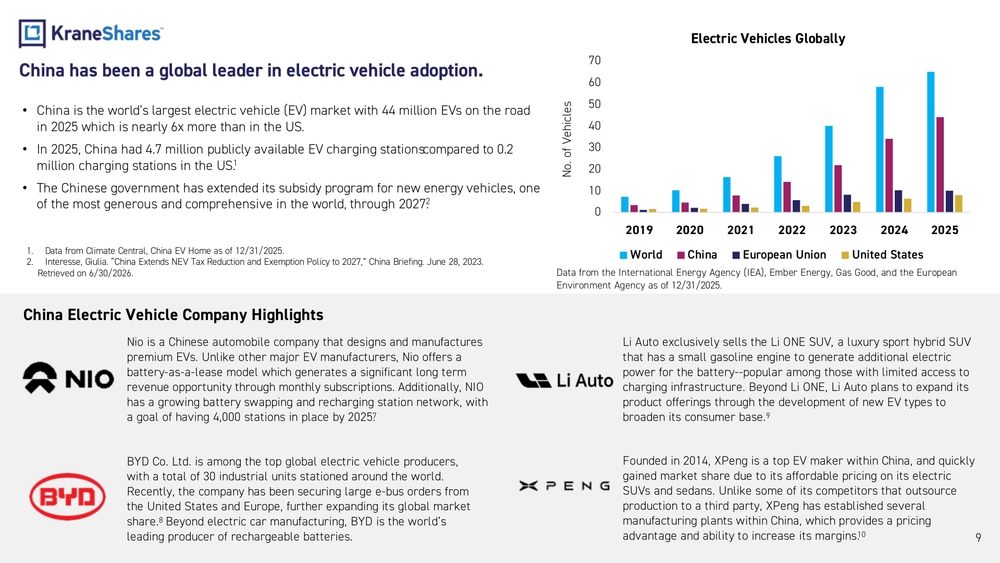
10China has outpaced other regions in its expansion of electric power capacity from renewable technologies and may continue to do so. Data from International Energy Agency (IEA), Carbon Brief, Economic Times, Solar Power Europe, National Bureau of Statistics of China, Latin American Energy Organization, European Environment Agency (EEA), Press Information Bureau of India, Ember, KraneShares, and S&P Global as of 12/31/202 5. Includes estimates. ASEAN = Association of Southeast Asian Nations. Gigawatts are a unit of electrical energy equal to 1,000,000,000 watts. Forward -looking scenarios and forecasts are hypothetical and not guarantees of future results. Results may differ significantly due to market and regulatory risks.05001,0001,5002,0002,500 China Europe India ASEAN Latin America AfricaGWRenewable Elecricity Generation Capacity By Region/Country 2000 2025 2027 Projection
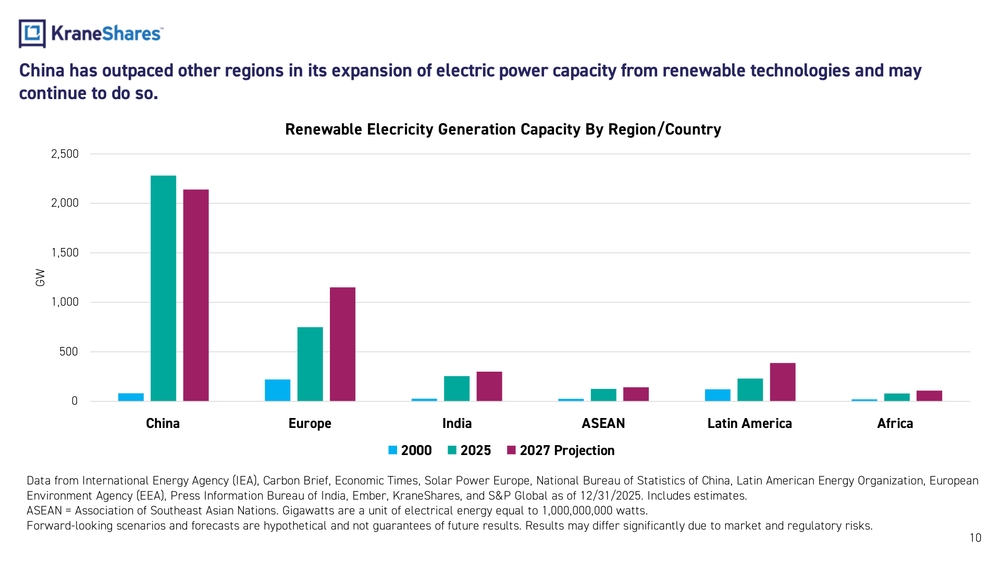
11However, China still lags the Americas and Europe in terms of renewable electricity per capita, meaning there remains significant room for growth. Data from Our World In Data, Energy Institute, and Ember as of 12/31/2025.05001,0001,5002,0002,5003,0003,5004,000 North America Europe South America China Asia Africa2025 Renewable Electricity Per Capita (kWh)
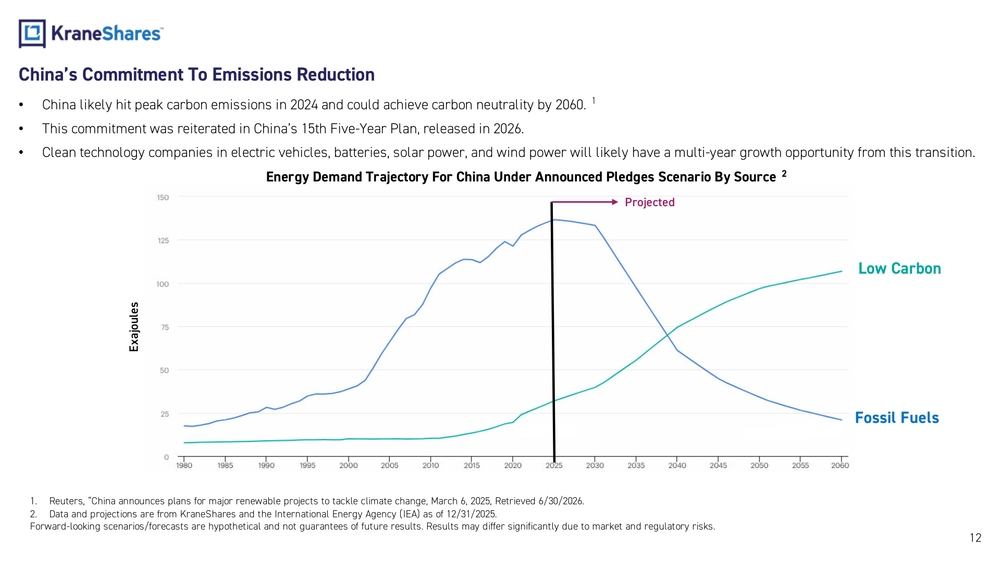
China’s Commitment To Emissions Reduction •China likely hit peak carbon emissions in 2024 and could achieve carbon neutrality by 2060.1 •This commitment was reiterated in China’s 15th Five -Year Plan, released in 2026. •Clean technology companies in electric vehicles, batteries, solar power, and wind power will likely have a multi -year growth opp ortunity from this transition. 1.Reuters, “China announces plans for major renewable projects to tackle climate change, March 6, 2025, Retrieved 6/30/2026. 2.Data and projections are from KraneShares and the International Energy Agency (IEA) as of 12/31/2025. Forward -looking scenarios/forecasts are hypothetical and not guarantees of future results. Results may differ significantly due to market and regulatory risks. 12Energy Demand Trajectory For China Under Announced Pledges Scenario By Source2 ExajoulesProjected Low Carbon Fossil Fuels
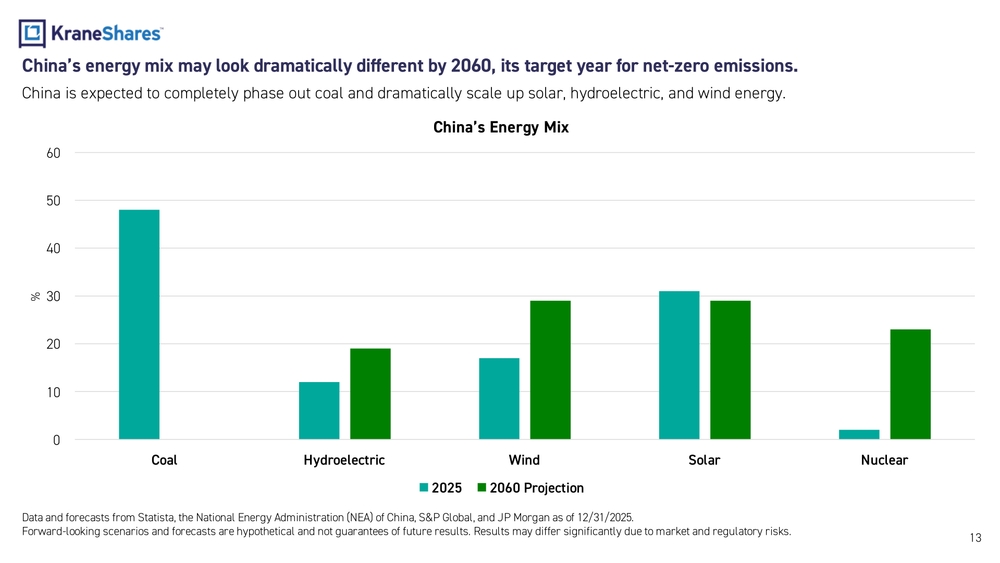
China’s energy mix may look dramatically different by 2060, its target year for net -zero emissions. China is expected to completely phase out coal and dramatically scale up solar, hydroelectric, and wind energy. Data and forecasts from Statista, the National Energy Administration (NEA) of China, S&P Global, and JP Morgan as of 12/31/20 25. Forward -looking scenarios and forecasts are hypothetical and not guarantees of future results. Results may differ significantly due to market and regulatory risks.0102030405060 Coal Hydroelectric Wind Solar Nuclear%China’s Energy Mix 2025 2060 Projection 13
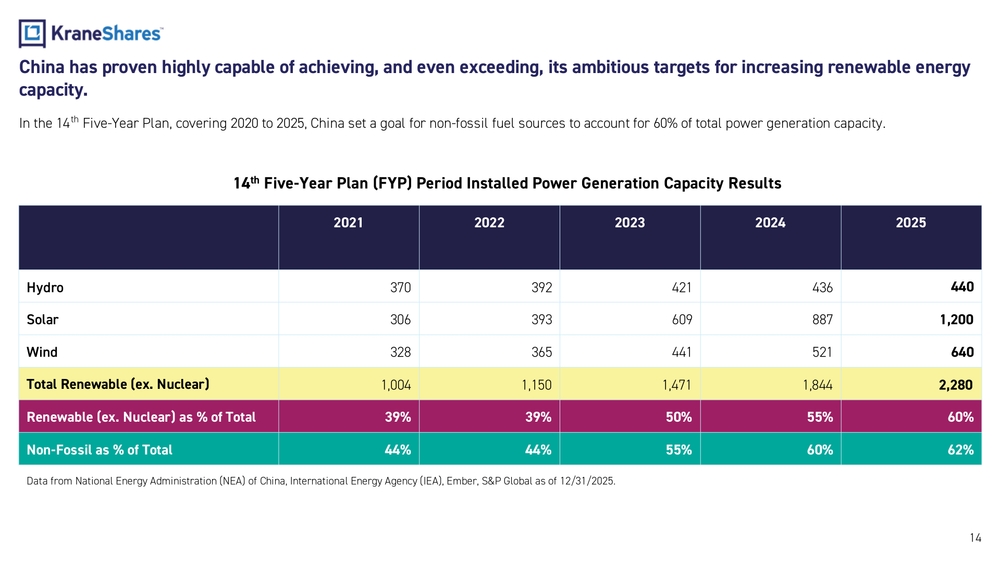
142021 2022 2023 2024 2025 Hydro 370 392 421 436 440 Solar 306 393 609 887 1,200 Wind 328 365 441 521 640 Total Renewable (ex. Nuclear) 1,004 1,150 1,471 1,844 2,280 Renewable (ex. Nuclear) as % of Total 39% 39% 50% 55% 60% Non-Fossil as % of Total 44% 44% 55% 60% 62%China has proven highly capable of achieving, and even exceeding, its ambitious targets for increasing renewable energy capacity. In the 14th Five-Year Plan, covering 2020 to 2025, China set a goal for non -fossil fuel sources to account for 60% of total power generatio n capacity. Data from National Energy Administration (NEA) of China, International Energy Agency (IEA), Ember, S&P Global as of 12/31/2025.14th Five-Year Plan (FYP) Period Installed Power Generation Capacity Results
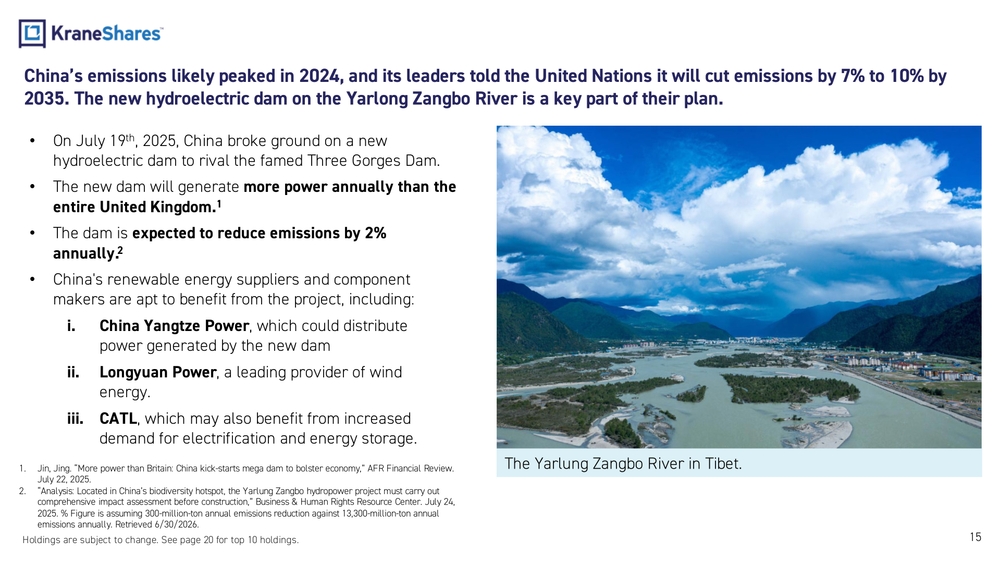
China’s emissions likely peaked in 2024, and its leaders told the United Nations it will cut emissions by 7% to 10% by
2035. The new hydroelectric dam on the Yarlong Zangbo River is a key part of their plan.
•On July 19th, 2025, China broke ground on a new
hydroelectric dam to rival the famed Three Gorges Dam.
•The new dam will generate more power annually than the
entire United Kingdom.1
•The dam is expected to reduce emissions by 2%
annually.2
•China's renewable energy suppliers and component
makers are apt to benefit from the project, including:
i. China Yangtze Power , which could distribute
power generated by the new dam
ii. Longyuan Power , a leading provider of wind
energy.
iii. CATL , which may also benefit from increased
demand for electrification and energy storage.
15The Yarlung Zangbo River in Tibet.1. Jin, Jing. “More power than Britain: China kick -starts mega dam to bolster economy,” AFR Financial Review.
July 22, 2025.
2. “Analysis: Located in China’s biodiversity hotspot, the Yarlung Zangbo hydropower project must carry out
comprehensive impact assessment before construction,” Business & Human Rights Resource Center. July 24,
2025. % Figure is assuming 300 -million -ton annual emissions reduction against 13,300 -million -ton annual
emissions annually. Retrieved 6/30/2026.
Holdings are subject to change. See page 20 for top 10 holdings.
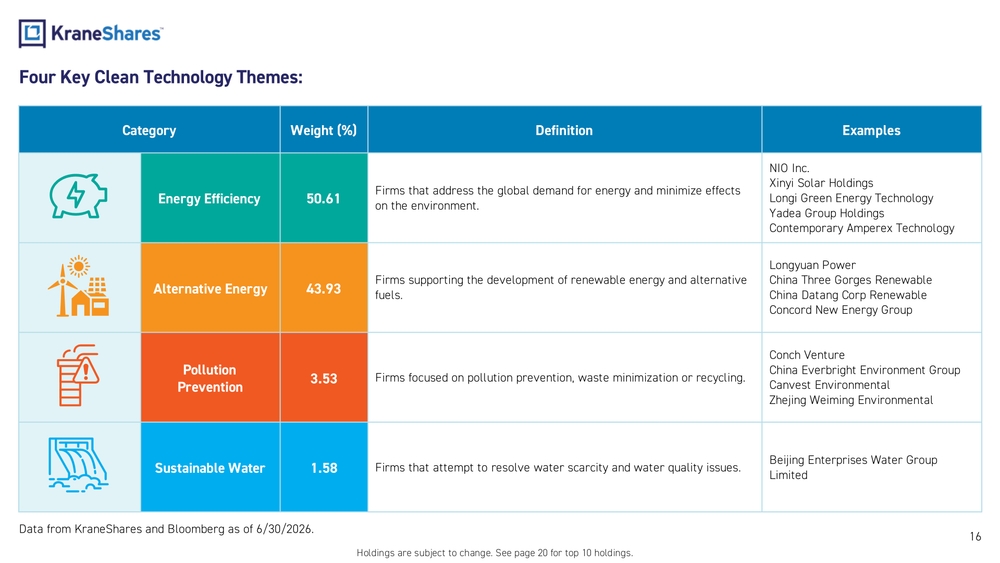
Four Key Clean T echnology Themes: Category Weight (%) Definition Examples Energy Efficiency 50.61Firms that address the global demand for energy and minimize effects on the environment.NIO Inc. Xinyi Solar Holdings Longi Green Energy Technology Yadea Group Holdings Contemporary Amperex Technology Alternative Energy 43.93Firms supporting the development of renewable energy and alternative fuels.Longyuan Power China Three Gorges Renewable China Datang Corp Renewable Concord New Energy Group Pollution Prevention3.53 Firms focused on pollution prevention, waste minimization or recycling.Conch Venture China Everbright Environment Group Canvest Environmental Zhejing Weiming Environmental Sustainable Water 1.58 Firms that attempt to resolve water scarcity and water quality issues.Beijing Enterprises Water Group Limited 16Data from KraneShares and Bloomberg as of 6/30/2026. Holdings are subject to change. See page 20 for top 10 holdings.
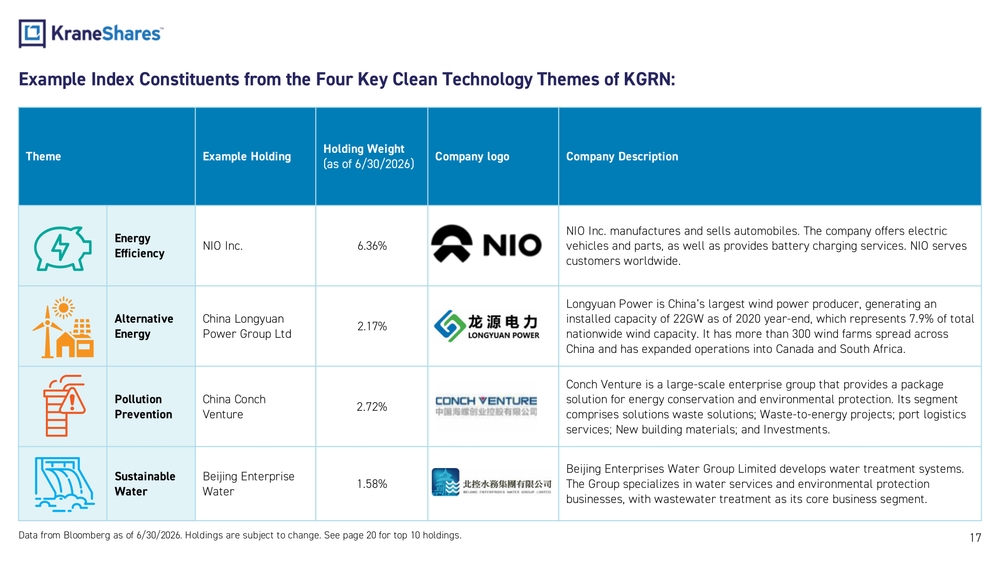
Example Index Constituents from the Four Key Clean Technology Themes of KGRN: Data from Bloomberg as of 6/30/2026 . Holdings are subject to change. See page 20 for top 10 holdings.Theme Example HoldingHolding Weight (as of 6/30/2026)Company logo Company Description Energy EfficiencyNIO Inc. 6.36%NIO Inc. manufactures and sells automobiles. The company offers electric vehicles and parts, as well as provides battery charging services. NIO serves customers worldwide. Alternative EnergyChina Longyuan Power Group Ltd2.17%Longyuan Power is China’s largest wind power producer, generating an installed capacity of 22GW as of 2020 year -end, which represents 7.9% of total nationwide wind capacity. It has more than 300 wind farms spread across China and has expanded operations into Canada and South Africa. Pollution PreventionChina Conch Venture 2.72%Conch Venture is a large -scale enterprise group that provides a package solution for energy conservation and environmental protection. Its segment comprises solutions waste solutions; Waste -to-energy projects; port logistics services; New building materials; and Investments. Sustainable WaterBeijing Enterprise Water1.58%Beijing Enterprises Water Group Limited develops water treatment systems. The Group specializes in water services and environmental protection businesses, with wastewater treatment as its core business segment. 17
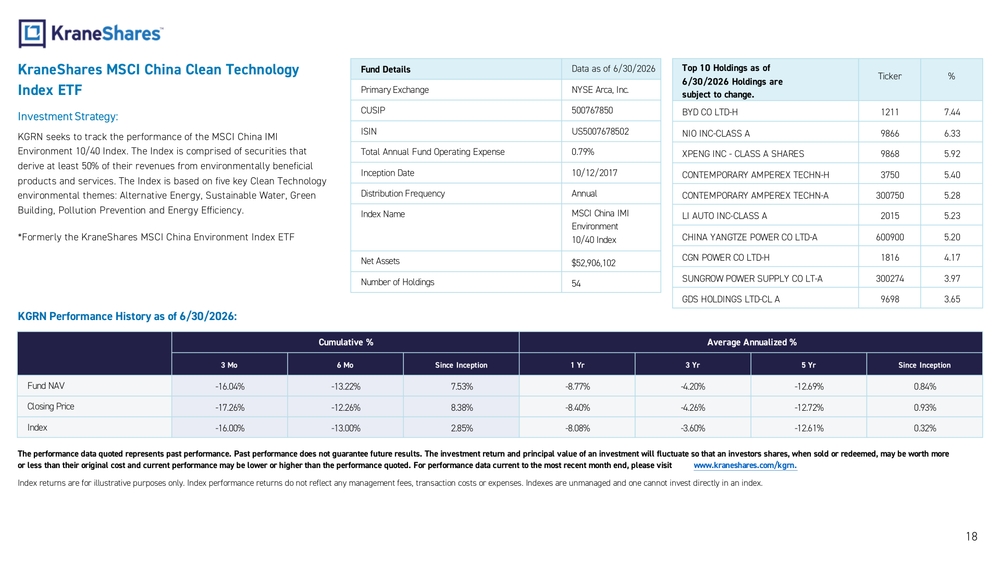
KraneShares MSCI China Clean Technology Index ETF Investment Strategy: KGRN seeks totrack theperformance oftheMSCI China IMI Environment 10/40 Index. TheIndex iscomprised ofsecurities that derive atleast 50% oftheir revenues from environmentally beneficial products andservices. TheIndex isbased onfivekeyClean Technology environmental themes: Alternative Energy, Sustainable Water, Green Building, Pollution Prevention andEnergy Efficiency. *Formerly theKraneShares MSCI China Environment Index ETFFund Details Data as of 6/30/2026 Primary Exchange NYSE Arca, Inc. CUSIP 500767850 ISIN US5007678502 Total Annual Fund Operating Expense 0.79% Inception Date 10/12/2017 Distribution Frequency Annual Index Name MSCI China IMI Environment 10/40 Index Net Assets $52,906,102 Number of Holdings 54Top 10 Holdings as of 6/30/2026 Holdings are subject to change.Ticker % BYD CO LTD -H 1211 7.44 NIO INC -CLASS A 9866 6.33 XPENG INC -CLASS A SHARES 9868 5.92 CONTEMPORARY AMPEREX TECHN -H 3750 5.40 CONTEMPORARY AMPEREX TECHN -A 300750 5.28 LI AUTO INC -CLASS A 2015 5.23 CHINA YANGTZE POWER CO LTD -A 600900 5.20 CGN POWER CO LTD -H 1816 4.17 SUNGROW POWER SUPPLY CO LT -A 300274 3.97 GDS HOLDINGS LTD -CL A 9698 3.65 KGRN Performance History asof6/30/202 6: Cumulative % Average Annualized % 3Mo 6Mo Since Inception 1Yr 3Yr 5Yr Since Inception Fund NAV -16.04 % -13.22% 7.53% -8.77% -4.20% -12.69 % 0.84% Closing Price -17.26 % -12.26 % 8.38% -8.40% -4.26% -12.72 % 0.93% Index -16.00 % -13.00% 2.85% -8.08% -3.60% -12.61 % 0.32% Theperformance data quoted represents past performance. Past performance does notguarantee future results. Theinvestment return andprincipal value ofaninvestment willfluctuate sothat aninvestors shares, when sold orredeemed, may beworth more orless than their original cost andcurrent performance may belower orhigher than theperformance quoted. Forperformance data current tothemost recent month end, please visit www.kraneshares.com/kgrn. Index returns areforillustrative purposes only. Index performance returns donotreflect anymanagement fees, transaction costs orexpenses. Indexes areunmanaged andonecannot invest directly inanindex. 18
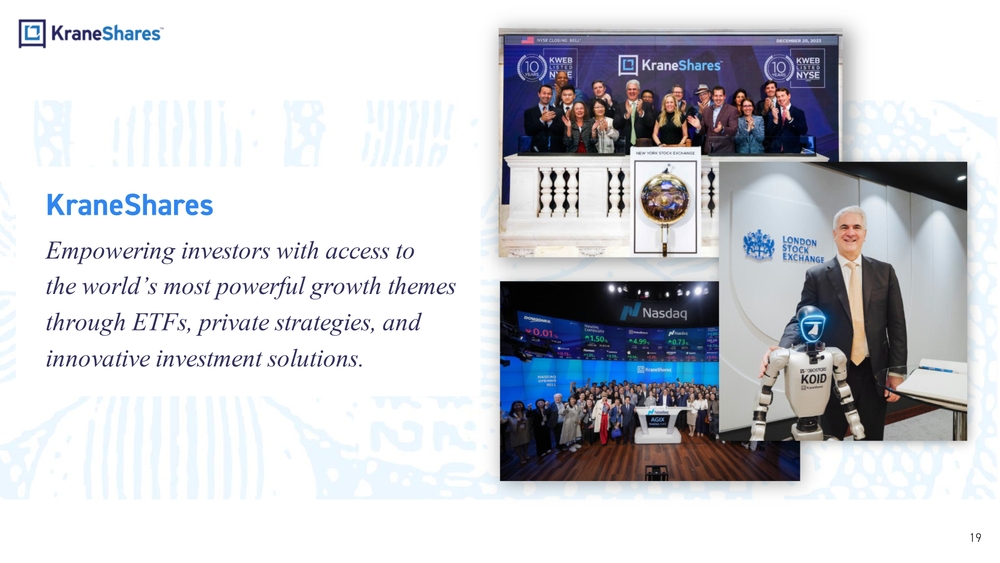
KraneShares Empowering investors with access to the world’ s most powerful growth themes through ETFs, private strategies, and innovative investment solutions. 19
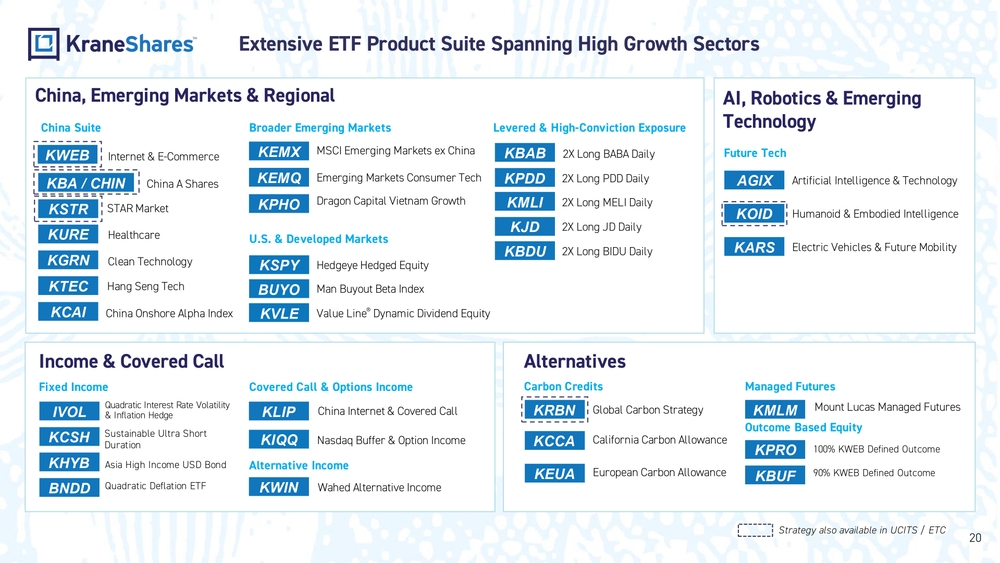
China, Emerging Markets & Regional Alternatives Income & Covered Call AI, Robotics & Emerging Technology KURE Healthcare KGRN Clean TechnologyKSTR STAR Market KTEC Hang Seng TechKWEB Internet & E -Commerce China A Shares KBA / CHIN KCAI China Onshore Alpha IndexAGIX Artificial Intelligence & Technology KOID Humanoid & Embodied Intelligence Electric Vehicles & Future Mobility KARSChina Suite Future TechBroader Emerging Markets KEMQ Emerging Markets Consumer Tech KPHODragon Capital Vietnam GrowthKEMX MSCI Emerging Markets ex China U.S. & Developed Markets KVLE Value Line® Dynamic Dividend EquityHedgeye Hedged Equity KSPY Man Buyout Beta Index BUYO Fixed Income BNDDQuadratic Deflation ETFIVOLQuadratic Interest Rate Volatility & Inflation Hedge KHYB Asia High Income USD BondSustainable Ultra Short DurationKCSH KEUA European Carbon AllowanceGlobal Carbon Strategy KRBNCarbon CreditsKPDD 2X Long PDD Daily KJD 2X Long JD DailyKBAB 2X Long BABA Daily KMLI 2X Long MELI Daily Covered Call & Options Income Managed Futures KMLMMount Lucas Managed Futures KWIN Wahed Alternative IncomeKLIP China Internet & Covered Call Outcome Based Equity KIQQ Nasdaq Buffer & Option IncomeLevered & High -Conviction Exposure KBUF90% KWEB Defined Outcome100% KWEB Defined Outcome KPRO Alternative Income KCCA California Carbon AllowanceExtensive ETF Product Suite Spanning High Growth Sectors Strategy also available in UCITS / ETCKBDU 2X Long BIDU Daily 20
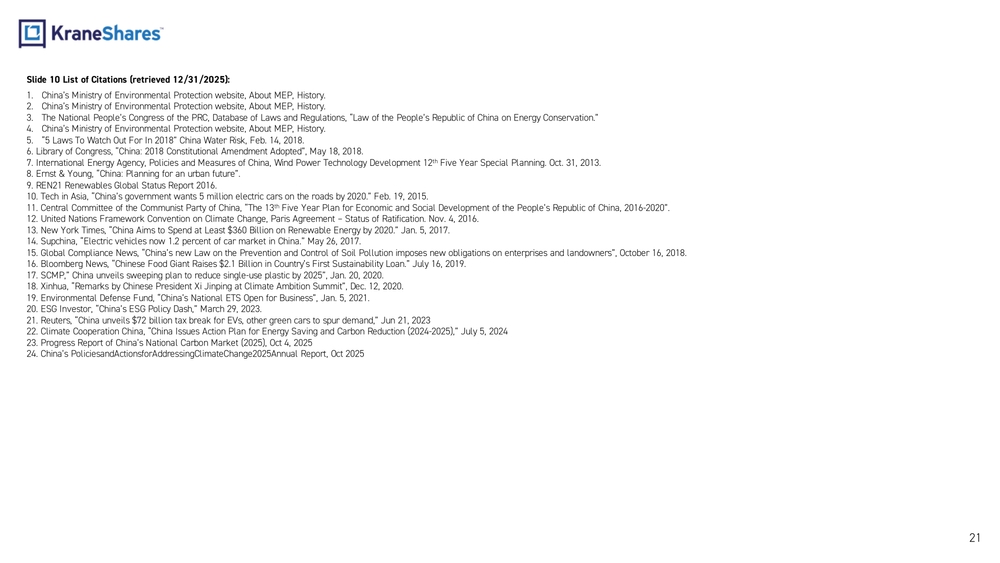
21Slide 10 List of Citations (retrieved 12/31/2025): 1.China’s Ministry of Environmental Protection website, About MEP, History. 2.China’s Ministry of Environmental Protection website, About MEP, History. 3.The National People’s Congress of the PRC, Database of Laws and Regulations, “Law of the People’s Republic of China on Energy Conservation.” 4.China’s Ministry of Environmental Protection website, About MEP, History. 5.“5 Laws To Watch Out For In 2018” China Water Risk, Feb. 14, 2018. 6. Library of Congress, “China: 2018 Constitutional Amendment Adopted”, May 18, 2018. 7. International Energy Agency, Policies and Measures of China, Wind Power Technology Development 12th Five Year Special Planning. Oct. 31, 2013. 8. Ernst & Young, “China: Planning for an urban future”. 9. REN21 Renewables Global Status Report 2016. 10. Tech in Asia, “China’s government wants 5 million electric cars on the roads by 2020.” Feb. 19, 2015. 11. Central Committee of the Communist Party of China, “The 13th Five Year Plan for Economic and Social Development of the People’s Republic of China, 2016 -2020”. 12. United Nations Framework Convention on Climate Change, Paris Agreement – Status of Ratification. Nov. 4, 2016. 13. New York Times, “China Aims to Spend at Least $360 Billion on Renewable Energy by 2020.” Jan. 5, 2017. 14. Supchina , “Electric vehicles now 1.2 percent of car market in China.” May 26, 2017. 15. Global Compliance News, “China’s new Law on the Prevention and Control of Soil Pollution imposes new obligations on enter prises and landowners”, October 16, 2018. 16. Bloomberg News, “Chinese Food Giant Raises $2.1 Billion in Country’s First Sustainability Loan.” July 16, 2019. 17. SCMP,” China unveils sweeping plan to reduce single -use plastic by 2025”, Jan. 20, 2020. 18. Xinhua, “Remarks by Chinese President Xi Jinping at Climate Ambition Summit”, Dec. 12, 2020. 19. Environmental Defense Fund, “China’s National ETS Open for Business”, Jan. 5, 2021. 20. ESG Investor, “China’s ESG Policy Dash,” March 29, 2023. 21. Reuters, “China unveils $72 billion tax break for EVs, other green cars to spur demand,” Jun 21, 2023 22. Climate Cooperation China, “China Issues Action Plan for Energy Saving and Carbon Reduction (2024 -2025),” July 5, 2024 23. Progress Report of China’s National Carbon Market (2025), Oct 4, 2025 24. China’s PoliciesandActionsforAddressingClimateChange2025Annual Report, Oct 2025
22Important Notes Carefully consider the Funds’ investment objectives, risk factors, charges and expenses before investing. This and additional information can be found in the Funds‘ full and summary prospectus, which may be obtained by visiting www.kraneshares.com/kgrn . Read the prospectus carefully before investing. Risk Disclosures: Investing involves risk, including possible loss of principal. There can be no assurance that a Fund will achieve its stated objectives. Indices are unmanaged and do not include the effect of fees. One cannot invest directly in an index. This information should not be relied upon as research, investment advice, or a recommendation regarding any products, strate gies, or any security in particular. This material is strictly for illustrative, educational, or informational purposes and is subject to change. Certain content represents an assessment of the market environment at a specific time and is not intended to be a forecast of future events or a guarantee of future results; materi al is as of the dates noted and is subject to change without notice. The Fund may invest in derivatives, which are often more volatile than other investments and may magnify the Fund’s gains or losses. A derivative (i.e., futures/forward contracts, swaps, and options) is a contract that derives its value from the performance of an underlying ass et. The primary risk of derivatives is that changes in the asset’s market value and the derivative may not be proportionate, and some derivatives can have the poten tial for unlimited losses. Derivatives are also subject to liquidity and counterparty risk. The Fund is subject to liquidity risk, meaning that certain investments may become difficult to purchase or sell at a reasonable time and price. If a transaction for these securities is large, it may not be possible to initiate, which may ca use the Fund to suffer losses. Counterparty risk is the risk of loss in the event that the counterparty to an agreement fails to make required payments or otherwise comp ly with the terms of the derivative. The ability of the Fund to achieve its respective investment objectives is dependent, in part, on the continuous availability of A Shares and the ability to obtain, if necessary, additional A Shares quota. If the Fund is unable to obtain sufficient exposure to limited availability of A Share quota, the Fund could seek exposure to the component securities of the Underlying Index by investment in other types of securities. The Fund is subject to political , social or economic instability within China which may cause decline in value. Emerging markets involve heightened risk related to the same factors as well as incre ase volatility and lower trading volume. Fluctuations in currency of foreign countries may have an adverse effect to domestic currency values. The Fund may u nderperform other similar funds that do not consider conscious company/ESG guidelines when making investment decisions. The Fund may invest in Initial Public Offerings (IPOs). Securities issued in IPOs have no trading history, and information about the companies may be available for very limited periods. In add ition, the prices of securities sold in IPOs may be highly volatile. In addition, as the Fund increases in size, the impact of IPOs on the Fund’s performance will ge nerally decrease.
23Risk Disclosures Continued: Narrowly focused investments typically exhibit higher volatility. The Fund’s assets are expected to be concentrated in a sect or, industry, market, or group of concentrations to the extent that the Underlying Index has such concentrations. The securities or futures in that concentrat ion could react similarly to market developments. Thus, the Fund is subject to loss due to adverse occurrences that affect that concentration. In addition to the normal risks associated with investing, investments in smaller companies typically exhibit higher volatility. KGRN is non -diversified. ETF shares are bought and sold on an exchange at market price (not NAV) and are not individually redeemed from the Fund. Howe ver, shares may be redeemed at NAV directly by certain authorized broker -dealers (Authorized Participants) in very large creation/redemption units. The returns shown do not represent the returns you would receive if you traded shares at other times. Shares may trade at a premium or discount to their NAV in the secondar y market. Brokerage commissions will reduce returns. Beginning 12/23/2020, market price returns are based on the official closing price of an ETF share or, if the official closing price isn't available, the midpoint between the national best bid and national best offer ("NBBO") as of the time the ETF calculates the current NAV per share. Prior to that date, market price returns were based on the midpoint between the Bid and Ask price. NAVs are calculated using prices as of 4:00 PM Eastern Time . The KraneShares ETFs and KFA Funds ETFs are distributed by SEI Investments Distribution Company (SIDCO), 1 Freedom Valley Dri ve, Oaks, PA 19456, which is not affiliated with Krane Funds Advisors, LLC, the Investment Adviser for the Funds, or any sub -advisers for the Funds. [R_US_KS_SEI]