EM ETF | KEMX: Emerging Markets ex China Index ETF
by Kraneshares
1 Customizing China Exposure within Emerging Market Portfolios An Overview of the KraneShares MSCI Emerging Markets ex China ETF (Ticker: KEMX)KEMX info@kraneshares.com6/30/2026
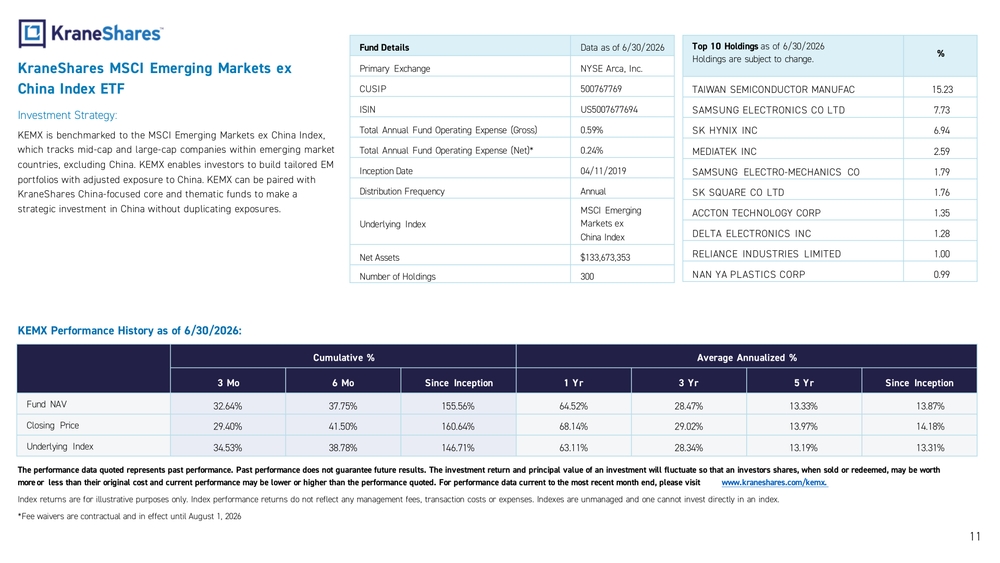
2 Investment Strategy: KEMX is benchmarked to the MSCI Emerging Markets ex China Index, which tracks large -cap and mid -cap companies within emerging market countries, excluding China. KEMX enables investors to build tailored Emerging Market (EM) portfolios when combined with exposure to China. KEMX can be paired with KraneShares’ China -focused funds to establish strategic positions in China without duplicating exposures. KEMX Features: •Exposure to large -cap and mid -cap companies within emerging market countries, excluding China •Benchmarked to MSCI, a global leader in international indexing By pairing KEMX with other KraneShares China -focused funds, including the below, investors can make strategic allocations to China. •Offshore China (Growth): The KraneShares CSI China Internet ETF (Ticker: KWEB) •Onshore China (Growth & Value): The KraneShares Bosera MSCI China A 50 Connect Index ETF (Ticker: KBA)KEMX KraneShares MSCI Emerging Markets ex China ETF
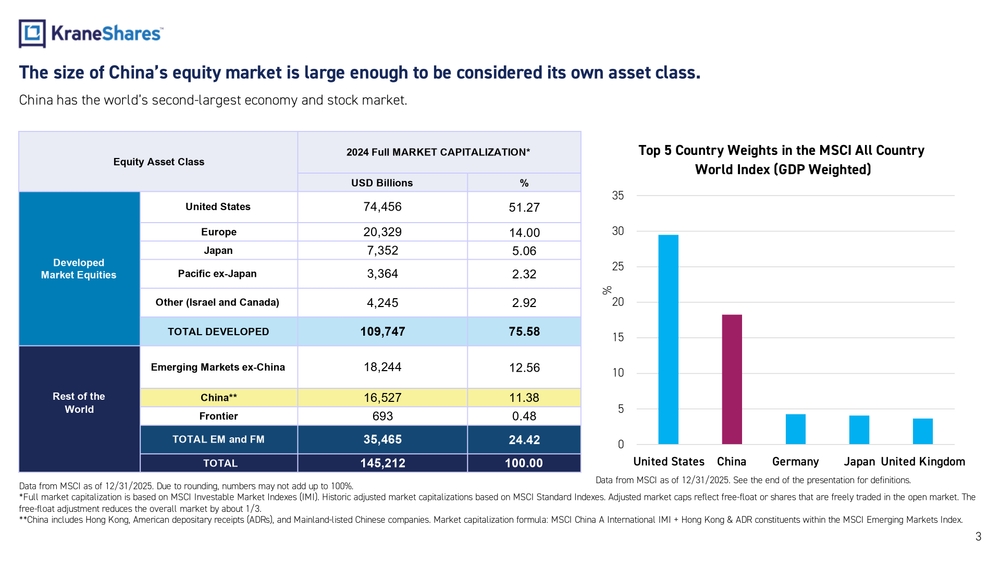
3 The size of China’s equity market is large enough to be considered its own asset class. China has the world’s second -largest economy and stock market. Data from MSCI as of 12 /31/2025 . See the end of the presentation for definitions.Data from MSCI as of 12/31/2025. Due to rounding, numbers may not add up to 100%. Full market capitalization is based on MSCI Investable Market Indexes (IMI). Historic adjusted market capitalizations based on MSCI Standard Indexes. Adjusted market caps reflect free -float or shares that are freely traded in the open market. The free-float adjustment reduces the overall market by about 1/3. China includes Hong Kong, American depositary receipts (ADRs), and Mainland -listed Chinese companies. Market capitalization fo rmula: MSCI China A International IMI + Hong Kong & ADR constituents within the MSCI Emerging Markets Index.Equity Asset Class2024 Full MARKET CAPITALIZATION USD Billions % Developed Market EquitiesUnited States 74,456 51.27 Europe 20,329 14.00 Japan 7,352 5.06 Pacific ex -Japan 3,364 2.32 Other (Israel and Canada) 4,245 2.92 TOTAL DEVELOPED 109,747 75.58 Rest of the WorldEmerging Markets ex -China 18,244 12.56 China 16,527 11.38 Frontier 693 0.48 TOTAL EM and FM 35,465 24.42 TOTAL 145,212 100.0005101520253035 United States China Germany Japan United KingdomTop 5 Country Weights in the MSCI All Country World Index (GDP Weighted)%
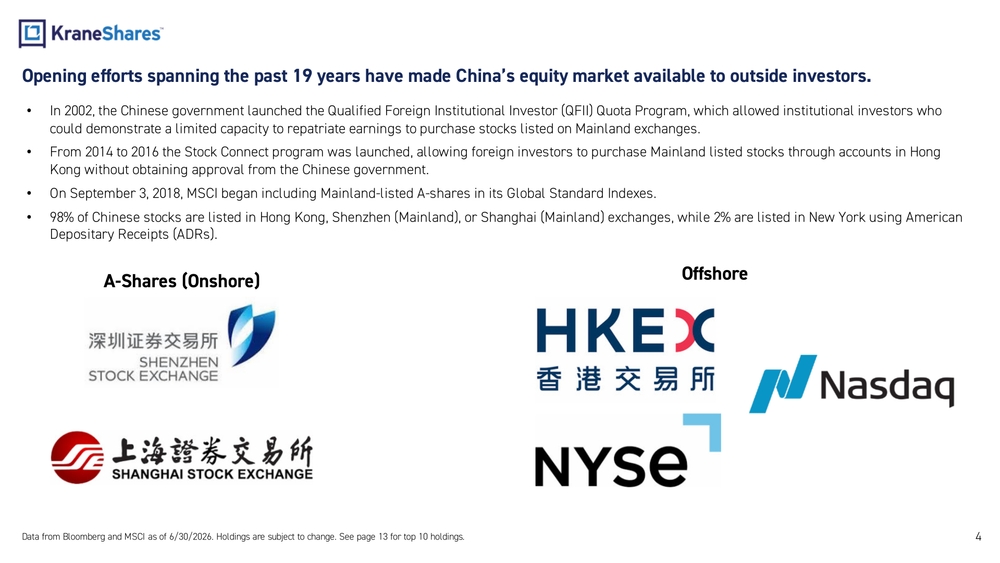
4 Opening efforts spanning the past 19 years have made China’s equity market available to outside investors. •In 2002, the Chinese government launched the Qualified Foreign Institutional Investor (QFII) Quota Program, which allowed ins titutional investors who could demonstrate a limited capacity to repatriate earnings to purchase stocks listed on Mainland exchanges. •From 2014 to 2016 the Stock Connect program was launched, allowing foreign investors to purchase Mainland listed stocks throu gh accounts in Hong Kong without obtaining approval from the Chinese government. •On September 3, 2018, MSCI began including Mainland -listed A-shares in its Global Standard Indexes . •98% of Chinese stocks are listed in Hong Kong, Shenzhen (Mainland), or Shanghai (Mainland) exchanges, while 2% are listed in New York using American Depositary Receipts (ADRs). Data from Bloomberg and MSCI as of 6/30/2026 . Holdings are subject to change. See page 13 for top 10 holdings. A-Shares (Onshore)Offshore
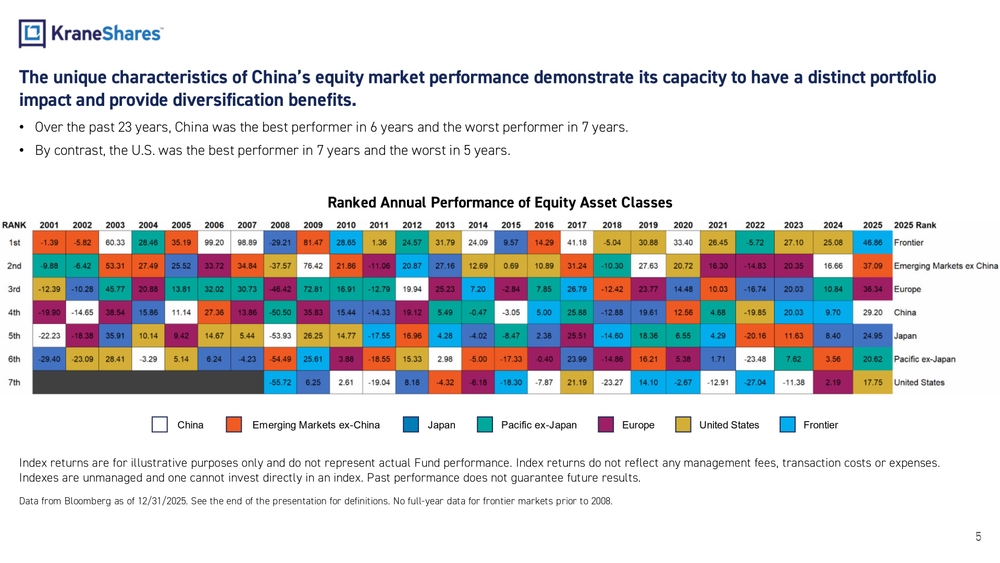
5 The unique characteristics of China’s equity market performance demonstrate its capacity to have a distinct portfolio impact and provide diversification benefits. •Over the past 23 years, China was the best performer in 6 years and the worst performer in 7 years. •By contrast, the U.S. was the best performer in 7 years and the worst in 5 years. Data from Bloomberg as of 12/31/2025. See the end of the presentation for definitions . No full -year data for frontier markets prior to 2008. 5Ranked Annual Performance of Equity Asset Classes Index returns are for illustrative purposes only and do not represent actual Fund performance. Index returns do not reflect a ny management fees, transaction costs or expenses. Indexes are unmanaged and one cannot invest directly in an index. Past performance does not guarantee future results. China Emerging Markets ex -China Japan Pacific ex -Japan Europe United States Frontier
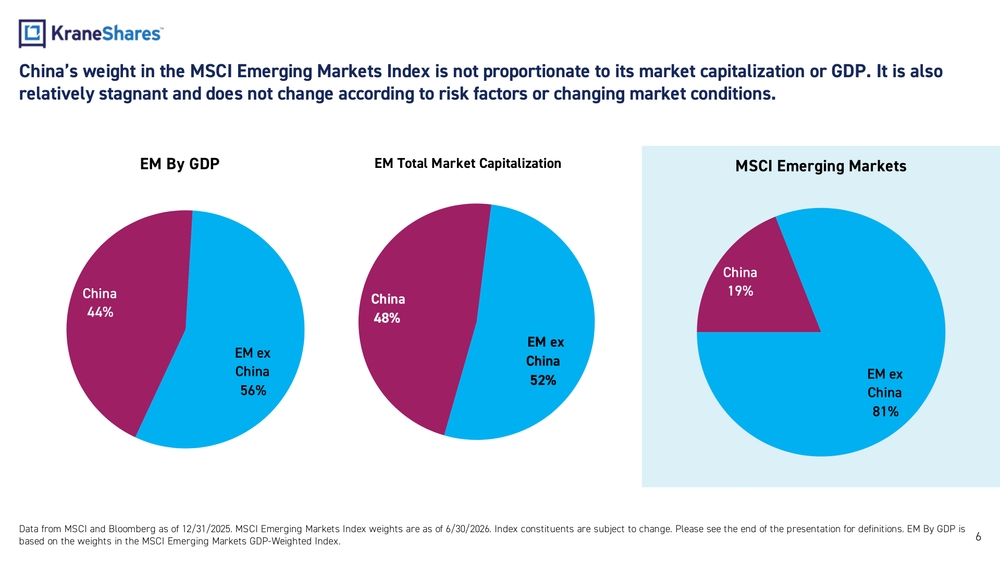
6 China’s weight in the MSCI Emerging Markets Index is not proportionate to its market capitalization or GDP. It is also relatively stagnant and does not change according to risk factors or changing market conditions. Data from MSCI and Bloomberg as of 12/31/202 5. MSCI Emerging Markets Index weights are as of 6/30/2026. Index constituents are subject to change. Please see the end of the presentation for definitions. EM By GDP is based on the weights in the MSCI Emerging Markets GDP -Weighted Index.China 44% EM ex China 56%EM By GDP China 19% EM ex China 81%MSCI Emerging Markets China 48% EM ex China 52%EM Total Market Capitalization
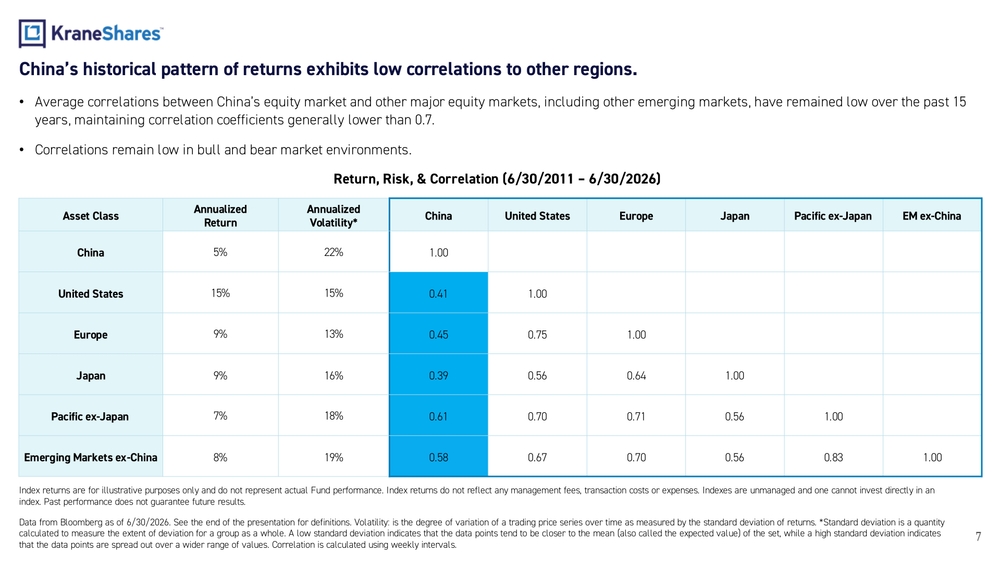
7 China’s historical pattern of returns exhibits low correlations to other regions. •Average correlations between China’s equity market and other major equity markets, including other emerging markets, have rem ained low over the past 15 years, maintaining correlation coefficients generally lower than 0.7. •Correlations remain low in bull and bear market environments. Data from Bloomberg as of 6/30/2026 . See the end of the presentation for definitions . Volatility: is the degree of variation of a trading price series over time as measured by the standard deviation of returns. Standard deviation is a quantity calculated to measure the extent of deviation for a group as a whole . A low standard deviation indicates that the data points tend to be closer to the mean (also called the expected value) of t he set, while a high standard deviation indicates that the data points are spread out over a wider range of values. Correlation is calculated using weekly intervals.7Index returns are for illustrative purposes only and do not represent actual Fund performance. Index returns do not reflect a ny management fees, transaction costs or expenses. Indexes are unmanaged and one cannot invest directly in an index. Past performance does not guarantee future results. Return, Risk, & Correlation (6/30/2011 – 6/30/2026 ) Asset ClassAnnualized ReturnAnnualized VolatilityChina United States Europe Japan Pacific ex -Japan EM ex -China China 5% 22% 1.00 United States 15% 15% 0.41 1.00 Europe 9% 13% 0.45 0.75 1.00 Japan 9% 16% 0.39 0.56 0.64 1.00 Pacific ex -Japan 7% 18% 0.61 0.70 0.71 0.56 1.00 Emerging Markets ex -China 8% 19% 0.58 0.67 0.70 0.56 0.83 1.00
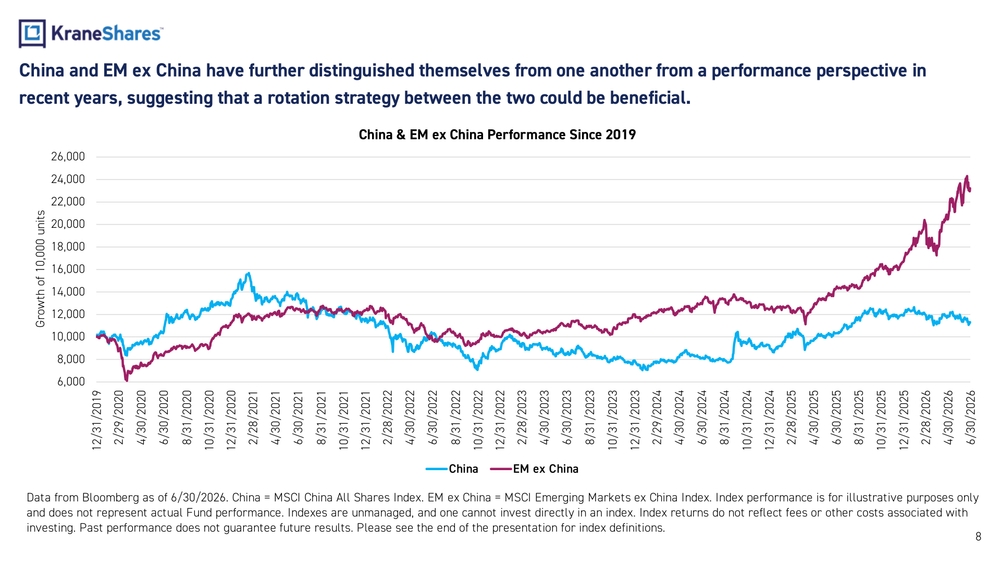
8 China and EM ex China have further distinguished themselves from one another from a performance perspective in recent years, suggesting that a rotation strategy between the two could be beneficial. Data from Bloomberg as of 6/30/2026 . China = MSCI China All Shares Index. EM ex China = MSCI Emerging Markets ex China Index. Index performance is for illustrat ive purposes only and does not represent actual Fund performance. Indexes are unmanaged, and one cannot invest directly in an index. Index retu rns do not reflect fees or other costs associated with investing. Past performance does not guarantee future results. Please see the end of the presentation for index definitions.6,0008,00010,00012,00014,00016,00018,00020,00022,00024,00026,000 12/31/2019 2/29/2020 4/30/2020 6/30/2020 8/31/2020 10/31/2020 12/31/2020 2/28/2021 4/30/2021 6/30/2021 8/31/2021 10/31/2021 12/31/2021 2/28/2022 4/30/2022 6/30/2022 8/31/2022 10/31/2022 12/31/2022 2/28/2023 4/30/2023 6/30/2023 8/31/2023 10/31/2023 12/31/2023 2/29/2024 4/30/2024 6/30/2024 8/31/2024 10/31/2024 12/31/2024 2/28/2025 4/30/2025 6/30/2025 8/31/2025 10/31/2025 12/31/2025 2/28/2026 4/30/2026 6/30/2026Growth of 10,000 unitsChina & EM ex China Performance Since 2019 China EM ex China
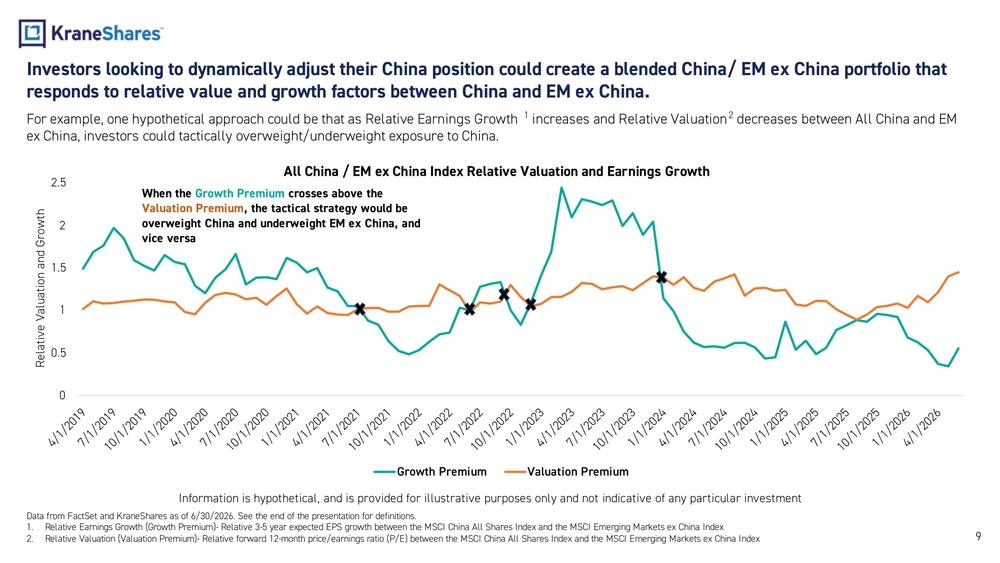
9 00.511.522.5Relative Valuation and Growth Growth Premium Valuation Premium Information is hypothetical, and is provided for illustrative purposes only and not indicative of any particular investment Investors looking to dynamically adjust their China position could create a blended China/ EM ex China portfolio that responds to relative value and growth factors between China and EM ex China. For example, one hypothetical approach could be that as Relative Earnings Growth1 increases and Relative Valuation2 decreases between All China and EM ex China, investors could tactically overweight/underweight exposure to China. Data from FactSet and KraneShares as of 6/30/2026 . See the end of the presentation for definitions .
- Relative Earnings Growth (Growth Premium) - Relative 3 -5 year expected EPS growth between the MSCI China All Shares Index and the MSCI Emerging Markets ex China Index
- Relative Valuation (Valuation Premium) - Relative forward 12 -month price/earnings ratio (P/E) between the MSCI China All Shares I ndex and the MSCI Emerging Markets ex China IndexAll China / EM ex China Index Relative Valuation and Earnings Growth When the Growth Premium crosses above the Valuation Premium , the tactical strategy would be overweight China and underweight EM ex China, and vice versa
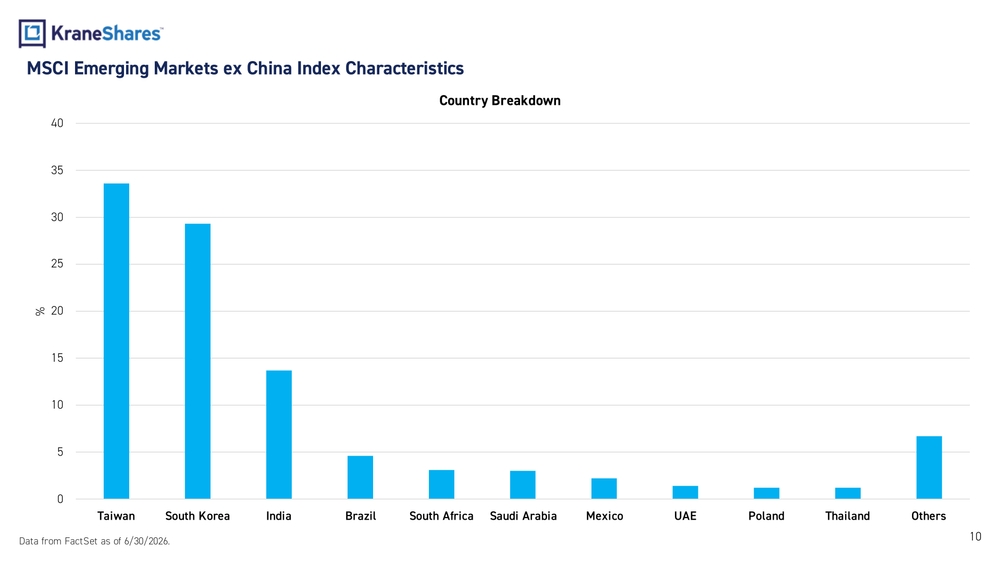
10 MSCI Emerging Markets ex China Index Characteristics Data from FactSet as of 6/30/2026 .0510152025303540 Taiwan South Korea India Brazil South Africa Saudi Arabia Mexico UAE Poland Thailand Others%Country Breakdown
11
KraneShares MSCI Emerging Markets ex
China Index ETF
Investment Strategy:
KEMX isbenchmarked totheMSCI Emerging Markets exChina Index,
which tracks mid-capandlarge -capcompanies within emerging market
countries, excluding China. KEMX enables investors tobuild tailored EM
portfolios with adjusted exposure toChina. KEMX canbepaired with
KraneShares China -focused core andthematic funds tomake a
strategic investment inChina without duplicating exposures.
KEMX Performance History asof6/30/202 6:
Theperformance data quoted represents past performance. Past performance does notguarantee future results. Theinvestment return andprincipal value ofaninvestment will fluctuate sothat aninvestors shares, when sold orredeemed, may beworth
more orless than their original cost andcurrent performance may belower orhigher than theperformance quoted. Forperformance data current tothemost recent month end, please visit www.kraneshares.com/kemx.
Index returns areforillustrative purposes only. Index performance returns donotreflect anymanagement fees, transaction costs orexpenses. Indexes areunmanaged and onecannot invest directly inanindex.
Fee waivers arecontractual andineffect until August 1,2026Fund Details Data as of 6/30/2026
Primary Exchange NYSE Arca, Inc.
CUSIP 500767769
ISIN US5007677694
Total Annual Fund Operating Expense (Gross) 0.59%
Total Annual Fund Operating Expense (Net) 0.24%
Inception Date 04/11/2019
Distribution Frequency Annual
Underlying IndexMSCI Emerging
Markets ex
China Index
NetAssets $133,673,353
Number ofHoldings 300Top10Holdings asof6/30/202 6
Holdings aresubject tochange.%
TAIWAN SEMICONDUCTOR MANUFAC 15.23
SAMSUNG ELECTRONICS COLTD 7.73
SKHYNIX INC 6.94
MEDIATEK INC 2.59
SAMSUNG ELECTRO -MECHANICS CO 1.79
SKSQUARE COLTD 1.76
ACCTON TECHNOLOGY CORP 1.35
DELTA ELECTRONICS INC 1.28
RELIANCE INDUSTRIES LIMITED 1.00
NAN YAPLASTICS CORP 0.99
Cumulative % Average Annualized %
3Mo 6Mo Since Inception 1Yr 3Yr 5Yr Since Inception
Fund NAV 32.64% 37.75% 155.56% 64.52% 28.47% 13.33% 13.87%
Closing Price 29.40% 41.50% 160.64% 68.14% 29.02% 13.97% 14.18%
Underlying Index 34.53% 38.78% 146.71% 63.11% 28.34% 13.19% 13.31%
12 Conclusion Email : info@KraneShares.com Phone: +(1) 855 8KRANE8•Within emerging markets, KraneShares believes China is in a league of its own; an asset class unto itself distinguished by its market size and unique drivers of risk and return. •We believe that incorporating a strategic China investment strategy that distinguishes China from the rest of EM may help to optimize EM performance. •We believe KEMX is a great tool to enable a variety of custom completion strategies around China. Contact us for further insight into right -sizing your China exposure!China Core -Thematic Thematic investments may generally complement the China core allocation.By analyzing various characteristics across countries and within regions, each strategy can be implemented tactically to further refine return and risk.China Tactical Custom China Allocation Strategies
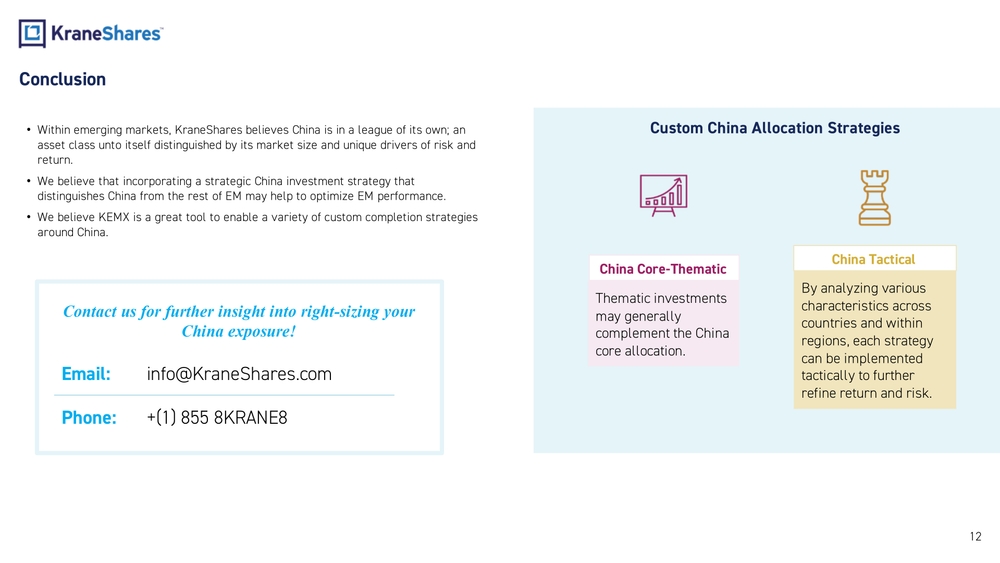
13 KraneShares Empowering investors with access to the world’ s most powerful growth themes through ETFs, private strategies, and innovative investment solutions.
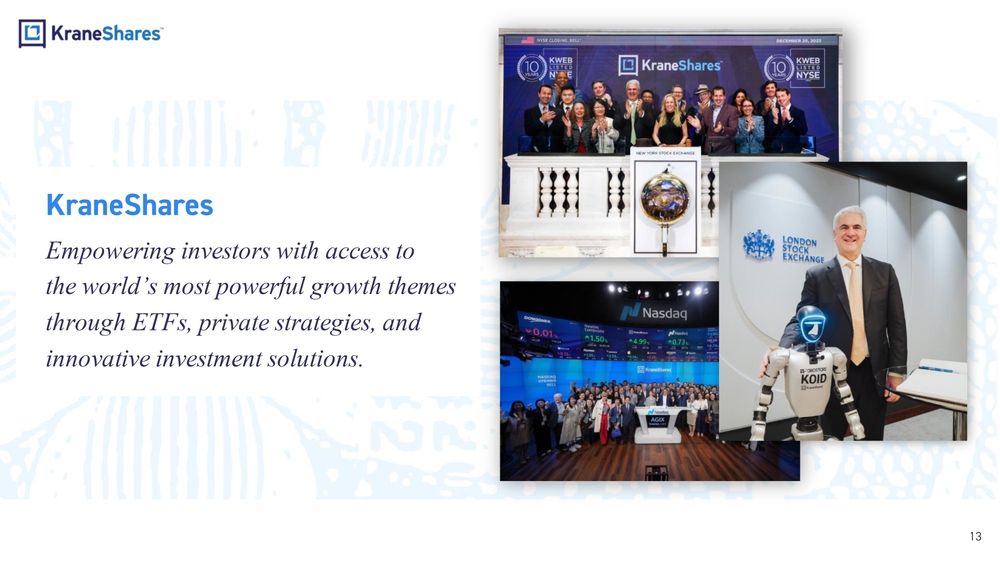
14 China, Emerging Markets & Regional Alternatives Income & Covered Call AI, Robotics & Emerging Technology KURE Healthcare KGRN Clean TechnologyKSTR STAR Market KTEC Hang Seng TechKWEB Internet & E -Commerce China A Shares KBA / CHIN KCAI China Onshore Alpha IndexAGIX Artificial Intelligence & Technology KOID Humanoid & Embodied Intelligence Electric Vehicles & Future Mobility KARSChina Suite Future TechBroader Emerging Markets KEMQ Emerging Markets Consumer Tech KPHODragon Capital Vietnam GrowthKEMX MSCI Emerging Markets ex China U.S. & Developed Markets KVLE Value Line® Dynamic Dividend EquityHedgeye Hedged Equity KSPY Man Buyout Beta Index BUYO Fixed Income BNDDQuadratic Deflation ETFIVOLQuadratic Interest Rate Volatility & Inflation Hedge KHYB Asia High Income USD BondSustainable Ultra Short DurationKCSH KEUA European Carbon AllowanceGlobal Carbon Strategy KRBNCarbon CreditsKPDD 2X Long PDD Daily KJD 2X Long JD DailyKBAB 2X Long BABA Daily KMLI 2X Long MELI Daily Covered Call & Options Income Managed Futures KMLMMount Lucas Managed Futures KWIN Wahed Alternative IncomeKLIP China Internet & Covered Call Outcome Based Equity KIQQ Nasdaq Buffer & Option IncomeLevered & High -Conviction Exposure KBUF90% KWEB Defined Outcome100% KWEB Defined Outcome KPRO Alternative Income KCCA California Carbon AllowanceExtensive ETF Product Suite Spanning High Growth Sectors Strategy also available in UCITS / ETCKBDU 2X Long BIDU Daily
15
Index Definitions:
MSCI ACWI GDP Weighted (USD Gross) Index: This index is based on the flagship MSCI ACWI Index, its parent index, and includes large and mid cap stocks across 23 Developed Markets (DM)
and 24 Emerging Markets (EM) countries. The index uses a different weighting scheme than its cap weighted parent index, howev er. The weight of each country in the index is derived from its
economic size (using GDP data) rather than the size of its equity market. Over time, GDP data tends to have more stability th an equity market prices.
MSCI China (USD Net) Index: The index captures large and mid -cap representation across offshore listings of Chinese companies in the form of H shares, B sha res, Red chips, P chips, and foreign
listings such as ADRs. With 447 constituents, the index covers about 85% of this China equity universe. Currently, the index also includes Large Cap A shares, represented at 2.5% of their free float
adjusted market capitalization.
China’s Equity (Stock) Market: For the purposes of this presentation, this refers to the superset of investments including the Mainland, Hong Kong, and over seas listed securities found in the
MSCI China All Shares Index. Note that others may use a different definition and, as such, the data provided by other sources may not match ours as it may exclude shares listed in certain places.
16
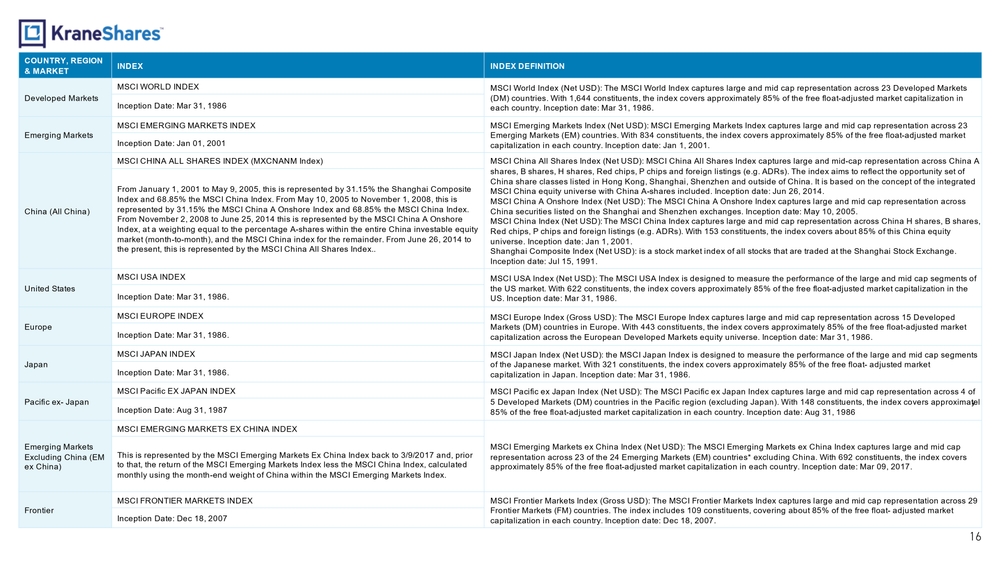
COUNTRY, REGION
& MARKET INDEX INDEX DEFINITION
Developed Markets MSCI WORLD INDEX MSCI World Index (Net USD): The MSCI World Index captures large and mid cap representation across 23 Developed Markets
(DM) countries. With 1,644 constituents, the index covers approximately 85% of the free float -adjusted market capitalization in
each country. Inception date: Mar 31, 1986. Inception Date: Mar 31, 1986
Emerging Markets MSCI EMERGING MARKETS INDEX MSCI Emerging Markets Index (Net USD): MSCI Emerging Markets Index captures large and mid cap representation across 23
Emerging Markets (EM) countries. With 834 constituents, the index covers approximately 85% of the free float -adjusted market
capitalization in each country. Inception date: Jan 1, 2001. Inception Date: Jan 01, 2001
China (All China)MSCI CHINA ALL SHARES INDEX (MXCNANM Index) MSCI China All Shares Index (Net USD): MSCI China All Shares Index captures large and mid -cap representation across China A
shares, B shares, H shares, Red chips, P chips and foreign listings (e.g. ADRs). The index aims to reflect the opportunity set of
China share classes listed in Hong Kong, Shanghai, Shenzhen and outside of China. It is based on the concept of the integrate d
MSCI China equity universe with China A -shares included. Inception date: Jun 26, 2014.
MSCI China A Onshore Index (Net USD): The MSCI China A Onshore Index captures large and mid cap representation across
China securities listed on the Shanghai and Shenzhen exchanges. Inception date: May 10, 2005.
MSCI China Index (Net USD): The MSCI China Index captures large and mid cap representation across China H shares, B shares,
Red chips, P chips and foreign listings (e.g. ADRs). With 153 constituents, the index covers about 85% of this China equity
universe. Inception date: Jan 1, 2001.
Shanghai Composite Index (Net USD) : is a stock market index of all stocks that are traded at the Shanghai Stock Exchange.
Inception date: Jul 15, 1991. From January 1, 2001 to May 9, 2005, this is represented by 31.15% the Shanghai Composite
Index and 68.85% the MSCI China Index. From May 10, 2005 to November 1, 2008, this is
represented by 31.15% the MSCI China A Onshore Index and 68.85% the MSCI China Index.
From November 2, 2008 to June 25, 2014 this is represented by the MSCI China A Onshore
Index, at a weighting equal to the percentage A -shares within the entire China investable equity
market (month -to-month), and the MSCI China index for the remainder. From June 26, 2014 to
the present, this is represented by the MSCI China All Shares Index..
United States MSCI USA INDEX MSCI USA Index (Net USD): The MSCI USA Index is designed to measure the performance of the large and mid cap segments of
the US market. With 622 constituents, the index covers approximately 85% of the free float -adjusted market capitalization in the
US. Inception date: Mar 31, 1986. Inception Date: Mar 31, 1986.
Europe MSCI EUROPE INDEX MSCI Europe Index (Gross USD): The MSCI Europe Index captures large and mid cap representation across 15 Developed
Markets (DM) countries in Europe. With 443 constituents, the index covers approximately 85% of the free float -adjusted market
capitalization across the European Developed Markets equity universe. Inception date: Mar 31, 1986. Inception Date: Mar 31, 1986.
Japan MSCI JAPAN INDEX MSCI Japan Index (Net USD): the MSCI Japan Index is designed to measure the performance of the large and mid cap segments
of the Japanese market. With 321 constituents, the index covers approximately 85% of the free float - adjusted market
capitalization in Japan. Inception date: Mar 31, 1986. Inception Date: Mar 31, 1986.
Pacific ex - Japan MSCI Pacific EX JAPAN INDEX MSCI Pacific ex Japan Index (Net USD): The MSCI Pacific ex Japan Index captures large and mid cap representation across 4 of
5 Developed Markets (DM) countries in the Pacific region (excluding Japan). With 148 constituents, the index covers approxima tely
85% of the free float -adjusted market capitalization in each country. Inception date: Aug 31, 1986 Inception Date: Aug 31, 1987
Emerging Markets
Excluding China (EM
ex China)MSCI EMERGING MARKETS EX CHINA INDEX
MSCI Emerging Markets ex China Index (Net USD) : The MSCI Emerging Markets ex China Index captures large and mid cap
representation across 23 of the 24 Emerging Markets (EM) countries* excluding China. With 692 constituents, the index covers
approximately 85% of the free float -adjusted market capitalization in each country. Inception date: Mar 09, 2017.This is represented by the MSCI Emerging Markets Ex China Index back to 3/9/2017 and, prior
to that, the return of the MSCI Emerging Markets Index less the MSCI China Index, calculated
monthly using the month -end weight of China within the MSCI Emerging Markets Index.
Frontier MSCI FRONTIER MARKETS INDEX MSCI Frontier Markets Index (Gross USD) : The MSCI Frontier Markets Index captures large and mid cap representation across 29
Frontier Markets (FM) countries. The index includes 109 constituents, covering about 85% of the free float - adjusted market
capitalization in each country. Inception date: Dec 18, 2007. Inception Date: Dec 18, 2007
17
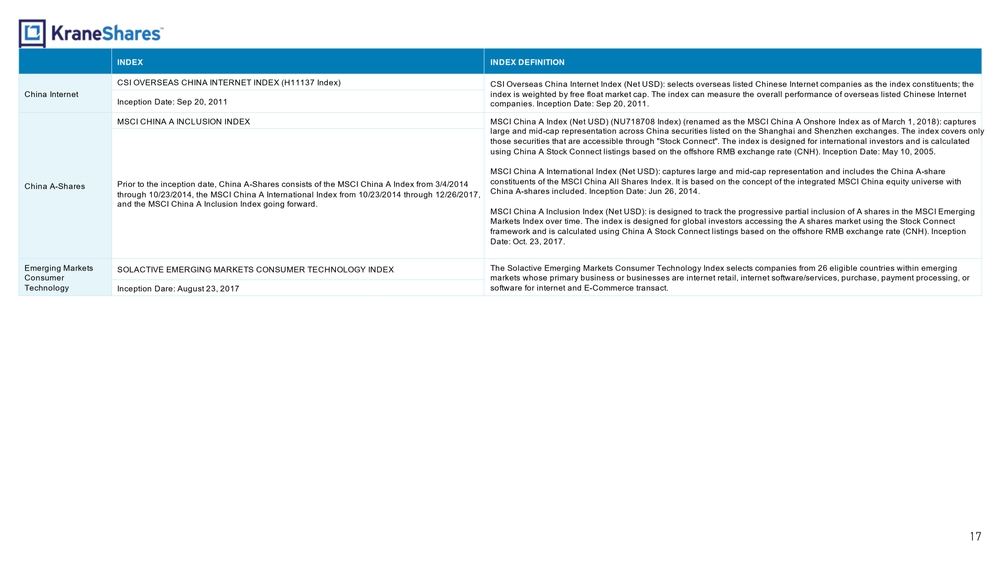
INDEX INDEX DEFINITION
China InternetCSI OVERSEAS CHINA INTERNET INDEX (H11137 Index) CSI Overseas China Internet Index (Net USD): selects overseas listed Chinese Internet companies as the index constituents; the
index is weighted by free float market cap. The index can measure the overall performance of overseas listed Chinese Internet
companies. Inception Date: Sep 20, 2011. Inception Date: Sep 20, 2011
China A -SharesMSCI CHINA A INCLUSION INDEX MSCI China A Index (Net USD) ( NU718708 Index) (renamed as the MSCI China A Onshore Index as of March 1, 2018) : captures
large and mid -cap representation across China securities listed on the Shanghai and Shenzhen exchanges. The index covers only
those securities that are accessible through "Stock Connect". The index is designed for international investors and is calcul ated
using China A Stock Connect listings based on the offshore RMB exchange rate (CNH). Inception Date: May 10, 2005.
MSCI China A International Index (Net USD) : captures large and mid -cap representation and includes the China A -share
constituents of the MSCI China All Shares Index. It is based on the concept of the integrated MSCI China equity universe with
China A -shares included. Inception Date: Jun 26, 2014.
MSCI China A Inclusion Index (Net USD) : is designed to track the progressive partial inclusion of A shares in the MSCI Emerging
Markets Index over time. The index is designed for global investors accessing the A shares market using the Stock Connect
framework and is calculated using China A Stock Connect listings based on the offshore RMB exchange rate (CNH). Inception
Date: Oct. 23, 2017.Prior to the inception date, China A -Shares consists of the MSCI China A Index from 3/4/2014
through 10/23/2014, the MSCI China A International Index from 10/23/2014 through 12/26/2017,
and the MSCI China A Inclusion Index going forward.
Emerging Markets
Consumer
TechnologySOLACTIVE EMERGING MARKETS CONSUMER TECHNOLOGY INDEX The Solactive Emerging Markets Consumer Technology Index selects companies from 26 eligible countries within emerging
markets whose primary business or businesses are internet retail, internet software/services, purchase, payment processing, o r
software for internet and E -Commerce transact. Inception Dare: August 23, 2017
18
Important Notes:
Carefully consider the Funds’ investment objectives, risk factors, charges and expenses before investing. This and additional information can be found in the Funds' full and summary
prospectus, which may be obtained by visiting www.kraneshares.com/kemx . Read the prospectus carefully before investing.
Risk Disclosures:
Investing involves risk, including possible loss of principal. There can be no assurance that a Fund will achieve its stated objectives. Indices are unmanaged and do not include the effect of fees. One cannot invest directly in an index.
This information should not be relied upon as research, investment advice, or a recommendation regarding any products, strategies, or any security in particular. This material is strictly for illustrative, educational, or informational
purposes and is subject to change. Certain content represents an assessment of the market environment at a specific time and is not intended to be a forecast of future events or a guarantee of future results; material is as of the
dates noted and is subject to change without notice.
The Funds may invest in derivatives, which are often more volatile than other investments and may magnify the Funds’ gains or losses. A derivative (i.e., futures/forward contracts, swaps, and options) is a contract that derives its value
from the performance of an underlying asset. The primary risk of derivatives is that changes in the asset’s market value and the derivative may not be proportionate, and some derivatives can have the potential for unlimited losses.
Derivatives are also subject to liquidity and counterparty risk. The Funds are subject to liquidity risk, meaning that certai n investments may become difficult to purchase or sell at a reasonable time and price. If a transaction for these
securities is large, it may not be possible to initiate, which may cause the Funds to suffer losses. Counterparty risk is the risk of loss in the event that the counterparty to an agreement fails to make required payments or otherwise
comply with the terms of the derivative.
The ability of KBA and KWEB to achieve their respective investment objectives is dependent, in part, on the continuous availa bility of A Shares and the ability to obtain, if necessary, additional A Shares quota. If the Funds are unable to
obtain sufficient exposure to limited availability of A Share quota, the Funds could seek exposure to the component securitie s of the Underlying Index by investment in other types of securities.
KBA and KWEB are subject to political, social or economic instability within China which may cause a decline in value. KEMX i s subject to the political, social or economic instability associated with investing internationally which may
cause a decline in value. Emerging markets involve heightened risk related to the same factors as well as increase volatility and lower trading volume. Fluctuations in currency of foreign countries may have an adverse effect to
domestic currency values. The Funds may invest in Initial Public Offerings (IPOs). Securities issued in IPOs have no trading history, and information about the companies may be available for very limited periods. In addition, the prices of
securities sold in IPOs may be highly volatile. In addition, as the Funds increases in size, the impact of IPOs on the Funds’ performance will generally decrease.
Narrowly focused investments typically exhibit higher volatility. The Funds’ assets are expected to be concentrated in a sector,industry , market, or group of concentrations to the extent that the Underlying Index has such concentrations.
The securities or futures in that concentration could react similarly to market developments. Thus, the Funds are subject to loss due to adverse occurrences that affect that concentration. In addition to the normal risks associated with
investing, investments in smaller companies typically exhibit higher volatility. KWEB is non -diversified.
ETF shares are bought and sold on an exchange at market price (not NAV) and are not individually redeemed from the Fund. However, shares may be redeemed at NAV directly by certain authorized broker -dealers (Authorized
Participants) in very large creation/redemption units. The returns shown do not represent the returns you would receive if you traded shares at other times. Shares may trade at a premium or discount to their NAV in the secondary
market. Brokerage commissions will reduce returns. Beginning 12/23/2020, market price returns are based on the official closing price of an ETF share or, if the official closing price isn't available, the midpoint between the national
best bid and national best offer ("NBBO") as of the time the ETF calculates the current NAV per share. Prior to that date, market price returns were based on the midpoint between the Bid and Ask price. NAVs are calculated using
prices as of 4:00 PM Eastern Time.
The KraneShares ETFs and KFA Funds ETFs are distributed by SEI Investments Distribution Company (SIDCO), 1 Freedom Valley Drive, Oaks, PA 19456, which is not affiliated with Krane Funds Advisors, LLC, the Investment
Adviser for the Funds, or any sub-advisers for the Funds.
[R_US_KS_SEI]