2024_11_cca_policy_uncertainty_oktay_eu
by Kraneshares
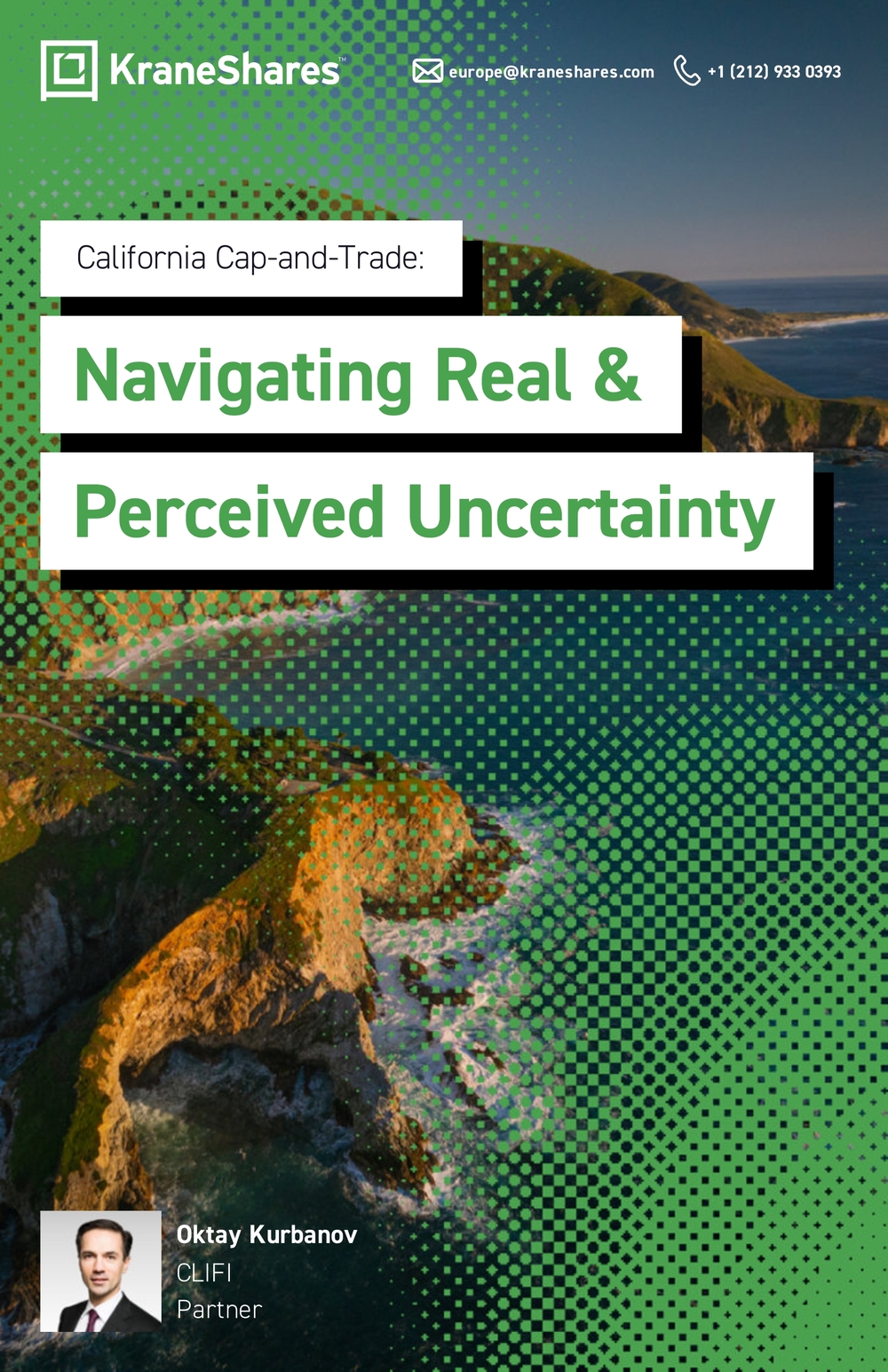
Oktay Kurbanov CLIFI Partner California Cap-and-Trade: Navigating Real & Perceived Uncertaintyeurope@kraneshares.com +1 (212) 933 0393
2 kraneshares.com Back to Top ↑Table of Contents Introduction 3 2024 Presidential Elections 4 Local Political Support 6 Upcoming Reforms 8 Conclusion 12 Citations 12 Disclosures 13europe@kraneshares.com +1 (212) 933 0393
3 kraneshares.eu europe@kraneshares.com +1 (212) 933 0393 Back to Top ↑Introduction The California carbon market has been a star performer, garnering growing attention from financial players. For the last five years, from 2019 through 2023, California carbon allowances (CCAs) appreciated 13.6% per annum. This great run was interrupted in 2024, with CCAs declining from $42 at the beginning of the year to $36 at the end of September.1 While many factors may explain underperformance, we focus on what we think has been a major contributor: the towering uncertainty over the timing and magnitude of upcoming reforms. This uncertainty has been magnified by the upcoming contested presidential election, which is fueled by fears of a negative impact on cap-and-trade. Finally, the possibility of Washington's Cap-and-invest repeal made some investors worry about similar political risks in California. In this paper, we will address these risks and uncertainties, with key takeaways below: •Presidential elections do not have a direct impact on emission trading systems in the United States. US Emission Trading Systems (ETS), such as California's Cap- and-trade and the Northeast US power Regional Greenhouse Gas Initiative (RGGI), are programs that are established and run by the states and, as such, are not subject to federal jurisdiction. There are some second-order effects that are worth understanding and analyzing. The analysis shows that, if anything, these effects present an upside risk for CCAs. •Local political support is a cornerstone of any effective ETS, and this support has been strong and continues to increase in California. The original and subsequent cap-and-trade legislation has largely been supported along party lines, driven by the Democratic Party. The representation of the Democratic Party in both the state senate and assembly has steadily increased over the last ten years to an overwhelming majority. Moreover, the most recent extension of the cap-and-trade in 2017 (Assembly Bill 398) enjoyed bi-partisan support. This paper will provide a historical analysis of these trends and contrast them with the political trends in Washington. •Market reform delays and uncertainty have weighed heavily on CCAs. However, the additional time delay in implementation is only a year. Either of the two cap- reduction options presented by the California Air Resource Board (CARB) will significantly tighten the market by reducing the supply available through auctions
4 kraneshares.eu europe@kraneshares.com +1 (212) 933 0393 Back to Top ↑and free allocations. Over the 10-year period from 2026 (the first year of the new caps) to 2035, the supply is expected to decrease by at least 20% under Option 1 and 26% under Option 2. While this uncertainty is real, it is limited in both time and scope and should not detract from the favorable supply-demand outlook in California's Cap-and-trade. Based on these observations, we believe the market has overreacted to these uncertainties, bringing CCAs down to highly attractive levels. Those investors who can rationalize and navigate these uncertainties stand to take advantage of the current opportunities in carbon markets. 2024 Presidential Elections Green energy transition initiatives, electric vehicle (EV) adoption targets, the 2022 Inflation Reduction Act and other climate related issues have become hot topics of debate in the 2024 presidential elections. Are state-run ETS programs, like California's Cap-and-trade, also at risk of becoming entangled in political conflicts, and what challenges could arise from a change in the White House administration? There are some key considerations that protect the cap-and-trade programs from federal interference. First, due to absence of a federal cap-and-trade program, California is relying on the constitutional authority under the 10th amendment for the state to regulate matters not explicitly reserved for the federal government.2 This is further supported by the decades-old US EPA's Clean Air Act that gave California special status to implement stricter air quality regulations than those imposed by the federal government, including cap-and-trade regulations.3 Finally, multiple court rulings have upheld the constitutionality of California's cap-and-trade program, affirming that the state has the authority to design and implement its own system. In April 2017, California's Third District Court of Appeal rejected the California Chamber of Commerce's argument that auctioning carbon allowances constitutes an unlawful tax. It stated that "the purchase of allowances is a voluntary decision driven by business judgments as to whether it is more beneficial to the company to make the purchase than to reduce emissions. Reducing emissions reduces air pollution, and no entity has a vested right to pollute."4 This solid legal foundation may explain why the Trump administration did not challenge the cap-and-trade directly but chose to contest its linkage with Quebec in October 2019, arguing presidential authority over foreign
5 kraneshares.eu europe@kraneshares.com +1 (212) 933 0393 Back to Top ↑affairs. This challenge was dismissed as well by a US District Judge in March 2020 based on the grounds that the linkage agreement does not fall under the "treaty" definition and thus does not encroach on federal powers.5 There are some areas where the federal government does have a sway, which may have an indirect effect on cap-and-trade and other states-run ETS. It is reasonable to assume that under the Democratic Harris administration, climate-related and green energy transition initiatives implemented under the Biden administration will continue their course. On the other side, the Republican candidate and former President Trump made clear his support for developing fossil fuels, scaling back renewable energy policies, and reversing electric vehicle mandates.6 He can accomplish these measures using various tools in the federal administration such as removing regulations limiting drilling for oil and gas, ending delays for permits to drill on federal land, halting permits for new wind power projects by ordering fresh studies of impact, rolling back electric vehicles subsidies and vehicle efficiency rules. It is worth noting that much of the rhetoric will not go further than the campaign trail for a few reasons. Rollbacks of regulations by Trump's administration in its first term have faced numerous legal challenges. For example, out of 32 deregulation challenges in the area of environment, energy, and natural resources, the former administration lost 27 cases.7 Scrapping climate funding under the Inflation Reduction Act (IRA) may also prove politically difficult considering that about 90% of the capital is directed toward Republican congressional districts.8 Some new energy areas can also bring new jobs and industry demand, reducing incentives to fight them. For example, developers expect that offshore wind can deliver up to $25 billion in annual output in the US by driving demand for steel, new ships and other specialty equipment.9 The important point to conclude, however, is that even if some of these rollbacks do occur, they will lead to more fossil fuels usage in the form of energy and gasoline. To the degree it will affect California, this will create incremental demand for California's carbon allowances, providing support for prices. While the likelihood of a material impact on CCAs from the presidential elections is low, the risk is skewed on the upside.
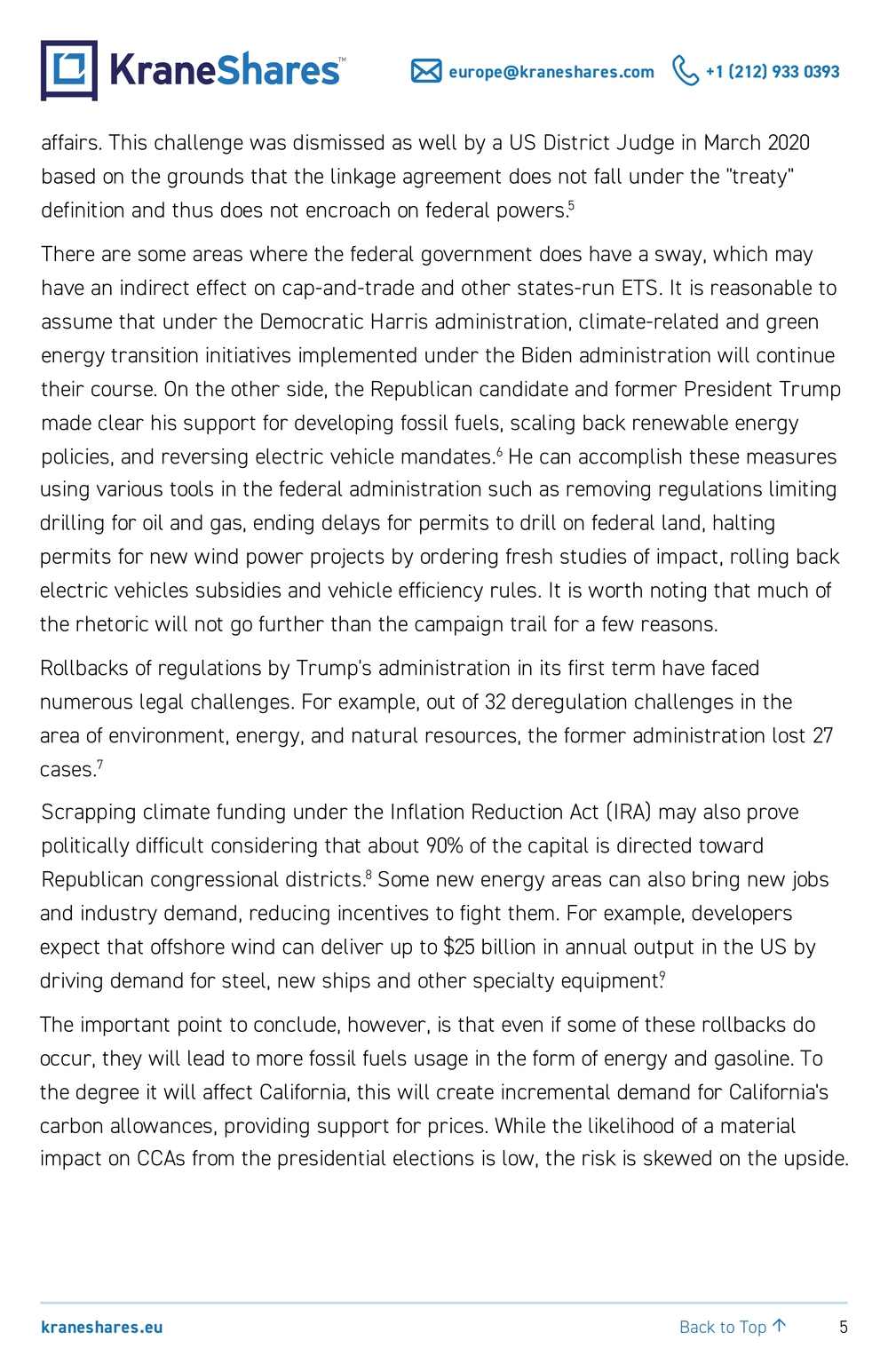
6 kraneshares.eu europe@kraneshares.com +1 (212) 933 0393 Back to Top ↑Local Political Support Heated political debates make some worry if these may undermine local support for the cap-and-trade. Could it be at risk of repeal, similar to Washington's Cap-and- Invest program? We use voting for Democratic candidates as a proxy for supporting the state's emissions trading system and voting for Republican candidates as a proxy for opposition. While this simplifies the dynamics, given that most cap-and-trade legislation has been passed along party lines, it is a reasonable assumption. We start our analysis by analyzing the trends in popular votes using combined data from presidential and gubernatorial elections. This data is relevant if a question of repeal ever makes it to the ballot box as it did in the state of Washington ("Initiative 2117").10 While both states voted Democratic in recent elections, to analyze the strength and stability of the support one has to look at the voting margin, i.e. the difference between Democratic and Republican votes. Figure 1 below presents this margin for the last three presidential and gubernatorial elections as well as the recent polls for the 2024 elections, for both Washington and California: Figure 1. Voting Margin Favoring Democrats over Republicans for presidential and gubernatorial elections 0%5%10%15%20%25%30%35% 3rd Prev Pres 3rd Prev Gov2 nd Prev Pres 2nd Prev GovP rev Pres Prev Gov2 024 Pres Polls2 024 Gov Polls Washington California Sources: CLIFI, 270toWin, Ballotpedia, polls as of 10/15/24
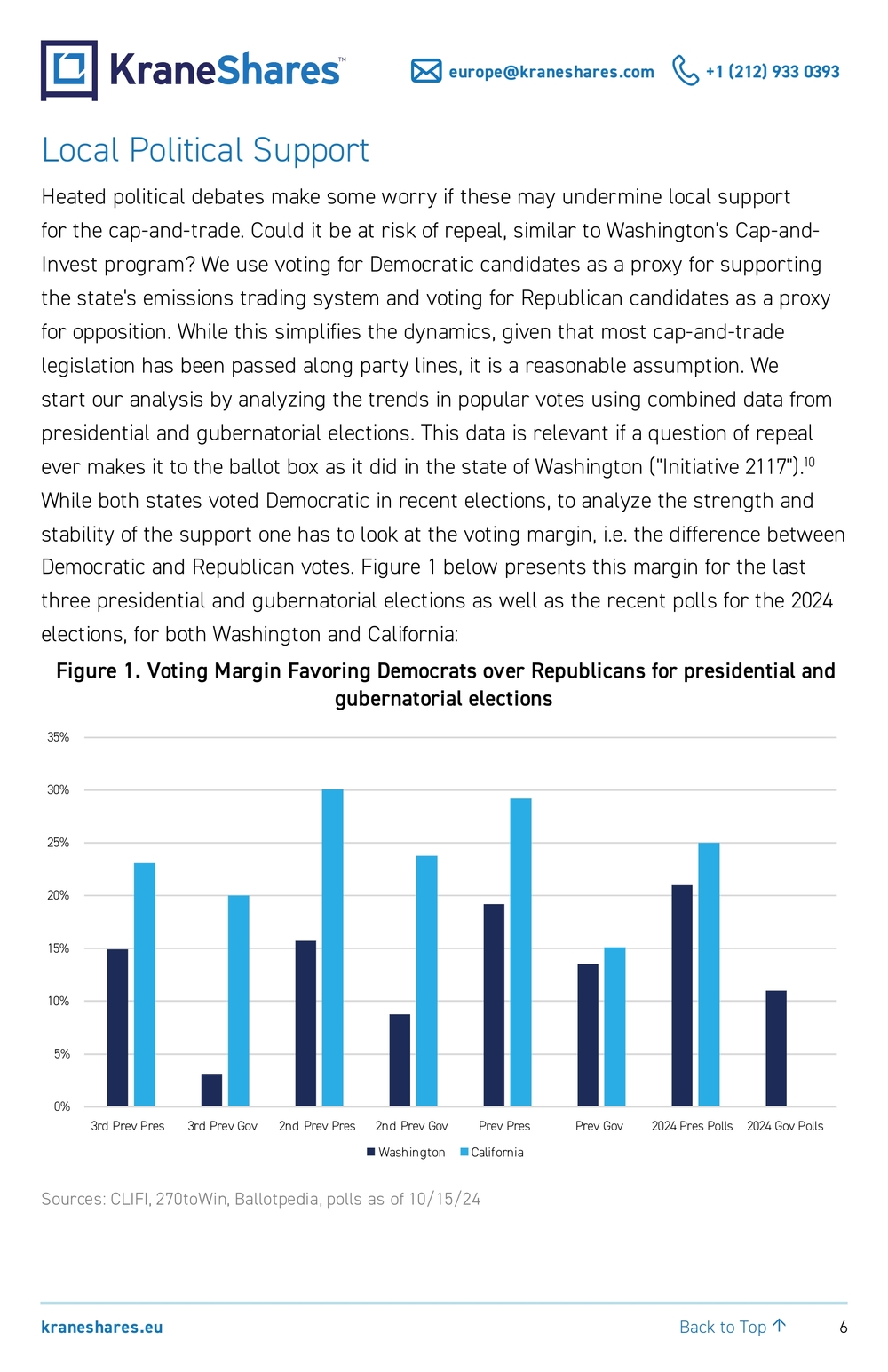
7 kraneshares.eu europe@kraneshares.com +1 (212) 933 0393 Back to Top ↑One can clearly see a significant margin favoring Democratic candidates in both states. However, this spread is consistently bigger for California, averaging more than 23% over the years, while Washington enjoys a much smaller margin, less than 14%. While both states should receive majority support for Democrats-driven programs, California's Cap-and-trade is in a more comfortable spot in terms of receiving a strong majority should it ever come to the ballot. Another possible risk to the program comes from the regulatory side, where the state's legislature is not fully behind the program. This occurred in Virginia, which left RGGI in 2023, and in Pennsylvania, which was blocked from participating in RGGI in 2022 after an initial push forward. These setbacks are prone to happen when different parties control different chambers and branches of the state government. For example, at the time Virginia adopted legislation to join RGGI, Democrats controlled the Senate, the House of Delegates, and the Governor's office.11 However, in 2021, Republicans won the governorship and regained a majority in the Virginia House, allowing Governor Youngkin to push through legislation to withdraw from RGGI. In contrast, California has had a Democratic trifecta since 2012. Figure 2 below presents the Democratic majority margin in both chambers of the legislature for California and Washington: Figure 2. Democratic majority margin in California and Washington Senate and Assembly -10%0%10%20%30%40%50%60%70% 2012 2014 2016 2018 2020 2022 2024 Cal - Se nate Cal - As sembly Wash - Senate Wash - Assembly Source: CLIFI, Ballotpedia. 2012-2022 are election results, 2024 are actual numbers in October.
8 kraneshares.eu europe@kraneshares.com +1 (212) 933 0393 Back to Top ↑While both states enjoyed a Democratic majority in the legislature, Washington's majority margin is much smaller and was briefly lost in the Senate during the 2014 and 2016 elections. California's Democrats on the other side, have consistently sustained a significant majority margin, which has increased over the last ten years by about 20%. As of 2024, both California's Senate and Assembly are split about the same, 78% Democrats and 22% Republicans. This consistent large majority margin for Democrats should provide strong governmental support for California's Cap-and-trade going forward. It is also worth mentioning that the most recent extension of cap-and-trade, 2017 Assembly Bill 398 (AB 398), enjoyed bipartisan support when 7 out of 22 Republicans in the assembly voted for the bill. The bill gained the support of some Republicans by emphasizing the "need to avoid adverse impacts on resident households, businesses, and the state's economy" and established the price ceiling and other business-friendly regulations such as tax breaks and removal of certain fees.13,14 Another reason for wide popular support for California's Cap-and-trade is its proven record of directing its revenues to California's communities. Since its inception, the program has raised $27 billion to support California's climate, energy, and social programs.15 $11 billion of that was used for community needs to deliver economic, environmental, and public health benefits for California residents. These projects included affordable housing, benefits for disadvantaged and low-income communities, planting trees, land conservation, and improving transit service.16 With its proven track record of reducing emissions, public benefit programs, and strong governmental support, California is well-positioned to continue its successful operation of cap-and- trade toward net carbon neutrality in 2045. Upcoming Reforms Many market participants have gotten frustrated by the slow pace of progress of the market-tightening reforms by CARB. This has affected both the price performance as well as the willingness of some investors to enter this market or increase their allocations to CCAs. However, there is light at the end of the tunnel as CARB has gradually moved through the required steps and reached the final stages of reform implementation. These steps included critical milestones such as delivering Standardized Regulatory Impact Analysis (SRIA), the July workshop that narrowed
9 kraneshares.eu europe@kraneshares.com +1 (212) 933 0393 Back to Top ↑down implementation options, and a joint meeting of CARB with the Environmental Justice Advisory Committee (EJAC) in September. Considering this progression, the timing of the reform is a lot more certain now: CARB is set to release the final rule- making package before the end of the year for a 45-day public comment period. This will be followed by a formal board vote in 2025, with 2026 as the first year of tighter emission caps. The uncertainty that remains is the trajectory of these cap adjustments. In its most recent update in July 2024, CARB presented two possible trajectories of tightening emission caps to achieve the goal of 48% reduction of greenhouse emissions in 2030 (vs. 1990) and the goal of carbon neutrality by 2045:17 •Option 1: a less aggressive, 180Mt total cap reduction through 2030, with a subsequent linear decline to a net-carbon neutral cap of 30Mt in 2045 •Option 2: a more aggressive 265Mt total cap reduction through 2030, followed by a plateau through 2037, and resumption of a linear decrease to the 30Mt cap in 2045 Figure 3 illustrates these trajectories and compares them to the current regulation: Figure 3. Comparison of Option 1 and Option 2 emission caps to the current regulation 050100150200250300350 2020 2025 2030 2035 2040 2045Mt CO2e Current Regulation CARB Option 1 CARB Option 2 Source: CARB, Potential Allowance Budget Scenarios for July 10, 2024 workshop
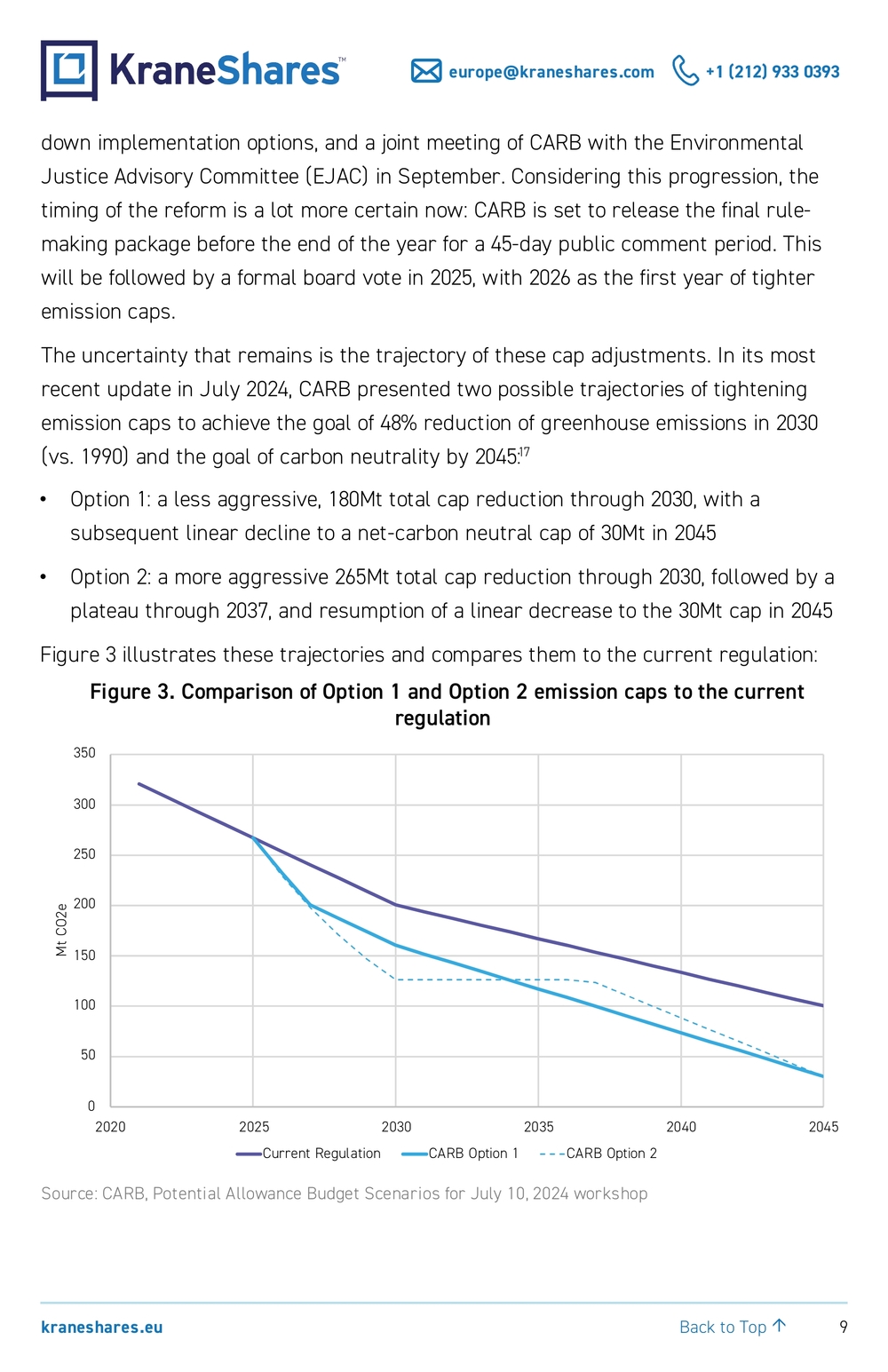
10 kraneshares.eu europe@kraneshares.com +1 (212) 933 0393 Back to Top ↑The area under each cap trajectory represents the total emission budget for a given path. One immediately notices that the emission budget for both options is significantly tighter than the current regulation. Another notable fact is that both trajectories have the same endpoint, eventually converging by 2045, regardless of the initial level of aggressiveness. So, it is a certainty that the supply will be drastically reduced, but a question of how these reductions are spread over time. To provide specific numbers, Table 1 below compares the decrease in supply for Option 1 and Option 2 versus the current regulation for various forward-looking time horizons relative to the 2025 cap (the year before the implementation of new caps): Table 1. Decrease in Carbon Allowance Supply under Option 1 and Option 2 Total Emission Caps by PeriodDecrease in Supply vs Current Regulation PeriodCurrent RegulationCARB Option 1CARB Option 2CARB Option 1CARB Option 2 2026-30 1,136 956 872 -16% -23% 2026-35 2,038 1,628 1,504 -20% -26% 2026-45 3,340 2,322 2,322 -30% -30% Source: CARB, Potential Allowance Budget Scenarios for July 10, 2024 workshop The table shows once again that both options decrease supply dramatically versus the current regulation. While Option 1 is not as aggressive as Option 2, it still reduces supply by 16% in the 5-year period through 2030 and by 20% in the 10-year period through 2035. As we look further out to 2045, the decrease in supply under both options is the same, as intended by CARB. By 2045, a total of 1 billion tons will be removed from the current regulations' supply, or a 30% reduction. The projected trajectories of the cumulative surplus of carbon allowances provide another certainty in the supply-demand dynamics of California's Cap-and-trade program. Figure 4 below presents these trajectories ("cumulative balance") for Options 1 & 2, superimposed with annual supply/demand balances for each option:
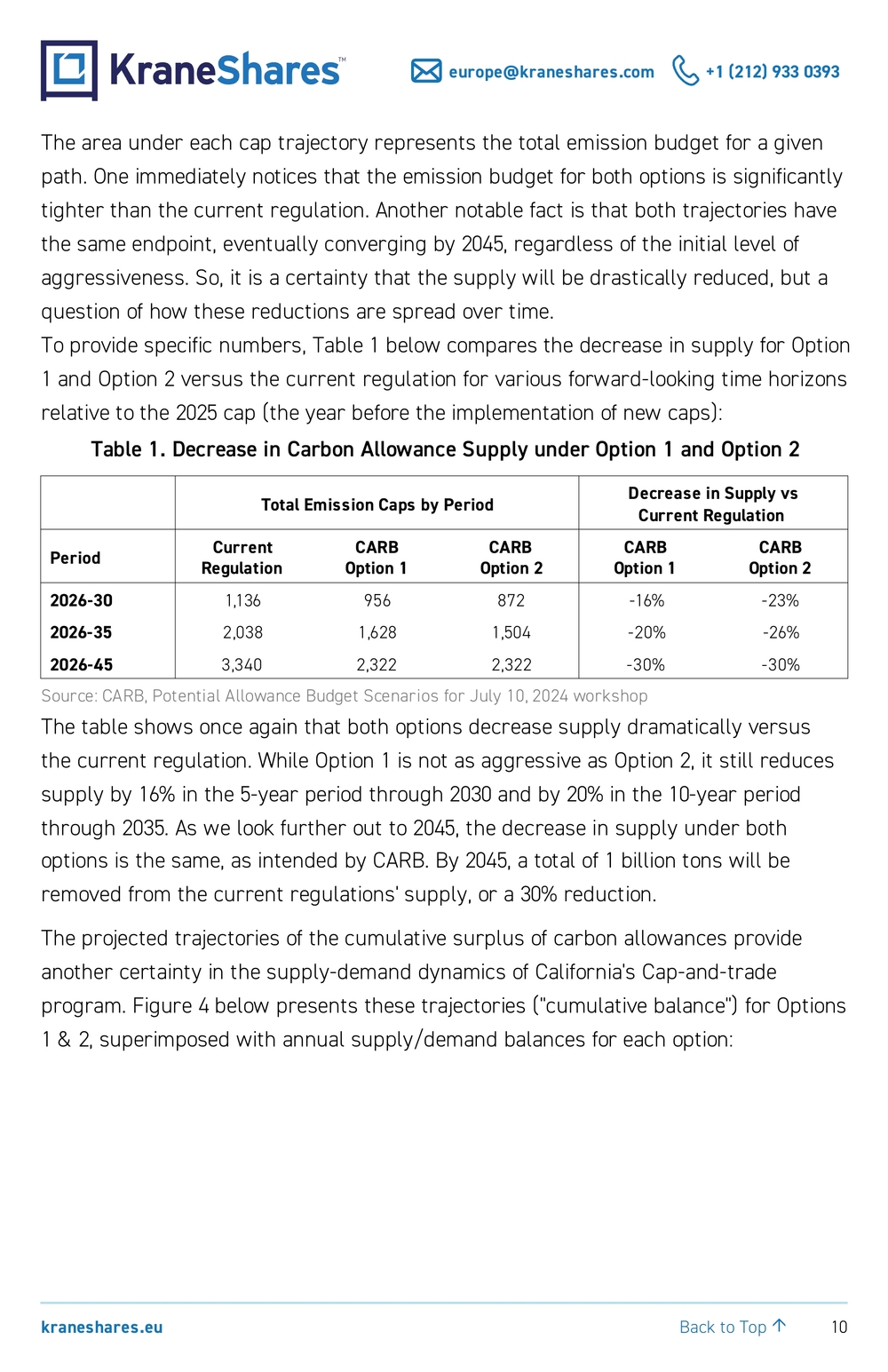
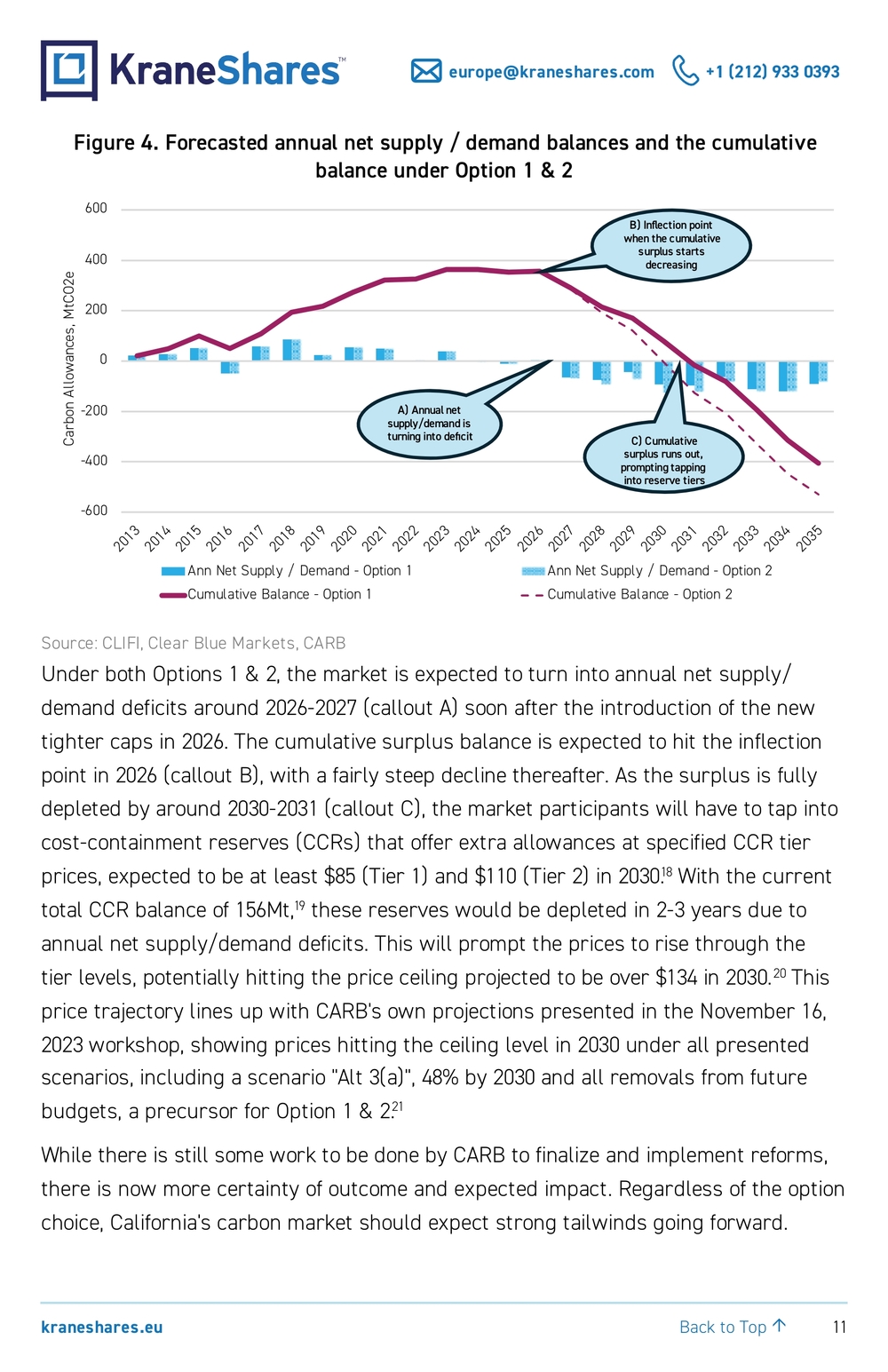
11 kraneshares.eu europe@kraneshares.com +1 (212) 933 0393 Back to Top ↑Figure 4. Forecasted annual net supply / demand balances and the cumulative balance under Option 1 & 2 -600-400-2000200400600 2013 2014 2015 2016 2017 2018 2019 2020 2021 2022 2023 2024 2025 2026 2027 2028 2029 2030 2031 2032 2033 2034 2035Carbon Allowances, MtCO2e Ann Ne t Supply / Demand - Option 1 Ann Ne t Supply / Demand - Option 2 Cumulative Balance - Op tion 1 Cumulative Balance - Op tion 2A) Annual net supply/demand is turning into deficitB) Inflection point when the cumulative surplus starts decreasin g C) Cumulative surplus runs out, prompting tapping into reserve tiers Source: CLIFI, Clear Blue Markets, CARB Under both Options 1 & 2, the market is expected to turn into annual net supply/ demand deficits around 2026-2027 (callout A) soon after the introduction of the new tighter caps in 2026. The cumulative surplus balance is expected to hit the inflection point in 2026 (callout B), with a fairly steep decline thereafter. As the surplus is fully depleted by around 2030-2031 (callout C), the market participants will have to tap into cost-containment reserves (CCRs) that offer extra allowances at specified CCR tier prices, expected to be at least $85 (Tier 1) and $110 (Tier 2) in 2030.18 With the current total CCR balance of 156Mt,19 these reserves would be depleted in 2-3 years due to annual net supply/demand deficits. This will prompt the prices to rise through the tier levels, potentially hitting the price ceiling projected to be over $134 in 2030.20 This price trajectory lines up with CARB's own projections presented in the November 16, 2023 workshop, showing prices hitting the ceiling level in 2030 under all presented scenarios, including a scenario "Alt 3(a)", 48% by 2030 and all removals from future budgets, a precursor for Option 1 & 2.21 While there is still some work to be done by CARB to finalize and implement reforms, there is now more certainty of outcome and expected impact. Regardless of the option choice, California's carbon market should expect strong tailwinds going forward.
12 kraneshares.eu europe@kraneshares.com +1 (212) 933 0393 Back to Top ↑Conclusion Dealing with uncertainty is part of all investment decisions. Diversification22 is partially addressing this issue by reducing the concentration of uncertainty in any given asset. Another important aspect of addressing uncertainty is rationalizing its scope and impact in order to properly assign risk/reward characteristics to a given asset, as this is a key input in building a diversified portfolio. In the case of California's carbon market, this paper demonstrated that the uncertainty has narrowed significantly as the regulatory reforms progressed through the year. Both possible implementation options for cap trajectory introduce much tighter emissions caps, which would be highly supportive of carbon prices. Examining concerns around the negative impact on cap-and-trade arising from presidential elections and possible erosion of local legislative support does not uncover the substance needed to validate them. This creates a unique opportunity for investors to capitalize on CCAs that have been depressed by uncertainty – often more perceived than real. EU gatekeepers and UK financial professionals can access CCAs through the KraneShares ETC Programme, which offers an ETC Series that provides unique exposure to the four largest, most liquid carbon allowance futures markets, including the California market. Citations
- Source: ICE, California Carbon Allowance Futures, computing returns based on front December contracts
- US Constitution, 10th amendment
- CARB, “ California & the waiver: The facts ”
- EDF, “ California’s Landmark Cap-and-Trade Program Upheld by California Supreme Court ”, 6/28/2017
- LegalPlanet, “ Court Rejects Trump Administration’s Cap-and-Trade Lawsuit Against California ”, 3/24/2020
- Brookings, “ Trump has big plans for climate and energy policy, but can he implement them? ”, 7/30/2024
- NYU School of Law, “ Roundup: Trump-Era Agency Policy in the Courts ”, accessed 10/1/2024
- Bloomberg Green, “A guide to Trump 2.0”, 9/30/2024
- Bloomberg, “ Trump Vows ‘Day One’ Executive Order Targeting Offshore Wind ”, 5/12/2024
- Ballotpedia, “ Washington Initiative 2117 … ”, accessed 10/10/2024
- ballotpedia.org/Virginia_General_Assembly, ballotpedia.org/Virginia_
13 kraneshares.eu europe@kraneshares.com +1 (212) 933 0393 Back to Top ↑gubernatorial_election,_2021, accessed 10/15/2024 12. Openstates, Vote on AB 398 , accessed 10/10/2024 13. California Legislative Information, AB-398 California Global Warming Solutions Act of 2006: market-based compliance mechanisms , accessed 10/10/2024 14. Vox, “ California just got bipartisan support to extend its cap and trade program to 2030 ”, 7/18/2017 15. IETA, USA - California Cap-and-Trade Program , accessed 10/10/2024 16. California Climate Investments, 2024 Annual Report 17. CARB, Cap-and-Trade Program Workshop , 7/10/2024 18. These are lower-bound estimates since in its 10/15/2024 market notice , CARB announced plans to do a one-time increase of Tier 1, 2, and ceiling prices. No further details were provided. 19. CARB, September 2024 Reserve Sales Notice 20. Increasing 2024 levels of Tier 1, Tier 2 and ceiling price by 5% + IMF inflation forecasts as of April 2024 21. CARB, Join Cap-and-Trade Program Workshop , November 16th, 2023, slides 12 & 34 22. Diversification does not ensure a profit or guarantee against a loss. Important Notes These materials have been prepared solely for the purpose of facilitating product development discussions with investment platform gatekeepers regarding an ETC Programme established by KraneShares ETC plc (the “Issuer”) and arranged by Krane Fund Advisors, LLC (the “ETC Programme”). The ETC Programme will issue Exchange Traded Commodities (“ETCs”) linked to opportunities in the Global Carbon Credit Markets. Investors in the ETCs will be advised to consider carefully the relevant ETCs’ investment objectives, risk factors, charges and expenses before investing. Important information in relation to the relevant ETCs will be made available on www.kraneshares.eu . Such information will include the Base Prospectus dated 13 September 2024 relating to the ETC Programme and the Final Terms relating to each series of ETCs (each a separate “ETC Series”), which investors will be advised to read carefully before investing. Risk Disclosure Investors will be advised that investing involves risk, including possible loss of principal. There can be no assurance that any series of ETCs will achieve its stated objectives. Under the ETC Programme, the Issuer may offer multiple different ETC Series. The performance of each ETC Series will be linked to specified reference indices comprised of futures contracts in the Global Carbon Credit Markets. The indices, and corresponding future contracts, are subject to political, social or economic changes which may cause decline in value. The Issuer may invest in derivatives, which are often more volatile than other investments and may magnify gains or losses
14 kraneshares.eu europe@kraneshares.com +1 (212) 933 0393 Back to Top ↑for investors in the relevant ETC Series. Fluctuations in the currencies of foreign countries may have an adverse effect to domestic currency values. Narrowly focused investments typically exhibit higher volatility. Investors will be advised of these and other relevant risk factors before investing in any ETC Series. The ETCs are not principal protected and are a high-risk investment. The ETCs are secured, limited recourse obligations of the Issuer. The ETCs issued under the Programme will not be guaranteed by any entity and no person other than the Issuer will be obliged to make payments on the ETCs. For investors in the EU: Information and material provided is for information only and does not constitute an offer or recommendation to buy or sell any specific investment, and does not contain any investment advice. It is not, under any circumstances, intended for distribution to the general public. For investors in the United Kingdom: Information and material provided is for information only and does not constitute an offer or recommendation to buy or sell any investment, or subscribe to any investment management or advisory service. It is not, under any circumstances, intended for distribution to the general public. You are accessing information which may constitute a financial promotion under section 21 of the Financial Services and Markets Act 2000 ("FSMA"). In relation to the United Kingdom, this information is only directed at, and may only be distributed to, persons who are “Investment Professionals” (being persons having professional experience in matters relating to investments) within the meaning of article 19(5) of the FSMA (Financial Promotion) Order 2005 (the “Financial Promotion Order”), persons to whom any of paragraphs (2)(a) to (d) of article 49 (high net worth companies, unincorporated associations etc.) of the financial promotion order apply, or persons to whom distribution may otherwise lawfully be made. Any investment, and investment activity or controlled activity, to which this information relates is available only to such persons and will be engaged in only with such persons. Persons that do not have professional experience should not rely or act upon this information unless they are persons to whom any of paragraphs (2)(a) to (d) of article 49 apply to whom distribution of this information may otherwise lawfully be made. The views and opinions expressed in this material are those of the author, Krane Funds Advisors, LLC. These opinions have been given in good faith but are subject to change without notice. It is the responsibility of the reader to evaluate the accuracy, completeness and usefulness of any opinions, opportunities or other information provided. This is a product development related communication. Any performance quoted represents past performance and is no guarantee of future results. Past performance is not indicative or a guarantee of future performance. These materials do not take into account individual client circumstances, objectives, or needs, and are not intended as recommendations of particular securities, financial instruments, or strategies to particular clients or prospects.
15 kraneshares.eu europe@kraneshares.com +1 (212) 933 0393 Back to Top ↑The information contained herein may be confidential. This document is intended for direct recipient use only and must not be copied or distributed without the express written permission of Krane Funds Advisors, LLC. Krane Funds Advisors, LLC acts as Arranger in relation to the Issuer’s ETC Programme as described in a Base Prospectus dated 13 September 2024 approved by the Central Bank of Ireland pursuant to the EU Prospectus Regulation (Regulation (EU) 2017/1129) and available on www.kraneshares.eu. In relation to each ETC Series, Waystone Management Company (IE) Limited acts as Trustee pursuant to a trust deed and as Security Trustee pursuant to an Irish law security trust deed.

europe@kraneshares.com +1 (212) 933 0393ABOUT KRANESHARES Krane Funds Advisors, LLC is the investment manager for KraneShares ETFs. KraneShares offers innovative investment solutions tailored to three key pillars: China, Climate, and Alternatives. Our team is determined to provide industry-leading, differentiated, and high-conviction investment strategies that offer access to key market trends. Our mission is to empower investors with the knowledge and tools necessary to capture the importance of these themes as an essential element of a well-designed investment portfolio. Climate Market Blog ClimateMarketNow.comSubscribe to our climate blog: