KCAI Presentation
by Kraneshares
AI-Optimized Onshore China Exposure
Overview of the KraneShares China Alpha Index ETF (Ticker: KCAI)
Introduction to KraneShares
About KraneShares
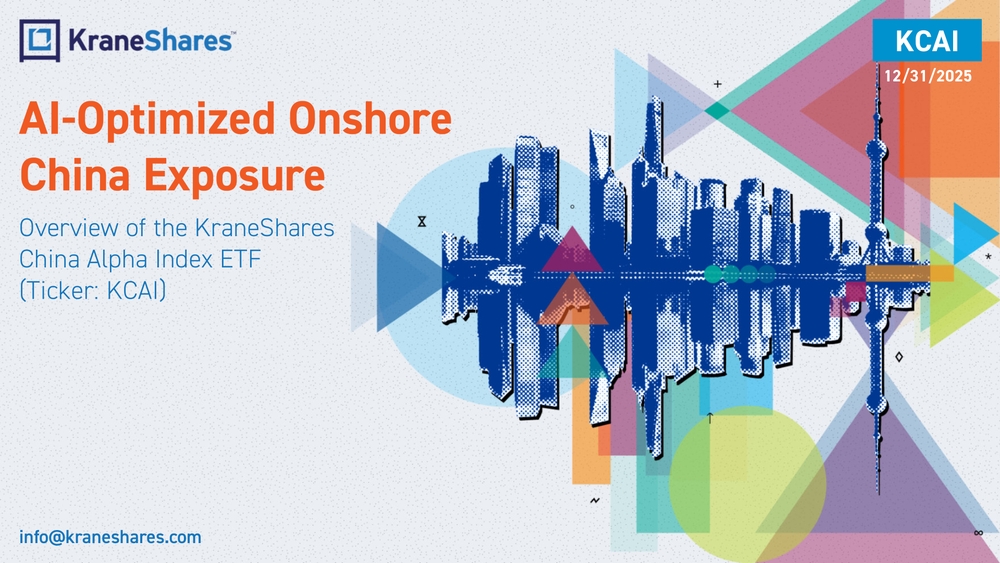
Krane Funds Advisors, LLC is a specialist investment manager focused on China, Carbon, Climate, and other uncorrelated assets. KraneShares seeks to provide innovative, high conviction, and first to market strategies. The firm was founded in 2013 and manages for institutions and individuals globally. The firm is a signatory of the United Nations-supported Principles for Responsible Investment (UN PRI).
Product Suite
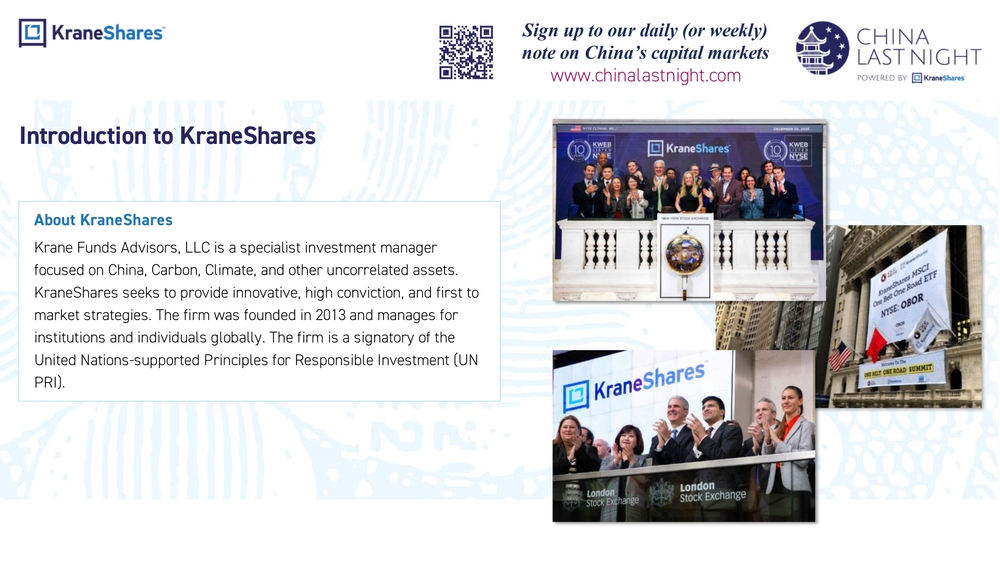
China Thematic Equity
- KWEB: Internet & E-Commerce*
- KURE: Healthcare
- KGRN: Clean Technology
- KSTR: STAR Market*
- KTEC: Hang Seng Tech
China Core Equity
- KBA: MSCI China A 50
- KCAI: China Onshore Alpha Index
Options Income
- KLIP: China Internet & Covered Call
- KWIN: Wahed Short-Term Alternative Income
Managed Futures
- KMLM: Mount Lucas Managed Futures
Global Equity
- KARS: Electric Vehicles & Future Mobility*
- AGIX: Artificial Intelligence & Technology
- KOID: Humanoid & Embodied Intelligence*
EM Equity
- KEMX: MSCI Emerging Markets ex China
- KEMQ: Emerging Markets Consumer Tech
- KPHO: Dragon Capital Vietnam Growth
Levered
- KBAB: 2X Long BABA Daily
- KPDD: 2X Long PDD Daily
- KMLI: 2X Long MELI Daily
- KJD: 2X Long JD Daily
- KBDU: 2X Long BIDU Daily
Carbon
- KRBN: Global Carbon Strategy*
- KEUA: European Carbon Allowance
- KCCA: California Carbon Allowance
Fixed Income
- IVOL: Quadratic Interest Rate Volatility & Inflation Hedge
- BNDD: Quadratic Deflation ETF
- KHYB: Asia High Income USD Bond
- KCSH: Sustainable Ultra Short Duration
US Equity
- KSPY: Hedgeye Hedged Equity
- BUYO: Man Buyout Beta Index
- KVLE: Value Line® Dynamic Dividend Equity
*Strategy also available in UCITS
KCAI KraneShares China Alpha Index ETF
Investment Strategy:
KCAI tracks the Qi China Alpha Index, which seeks to outperform the CSI 300 Index by applying a systematic machine learning approach. KCAI's index was developed by Quant Insight (Qi) to generate excess returns in China A-Shares through an alpha optimization filtering process combined with proprietary AI technology.
KCAI Features:
- Long Only: Stock selection from the CSI 300 Index universe
- Low Concentration: No individual stock can make up more than 5% of the ETF.
- Frequent Rebalancing: Rebalanced monthly using proprietary AI investment decision making technology.
Why AI for China A-Share Exposure:
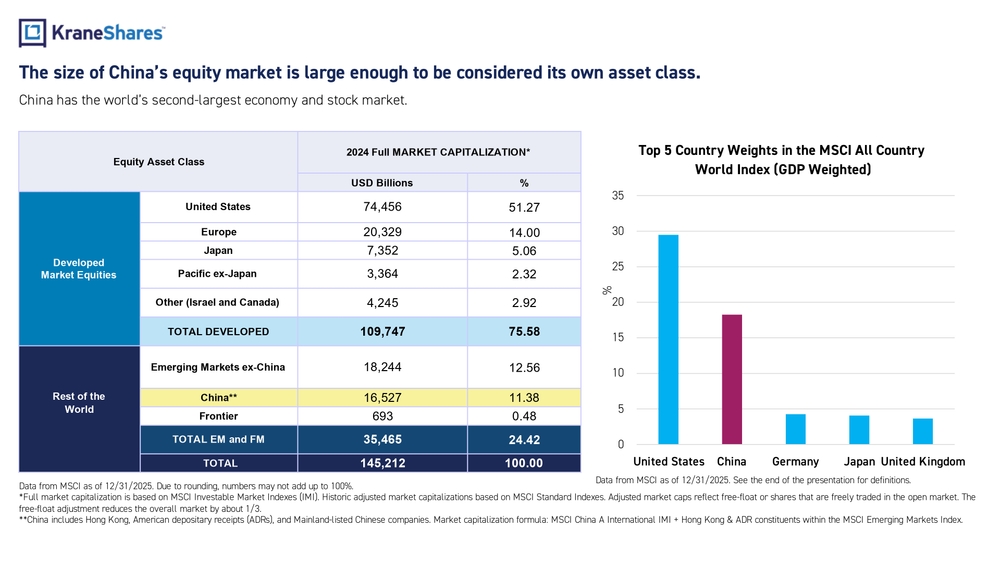
- China A-Shares are vastly underrepresented in global indexes. While the United States has a weight of 64% in the MSCI All Country World Index, China only has a weight of 3%¹.
- China A shares have exhibited an unusually low correlation to global markets of less than 0.4 over the past ten years,² demonstrating the potential diversification* benefits of adding an allocation to China A shares to a global portfolio.
- Unique characteristics of the China A-shares market, such as high retail ownership and volatility, make it a potentially important source of alpha.
¹ Data from MSCI as of 12/31/2025. ² Data from Bloomberg as of 12/31/2025. Correlation is based on weekly observations of the MSCI China A Index and the MSCI All Country World Index (ACWI).
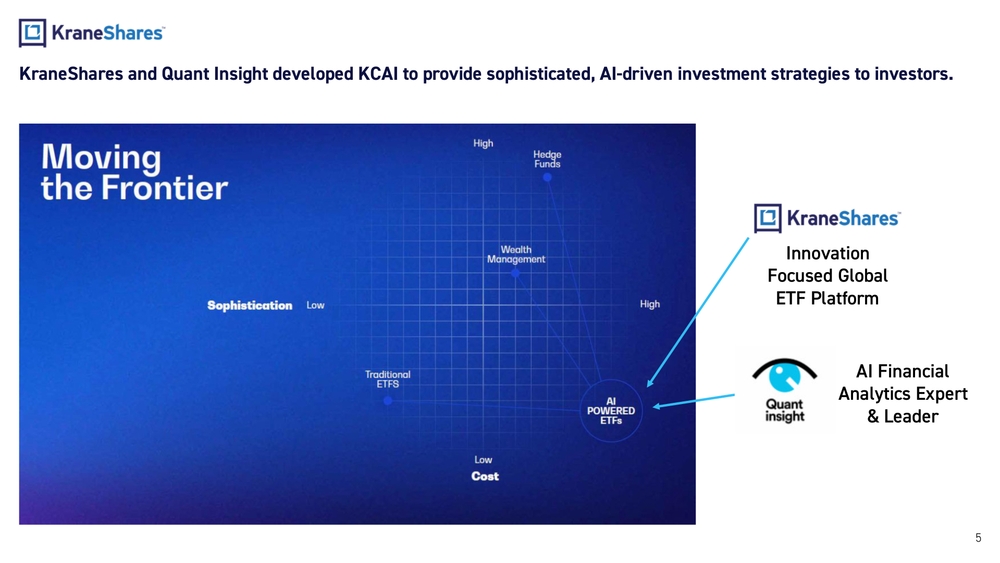
KraneShares and Quant Insight developed KCAI to provide sophisticated, AI-driven investment strategies to investors.
- Innovation Focused Global ETF Platform
- AI Financial Analytics Expert & Leader
Introducing Quant Insight (Qi)
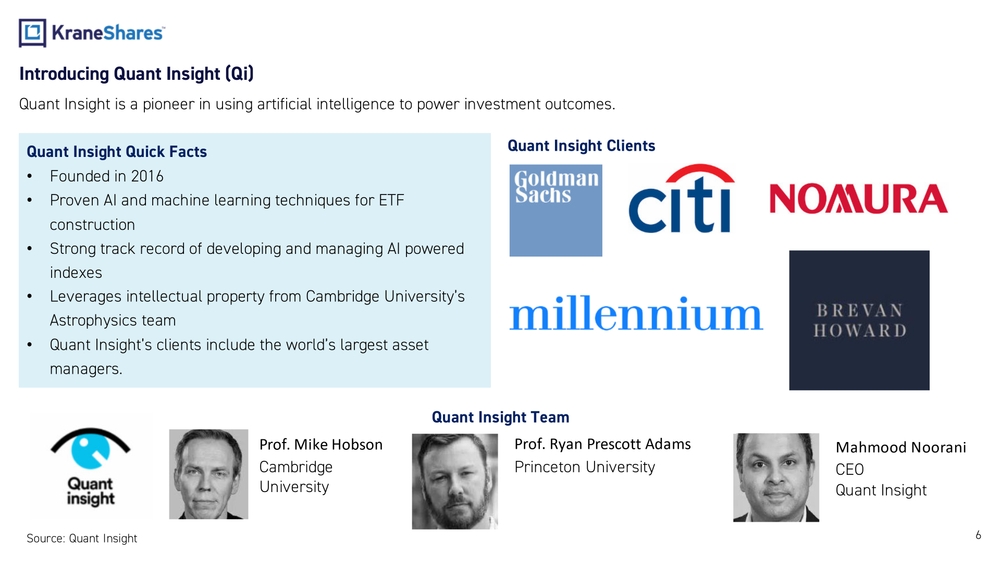
Quant Insight is a pioneer in using artificial intelligence to power investment outcomes.
Quant Insight Quick Facts
- Founded in 2016
- Proven AI and machine learning techniques for ETF construction
- Strong track record of developing and managing AI powered indexes
- Leverages intellectual property from Cambridge University's Astrophysics team
- Quant Insight's clients include the world's largest asset managers.
Quant Insight Clients
- Goldman Sachs
- Citi
- Nomura
- Millennium
- Brevan Howard
Quant Insight Team
- Prof. Mike Hobson, Cambridge University
- Prof. Ryan Prescott Adams, Princeton University
- Mahmood Noorani, CEO, Quant Insight
Why are China A-Shares well suited for AI alpha generation?
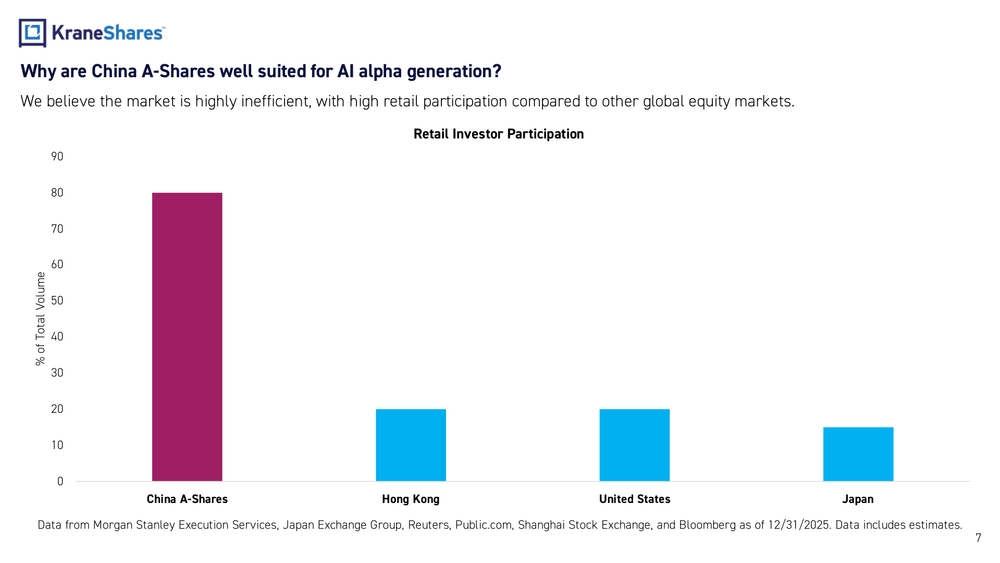
We believe the market is highly inefficient, with high retail participation compared to other global equity markets.
Retail Investor Participation
- China A-Shares: ~80% of Total Volume
- Hong Kong: ~20% of Total Volume
- United States: ~20% of Total Volume
- Japan: ~15% of Total Volume
Data from Morgan Stanley Execution Services, Japan Exchange Group, Reuters, Public.com, Shanghai Stock Exchange, and Bloomberg as of 12/31/2025. Data includes estimates.
Why are China A-Shares well suited for AI alpha generation?
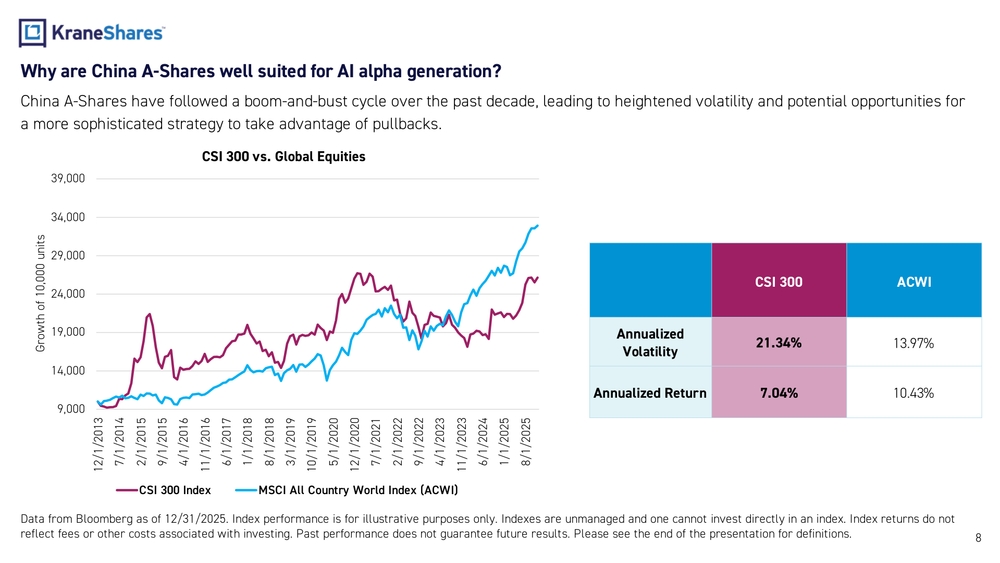
China A-Shares have followed a boom-and-bust cycle over the past decade, leading to heightened volatility and potential opportunities for a more sophisticated strategy to take advantage of pullbacks.
CSI 300 vs. Global Equities
| CSI 300 | ACWI | |
|---|---|---|
| Annualized Volatility | 21.34% | 13.97% |
| Annualized Return | 7.04% | 10.43% |
Data from Bloomberg as of 12/31/2025. Index performance is for illustrative purposes only. Indexes are unmanaged and one cannot invest directly in an index. Index returns do not reflect fees or other costs associated with investing. Past performance does not guarantee future results.
The Qi China Alpha Index Methodology
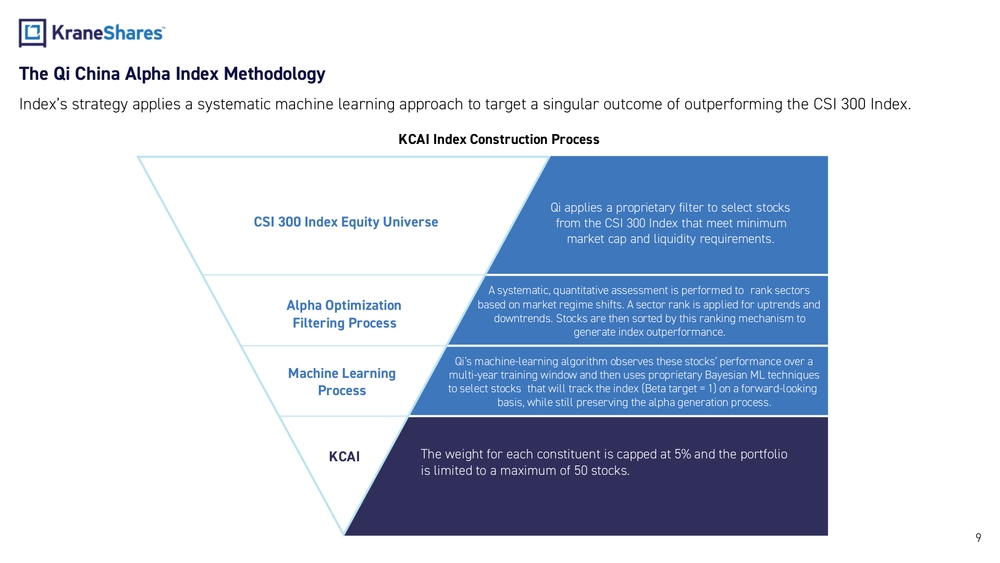
Index's strategy applies a systematic machine learning approach to target a singular outcome of outperforming the CSI 300 Index.
KCAI Index Construction Process
-
CSI 300 Index Equity Universe
- Qi applies a proprietary filter to select stocks from the CSI 300 Index that meet minimum market cap and liquidity requirements.
-
Alpha Optimization Filtering Process
- A systematic, quantitative assessment is performed to rank sectors based on market regime shifts. A sector rank is applied for uptrends and downtrends. Stocks are then sorted by this ranking mechanism to generate index outperformance.
-
Machine Learning Process
- Qi's machine-learning algorithm observes these stocks' performance over a multi-year training window and then uses proprietary Bayesian ML techniques to select stocks that will track the index (Beta target = 1) on a forward-looking basis, while still preserving the alpha generation process.
-
KCAI
- The weight for each constituent is capped at 5% and the portfolio is limited to a maximum of 50 stocks.
Qi China Alpha Index Performance
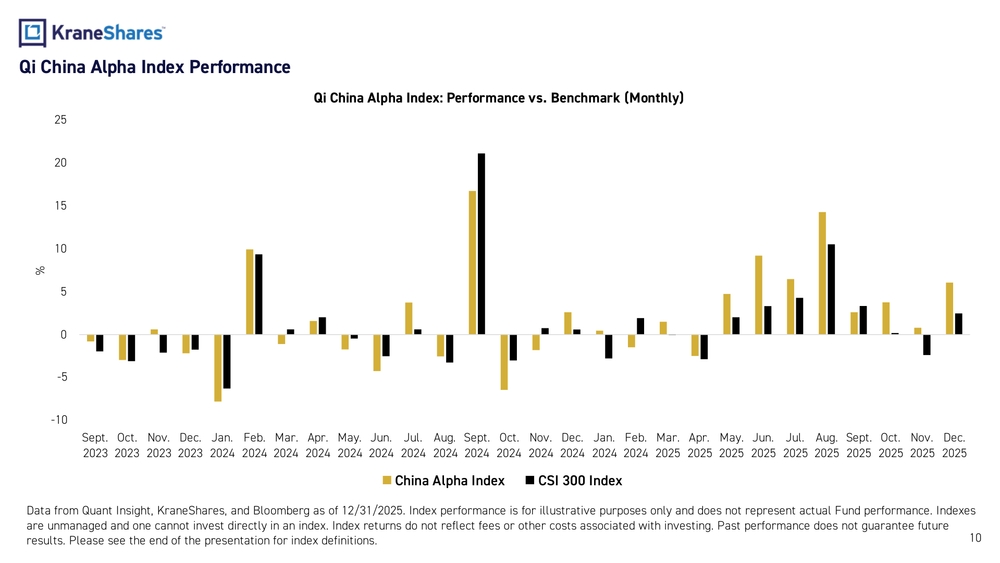
Qi China Alpha Index: Performance vs. Benchmark (Monthly)
[Chart showing monthly performance comparison between China Alpha Index and CSI 300 Index from September 2023 through December 2025]
Data from Quant Insight, KraneShares, and Bloomberg as of 12/31/2025. Index performance is for illustrative purposes only and does not represent actual Fund performance. Indexes are unmanaged and one cannot invest directly in an index. Index returns do not reflect fees or other costs associated with investing. Past performance does not guarantee future results.
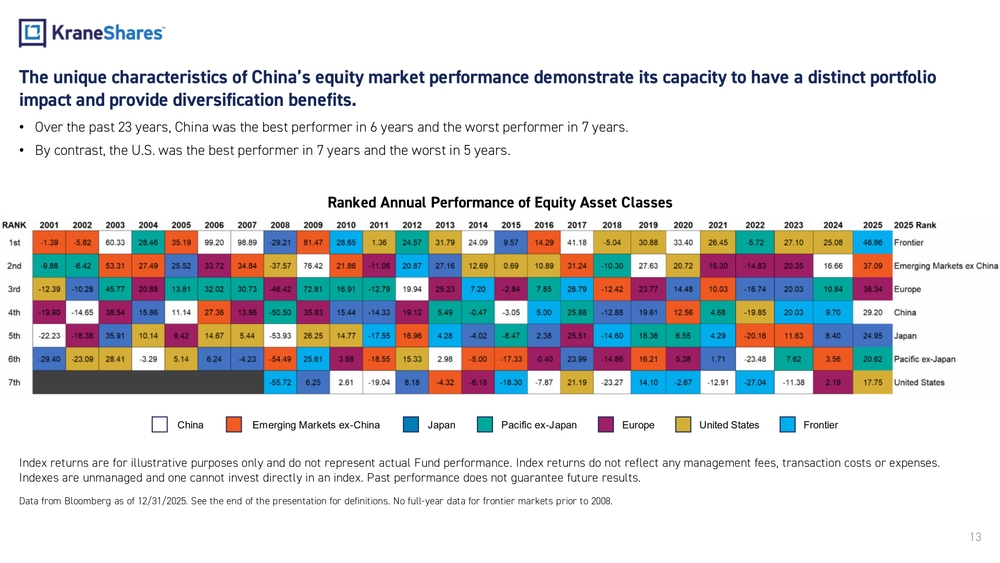
The unique characteristics of China's equity market performance demonstrate its capacity to have a distinct portfolio impact and provide diversification benefits.
- Over the past 23 years, China was the best performer in 6 years and the worst performer in 7 years.
- By contrast, the U.S. was the best performer in 7 years and the worst in 5 years.
Ranked Annual Performance of Equity Asset Classes
Index returns are for illustrative purposes only and do not represent actual Fund performance. Index returns do not reflect any management fees, transaction costs or expenses. Indexes are unmanaged and one cannot invest directly in an index. Past performance does not guarantee future results.
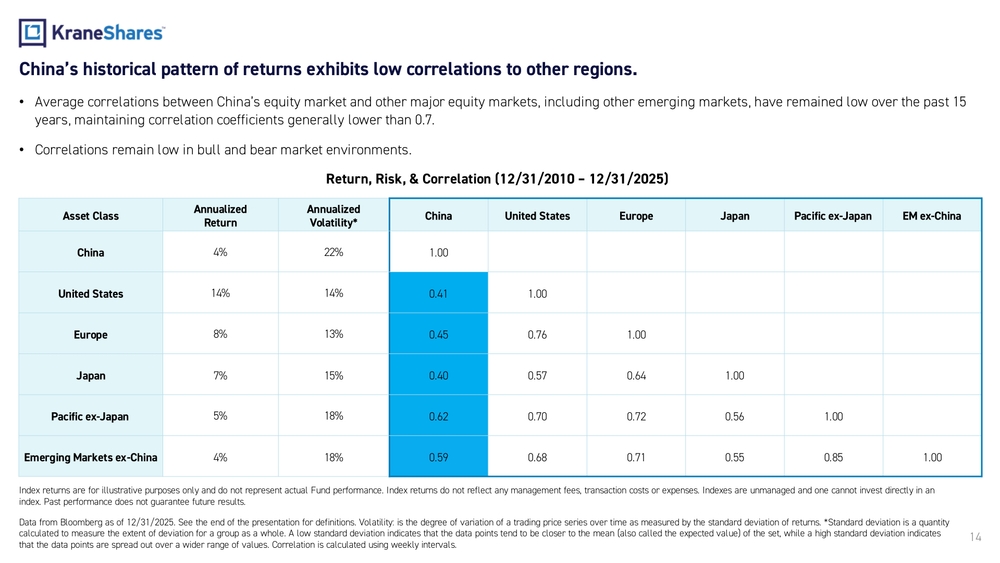
China's historical pattern of returns exhibits low correlations to other regions.
- Average correlations between China's equity market and other major equity markets, including other emerging markets, have remained low over the past 15 years, maintaining correlation coefficients generally lower than 0.7.
- Correlations remain low in bull and bear market environments.
Return, Risk, & Correlation (12/31/2010 – 12/31/2025)
| Asset Class | Annualized Return | Annualized Volatility* | China | United States | Europe | Japan | Pacific ex-Japan | EM ex-China |
|---|---|---|---|---|---|---|---|---|
| China | 4% | 22% | 1.00 | |||||
| United States | 14% | 14% | 0.41 | 1.00 | ||||
| Europe | 8% | 13% | 0.45 | 0.76 | 1.00 | |||
| Japan | 7% | 15% | 0.40 | 0.57 | 0.64 | 1.00 | ||
| Pacific ex-Japan | 5% | 18% | 0.62 | 0.70 | 0.72 | 0.56 | 1.00 | |
| Emerging Markets ex-China | 4% | 18% | 0.59 | 0.68 | 0.71 | 0.55 | 0.85 | 1.00 |
Index returns are for illustrative purposes only and do not represent actual Fund performance. Index returns do not reflect any management fees, transaction costs or expenses. Indexes are unmanaged and one cannot invest directly in an index. Past performance does not guarantee future results.
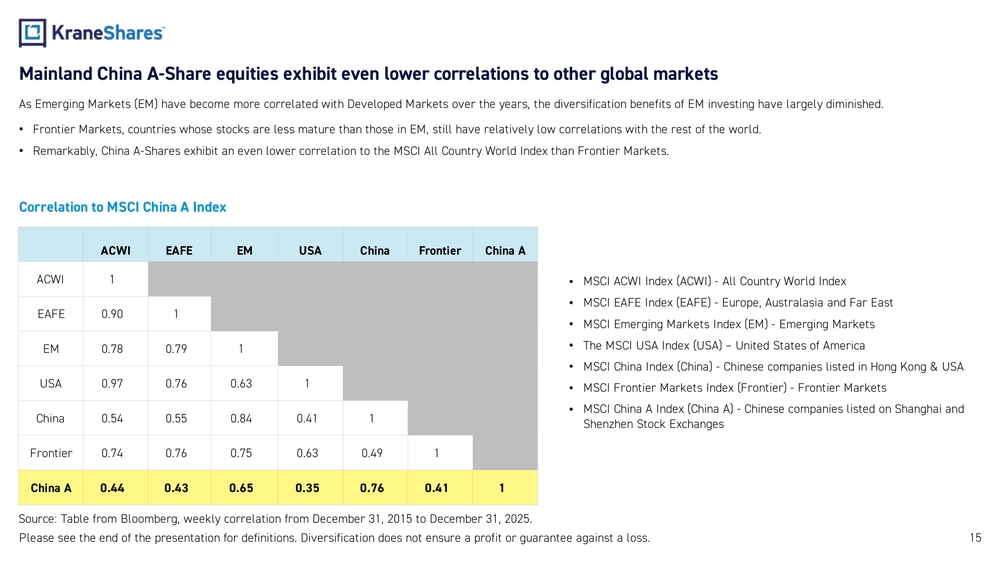
Mainland China A-Share equities exhibit even lower correlations to other global markets
As Emerging Markets (EM) have become more correlated with Developed Markets over the years, the diversification benefits of EM investing have largely diminished.
- Frontier Markets, countries whose stocks are less mature than those in EM, still have relatively low correlations with the rest of the world.
- Remarkably, China A-Shares exhibit an even lower correlation to the MSCI All Country World Index than Frontier Markets.
Correlation to MSCI China A Index
| ACWI | EAFE | EM | USA | China | Frontier | China A | |
|---|---|---|---|---|---|---|---|
| ACWI | 1 | ||||||
| EAFE | 0.90 | 1 | |||||
| EM | 0.78 | 0.79 | 1 | ||||
| USA | 0.97 | 0.76 | 0.63 | 1 | |||
| China | 0.54 | 0.55 | 0.84 | 0.41 | 1 | ||
| Frontier | 0.74 | 0.76 | 0.75 | 0.63 | 0.49 | 1 | |
| China A | 0.44 | 0.43 | 0.65 | 0.35 | 0.76 | 0.41 | 1 |
- MSCI ACWI Index (ACWI) - All Country World Index
- MSCI EAFE Index (EAFE) - Europe, Australasia and Far East
- MSCI Emerging Markets Index (EM) - Emerging Markets
- The MSCI USA Index (USA) – United States of America
- MSCI China Index (China) - Chinese companies listed in Hong Kong & USA
- MSCI Frontier Markets Index (Frontier) - Frontier Markets
- MSCI China A Index (China A) - Chinese companies listed on Shanghai and Shenzhen Stock Exchanges
Conclusion
- China's A-Share equity market is under-owned by global investors relative to its size.
- Recent reform measures have made the market more open to foreign investors.
- We believe systematic trading strategies could provide more alpha in China A-Shares compared to global markets because of their inefficiency, which is evidenced by their high retail investor participation and heightened volatility.
- The KraneShares China Alpha Index ETF (Ticker: KCAI) seeks to outperform the CSI 300 Index using best-in-class artificial intelligence (AI) intellectual property from Quant Insight.
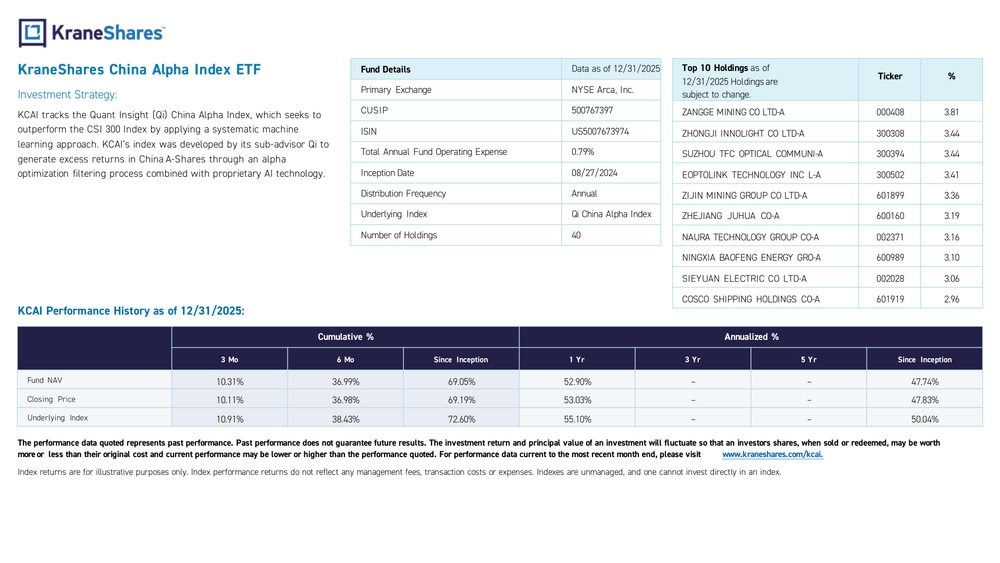
KraneShares China Alpha Index ETF
Investment Strategy:
KCAI tracks the Quant Insight (Qi) China Alpha Index, which seeks to outperform the CSI 300 Index by applying a systematic machine learning approach. KCAI's index was developed by its sub-advisor Qi to generate excess returns in China A-Shares through an alpha optimization filtering process combined with proprietary AI technology.
Fund Details (Data as of 12/31/2025)
| Primary Exchange | NYSE Arca, Inc. |
| CUSIP | 500767397 |
| ISIN | US5007673974 |
| Total Annual Fund Operating Expense | 0.79% |
| Inception Date | 08/27/2024 |
| Distribution Frequency | Annual |
| Underlying Index | Qi China Alpha Index |
| Number of Holdings | 40 |
Top 10 Holdings as of 12/31/2025 (Holdings are subject to change)
| Ticker | % | |
|---|---|---|
| ZANGGE MINING CO LTD-A | 000408 | 3.81 |
| ZHONGJI INNOLIGHT CO LTD-A | 300308 | 3.44 |
| SUZHOU TFC OPTICAL COMMUNI-A | 300394 | 3.44 |
| EOPTOLINK TECHNOLOGY INC L-A | 300502 | 3.41 |
| ZIJIN MINING GROUP CO LTD-A | 601899 | 3.36 |
| ZHEJIANG JUHUA CO-A | 600160 | 3.19 |
| NAURA TECHNOLOGY GROUP CO-A | 002371 | 3.16 |
| NINGXIA BAOFENG ENERGY GRO-A | 600989 | 3.10 |
| SIEYUAN ELECTRIC CO LTD-A | 002028 | 3.06 |
| COSCO SHIPPING HOLDINGS CO-A | 601919 | 2.96 |
KCAI Performance History as of 12/31/2025:
| Cumulative % | Annualized % | ||||||
|---|---|---|---|---|---|---|---|
| 3 Mo | 6 Mo | Since Inception | 1 Yr | 3 Yr | 5 Yr | Since Inception | |
| Fund NAV | 10.31% | 36.99% | 69.05% | 52.90% | – | – | 47.74% |
| Closing Price | 10.11% | 36.98% | 69.19% | 53.03% | – | – | 47.83% |
| Underlying Index | 10.91% | 38.43% | 72.60% | 55.10% | – | – | 50.04% |
The performance data quoted represents past performance. Past performance does not guarantee future results. The investment return and principal value of an investment will fluctuate so that an investors shares, when sold or redeemed, may be worth more or less than their original cost and current performance may be lower or higher than the performance quoted. For performance data current to the most recent month end, please visit www.kraneshares.com/kcai.
Index returns are for illustrative purposes only. Index performance returns do not reflect any management fees, transaction costs or expenses. Indexes are unmanaged, and one cannot invest directly in an index.
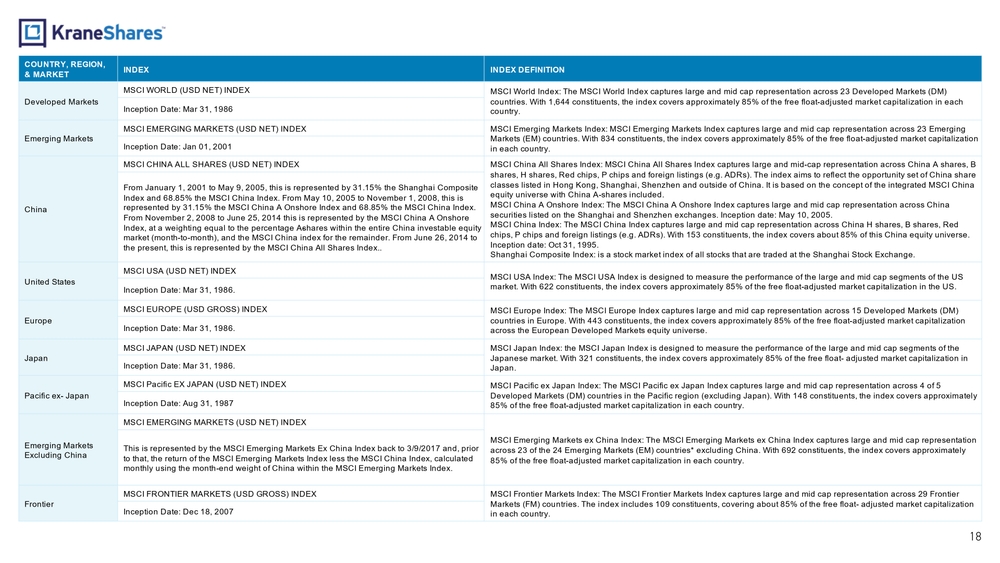
COUNTRY, REGION, & MARKET INDEX DEFINITIONS
Developed Markets
MSCI WORLD (USD NET) INDEX
MSCI World Index: The MSCI World Index captures large and mid cap representation across 23 Developed Markets (DM) countries. With 1,644 constituents, the index covers approximately 85% of the free float-adjusted market capitalization in each country. Inception Date: Mar 31, 1986
Emerging Markets
MSCI EMERGING MARKETS (USD NET) INDEX
MSCI Emerging Markets Index: MSCI Emerging Markets Index captures large and mid cap representation across 23 Emerging Markets (EM) countries. With 834 constituents, the index covers approximately 85% of the free float-adjusted market capitalization in each country. Inception Date: Jan 01, 2001
China
MSCI CHINA ALL SHARES (USD NET) INDEX
MSCI China All Shares Index: MSCI China All Shares Index captures large and mid-cap representation across China A shares, B shares, H shares, Red chips, P chips and foreign listings (e.g. ADRs). The index aims to reflect the opportunity set of China share classes listed in Hong Kong, Shanghai, Shenzhen and outside of China. It is based on the concept of the integrated MSCI China equity universe with China A-shares included.
MSCI China A Onshore Index: The MSCI China A Onshore Index captures large and mid cap representation across China securities listed on the Shanghai and Shenzhen exchanges. Inception date: May 10, 2005.
MSCI China Index: The MSCI China Index captures large and mid cap representation across China H shares, B shares, Red chips, P chips and foreign listings (e.g. ADRs). With 153 constituents, the index covers about 85% of this China equity universe. Inception date: Oct 31, 1995.
Shanghai Composite Index: is a stock market index of all stocks that are traded at the Shanghai Stock Exchange.
From January 1, 2001 to May 9, 2005, this is represented by 31.15% the Shanghai Composite Index and 68.85% the MSCI China Index. From May 10, 2005 to November 1, 2008, this is represented by 31.15% the MSCI China A Onshore Index and 68.85% the MSCI China Index. From November 2, 2008 to June 25, 2014 this is represented by the MSCI China A Onshore Index, at a weighting equal to the percentage A-shares within the entire China investable equity market (month-to-month), and the MSCI China index for the remainder. From June 26, 2014 to the present, this is represented by the MSCI China All Shares Index.
United States
MSCI USA (USD NET) INDEX
MSCI USA Index: The MSCI USA Index is designed to measure the performance of the large and mid cap segments of the US market. With 622 constituents, the index covers approximately 85% of the free float-adjusted market capitalization in the US. Inception Date: Mar 31, 1986.
Europe
MSCI EUROPE (USD GROSS) INDEX
MSCI Europe Index: The MSCI Europe Index captures large and mid cap representation across 15 Developed Markets (DM) countries in Europe. With 443 constituents, the index covers approximately 85% of the free float-adjusted market capitalization across the European Developed Markets equity universe. Inception Date: Mar 31, 1986.
Japan
MSCI JAPAN (USD NET) INDEX
MSCI Japan Index: the MSCI Japan Index is designed to measure the performance of the large and mid cap segments of the Japanese market. With 321 constituents, the index covers approximately 85% of the free float-adjusted market capitalization in Japan. Inception Date: Mar 31, 1986.
Pacific ex-Japan
MSCI Pacific EX JAPAN (USD NET) INDEX
MSCI Pacific ex Japan Index: The MSCI Pacific ex Japan Index captures large and mid cap representation across 4 of 5 Developed Markets (DM) countries in the Pacific region (excluding Japan). With 148 constituents, the index covers approximately 85% of the free float-adjusted market capitalization in each country. Inception Date: Aug 31, 1987
Emerging Markets Excluding China
MSCI EMERGING MARKETS (USD NET) INDEX
MSCI Emerging Markets ex China Index: The MSCI Emerging Markets ex China Index captures large and mid cap representation across 23 of the 24 Emerging Markets (EM) countries* excluding China. With 692 constituents, the index covers approximately 85% of the free float-adjusted market capitalization in each country.
This is represented by the MSCI Emerging Markets Ex China Index back to 3/9/2017 and, prior to that, the return of the MSCI Emerging Markets Index less the MSCI China Index, calculated monthly using the month-end weight of China within the MSCI Emerging Markets Index.
Frontier
MSCI FRONTIER MARKETS (USD GROSS) INDEX
MSCI Frontier Markets Index: The MSCI Frontier Markets Index captures large and mid cap representation across 29 Frontier Markets (FM) countries. The index includes 109 constituents, covering about 85% of the free float-adjusted market capitalization in each country. Inception Date: Dec 18, 2007
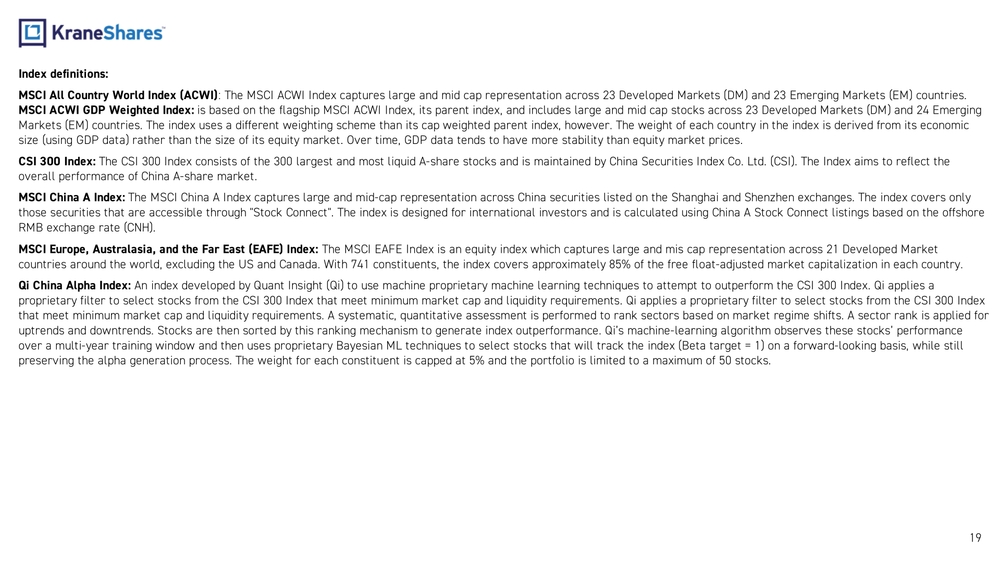
Index definitions:
MSCI All Country World Index (ACWI): The MSCI ACWI Index captures large and mid cap representation across 23 Developed Markets (DM) and 23 Emerging Markets (EM) countries.
MSCI ACWI GDP Weighted Index: is based on the flagship MSCI ACWI Index, its parent index, and includes large and mid cap stocks across 23 Developed Markets (DM) and 24 Emerging Markets (EM) countries. The index uses a different weighting scheme than its cap weighted parent index, however. The weight of each country in the index is derived from its economic size (using GDP data) rather than the size of its equity market. Over time, GDP data tends to have more stability than equity market prices.
CSI 300 Index: The CSI 300 Index consists of the 300 largest and most liquid A-share stocks and is maintained by China Securities Index Co. Ltd. (CSI). The Index aims to reflect the overall performance of China A-share market.
MSCI China A Index: The MSCI China A Index captures large and mid-cap representation across China securities listed on the Shanghai and Shenzhen exchanges. The index covers only those securities that are accessible through "Stock Connect". The index is designed for international investors and is calculated using China A Stock Connect listings based on the offshore RMB exchange rate (CNH).
MSCI Europe, Australasia, and the Far East (EAFE) Index: The MSCI EAFE Index is an equity index which captures large and mis cap representation across 21 Developed Market countries around the world, excluding the US and Canada. With 741 constituents, the index covers approximately 85% of the free float-adjusted market capitalization in each country.
Qi China Alpha Index: An index developed by Quant Insight (Qi) to use machine proprietary machine learning techniques to attempt to outperform the CSI 300 Index. Qi applies a proprietary filter to select stocks from the CSI 300 Index that meet minimum market cap and liquidity requirements. Qi applies a proprietary filter to select stocks from the CSI 300 Index that meet minimum market cap and liquidity requirements. A systematic, quantitative assessment is performed to rank sectors based on market regime shifts. A sector rank is applied for uptrends and downtrends. Stocks are then sorted by this ranking mechanism to generate index outperformance. Qi's machine-learning algorithm observes these stocks' performance over a multi-year training window and then uses proprietary Bayesian ML techniques to select stocks that will track the index (Beta target = 1) on a forward-looking basis, while still preserving the alpha generation process. The weight for each constituent is capped at 5% and the portfolio is limited to a maximum of 50 stocks.
Term definitions:
Morningstar-Ranked Top China A Share Mutual Fund: Morningstar ranks mutual funds in various categories including China equity. The performance quoted is for the top-ranked fund in the China active category, which is an A share fund, as of 9/30/2024.
Qualified Foreign Institutional Investor (QFII/RQFII): The Qualified Foreign Institutional Investor program grants access to China's domestic stock markets to foreign institutional investors that register with and are approved for trading by the State Administration of Foreign Exchange (SAFE). Until the launch of the Stock Connect program in 2016, this and the similar Registered Qualified Foreign Institutional Investor (RQFII) were the only means by which foreign investors could access stock markets in Mainland China.
Stock Connect: A mutual market access program between the Hong Kong Stock Exchange, Shanghai Stock Exchange, and Shenzhen Stock Exchange. The program allows investors who are not citizens of the People's Republic of China (PRC) to trade stocks listed on the Shanghai Stock Exchange and/or the Shenzhen Stock Exchange through brokerage accounts used for trading on the Hong Kong Stock Exchange. It also allows for flows in the other direction, allowing investors located in Mainland China to trade certain stocks that are listed in Hong Kong.
Correlation: A statistical measure that calculates the strength of the relationship between the relative movements of two variables.
Volatility: The degree of variation of a trading price series over time as measured by the standard deviation of returns. Standard deviation is a quantity calculated to measure the extent of deviation for a group. A low standard deviation indicates that the data points tend to be closer to the mean (also called the expected value) of the set, while a high standard deviation indicates that the data points are spread out over a wider range of values. Correlation is calculated using weekly intervals.
Alpha: The degree to which an investment outperforms a designated benchmark.
Beta: The degree to which an investment tracks a designated benchmark.
Machine Learning (ML): The use and development of computer algorithms that are able to learn and adapt without following explicit instructions by using algorithms and statistical models to analyze and draw inferences from patterns in data.
Bayesian ML: A sophisticated paradigm in the field of artificial intelligence that marries the power of statistical inference with machine learning to allow a system to improve its predictions over time by dynamically learning from past experiences.
Index definitions:
MSCI All Country World Index (ACWI): The MSCI ACWI Index captures large and mid cap representation across 23 Developed Markets (DM) and 23 Emerging Markets (EM) countries.
MSCI ACWI GDP Weighted Index: is based on the flagship MSCI ACWI Index, its parent index, and includes large and mid cap stocks across 23 Developed Markets (DM) and 24 Emerging Markets (EM) countries. The index uses a different weighting scheme than its cap weighted parent index, however. The weight of each country in the index is derived from its economic size (using GDP data) rather than the size of its equity market. Over time, GDP data tends to have more stability than equity market prices.
CSI 300 Index: The CSI 300 Index consists of the 300 largest and most liquid A-share stocks and is maintained by China Securities Index Co. Ltd. (CSI). The Index aims to reflect the overall performance of China A-share market.
MSCI China A Index: The MSCI China A Index captures large and mid-cap representation across China securities listed on the Shanghai and Shenzhen exchanges. The index covers only those securities that are accessible through "Stock Connect". The index is designed for international investors and is calculated using China A Stock Connect listings based on the offshore RMB exchange rate (CNH).
MSCI Europe, Australasia, and the Far East (EAFE) Index: The MSCI EAFE Index is an equity index which captures large and mid cap representation across 21 Developed Market countries around the world, excluding the US and Canada. With 741 constituents, the index covers approximately 85% of the free float-adjusted market capitalization in each country.
Qi China Alpha Index: An index developed by Quant Insight (Qi) to use machine proprietary machine learning techniques to attempt to outperform the CSI 300 Index. Qi applies a proprietary filter to select stocks from the CSI 300 Index that meet minimum market cap and liquidity requirements. Qi applies a proprietary filter to select stocks from the CSI 300 Index that meet minimum market cap and liquidity requirements. A systematic, quantitative assessment is performed to rank sectors based on market regime shifts. A sector rank is applied for uptrends and downtrends. Stocks are then sorted by this ranking mechanism to generate index outperformance. Qi's machine-learning algorithm observes these stocks' performance over a multi-year training window and then uses proprietary Bayesian ML techniques to select stocks that will track the index (Beta target = 1) on a forward-looking basis, while still preserving the alpha generation process. The weight for each constituent is capped at 5% and the portfolio is limited to a maximum of 50 stocks.
Term definitions:
Morningstar-Ranked Top China A Share Mutual Fund: Morningstar ranks mutual funds in various categories including China equity. The performance quoted is for the top-ranked fund in the China active category, which is an A share fund, as of 9/30/2024.
Qualified Foreign Institutional Investor (QFII/RQFII): The Qualified Foreign Institutional Investor program grants access to China's domestic stock markets to foreign institutional investors that register with and are approved for trading by the State Administration of Foreign Exchange (SAFE). Until the launch of the Stock Connect program in 2016, this and the similar Registered Qualified Foreign Institutional Investor (RQFII) were the only means by which foreign investors could access stock markets in Mainland China.
Stock Connect: A mutual market access program between the Hong Kong Stock Exchange, Shanghai Stock Exchange, and Shenzhen Stock Exchange. The program allows investors who are not citizens of the People's Republic of China (PRC) to trade stocks listed on the Shanghai Stock Exchange and/or the Shenzhen Stock Exchange through brokerage accounts used for trading on the Hong Kong Stock Exchange. It also allows for flows in the other direction, allowing investors located in Mainland China to trade certain stocks that are listed in Hong Kong.
Correlation: A statistical measure that calculates the strength of the relationship between the relative movements of two variables.
Volatility: The degree of variation of a trading price series over time as measured by the standard deviation of returns. Standard deviation is a quantity calculated to measure the extent of deviation for a group. A low standard deviation indicates that the data points tend to be closer to the mean (also called the expected value) of the set, while a high standard deviation indicates that the data points are spread out over a wider range of values. Correlation is calculated using weekly intervals.
Alpha: The degree to which an investment outperforms a designated benchmark.
Beta: The degree to which an investment tracks a designated benchmark.
Machine Learning (ML): The use and development of computer algorithms that are able to learn and adapt without following explicit instructions by using algorithms and statistical models to analyze and draw inferences from patterns in data.
Bayesian ML: A sophisticated paradigm in the field of artificial intelligence that marries the power of statistical inference with machine learning to allow a system to improve its predictions over time by dynamically learning from past experiences.
Important Notes:
Carefully consider the Funds' investment objectives, risk factors, charges and expenses before investing. This and additional information can be found in the Funds' full and summary prospectus, which may be obtained by visiting www.kraneshares.com/kcai. Read the prospectus carefully before investing.
Risk Disclosures:
Investing involves risk, including possible loss of principal. There can be no assurance that a Fund will achieve its stated objectives. Indices are unmanaged and do not include the effect of fees. One cannot invest directly in an index.
This information should not be relied upon as research, investment advice, or a recommendation regarding any products, strategies, or any security in particular. This material is strictly for illustrative, educational, or informational purposes and is subject to change. Certain content represents an assessment of the market environment at a specific time and is not intended to be a forecast of future events or a guarantee of future results; material is as of the dates noted and is subject to change without notice.
A-Shares are issued by companies in mainland China and traded on local exchanges. They are available to domestic and certain foreign investors, including QFIs and those participating in Stock Connect Programs like Shanghai-Hong Kong and Shenzhen-Hong Kong. Foreign investments in A-Shares face various regulations and restrictions, including limits on asset repatriation. A-Shares may experience frequent trading halts and illiquidity, which can lead to volatility in the Fund's share price and increased trading halt risks. The Chinese economy is an emerging market, vulnerable to domestic and regional economic and political changes, often showing more volatility than developed markets. Companies face risks from potential government interventions, and the export-driven economy is sensitive to downturns in key trading partners, impacting the Fund. U.S.-China tensions raise concerns over tariffs and trade restrictions, which could harm China's exports and the Fund. China's regulatory standards are less stringent than in the U.S., resulting in limited information about issuers. Tax laws are unclear and subject to change, potentially impacting the Fund and leading to unexpected liabilities for foreign investors. Fluctuations in currency of foreign countries may have an adverse effect to domestic currency values.
Machine learning is a part of artificial intelligence that creates algorithms to improve from data without explicit programming. The Underlying Index depends on a machine learning model using various inputs, including historical data. If the model fails, the Index and Fund may lose value. Biases or errors in the model or data can lead to poor selections and may not be quickly corrected, harming the Fund. Additionally, machine learning models may overfit historical data and struggle with unexpected market conditions, negatively impacting the Index and the Fund. In addition to the normal risks associated with investing, investments in mid-size companies typically exhibit higher volatility. The Fund is new and does not yet have a significant number of shares outstanding. If the Fund does not grow in size, it will be at greater risk than larger funds of wider bid-ask spreads for its shares, trading at a greater premium or discount to NAV, liquidation and/or a trading halt.
Narrowly focused investments typically exhibit higher volatility. The Fund's assets are expected to be concentrated in a sector, industry, market, or group of concentrations to the extent that the Underlying Index has such concentrations. The securities or futures in that concentration could react similarly to market developments. Thus, the Fund is subject to loss due to adverse occurrences that affect that concentration. KCAI is non-diversified.
ETF shares are bought and sold on an exchange at market price (not NAV) and are not individually redeemed from the Fund. However, shares may be redeemed at NAV directly by certain authorized broker-dealers (Authorized Participants) in very large creation/redemption units. The returns shown do not represent the returns you would receive if you traded shares at other times. Shares may trade at a premium or discount to their NAV in the secondary market. Brokerage commissions will reduce returns. Beginning 12/23/2020, market price returns are based on the official closing price of an ETF share or, if the official closing price isn't available, the midpoint between the national best bid and national best offer ("NBBO") as of the time the ETF calculates the current NAV per share. Prior to that date, market price returns were based on the midpoint between the Bid and Ask price. NAVs are calculated using prices as of 4:00 PM Eastern Time.
The KraneShares ETFs and KFA Funds ETFs are distributed by SEI Investments Distribution Company (SIDCO), 1 Freedom Valley Drive, Oaks, PA 19456, which is not affiliated with Krane Funds Advisors, LLC, the Investment Adviser for the Funds, or any sub-advisers for the Funds.