2025_02_luxury_white_paper
by Kraneshares
info@kraneshares.com +1 (212) 933 0393 Global Luxury: A Fundamental Sector For Your Investment Portfolio
2 kraneshares.com info@kraneshares.com +1 (212) 933 0393 Back to Top ↑Table of Contents Global Luxury: A Fundamental Sector For Your Investment Porfolio 3 KLXY Performance 4 Luxury Sector Resilience & Growth 6 Evolving Consumer Demographics 6 New-Age Transformations in Luxury 7 China’s Luxury Market 8 Luxury’s Presence in the U.S. & Broad Emerging Markets 9 Conclusion 11 Citations 12 Definitions 12 Disclosures 13
3 kraneshares.com info@kraneshares.com +1 (212) 933 0393 Back to Top ↑Global Luxury: A Fundamental Sector For Your Investment Porfolio It is time for investors to recognize luxury’s utility as an asset class. Luxury stocks offer a unique blend of developed market stability and emerging market growth potential, providing differentiated exposure from major developed market indexes. Many luxury companies, based in established markets like Europe and the United States, derive meaningful revenue from rapidly growing economies. This characteristic, combined with the fundamental resilience of luxury stocks, makes the sector a versatile portfolio component. For investors seeking exposure to the global luxury market, the KraneShares Global Luxury Index ETF (Ticker: KLXY) offers access to leading luxury companies worldwide and could act as a benchmark for investors tracking the performance of the global luxury market.
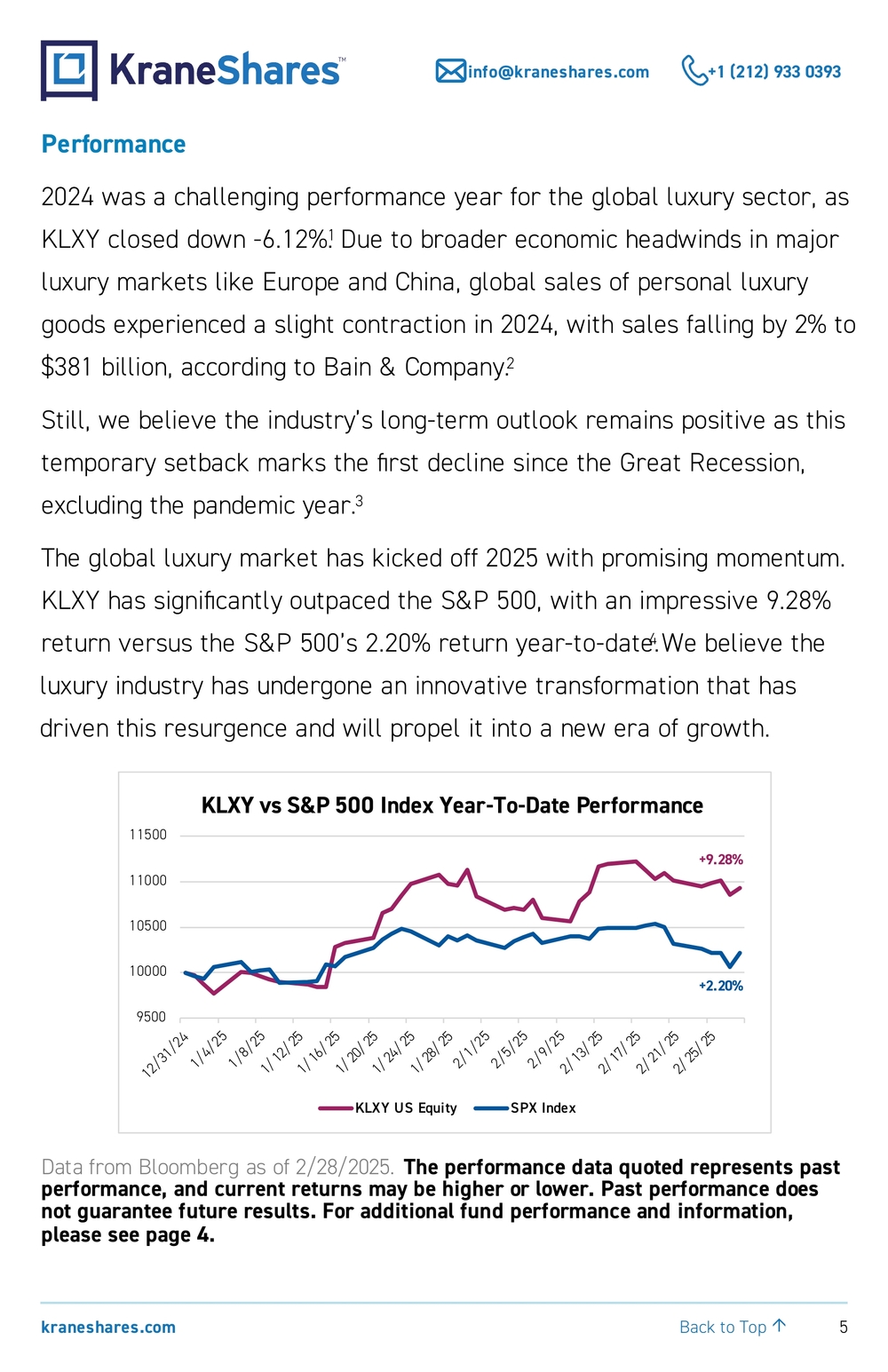
4 kraneshares.com info@kraneshares.com +1 (212) 933 0393 Back to Top ↑KraneShares Global Luxury Index ETF (Ticker KLXY) Performance Cumulative % Data as of: 2/28/2025 Fund NAV Closing Price Index 1 Month 0.31% 0.54% 0.41% 3 Month 13.38% 12.83% 13.64% 6 Month 7.23% 6.98% 7.49% YTD 9.28% 9.21% 9.42% Since Inception 4.51% 4.27% 5.44% Avg Annualized % Data as of quarter end: 12/31/2024 Fund NAV Closing Price Index 1 Year -6.12% -6.39% -5.99% Since Inception -3.32% -3.45% -2.76% KLXYs gross expense ratio is 0.69%. Inception Date: 9/6/2023. KLXY Index is the Solactive Global Luxury Select Index. The performance data quoted represents past performance. Past performance does not guarantee future results. The investment return and principal value of an investment will fluctuate so that an investor’s shares, when sold or redeemed, may be worth more or less than their original cost, and current performance may be lower or higher than the performance quoted. For performance data current to the most recent month end, please call +(1) 855 8KRANE8 or visit our website at www. kraneshares.com/klxy .
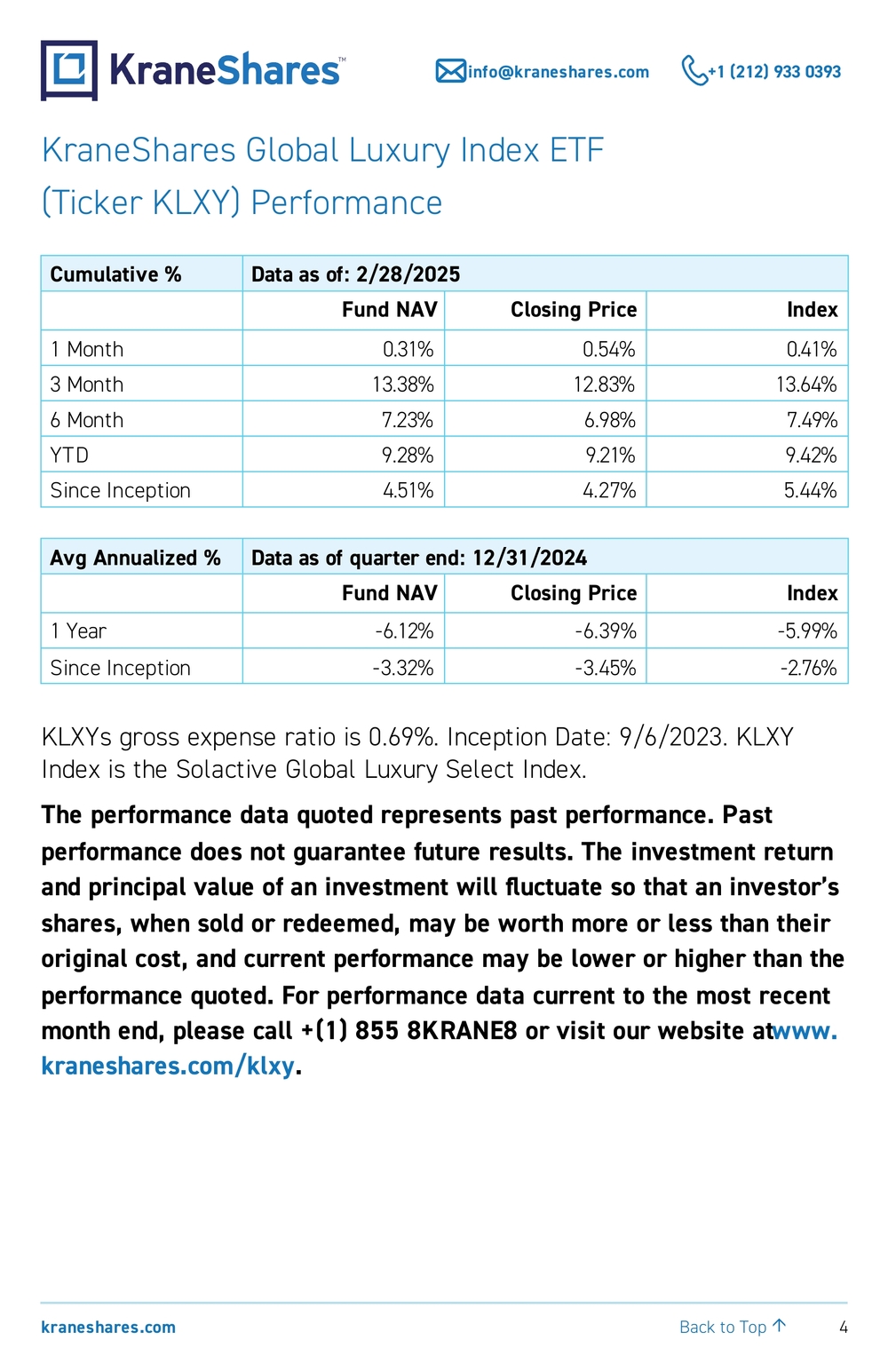
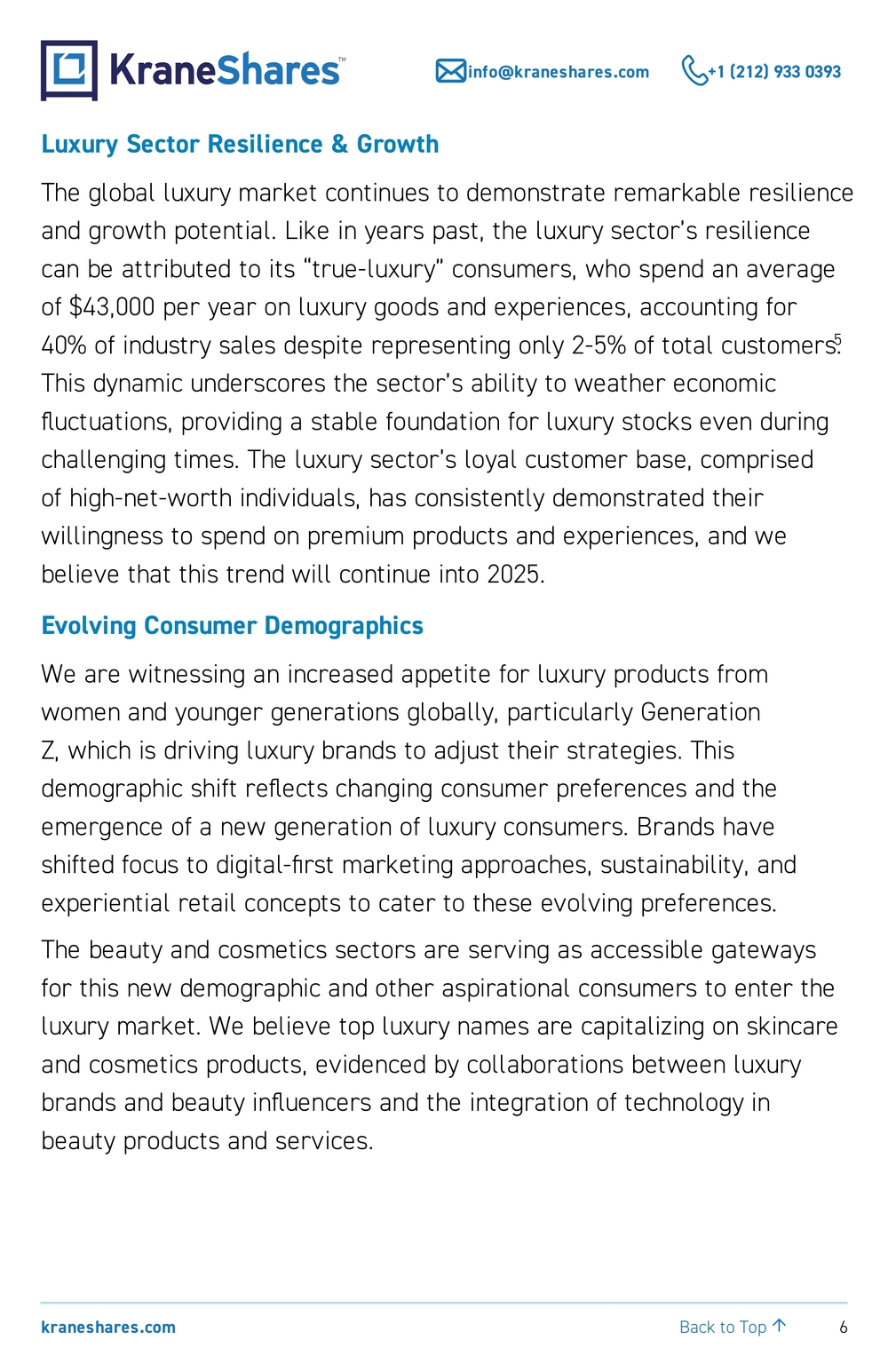
5 kraneshares.com info@kraneshares.com +1 (212) 933 0393 Back to Top ↑Performance 2024 was a challenging performance year for the global luxury sector, as KLXY closed down -6.12%.1 Due to broader economic headwinds in major luxury markets like Europe and China, global sales of personal luxury goods experienced a slight contraction in 2024, with sales falling by 2% to $381 billion, according to Bain & Company.2 Still, we believe the industry’s long-term outlook remains positive as this temporary setback marks the first decline since the Great Recession, excluding the pandemic year.3 The global luxury market has kicked off 2025 with promising momentum. KLXY has significantly outpaced the S&P 500, with an impressive 9.28% return versus the S&P 500’s 2.20% return year-to-date.4 We believe the luxury industry has undergone an innovative transformation that has driven this resurgence and will propel it into a new era of growth. 950010000105001100011500 12/31/24 1/4/25 1/8/25 1/12/25 1/16/25 1/20/25 1/24/25 1/28/25 2/1/25 2/5/25 2/9/25 2/13/25 2/17/25 2/21/25 2/25/25KLXY vs S&P 500 Index Year-To-Date Performance KLXY US Equity SPX Index+9.28% +2.20% Data from Bloomberg as of 2/28/2025. The performance data quoted represents past performance, and current returns may be higher or lower. Past performance does not guarantee future results. For additional fund performance and information, please see page 4.
6 kraneshares.com info@kraneshares.com +1 (212) 933 0393 Back to Top ↑Luxury Sector Resilience & Growth The global luxury market continues to demonstrate remarkable resilience and growth potential. Like in years past, the luxury sector’s resilience can be attributed to its “true-luxury” consumers, who spend an average of $43,000 per year on luxury goods and experiences, accounting for 40% of industry sales despite representing only 2-5% of total customers.5 This dynamic underscores the sector’s ability to weather economic fluctuations, providing a stable foundation for luxury stocks even during challenging times. The luxury sector’s loyal customer base, comprised of high-net-worth individuals, has consistently demonstrated their willingness to spend on premium products and experiences, and we believe that this trend will continue into 2025. Evolving Consumer Demographics We are witnessing an increased appetite for luxury products from women and younger generations globally, particularly Generation Z, which is driving luxury brands to adjust their strategies. This demographic shift reflects changing consumer preferences and the emergence of a new generation of luxury consumers. Brands have shifted focus to digital-first marketing approaches, sustainability, and experiential retail concepts to cater to these evolving preferences. The beauty and cosmetics sectors are serving as accessible gateways for this new demographic and other aspirational consumers to enter the luxury market. We believe top luxury names are capitalizing on skincare and cosmetics products, evidenced by collaborations between luxury brands and beauty influencers and the integration of technology in beauty products and services.
7 kraneshares.com info@kraneshares.com +1 (212) 933 0393 Back to Top ↑New-Age Transformations in Luxury Digital transformation continues to play a crucial role in the luxury sector, with E-Commerce and omnichannel strategies becoming increasingly important. Luxury brands are investing in augmented reality (AR) and virtual reality (VR) technologies for virtual try-ons, developing exclusive online-only products and experiences, and integrating blockchain technology for authentication and traceability. This digital shift is not just about widening the market reach but also about leveraging technology to offer consumers personalized and exclusive shopping experiences. Additionally, luxury companies are expanding into new areas to create 360-degree luxury lifestyles, including branded restaurants, cafes, hotels, exclusive travel experiences, and luxury home goods. This diversification strategy could lead to new revenue streams and potentially higher valuations for luxury conglomerates, positively impacting their top-line growth. LVMH (9.67% weight in KLXY as of 2/28/2025) brand Louis Vuitton sparked a trend by opening its largest flagship store in Japan in February 2020, featuring its first Louis Vuitton cafe, ‘Le Café V,’ situated inside the store’s top floor. LVMH’s early adoption of a brand extension strategy has proven successful in driving foot traffic and attracting new customers and has influenced other luxury companies to follow suit. For instance, ‘Prada Caffè’ opened at Harrods in London on March 31, 2023, blending Italian culinary traditions with the brand’s iconic aesthetic, thus enhancing the shopping experience for customers. Similarly, Dior has officially launched ‘Café Dior’ in Dallas on February 22, 2025, under the direction of Michelin-starred chef Dominique Crenn, promising an upscale dining experience that merges haute cuisine with the elegance of the Dior brand. These examples illustrate how luxury brands are not only diversifying their offerings but also creating immersive experiences that resonate with their clientele and elevate their market presence.
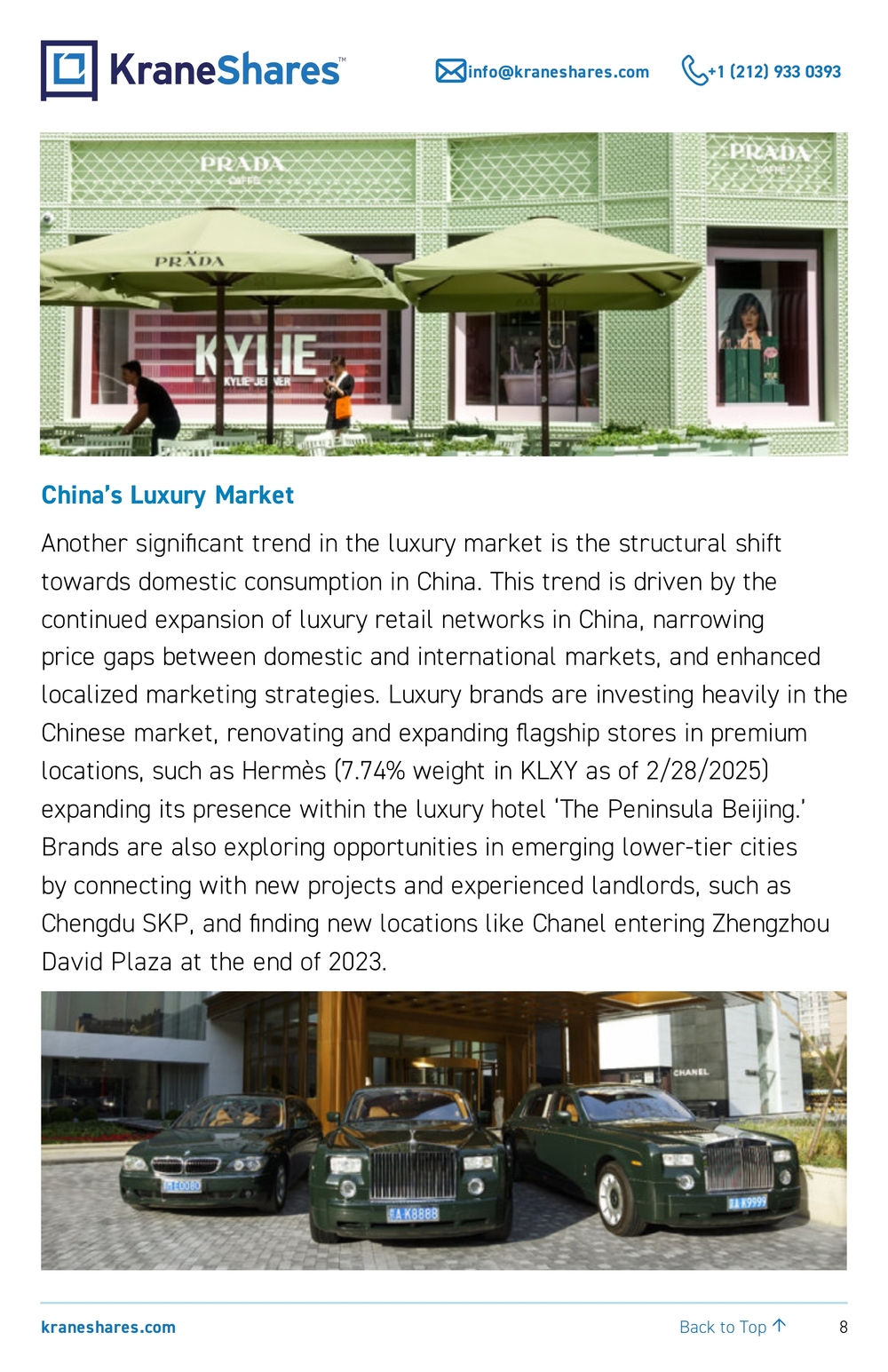
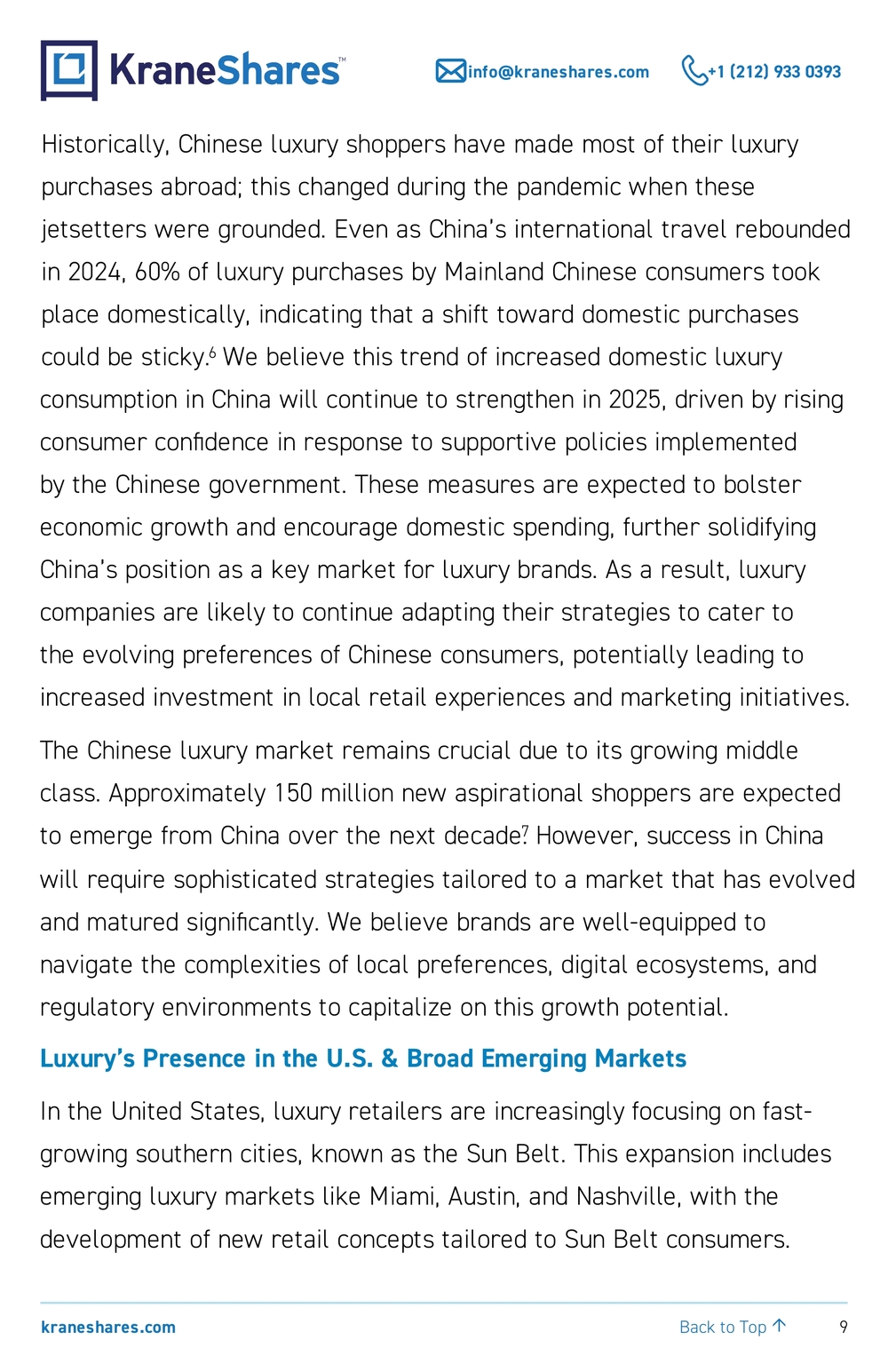
8 kraneshares.com info@kraneshares.com +1 (212) 933 0393 Back to Top ↑ China’s Luxury Market Another significant trend in the luxury market is the structural shift towards domestic consumption in China. This trend is driven by the continued expansion of luxury retail networks in China, narrowing price gaps between domestic and international markets, and enhanced localized marketing strategies. Luxury brands are investing heavily in the Chinese market, renovating and expanding flagship stores in premium locations, such as Hermès (7.74% weight in KLXY as of 2/28/2025) expanding its presence within the luxury hotel ‘The Peninsula Beijing.’ Brands are also exploring opportunities in emerging lower-tier cities by connecting with new projects and experienced landlords, such as Chengdu SKP, and finding new locations like Chanel entering Zhengzhou David Plaza at the end of 2023.
9 kraneshares.com info@kraneshares.com +1 (212) 933 0393 Back to Top ↑Historically, Chinese luxury shoppers have made most of their luxury purchases abroad; this changed during the pandemic when these jetsetters were grounded. Even as China’s international travel rebounded in 2024, 60% of luxury purchases by Mainland Chinese consumers took place domestically, indicating that a shift toward domestic purchases could be sticky.6 We believe this trend of increased domestic luxury consumption in China will continue to strengthen in 2025, driven by rising consumer confidence in response to supportive policies implemented by the Chinese government. These measures are expected to bolster economic growth and encourage domestic spending, further solidifying China’s position as a key market for luxury brands. As a result, luxury companies are likely to continue adapting their strategies to cater to the evolving preferences of Chinese consumers, potentially leading to increased investment in local retail experiences and marketing initiatives. The Chinese luxury market remains crucial due to its growing middle class. Approximately 150 million new aspirational shoppers are expected to emerge from China over the next decade.7 However, success in China will require sophisticated strategies tailored to a market that has evolved and matured significantly. We believe brands are well-equipped to navigate the complexities of local preferences, digital ecosystems, and regulatory environments to capitalize on this growth potential. Luxury’s Presence in the U.S. & Broad Emerging Markets In the United States, luxury retailers are increasingly focusing on fast- growing southern cities, known as the Sun Belt. This expansion includes emerging luxury markets like Miami, Austin, and Nashville, with the development of new retail concepts tailored to Sun Belt consumers.
10 kraneshares.com info@kraneshares.com +1 (212) 933 0393 Back to Top ↑In 2023, Texas was home to 6 of the 15 fastest-growing cities in North America.8 Other Sun Belt cities like Miami, Tampa, Charleston, and Phoenix are experiencing significant population growth as well. Nearly half of new luxury store openings in 2022 were in the southern belt of the United States, indicating a significant shift in the luxury retail landscape. The Middle East is also attracting more luxury brand investment and expansion, with an increased presence in Dubai, Abu Dhabi, and Saudi Arabia. The region is expected to significantly outpace global growth with an 82.4% rise in High-Net-Worth (HNWI) Individuals and a 33% rise in Ultra-HNWI by 2027.9 This rise in wealth indicates a significant increase in disposable income and capital in the region, likely translating into heightened demand for luxury goods. Luxury brands are actively implementing local strategies in the United Arab Emirates (UAE), aiming to engage consumers in the region through collaborations, dedicated collections, and immersive events set in iconic locations such as Al-Ula in Saudi Arabia. Gucci, a brand owned by Kering (4.45% weight in KLXY as of 2/28/2025)10, expanded its high jewelry collection to the UAE in March 2022. Additionally, the brand inaugurated its second high jewelry boutique in Kuwait, following the success of its initial boutique in Paris. According to Patrick Chalhoub, the CEO of the Dubai-based luxury retailer and distributor Chalhoub Group, renowned brands like Chanel, Hermès, Louis Vuitton, Cartier, a brand owned by Richemont (9.87% weight in KLXY as of 2/28/2025), and Tiffany, a brand owned by LVMH, are actively implementing local strategies in the UAE.10 We believe the Middle East could become a more influential market for global luxury brands in the
11 kraneshares.com info@kraneshares.com +1 (212) 933 0393 Back to Top ↑coming years, akin to established markets like the US, Europe, and China. Middle-market brands and customers are also gaining new appeal in the luxury sector. With a limited number of ultra-wealthy individuals in other major emerging markets, brands are fine-tuning their strategies to cater to the growing middle class. Over the next decade, more than 300 million potential new customers from this segment are expected to emerge from regions including India, Mexico, Southeast Asia, and Africa.11 This expansion of the addressable market presents significant growth opportunities for luxury brands that can successfully appeal to this growing demographic. Conclusion The luxury market continues to offer significant potential as an investment tool. The sector’s proven track record of resilience, emerging growth drivers, and evolving consumer demographics has cemented it as a potentially differentiated source of return and transformed it into a viable asset class for investors to utilize in their portfolios. For investors seeking exposure to the global luxury market, the KraneShares Global Luxury Index ETF (Ticker: KLXY) offers access to leading luxury companies worldwide. KLXY provides exposure to companies operating across various global luxury industries, including leather goods, jewelry, accessories, skincare, cosmetics, travel, and supercar businesses.
12 kraneshares.com info@kraneshares.com +1 (212) 933 0393 Back to Top ↑Holdings are subject to change. For KLXY top 10 holdings, risks, and other fund information, please click kraneshares.com/klxy . Citations
- Data from Bloomberg as of 12/31/2024.
- Data from Bain & Company as of 1/21/2025.
- Data from Bain & Company as of 11/13/2024.
- Data from Bloomberg as of 2/21/2025.
- Data from Boston Consulting Group and Bain & Company.
- Data from Bain & Company as of 1/21/2025.
- Data from Bain & Company as of 1/21/2025.
- Data from the U.S. Census Bureau as of 5/18/2023.
- Data from Knight Frank LLP as of December 2023.
- Data from Bloomberg as of 12/31/2024.
- Data from Bain & Company as of 1/17/2025. Definitions High-Net-Worth (HNWI) Individuals : A high-net-worth individual (HNWI) is someone with at least $1 million in liquid assets, like cash or investments that can be easily converted to cash. Ultra-high-net-worth Individuals: An ultra-high-net-worth individual (UHNWI) is someone with a net worth of at least $30 million, including their primary residence. This group includes the wealthiest people in the world. The Solactive Global Luxury Index: A net total return index, published in US Dollars, that tracks the performance of companies operating in the global luxury sector, including those in premium travel, apparel, and consumer goods.
13 kraneshares.com info@kraneshares.com +1 (212) 933 0393 Back to Top ↑Carefully consider the Funds’ investment objectives, risk factors, charges, and expenses before investing. This and additional information can be found in the Funds’ full and summary prospectus, which may be obtained by visiting www.kraneshares.com/klxy. Read the prospectus carefully before investing. Risk Disclosures: Investing involves risk, including possible loss of principal. There can be no assurance that a Fund will achieve its stated objectives. Indices are unmanaged and do not include the effect of fees. One cannot invest directly in an index. This information should not be relied upon as research, investment advice, or a recommendation regarding any products, strategies, or any security in particular. This material is strictly for illustrative, educational, or informational purposes and is subject to change. Certain content represents an assessment of the market environment at a specific time and is not intended to be a forecast of future events or a guarantee of future results; material is as of the dates noted and is subject to change without notice. KLXY may invest in derivatives, which are often more volatile than other investments and may magnify KLXY’s gains or losses. A derivative (i.e., futures/ forward contracts, swaps, and options) is a contract that derives its value from the performance of an underlying asset. The primary risk of derivatives is that changes in the asset’s market value and the derivative may not be proportionate, and some derivatives can have the potential for unlimited losses. Derivatives are also subject to liquidity and counterparty risk. KLXY is subject to liquidity risk, meaning that certain investments may become difficult to purchase or sell at a reasonable time and price. If a transaction for these securities is large, it may not be possible to initiate, which may cause KLXY to suffer losses. Counterparty risk is the risk of loss in the event that the counterparty to an agreement fails to make required payments or otherwise comply with the terms of the derivative.
14 kraneshares.com info@kraneshares.com +1 (212) 933 0393 Back to Top ↑KLXY is subject to non-U.S. issuers risk, which may be less liquid than investments in U.S. issuers, may have less governmental regulation and oversight, are typically subject to different investor protection standards than U.S. issuers, and the economic instability of the non-U.S. countries. Fluctuations in currency of foreign countries may have an adverse effect to domestic currency values. KLXY invests in companies in luxury-related sectors that may face intense competition and be dependent on their ability to maintain brand image. These companies may be subject to changes in consumer preferences and the spending of a relatively small segment of the general population, and technologies employed by the companies that may become obsolete. The companies can be especially sensitive to a decline in consumer confidence or any downturns in the broader economy. Demand for luxury products may be seasonal, and incorrect assessment of future demand can lead to overproduction or underproduction, which can impact company profitability. KLXY is new and does not yet have a significant number of shares outstanding. If KLXY does not grow in size, it will be at greater risk than larger funds of wider bid-ask spreads for its shares, trading at a greater premium or discount to NAV, liquidation and/or a trading halt. Narrowly focused investments typically exhibit higher volatility. KLXY’s assets are expected to be concentrated in a sector, industry, market, or group of concentrations to the extent that the Underlying Index has such concentrations. The securities or futures in that concentration could react similarly to market developments. Thus, KLXY is subject to loss due to adverse occurrences that affect that concentration. KLXY is non-diversified. ETF shares are bought and sold on an exchange at market price (not NAV) and are not individually redeemed from the Fund. However, shares may be redeemed at NAV directly by certain authorized broker-dealers (Authorized Participants) in very large creation/redemption units. The returns shown do not represent the returns you would receive if you traded shares at other times.
15 kraneshares.com info@kraneshares.com +1 (212) 933 0393 Back to Top ↑Shares may trade at a premium or discount to their NAV in the secondary market. Brokerage commissions will reduce returns. Beginning 12/23/2020, market price returns are based on the official closing price of an ETF share or, if the official closing price isn’t available, the midpoint between the national best bid and national best offer (“NBBO”) as of the time the ETF calculates the current NAV per share. Prior to that date, market price returns were based on the midpoint between the Bid and Ask price. NAVs are calculated using prices as of 4:00 PM Eastern Time. The KraneShares ETFs and KFA Funds ETFs are distributed by SEI Investments Distribution Company (SIDCO), 1 Freedom Valley Drive, Oaks, PA 19456, which is not affiliated with Krane Funds Advisors, LLC, the Investment Adviser for the Funds, or any sub-advisers for the Funds.
ABOUT KRANESHARES Krane Funds Advisors, LLC is the investment manager for KraneShares ETFs. KraneShares offers innovative investment solutions tailored to three key pillars: China, Climate, and Uncorrelated Assets. Our team is determined to provide industry- leading, differentiated, and high-conviction investment strategies that offer access to key market trends. Our mission is to empower investors with the knowledge and tools necessary to capture the importance of these themes as an essential element of a well- designed investment portfolio. ABOUT CICC In 2017, China International Capital Corporation (CICC) formed a strategic partnership with Krane Funds Advisors, LLC, becoming the largest shareholder. CICC is a leading, publicly traded, Chinese financial services company with expertise in research, asset management, investment banking, private equity, and wealth management. Founded as the first Sino-US joint venture investment bank in 1995 with Morgan Stanley and China Construction Bank as the largest initial shareholders. Today CICC is majority owned by China Investment Corporation (CIC), the second largest sovereign wealth fund with roughly $1 trillion AUM. In 2020, The CICC Research Team ranked #1 in Institutional Investor’s All-China Research Category for the eighth year in a row. CICC has over 200 branches across Mainland China, with offices in Hong Kong, Singapore, New York, San Francisco, and London.info@kraneshares.com +1 (212) 933 0393