2025_winter_internet_report
by Kraneshares
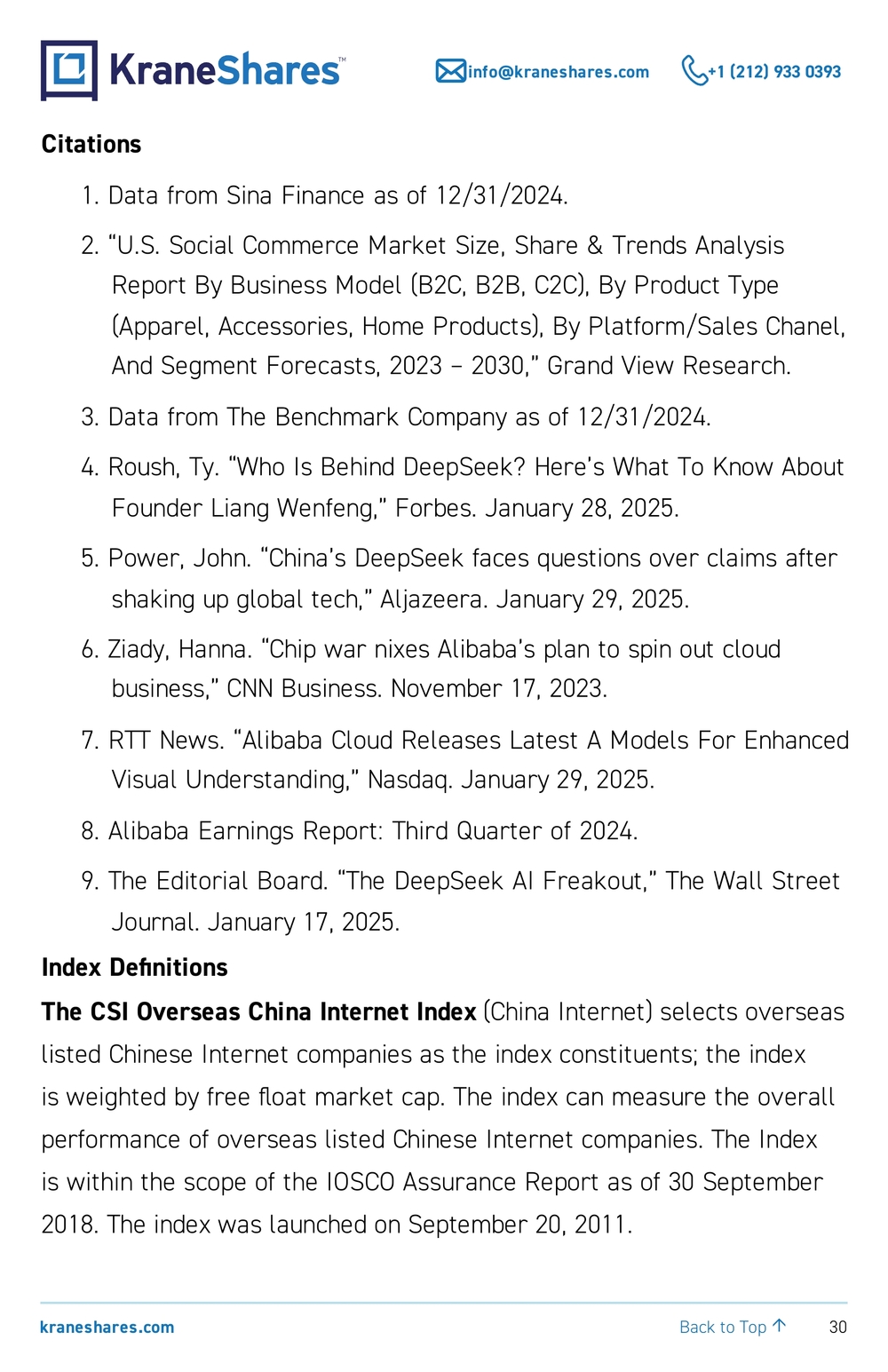
info@kraneshares.com +1 (212) 933 0393Winter 2025 China Internet Quarterly Earnings ReportDEEPSEEK, TIKTOK, REDNOTE, & TEMU: China Internet Making Waves in the USA
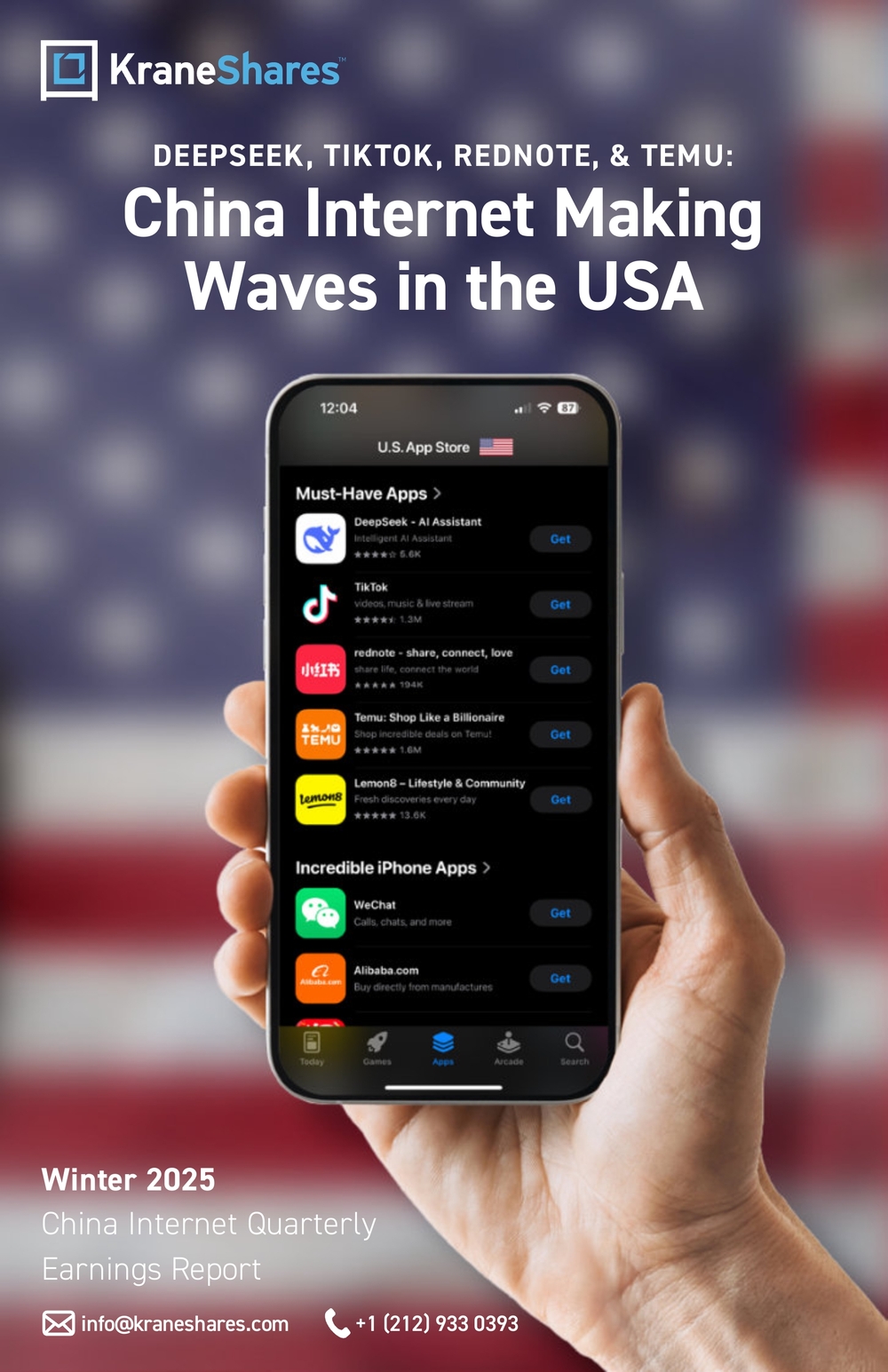
2 kraneshares.com info@kraneshares.com +1 (212) 933 0393 Back to Top ↑Introducing The KraneShares China/Emerging Markets Internet & Consumer Technology ETF Suite Option Income KLIP KWEB Covered Calls providing monthly distributions*Growth / Long Only KWEB China Internet & Consumer TechnologyKEMQ Broad Emerging Markets Internet & Consumer Technology Data from KraneShares as of 01/31/2025. The caps and buffers mentioned above do not reflect the effect of fees. KPRO and KBUF have characteristics unlike many other traditional investment products and may not be suitable for all investors. For more information regarding whether an investment in the Funds is right for you, please read the Funds’ prospectuses, including “Investor Suitability Considerations.” *Past performance does not guarantee future results. The performance data quoted represents past performance and current returns may be higher or lower.BufferKPRO 100% KWEB Defined Outcome January 2027KBUF 90% KWEB Defined Outcome January 2027
3 kraneshares.com info@kraneshares.com +1 (212) 933 0393 Back to Top ↑Table of Contents China Internet Recent Highlights 4 KWEB Performance 6 KWEB Top 10 Holdings Financials Summary 7 KWEB Key Metrics 8 Subsector Analysis 10 Theme Highlight – DeepSeek, TikTok, RedNote, & Temu: Making Waves in the USA13 Top 10 KWEB Holdings: Quarterly Earnings Update 21 Alibaba 21 Tencent 22 Meituan 23 JD.com 24 PDD 25 KE Holdings 26 Trip.com 26 Baidu 27 Bilibili 28 Kuaishou 29 Citations 30 Definitions 30 Disclosures 32
4 kraneshares.com info@kraneshares.com +1 (212) 933 0393 Back to Top ↑China Internet Recent Highlights •China has expanded its trade-in consumer subsidies to cover electronics including mobile phones, tablets, wearables, and others. The successful trade-in program was previously limited to automobiles and home appliances. Its expansion into more categories should provide a boost to sales volume on a broader set of E-Commerce platforms than before, especially Alibaba and PDD. •DeepSeek, China’s answer to OpenAI’s ChatGPT, soared to the top of Apple’s US app store in January and is reported to operate at a higher level of efficiency with fewer chips, potentially eliminating concerns over potential chip shortages for China’s internet giants. For more on this and how China’s internet ecosystem is penetrating markets abroad in unexpected ways, check out this edition’s theme highlight. •China’s top internet companies had a mostly positive third quarter as nine out of KWEB’s top 10 holdings beat analyst estimates for earnings. JD.com stands out for exceeding expectations by one of the widest margins on trade-in subsidies for autos and home appliances.
5 kraneshares.com info@kraneshares.com +1 (212) 933 0393 Back to Top ↑ •PDD was one of the only companies in KWEB’s top ten holdings whose earnings came up short of expectations in the third quarter. The company experienced a slowdown in growth after growing at a breakneck speed in previous quarters, which led to lofty estimates. •The US Department of Defense (DoD) added Tencent to its list of companies that are prohibited as vendors. While this has little to no impact on Tencent’s business, its inclusion on the list is optically problematic and has led to volatility in its shares. Company representatives have said that its inclusion on the list was a “mistake” and will engage in a reconsideration process with the DoD. •PDD’s Temu, the company’s international E-Commerce brand, now can source from local warehouses for orders in 19 countries, most recently adding Austria, Denmark, and Romania. The ability to provide local sourcing, rather than China-only sourcing, is key for the platform to become more competitive on shipping times and reduce the risk of protectionist backlash.
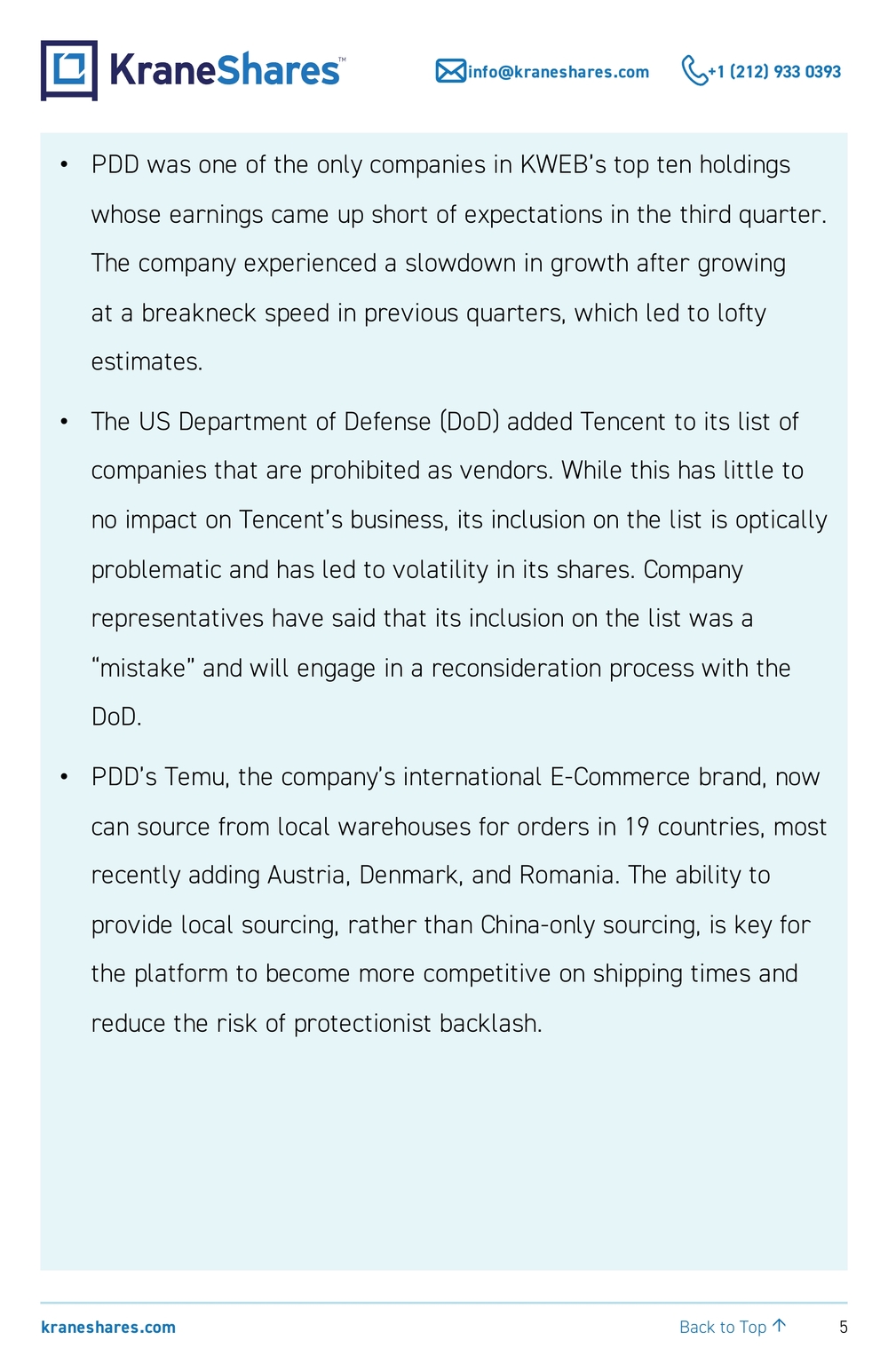
6 kraneshares.com info@kraneshares.com +1 (212) 933 0393 Back to Top ↑KraneShares CSI China Internet ETF (Ticker: KWEB) Performance Cumulative % Data as of: 1/31/2025 Fund NAV Closing Price Index 1 Month 4.69% 6.98% 5.02% 3 Month -0.85% 0.41% -0.84% 6 Month 19.14% 22.01% 19.33% YTD 4.69% 6.98% 5.02% Since Inception 49.10% 51.39% 51.01% Avg Annualized % Data as of quarter end: 12/31/2024 Fund NAV Closing Price Index 1 Year 13.25% 11.94% 11.95% 3 Year -5.34% -5.54% -5.56% 5 Year -7.26% -7.38% -7.11% 10 Year 0.75% 0.70% 0.98% Since Inception 3.14% 3.09% 3.23% KWEB’s gross expense ratio is 0.70%. Inception Date: 7/31/2013. KWEB Index is the CSI Overseas China Internet Index. The performance data quoted represents past performance. Past performance does not guarantee future results. The investment return and principal value of an investment will fluctuate so that an investor’s shares, when sold or redeemed, may be worth more or less than their original cost, and current performance may be lower or higher than the performance quoted. For performance data current to the most recent month end, please call +(1) 855 8KRANE8 or visit our website at www. kraneshares.com/kweb .
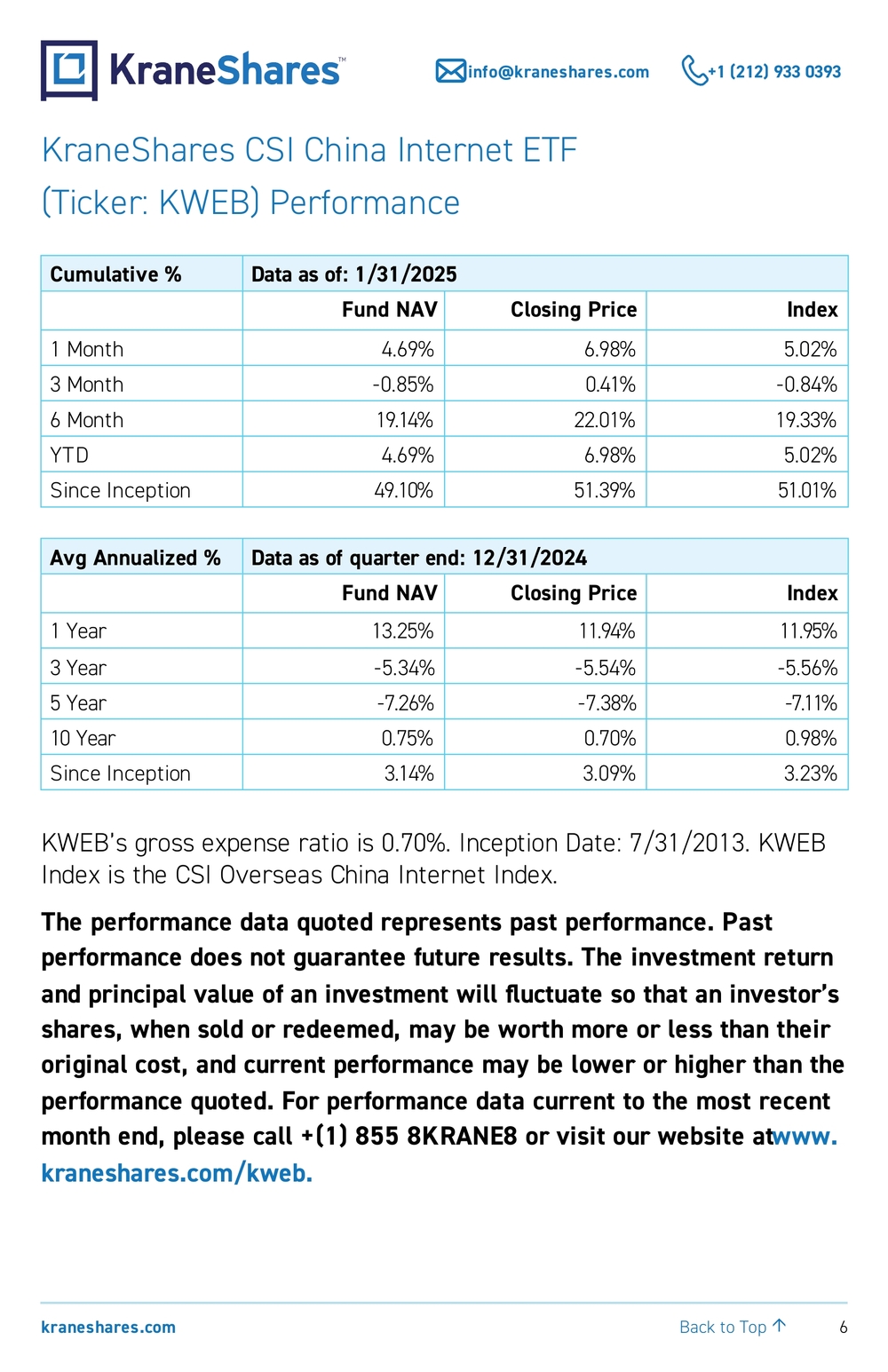
7 kraneshares.com info@kraneshares.com +1 (212) 933 0393 Back to Top ↑KWEB Top 10 Holdings Financials Summary Top 10 KWEB HoldingsKWEB Weight (%)Revenue ($ B)Net Income ($ B)Revenue Growth (%)Net Margin (%)Earnings per Share ($) Alibaba 10.99 33.0 4.4 5 13 1.8 Tencent 9.90 23.3 7.1 8 30 0.8 Meituan 9.06 13.1 1.7 22 13 0.3 JD.com 7.16 36.3 5.0 5 14 1.1 PDD 6.27 13.9 3.5 44 25 2.4 KE Holdings 4.23 3.2 0.1 27 3 0.1 Trip.com 4.13 2.2 0.8 16 36 1.1 Baidu 3.71 4.7 0.7 -3 15 1.9 Bilibili 3.61 1.0 0.0 26 0 0.0 Kuaishou 3.58 4.3 0.5 11 12 0.0 Total Weighted Average Total 62.64 135.0 23.8 11 10 9.7 Data as of 9/30/2024. Please see the end of the report for definitions. Figures are adjusted (non-GAAP) and % changes are year-over-year (YoY) unless otherwise indicated. Holdings are subject to change. Please see the end of the report for KWEB’s top ten holdings as of the most recent quarter-end.
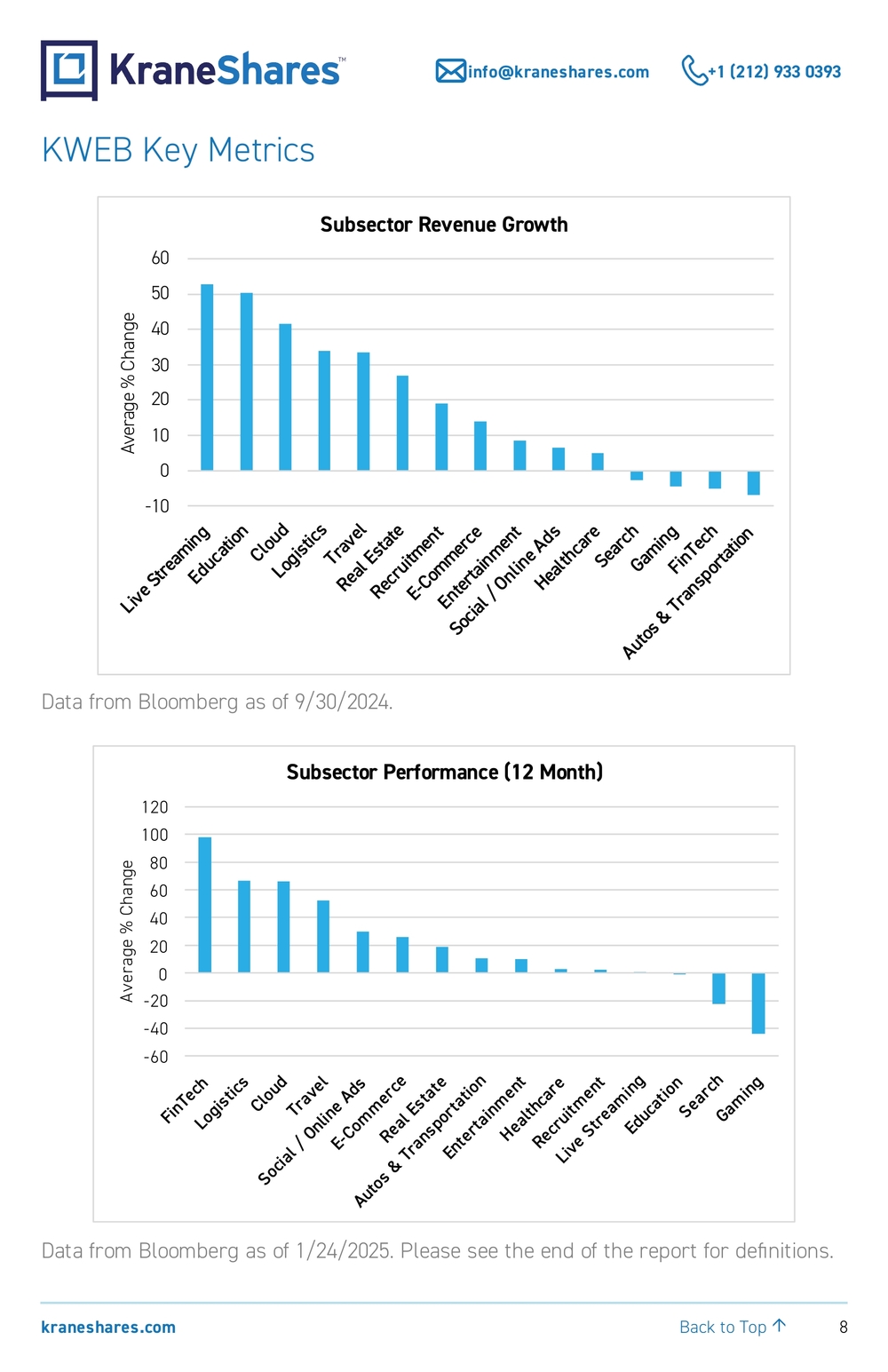
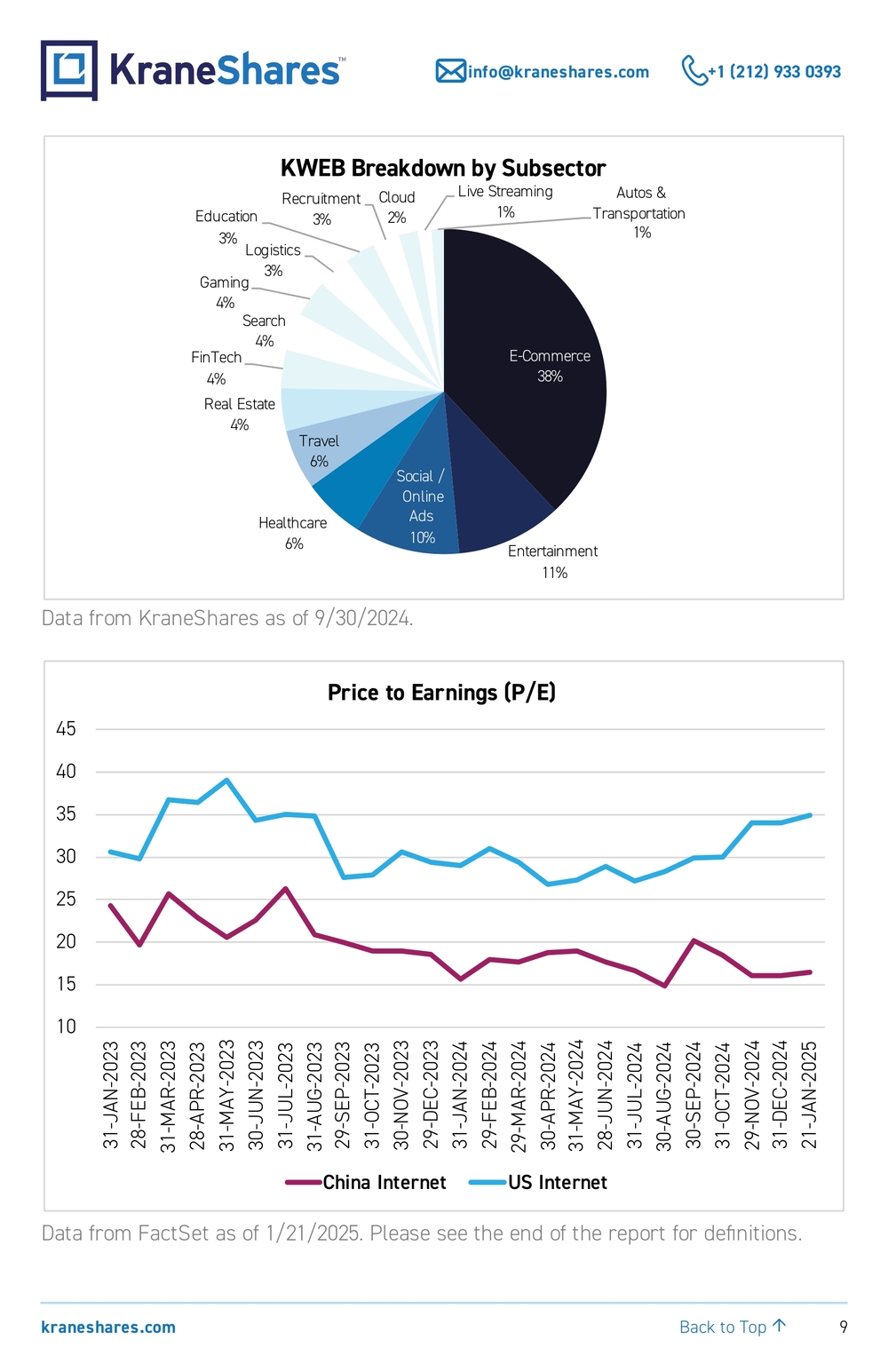
8 kraneshares.com info@kraneshares.com +1 (212) 933 0393 Back to Top ↑KWEB Key Metrics -100102030405060 Live Streaming Education Cloud Logistics Travel Real Estate Recruitment E-Commerce Entertainment Social / Online Ads Healthcare Search Gaming FinTech Autos & TransportationAverage % ChangeSubsector Revenue Growth Data from Bloomberg as of 9/30/2024. -60-40-20020406080100120 FinTech Logistics Cloud Travel Social / Online Ads E-Commerce Real Estate Autos & Transportation Entertainment Healthcare Recruitment Live Streaming Education Search GamingAverage % ChangeSubsector Performance (12 Month) Data from Bloomberg as of 1/24/2025. Please see the end of the report for definitions.
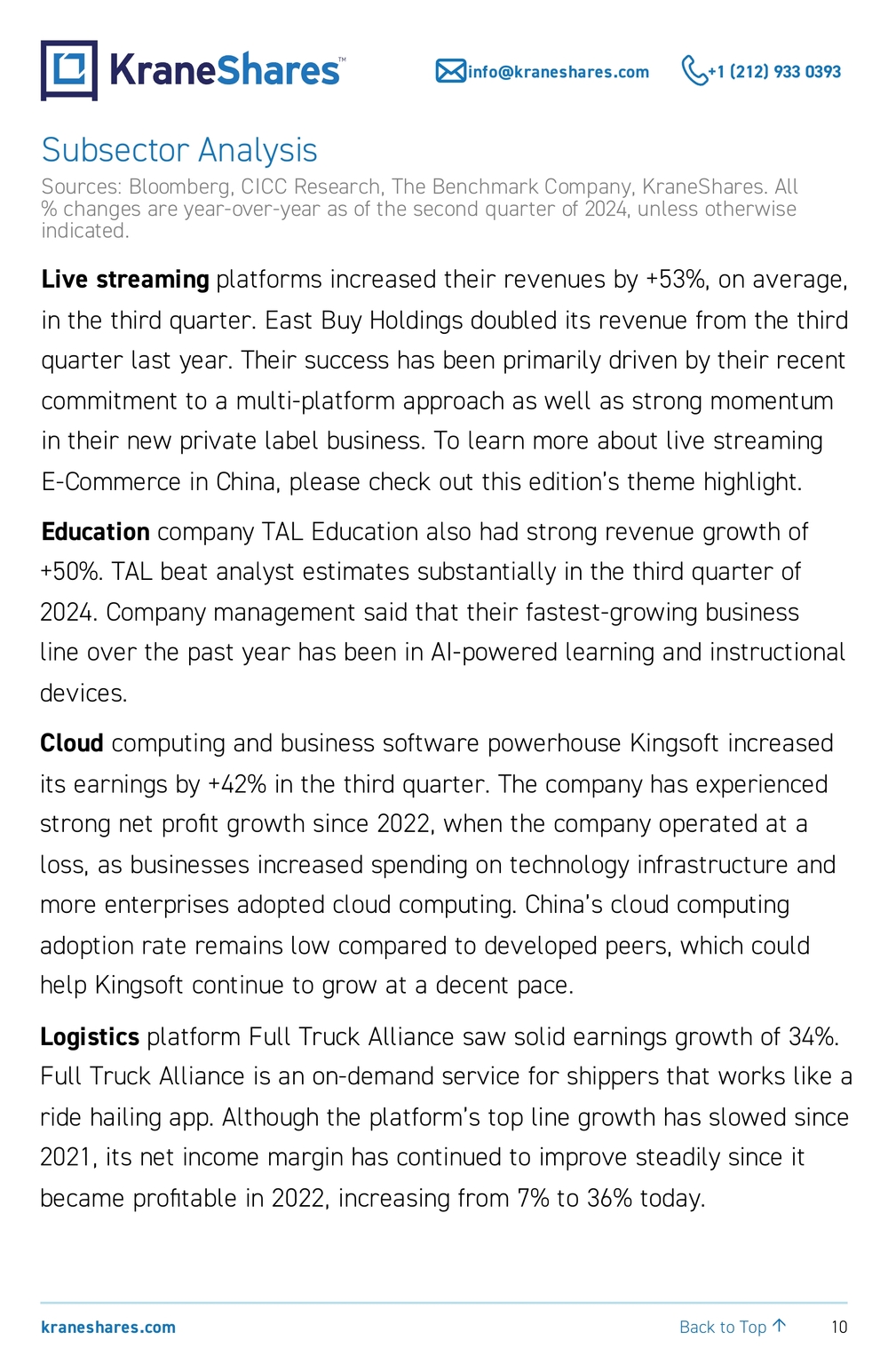
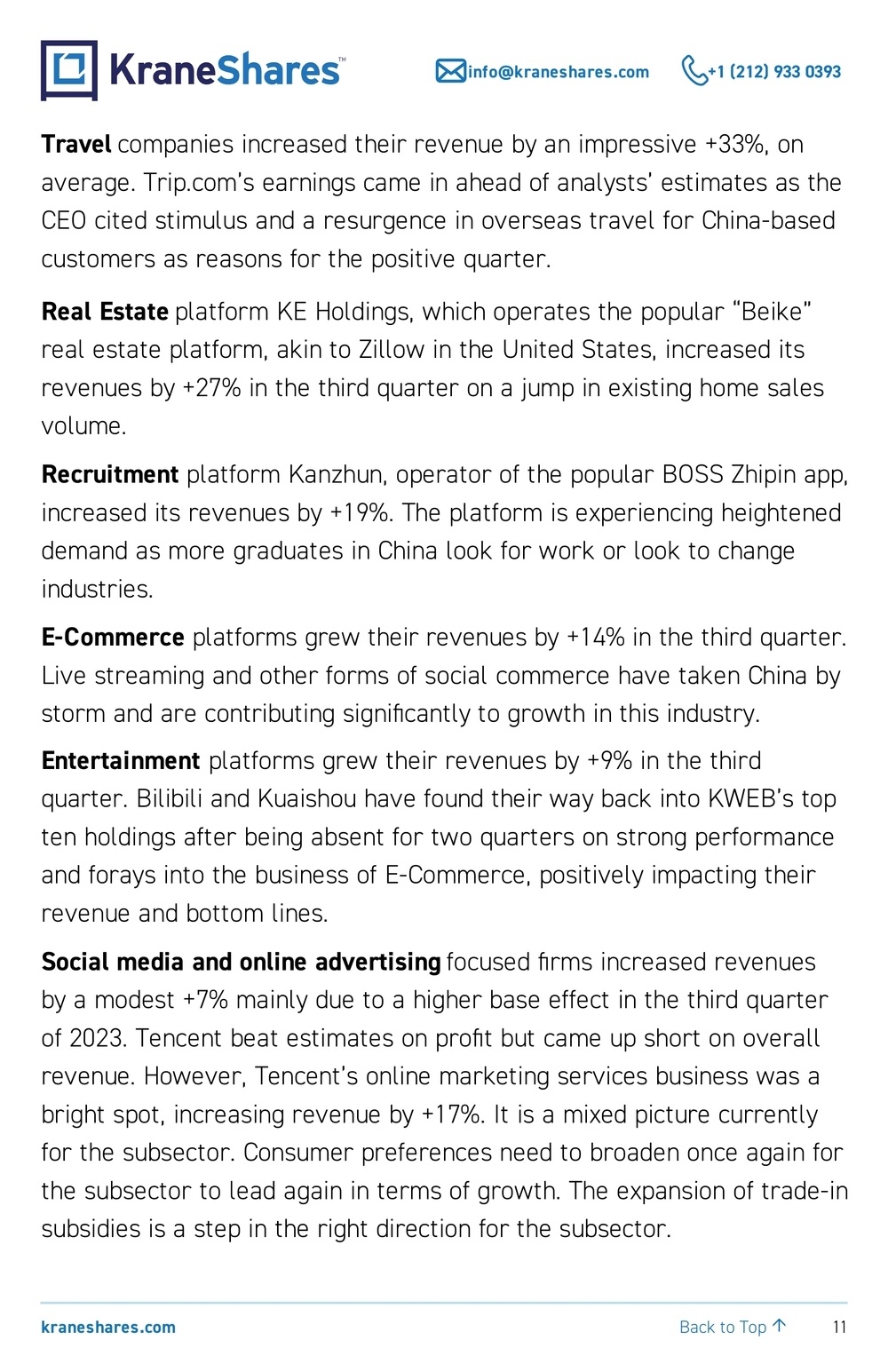
9 kraneshares.com info@kraneshares.com +1 (212) 933 0393 Back to Top ↑E-Commerce 38% Entertainment 11%Social / Online Ads 10%Healthcare 6%Travel 6%Real Estate 4%FinTech 4%Search 4%Gaming 4%Logistics 3%Education 3%Recruitment 3%Cloud 2%Live Streaming 1%Autos & Transportation 1%KWEB Breakdown by Subsector Data from KraneShares as of 9/30/2024. 1015202530354045 31-JAN-2023 28-FEB-2023 31-MAR-2023 28-APR-2023 31-MAY-2023 30-JUN-2023 31-JUL-2023 31-AUG-2023 29-SEP-2023 31-OCT-2023 30-NOV-2023 29-DEC-2023 31-JAN-2024 29-FEB-2024 29-MAR-2024 30-APR-2024 31-MAY-2024 28-JUN-2024 31-JUL-2024 30-AUG-2024 30-SEP-2024 31-OCT-2024 29-NOV-2024 31-DEC-2024 21-JAN-2025Price to Earnings (P/E) China Internet US Internet Data from FactSet as of 1/21/2025. Please see the end of the report for definitions.
10 kraneshares.com info@kraneshares.com +1 (212) 933 0393 Back to Top ↑Subsector Analysis Sources: Bloomberg, CICC Research, The Benchmark Company, KraneShares. All % changes are year-over-year as of the second quarter of 2024, unless otherwise indicated. Live streaming platforms increased their revenues by +53%, on average, in the third quarter. East Buy Holdings doubled its revenue from the third quarter last year. Their success has been primarily driven by their recent commitment to a multi-platform approach as well as strong momentum in their new private label business. To learn more about live streaming E-Commerce in China, please check out this edition’s theme highlight. Education company TAL Education also had strong revenue growth of +50%. TAL beat analyst estimates substantially in the third quarter of 2024. Company management said that their fastest-growing business line over the past year has been in AI-powered learning and instructional devices. Cloud computing and business software powerhouse Kingsoft increased its earnings by +42% in the third quarter. The company has experienced strong net profit growth since 2022, when the company operated at a loss, as businesses increased spending on technology infrastructure and more enterprises adopted cloud computing. China’s cloud computing adoption rate remains low compared to developed peers, which could help Kingsoft continue to grow at a decent pace. Logistics platform Full Truck Alliance saw solid earnings growth of 34%. Full Truck Alliance is an on-demand service for shippers that works like a ride hailing app. Although the platform’s top line growth has slowed since 2021, its net income margin has continued to improve steadily since it became profitable in 2022, increasing from 7% to 36% today.
11 kraneshares.com info@kraneshares.com +1 (212) 933 0393 Back to Top ↑Travel companies increased their revenue by an impressive +33%, on average. Trip.com’s earnings came in ahead of analysts’ estimates as the CEO cited stimulus and a resurgence in overseas travel for China-based customers as reasons for the positive quarter. Real Estate platform KE Holdings, which operates the popular “Beike” real estate platform, akin to Zillow in the United States, increased its revenues by +27% in the third quarter on a jump in existing home sales volume. Recruitment platform Kanzhun, operator of the popular BOSS Zhipin app, increased its revenues by +19%. The platform is experiencing heightened demand as more graduates in China look for work or look to change industries. E-Commerce platforms grew their revenues by +14% in the third quarter. Live streaming and other forms of social commerce have taken China by storm and are contributing significantly to growth in this industry. Entertainment platforms grew their revenues by +9% in the third quarter. Bilibili and Kuaishou have found their way back into KWEB’s top ten holdings after being absent for two quarters on strong performance and forays into the business of E-Commerce, positively impacting their revenue and bottom lines. Social media and online advertising focused firms increased revenues by a modest +7% mainly due to a higher base effect in the third quarter of 2023. Tencent beat estimates on profit but came up short on overall revenue. However, Tencent’s online marketing services business was a bright spot, increasing revenue by +17%. It is a mixed picture currently for the subsector. Consumer preferences need to broaden once again for the subsector to lead again in terms of growth. The expansion of trade-in subsidies is a step in the right direction for the subsector.
12 kraneshares.com info@kraneshares.com +1 (212) 933 0393 Back to Top ↑Health Care platform revenues grew by +5%, though the latest reports from JD Health and Ping An Health Tech for the six months ended June 30, 2024. Ali Health saw the strongest growth within the subsector, at +10%, with analysts expecting margin expansion thanks to a widening product offering in its direct pharmaceutical sales. Meanwhile, the entire industry could be getting a boost from the completion of a years- long antigraft campaign that had been targeting hospital procurement managers. Search engine Baidu’s revenues decreased -3%. The company is dealing with challenges including monetizing its AI products and losing out on market share in advertising to live streaming and short-form video platforms, including Douyin, China’s TikTok. Fintech companies’ revenue decreased by -5%. Qifu Technology, which focuses on subprime consumer loans, had the highest earnings growth among companies in the subsector in the third quarter. Meanwhile, Lufax continued to show negative earnings growth though did see a significant margin improvement versus the past two quarters. Lufax is still in the midst of a business transition to focus more on consumer loans as opposed to loans to small business owners (SBOs), which had historically been their largest segment. Auto marketplace Autohome saw its revenues decline by -7% on significant headwinds including the preference of newer electric vehicle makers to sell online themselves, direct to consumers, and the intense price competition among China-based manufacturers, which hurts dealers’ margins. However, the company announced it will pay a dividend in March that is +50% higher than last year’s.
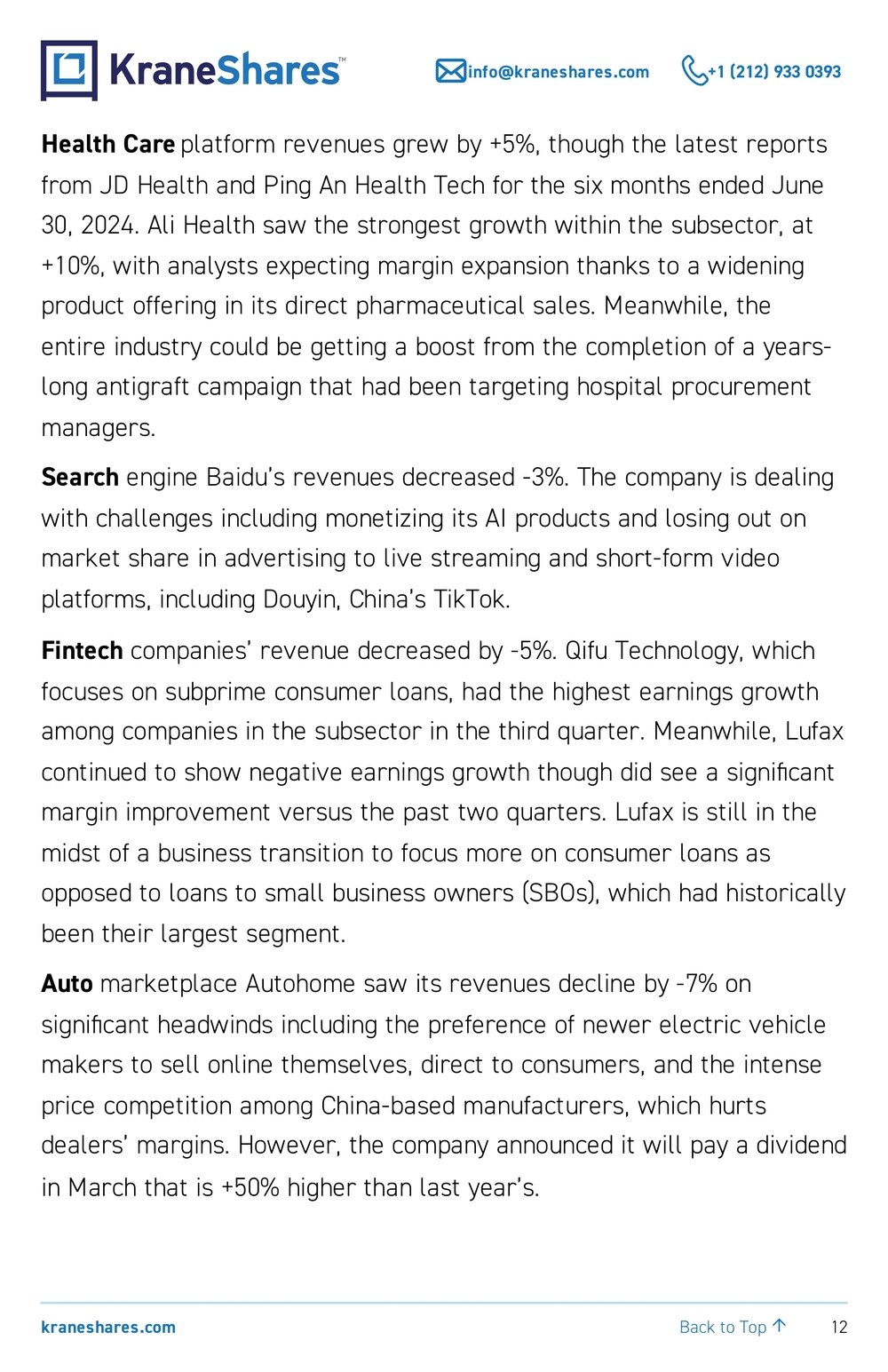
13 kraneshares.com info@kraneshares.com +1 (212) 933 0393 Back to Top ↑Theme Highlight – DeepSeek, TikTok, RedNote, & Temu: China Internet Making Waves in the USA Over the past year, we have seen apps from China internet companies consistently rank in the top ten most downloaded free apps in Apple’s US app store. These apps include PDD’s Temu, Bytedance’s TikTok and Lemon8, Xiao Hong Shu (or “RedNote”), and the current #1 at the time of writing, China’s large language model (LLM) and AI industry disruptor, DeepSeek. We believe this represents a watershed moment for China’s internet sector. Top internet companies, including the top holdings in the KraneShares CSI China Internet ETF (Ticker: KWEB) are going global. They are bridging the gap between the US and China in a way never thought possible when we launched the fund. Meanwhile, both China’s own firms and foreign firms are exporting trends, technologies, and online practices that were originally developed in China. These include short-form video social media, social commerce, and high-efficiency large language models (LLMs). This trend has the potential to re-shape the global internet and represents a significant growth opportunity for KWEB companies.
14 kraneshares.com info@kraneshares.com +1 (212) 933 0393 Back to Top ↑Short Video Social Media In Mid-January, the most-downloaded app in Apple’s US app store was Xiao Hong Shu ( 小红书 ), which translates as “Little Red Book”, though American users refer to the platform as “RedNote”. The platform counts Singapore’s Temasek and Tencent as its largest investors. Its unique app is best described as a hybrid of TikTok, Pinterest, and Instagram. RedNote rose in popularity in the US just before the US Supreme Court upheld Congress’ proposed legislation banning ByteDance’s TikTok social media platform. However, President Trump has delayed the enforcement of the legislation for 75 days. This has reversed the migration to RedNote somewhat, though the TikTok saga is not over yet and the China-native platform could yet see another surge in users if TikTok’s fate becomes uncertain again. RedNote’s rise in the US is not without precedent. As we wrote in a previous China Internet Earnings Report, PDD’s Temu E-Commerce platform topped the charts in US app stores in 2023, the first example of a KWEB holding to do so. Temu became popular for its easy-to-use, gamified shopping experience and rock-bottom prices for goods. Temu built up its following in the traditional way, through advertising, including an ad campaign in Super Bowl 57 in 2023. RedNote, on the other hand, became an overnight sensation in the United States not only as a protest of the potential removal of TikTok from the nation’s smartphones, but also because these American joiners, sometimes referred to as “TikTok refugees” are developing a genuine interest in learning what everyday life is like in China.
15 kraneshares.com info@kraneshares.com +1 (212) 933 0393 Back to Top ↑RedNote is a unique example, and its expansion is motivated by a one- time political stance. However, we believe it is indicative of the wider trend of internet practices developed in China going global. Americans loved TikTok’s model so much, that millions downloaded a previously unknown China-native app in protest of its potential ban. US social media giants Meta and Snap have caught on and have essentially copied the medium for their own platforms. Social Commerce Companies in China and abroad are also encouraging global consumers to consume more like the Chinese do: socially. Since Temu parent company PDD pioneered the concept of online group purchase orders at a discount, “social consumption” rates have skyrocketed on China’s internet. Social consumption can refer to many interactive ways of shopping online, including through live streams, group buying programs, games, influencer marketing, and many other forms. In China, social commerce already accounts for $900 billion worth of economic activity per year, which is about 30% of all E-Commerce sales.1 Meanwhile, in the US, it only represents $89 billion, which is less than 10% of E-Commerce sales, though rising steadily.2 Live streaming is the most common form of social commerce. According to Sina Finance, live streaming is the fastest growing type of E-Commerce in China. From January to November of 2024, analysis done by Sina Finance suggests that live streaming contributed 80% of the growth in the E-Commerce industry.1 Social commerce is also a significant source of competition within China’s internet sector. Douyin, which is China’s version of TikTok, short video
16 kraneshares.com info@kraneshares.com +1 (212) 933 0393 Back to Top ↑platform Kuaishou, PDD, and East Buy all compete fiercely for the social consumer’s wallet share. Right now, Douyin, owned by private company ByteDance, appears to be winning out. Over the past year, Douyin E-Commerce sales experienced growth of 39%.3 This is higher than the revenue growth rates of both Alibaba and JD.com. Douyin also said that over two-thirds of its E-Commerce revenue comes from live streams. Firms are beginning to export this E-Commerce model to their global customers. Bytedance launched the TikTok Shop, which is built into the TikTok app and allows live streamers and content creators to include built-in, one-click purchasing tools for users, worldwide. The online shop has already garnered interest from major brands and merchants. L ’Oreal and Puma have already begun selling products on the TikTok shop. Amazon has mimicked the internet giant’s unique spin on online spending with the launch of Amazon Live. Meta has also joined in on the trend with the launch of Instagram Shopping and Facebook Marketplace. International Markets: A Potential Catalyst For KWEB Companies PDD’s blockbuster growth over the past two years has been largely driven by their international expansion. Non-China revenue is estimated to account for nearly one third of PDD’s revenue. This has enabled PDD’s revenue to become completely unanchored from China’s consumption trends, at least in recent years.
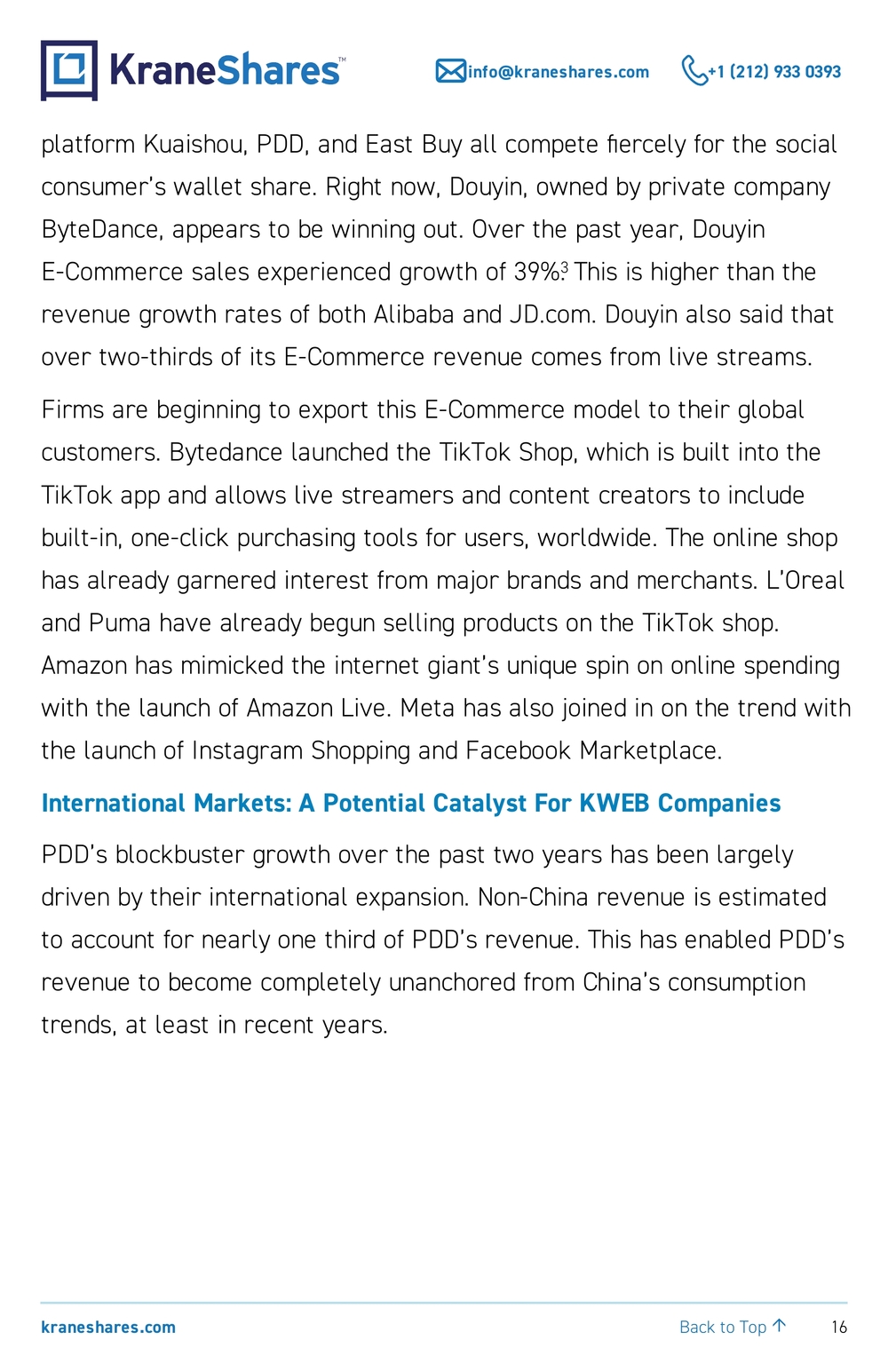
17 kraneshares.com info@kraneshares.com +1 (212) 933 0393 Back to Top ↑859095100105110115120 0102030405060 2020 2021 2022 2023 2024E$, BillionsPDD Annual Revenue Revenue (Left Axis) China Consumer Confidence Index Level (Right Axis)
Data from Bloomberg as of 12/31/2024. E = Estimate. Please see the end of the report for definitions. Growing familiarity with China-style E-Commerce and social media globally may drive more of KWEB’s holdings to begin to pursue or step up their existing efforts in the US and other Western countries. This could be positive for the industry overall. China’s E-Commerce giants Alibaba and JD.com have experienced setbacks, at times, from their continued reliance on China’s consumer strength. When China’s consumer confidence fell following the pandemic, these companies experienced some hits to growth and their bottom lines, though the ultimate impact on these companies was muted. While China’s consumer is expected to recover fully, having a more diversified business would make these companies more attractive as long-term investments. High-Efficiency Large Language Models (LLMs) DeepSeek is an AI-powered chat bot utilizing an LLM like that used by Chat GPT. DeepSeek is a startup founded in Hangzhou in 2023. Founder Liang Wenfeng spent many years managing a hedge fund called High
18 kraneshares.com info@kraneshares.com +1 (212) 933 0393 Back to Top ↑Flyer, which relied heavily on AI models to churn out stock picks.4 While it is not the first LLM developed in China, it is the first one to overcome its Western counterparts in terms of efficiency. According to the company, DeepSeek was developed for less than $6 million, which is orders of magnitude below what other developers spent to create and train their models, with some having spent $1 billion or more.5 We tested out DeepSeek’s capabilities, and they are certainly on par with the latest offerings from OpenAI. Beyond cost, the model’s creators say that it uses significantly fewer chips than were originally thought to be required by high-quality LLMs. This is critical as many have become concerned that China may experience a chip shortage following export restrictions imposed by the United States under the Biden Administration that target the most advanced chips needed for AI models. Moreover, DeepSeek’s open architecture means that others can benefit from their innovation, both inside and outside of China. This means that US and global companies are likely to incorporate DeepSeek’s technological advancements in their own AI models, which could be another powerful example of China exporting innovations. American AI powerhouse Perplexity has already begun to host DeepSeek’s R1 model on its platform. It could also cause Washington, DC to rethink its posture towards China on chips and AI, especially with a new Administration in place. Fewer Chips: A Potential Catalyst For KWEB Companies We believe DeepSeek’s success at building a world-class chat bot at a low cost and using fewer chips than previously thought possible is a positive signal for China’s internet giants, especially AI and cloud
19 kraneshares.com info@kraneshares.com +1 (212) 933 0393 Back to Top ↑computing leaders Alibaba, Tencent, and Baidu. Back in 2023, Alibaba executives said that US chip restrictions “may materially and adversely” impact its Cloud Intelligence Group’s operations, leading to their decision to postpone the spin off of the group.6 The landscape has changed since then. Shortly following the release of DeepSeek, Alibaba released a new version of its “Qwen” text, image, and video AI model, which it claims outperforms current versions of DeepSeek and Chat GPT7. Whether there will be an IPO of the cloud business remains to be seen, but Alibaba has clearly caught on to the same innovation as DeepSeek and rolling it out across its platforms. Alibaba’s Cloud Intelligence Group, which includes all AI initiatives, grew +7% overall, year-over-year, in the third quarter of 2024, outpacing the company’s total revenue growth for the period of 5%. AI-related product revenue, in particular, experienced triple-digit growth for the period, according to Alibaba’s earnings report.8 We believe AI products and cloud will be crucial growth drivers for the internet giant going forward, especially now that chip shortages are conceivably less of a risk for the segment. Meanwhile, Baidu and Tencent have yet to make significant announcements on AI following DeepSeek’s release. However, we believe these AI leaders are also likely to benefit significantly from lower costs and fewer chips. Where is all this AI innovation coming from? After the US’ Biden Administration began to place export restrictions on high-end semiconductors to China in 2023, local technology engineers were deeply motivated to develop homegrown alternatives. Although it remains
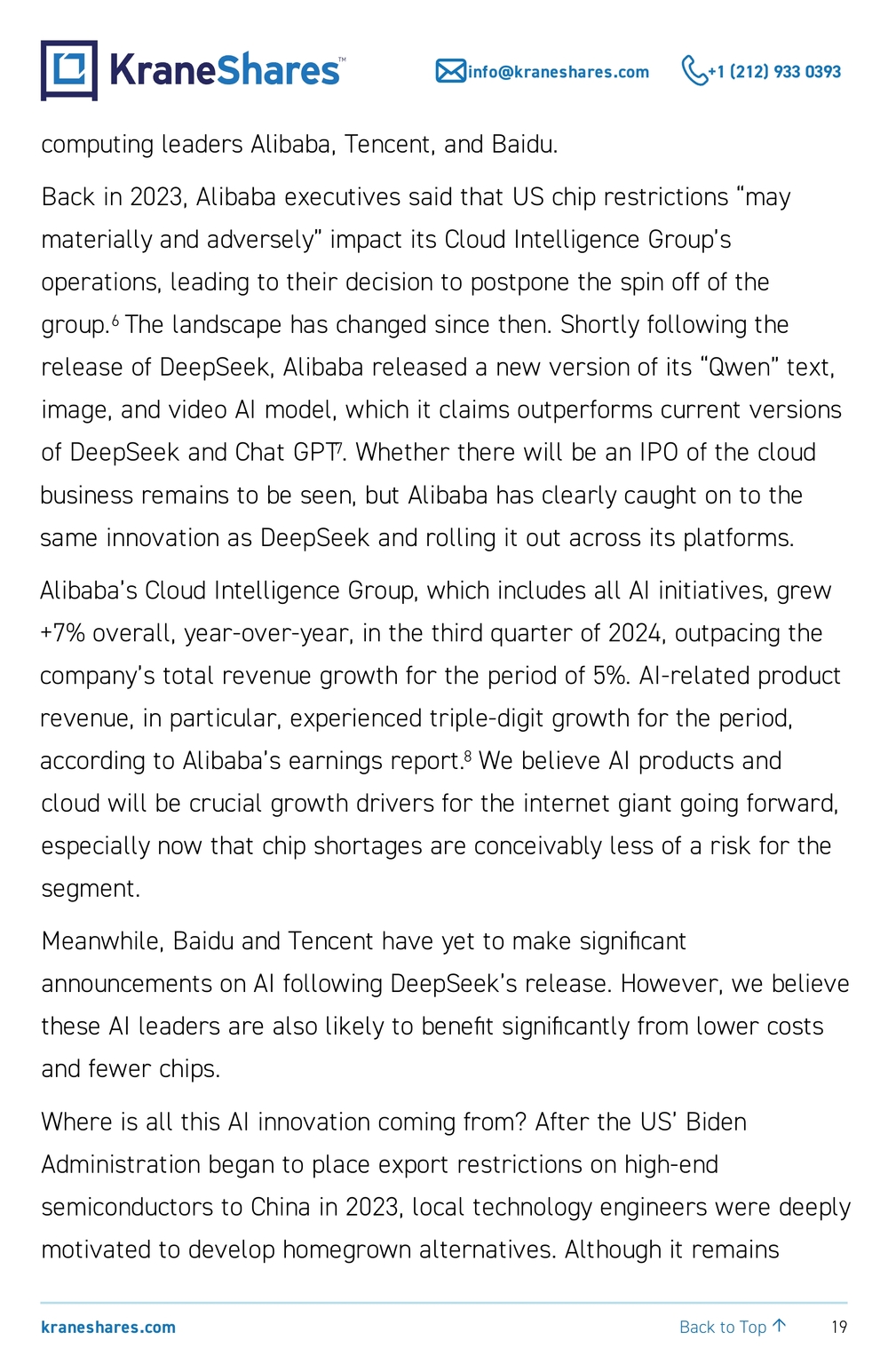
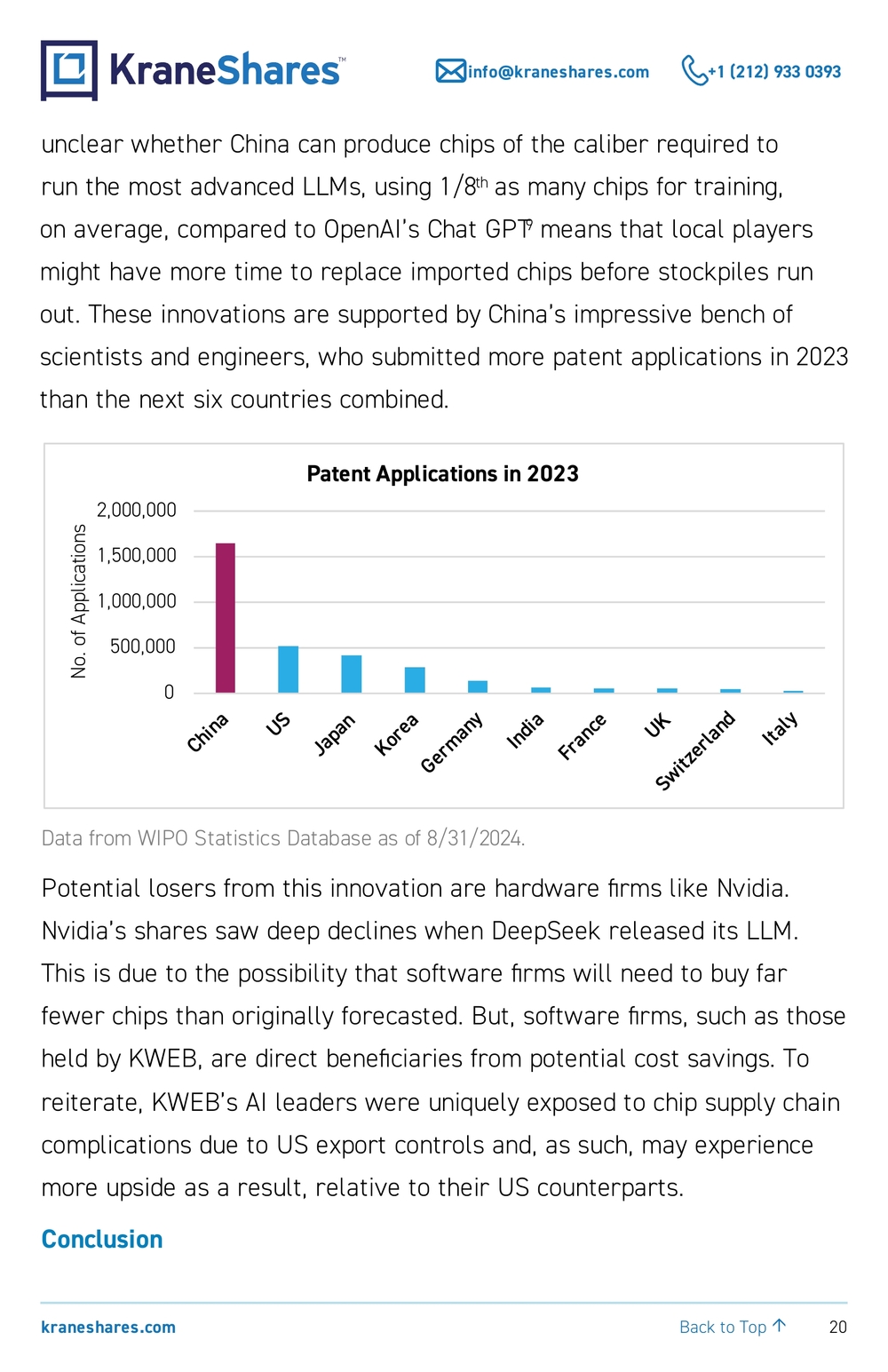
20 kraneshares.com info@kraneshares.com +1 (212) 933 0393 Back to Top ↑unclear whether China can produce chips of the caliber required to run the most advanced LLMs, using 1/8th as many chips for training, on average, compared to OpenAI’s Chat GPT9 means that local players might have more time to replace imported chips before stockpiles run out. These innovations are supported by China’s impressive bench of scientists and engineers, who submitted more patent applications in 2023 than the next six countries combined. 0500,0001,000,0001,500,0002,000,000 ChinaUS Japan Korea Germany India France UK Switzerland ItalyNo. of ApplicationsPatent Applications in 2023 Data from WIPO Statistics Database as of 8/31/2024. Potential losers from this innovation are hardware firms like Nvidia. Nvidia’s shares saw deep declines when DeepSeek released its LLM. This is due to the possibility that software firms will need to buy far fewer chips than originally forecasted. But, software firms, such as those held by KWEB, are direct beneficiaries from potential cost savings. To reiterate, KWEB’s AI leaders were uniquely exposed to chip supply chain complications due to US export controls and, as such, may experience more upside as a result, relative to their US counterparts. Conclusion
21 kraneshares.com info@kraneshares.com +1 (212) 933 0393 Back to Top ↑China’s internet sector has made great strides since the launch of KWEB. Few could have imagined that internet trends, platforms, and innovations that started in China would become commonplace in the United States and all over the world. We believe China-led innovations and trends are poised to reshape how the world socializes online, conducts transactions, and develops artificial intelligence. This represents a significant, long- term growth opportunity for KWEB companies, which are becoming key contributors to not only the development of China’s internet, but also the world’s internet. Meanwhile, recent innovations in artificial intelligence mean that KWEB’s AI leaders’ progress is unlikely to be hampered by limited access the US-made chips. KWEB Top 10 Holdings Earnings Update Sources: Bloomberg, CICC Research, company releases & filings, KraneShares. % changes are year-over-year unless otherwise indicated. Revenue figures are adjusted (non-GAAP). Alibaba Alibaba is a conglomerate primarily engaged in the E-Commerce industry. The company operates an online marketplace offering a wide variety of consumer goods. The company has also expanded beyond E-Commerce and is now a consortium of six businesses covering cloud, domestic E-Commerce, global digital commerce, media, logistics, and local services. Alibaba by The Numbers (Q3 2024) •Revenue +5% to RMB 241.8B ($33.0B) •Net Income RMB 32.2B ($4.4B) •Net Margin 13%
22 kraneshares.com info@kraneshares.com +1 (212) 933 0393 Back to Top ↑ •Earnings per Share RMB 13.2 ($1.8) Alibaba’s top-line revenue missed estimates slightly in the third quarter, while adjusted net income and adjusted EPS both beat analyst expectations. Taobao and Tmall, which are the core China E-Commerce businesses, increased revenues by +1%. Meanwhile, Cloud Intelligence Group grew revenue by +7% billion and Alibaba International Digital Commerce Group (AIDC), which includes all international marketplaces and logistics services, grew revenue by +29%. Management noted that the Singles Day sales festival saw “robust growth” and “record high” sales, though the impact of those sales will be reflected in the company’s results for the fourth quarter. Over the course of the third quarter, Alibaba bought back 414 million Hong Kong shares for $4.1 billion, reducing shares outstanding by -2.1%. The company has a remaining $22 billion cash set aside for potential share repurchases through March of 2027. Tencent Tencent is a diversi fied consumer technology company with businesses in social media, cloud services, payments, and online advertising. Tencent’s most well-known product is WeChat, one of China’s premier social media platforms with over one billion monthly active users (MAUs). Tencent by The Numbers (Q3 2024) •Revenue +8% to RMB 170.7B ($23.3B) •Net Income RMB 52.0B ($7.1B) •Net Margin 30% •Earnings per Share RMB 5.9 ($0.8)
23 kraneshares.com info@kraneshares.com +1 (212) 933 0393 Back to Top ↑Tencent’s positive third quarter results were driven by strong growth in domestic game revenue, which increased +14%, versus international game revenue, which only increased by +9%. Online marketing services revenues increased +17%, a positive signal not only for the company, but also for China’s economy. There is no reason to advertise if no one is buying. However, fintech was a weakness as management said that “payment services revenues declined due to subdued consumption spending,” which led to a “decrease in payment revenue, which was partially offset by increase in wealth management services revenue.” Meituan Meituan is an E-Commerce company that specializes in food delivery and other local services. The company operates many business lines, including general retail, restaurant booking, and travel booking services, and it serves over 600 million registered users. Meituan is one of China’s leading “super apps” that offer a wide variety of services, including from third parties. Meituan by The Numbers (Q3 2024) •Revenue +22% to RMB 96.0B ($13.1B) •Net Income RMB 12.5B ($1.7B) •Net Margin 13% •Earnings per Share RMB 2.2 ($0.3) Meituan delivered outstanding results, beating analyst estimates in the third quarter. The company’s new initiatives, including Pin Hao Fao, which allows for group deals on orders, and Shen Qiang Shou, a live-streaming E-Commerce platform, contributed the most to top-line growth.
24 kraneshares.com info@kraneshares.com +1 (212) 933 0393 Back to Top ↑Meanwhile, the company has seen a significant margin improvement over the past year, mostly owing to lower costs in its newer initiatives. Meituan’s Founder, CEO, & Chairman Xing Wang commented that Meituan may also see benefits from stimulus, but mostly downstream as consumer confidence leads to more orders and bookings on the platform. JD.com JD.com is one of the largest E-Commerce platforms in China. JD owns a large and growing marketplace for a wide variety of goods and offers its own logistics service. JD offers its services to over 500 million users. JD.com by The Numbers (Q3 2024) •Revenue +5% to RMB 265.0B ($36.3B) •Net Income RMB 36.5B ($5.0B) •Net Margin 14% •Earnings per Share RMB 8.0 ($1.1) JD.com’s third quarter results largely exceeded analysts’ expectations. In a press release, CEO Sandy Xu commented that JD is benefiting “as overall consumer sentiment continued to brighten.” JD is a direct beneficiary of trade-in subsidies for home appliances, serving as the online “Best Buy of China.” CFO Ian Su Shan commented that “China’s government-backed trade-in programs in over 20 provinces and cities…have been launched on JD.com”. He also commented on the rise in revenues “resulting from a rebound in growth of electronics and home appliances”. On the earnings call, when asked about the program, CEO Xu stated that “the full potential of the trade-in policy has yet to be fully realized in Q3 because some of the consumers haven’t been fully aware of this policy”.
25 kraneshares.com info@kraneshares.com +1 (212) 933 0393 Back to Top ↑The company announced a new, ambitious stock buyback program totaling $5 billion after repurchasing an impressive 8.1% of shares outstanding (15.5 million ADRs) in 2024 through the end of September. PDD PDD is an innovative global E-Commerce platform focused on the user experience and was one of the fi rst to embrace a social media-like model for online shopping. The company’s apps are known for their group-buying capabilities, inserting gaming into shopping and earning coupons, and rock-bottom prices for private-label goods. PDD is also famous for pioneering to lower overhead costs through an on-demand manufacturing model. PDD operates under the name “Pinduoduo” in China and “Temu” in the rest of the world. PDD by The Numbers (Q3 2024) •Revenue +44% to RMB 101.8B ($13.9B) •Net Income RMB 25.6B ($3.5B) •Net Margin 25% •Earnings per Share RMB 17.6 ($2.4) PDD’s growth has slowed significantly after its revenue nearly doubled in 2023. Analyst estimates for growth had been revised lower, but the company’s revenue growth still came in slightly below those revisions. However, its margin remains intact and was in line with expectations in the third quarter. PDD is experiencing increased competition from legacy E-Commerce platforms and short video and live streaming platforms getting into E-Commerce, including Bytedance’s TikTok and Douyin, both inside and outside of China.
26 kraneshares.com info@kraneshares.com +1 (212) 933 0393 Back to Top ↑KE Holdings KE Holdings is China’s leading online housing transaction and services platform. Originally a brick-and-mortar real estate brokerage, Beike expanded into an integrated online and of fline ecosystem, providing solutions for property sales, rentals, home renovation, and mortgages. KE Holdings by The Numbers (Q3 2024) •Revenue +27% to RMB 23.4B ($3.2B) •Net Income RMB 0.7B ($0.1B) •Net Margin 3% •Earnings per Share RMB 0.7 ($0.1) KE Holdings’ top-line revenue growth was higher than in recent quarters, though its cost of revenues might have increased as its net margin decreased. New home transactions jumped +18% in the third quarter, which is positive for China’s real estate sector. The platform had been focusing on its home decoration services recently amid the slump in the market. The rebound in home sales is positive for the company going forward, though regulators’ efforts to lower the transaction costs involved in home purchases may keep KE’s margins subdued for the time being. Trip.com Trip.com is a travel booking site widely recognized as an international competitor to Expedia. It provides search and complete booking services for fl ights, hotels, trains, car rentals, and more. The company offers international and domestic travel booking services to Chinese and global customers.
27 kraneshares.com info@kraneshares.com +1 (212) 933 0393 Back to Top ↑Trip.com by The Numbers (Q3 2024) •Revenue +16% to RMB 16.1B ($2.2B) •Net Income RMB 5.8B ($0.8B) •Net Margin 36% •Earnings per Share RMB 8.0 ($1.1) Trip.com’s earnings beat analyst expectations in the third quarter. Executive Chairman and Co-founder James Jianzhang Liang stated, “In the third quarter of 2024, China’s travel market demonstrated remarkable resilience with strong performance in both domestic and cross-border travel. This surge in demand reflects a recovery in consumer confidence and a growing enthusiasm for travel.” When asked if recent stimulus measures boosted travel spending, CFO Cindy Xiaofan Wang responded, “It may be too early to determine the direct impact of the recent stimulus measures, but a healthy economic environment should benefit all industries, including travel.” Baidu Baidu is a technology company with substantial businesses in arti ficial intelligence, search engines, cloud computing, mobility solutions, and more. Baidu operates China’s most popular search engine. Meanwhile, Baidu’s ERNIE AI chatbot has over 100 million users, and its Apollo program operates the world’s largest fl eet of robo-taxis.
28 kraneshares.com info@kraneshares.com +1 (212) 933 0393 Back to Top ↑Baidu by The Numbers (Q3 2024) •Revenue -3% to RMB 34.3B ($4.7B) •Net Income RMB 5.1B ($0.7B) •Net Margin 15% •Earnings per Share RMB 0.0 ($0.0) Back in KWEB’s top ten after two quarters, Baidu had a challenging third quarter in 2024. Baidu is facing headwinds from slow monetization of its web-based AI products and competition in advertising. However, its Baidu Apollo robo-taxi business is a bright spot and has been breaking even in some regions, the first autonomous driving scheme to do so. Bilibili Bilibili is an innovative and growing online entertainment platform in China. Bilibili is akin to YouTube in the US but offers a wider variety of content including games and comics. Bilibili has also become a significant player in live streaming, especially e-sports. The company listed shares publicly for the first time in 2018 on the New York Stock Exchange. Bilibili by The Numbers (Q3 2024) •Revenue +26% to RMB 7.3B ($1.0B) •Net Income RMB 0.0B ($0.0B) •Net Margin 0% •Earnings per Share RMB 0.0 ($0.0) Bilibili achieved a significant milestone of a slight profit in the third quarter after operating at a loss for the past three years. Although the company is operating more efficiently, a slowdown in gaming and live
29 kraneshares.com info@kraneshares.com +1 (212) 933 0393 Back to Top ↑streaming revenue is possible going forward on intensifying competition in both spaces in China. Consumer spending online rose in the past year, but now consumers are rotating back into physical goods with trade-in subsidies becoming available. This could dint Bilibili’s growth outlook. Kuaishou Kuaishou, which translates literally as “quick hand”, is a leading short- form video and live streaming content platform in China, akin to YouTube in the United States. More than a sharing and viewing platform, Kuaishou also provides advanced tools for creators and businesses to edit their videos and increase their reach. Kuaishou by The Numbers (Q3 2024) •Revenue +11% to RMB 31.4B ($4.3B) •Net Income RMB 3.7B ($0.5B) •Net Margin 12% •Earnings per Share RMB 0.0 ($0.0) Kuaishou’s third quarter earnings were slightly higher than estimates on the top line. The positive quarterly results were primarily driven by an increase in revenue from online marketing services. Kuaishou’s margins continue to trend higher after the company reached profitability in 2023. The platform competes heavily with Bilibili and others in one of the most competitive industries in China and appears to be winning out, for now.
30 kraneshares.com info@kraneshares.com +1 (212) 933 0393 Back to Top ↑Citations
- Data from Sina Finance as of 12/31/2024.
- “U.S. Social Commerce Market Size, Share & Trends Analysis Report By Business Model (B2C, B2B, C2C), By Product Type (Apparel, Accessories, Home Products), By Platform/Sales Chanel, And Segment Forecasts, 2023 – 2030,” Grand View Research.
- Data from The Benchmark Company as of 12/31/2024.
- Roush, Ty. “Who Is Behind DeepSeek? Here’s What To Know About Founder Liang Wenfeng,” Forbes. January 28, 2025.
- Power, John. “China’s DeepSeek faces questions over claims after shaking up global tech,” Aljazeera. January 29, 2025.
- Ziady, Hanna. “Chip war nixes Alibaba’s plan to spin out cloud business,” CNN Business. November 17, 2023.
- RTT News. “Alibaba Cloud Releases Latest A Models For Enhanced Visual Understanding,” Nasdaq. January 29, 2025.
- Alibaba Earnings Report: Third Quarter of 2024.
- The Editorial Board. “The DeepSeek AI Freakout,” The Wall Street Journal. January 17, 2025. Index Definitions The CSI Overseas China Internet Index (China Internet) selects overseas listed Chinese Internet companies as the index constituents; the index is weighted by free float market cap. The index can measure the overall performance of overseas listed Chinese Internet companies. The Index is within the scope of the IOSCO Assurance Report as of 30 September
- The index was launched on September 20, 2011.