Hedged Equity ETF | KSPY | KraneShares
by Kraneshares
info@kraneshares.com6/30/2026 1A Risk- Managed Approach to US Equities Overview of the KraneShares Hedgeye Hedged Equity Index ETF (Ticker: KSPY)KSPY
Investment Strategy: KSPY tracks the Hedgeye Hedged Equity Index, which provides exposure to the S&P 500 while actively reducing volatility and providing downside risk management. The Index is managed by Hedgeye Asset Management, LLC and utilizes a model based on Hedgeye’s proprietary Risk Range Signals that analyze the daily trading range of the S&P 500. The Index toggles between three options strategies based on where the S&P 500 falls within these ranges. These options strategies are intended to provide downside risk management, option income, and potential compensation for the loss of upside. Depending on market conditions, the Index can change options strategies as frequently as daily. KSPY Features: •KSPY’s Index offers investors passive exposure to the S&P 500, while seeking to reduce volatility and to provide downside risk management. •KSPY’s Index provides the downside risk management with a combination of put and call options to hedge its underlying exposure to the S&P 500. •KraneShares manages the options exposure for investors, which can be more economical and time efficient than buying individual stock options. •KSPY’s Index strategy is guided by Hedgeye’s Risk Range Signals, which, on a daily basis, may buy and sell options produced using Hedgeye’s proprietary price, volume, and volatility model. •Hedgeye began publishing its Risk Range Signals in 2015 and has grown a significant user base of both institutional and individual investors.KSPY KraneShares Hedgeye Hedged Equity Index ETF 2*Data from Hedgeye Asset Management, LLC, retrieved 6/30/2026.
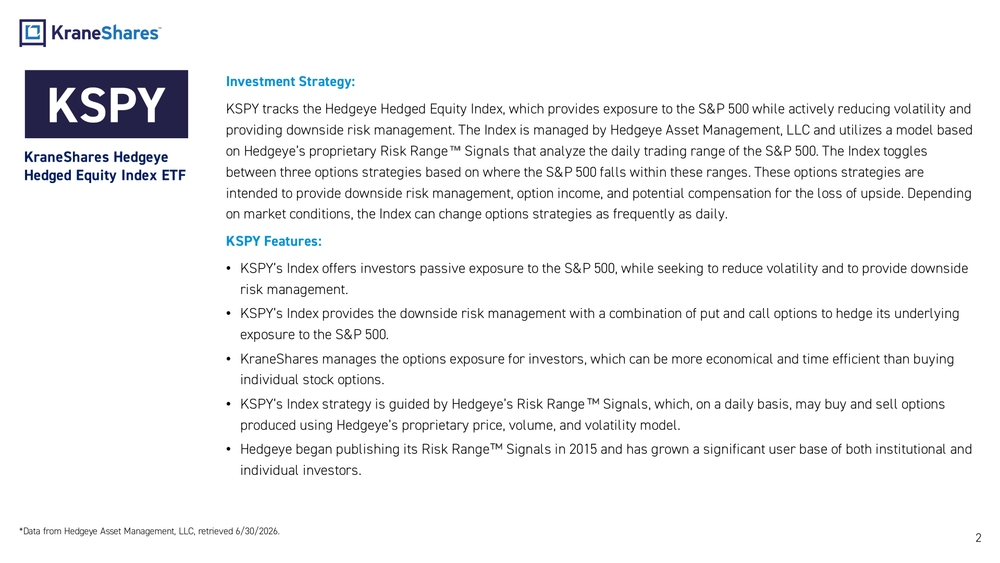
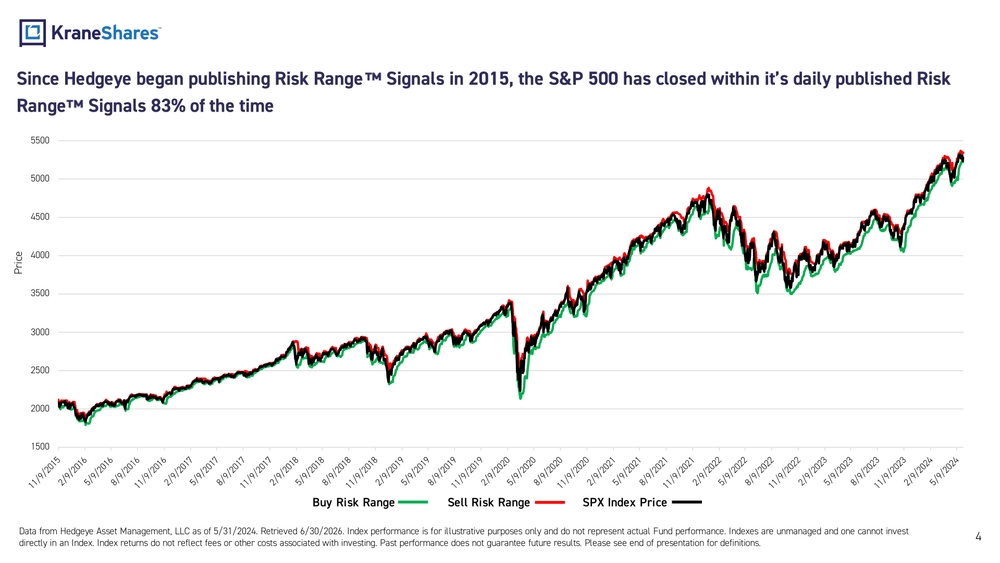
3Hedgeye’s Risk Range Signals: How They Work •Hedgeye’s Risk Range Signals were developed by Keith McCullough as a hedge fund manager, providing a quantitative risk management tool to augment fundamental views. •The proprietary model analyzes price, volatility and volume to generate ranges that can help market participants identify entry and exit points. •Since 2015, the S&P 500 has closed within Hedgeye’s daily published Risk Range Signals 83% of the time. The Hedgeye Hedged Equity Index utilizes Hedgeye’s Risk Range Signals to effectively manage S&P 500 volatility in a systematic manner.Initially designed to operate in a hedge fund setting, Hedgeye’s Risk Range
Signals are a quantitative, data -driven tool for identifying entry and exit prices.Publication of Hedgeye’s Risk Range
Signals began in 2015, since growing a significant user base of both institutional and individual investors. Data from Hedgeye Asset Management, LLC, retrieved 6/30/2026.
Since Hedgeye began publishing Risk Range Signals in 2015, the S&P 500 has closed within it’s daily published Risk Range Signals 83% of the time 4Data from Hedgeye Asset Management, LLC as of 5/31/2024. Retrieved 6/30/2026. Index performance is for illustrative purposes only and do not re present actual Fund performance. Indexes are unmanaged and one cannot invest directly in an Index. Index returns do not reflect fees or other costs associated with investing. Past performance does not g uarantee future results. Please see end of presentation for definitions. 150020002500300035004000450050005500 Buy Risk Range Sell Risk Range SPX Index PricePrice
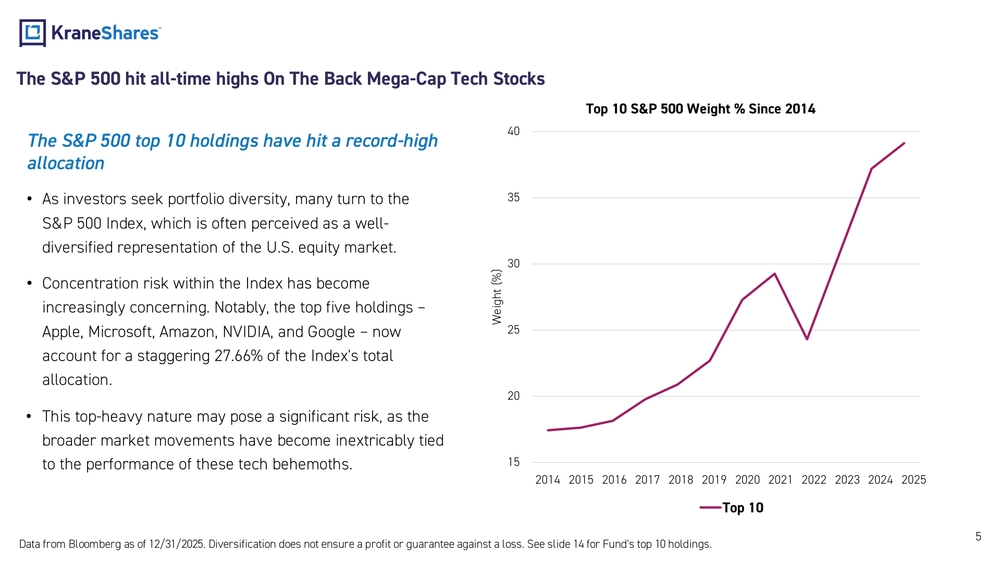
5The S&P 500 hit all -time highs On The Back Mega- Cap Tech Stocks Data from Bloomberg as of 12/31/2025. Diversification does not ensure a profit or guarantee against a loss. See slide 14 for Fund's top 10 holdings.The S&P 500 top 10 holdings have hit a record- high allocation •As investors seek portfolio diversity, many turn to the S&P 500 Index, which is often perceived as a well - diversified representation of the U.S. equity market. •Concentration risk within the Index has become increasingly concerning. Notably, the top five holdings – Apple, Microsoft, Amazon, NVIDIA, and Google – now account for a staggering 27.66% of the Index's total allocation. •This top -heavy nature may pose a significant risk, as the broader market movements have become inextricably tied to the performance of these tech behemoths. 152025303540 2014 2015 2016 2017 2018 2019 2020 2021 2022 2023 2024 2025Weight (%)Top 10 S&P 500 Weight % Since 2014 Top 10
6But now, we believe equity market uncertainty has re- emerged in 2026
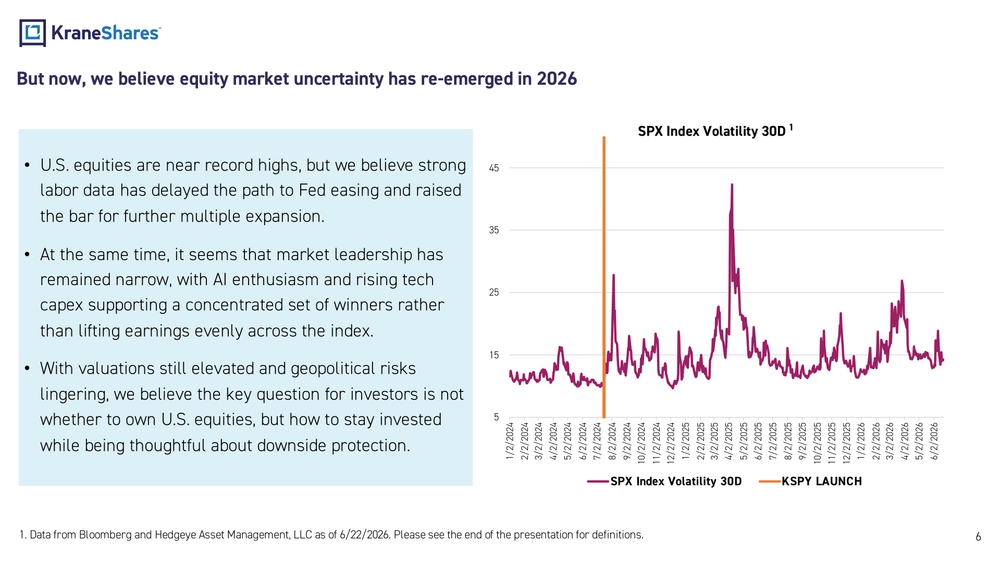
- Data from Bloomberg and Hedgeye Asset Management, LLC as of 6/22/2026. Please see the end of the presentation for definitions.•U.S. equities are near record highs, but we believe strong labor data has delayed the path to Fed easing and raised the bar for further multiple expansion. •At the same time, it seems that market leadership has remained narrow, with AI enthusiasm and rising tech capex supporting a concentrated set of winners rather than lifting earnings evenly across the index. •With valuations still elevated and geopolitical risks lingering, we believe the key question for investors is not whether to own U.S. equities, but how to stay invested while being thoughtful about downside protection. 515253545 1/2/2024 2/2/2024 3/2/2024 4/2/2024 5/2/2024 6/2/2024 7/2/2024 8/2/2024 9/2/2024 10/2/202411/2/2024 12/2/2024 1/2/2025 2/2/2025 3/2/2025 4/2/2025 5/2/2025 6/2/2025 7/2/2025 8/2/2025 9/2/2025 10/2/202511/2/2025 12/2/2025 1/2/2026 2/2/2026 3/2/2026 4/2/2026 5/2/2026 6/2/2026SPX Index Volatility 30D1 SPX Index Volatility 30D KSPY LAUNCH
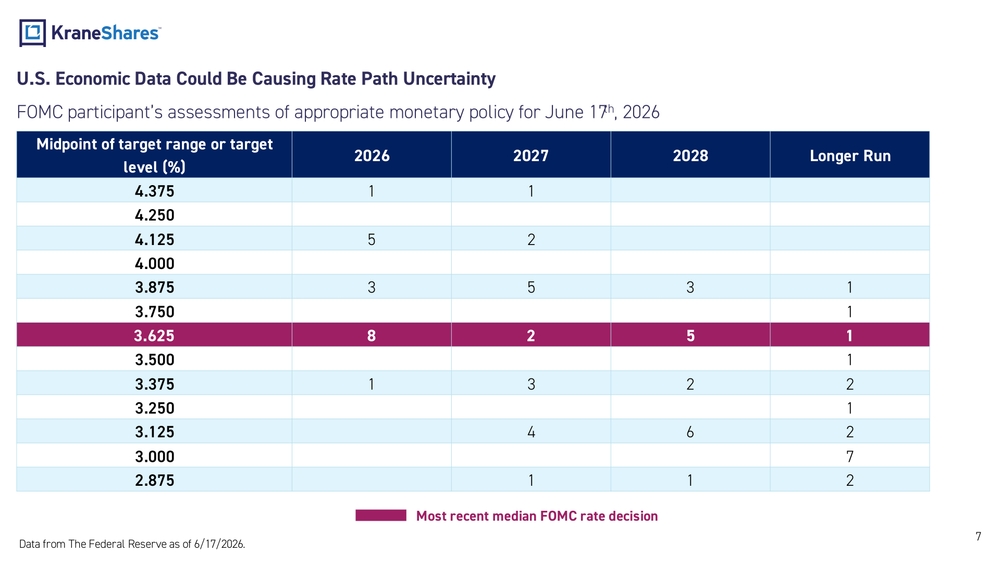
7U.S. Economic Data Could Be Causing Rate Path Uncertainty FOMC participant’s assessments of appropriate monetary policy for June 17th, 2026 Data from The Federal Reserve as of 6/17/2026.Midpoint of target range or target level (%)2026 2027 2028 Longer Run 4.375 1 1 4.250 4.125 5 2 4.000 3.875 3 5 3 1 3.750 1 3.625 8 2 5 1 3.500 1 3.375 1 3 2 2 3.250 1 3.125 4 6 2 3.000 7 2.875 1 1 2 Most recent median FOMC rate decision
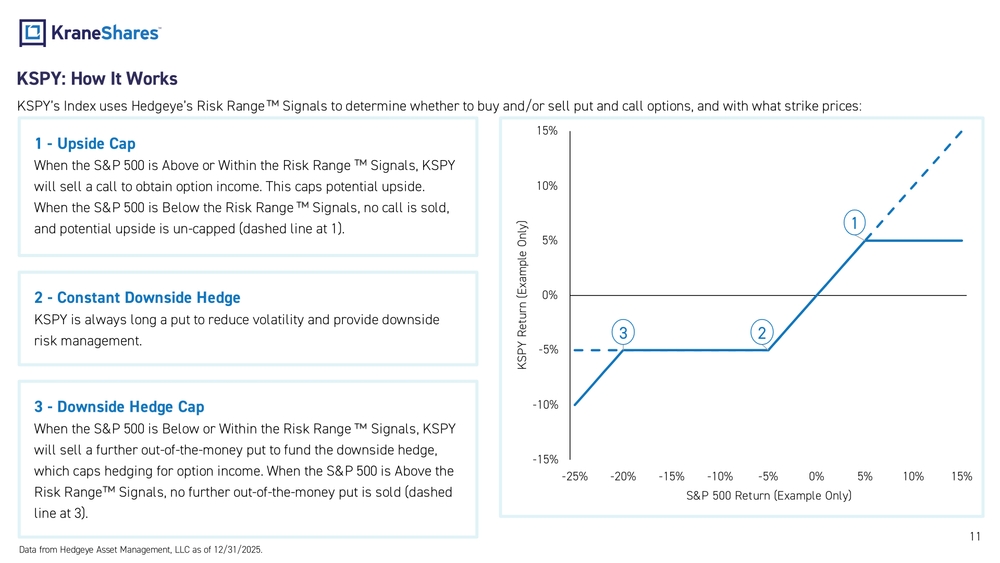
8The S&P 500 Index has now reached new all -time highs in 2026, how long will it continue? Data from Bloomberg as of 6/18/2026. Index returns are for illustrative purposes only and do not reflect management fees, tra nsaction costs, or expenses. Indexes are unmanaged, and one cannot invest directly in an index. The performance data quoted represents past performance. Past performance does not guarantee future results. The investment retu rn and principal value of an investment will fluctuate so that an investor’s shares, when redeemed or sold, may be worth more or less than the origi nal cost. Current performance may be lower or higher than the performance quoted. For performance data current to the last month end, please see slide 14. Please see the end of the presentation for definitions.8500950010500115001250013500Growth of 10,000 UnitsS&P 500 Index vs KSPY Net Asset Value (NAV) Return Since 7/15/2024 (KSPY Inception) SPX Index KSPY US Equity+36.45% +26.21%
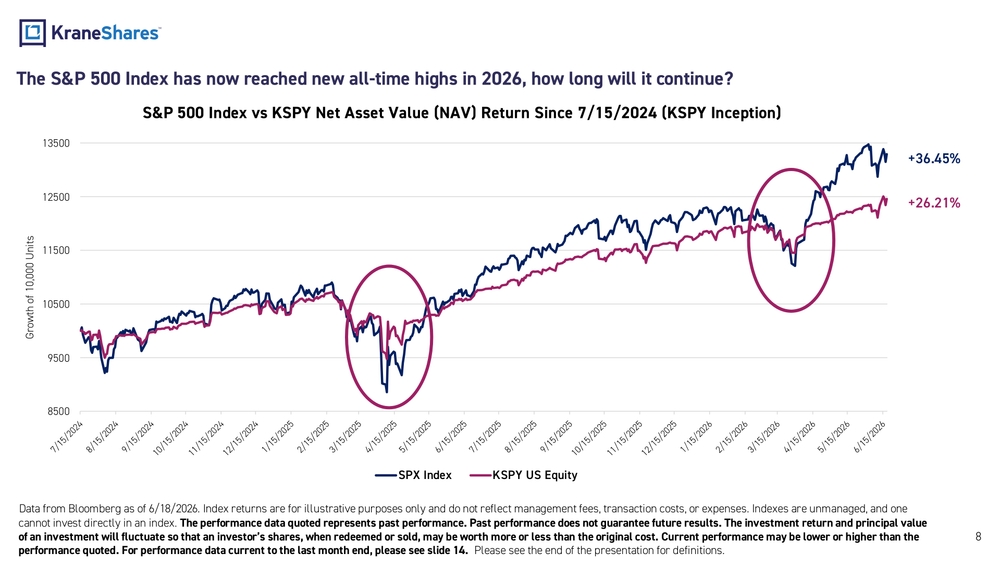
9KSPY: How It Works The Index will ( i) sell an out- of- the-money put for option income and (ii) use the option income to buy an at- the-money or nearer - to-the-money put to obtain a downside hedge.Below Risk Range Signals The Index will ( i) buy a put to obtain a downside hedge; and (ii) sell a call to obtain option income to pay for (i) and compensate for the potential loss of upside from (i & ii) . Above Risk Range Signals The Index will ( i) sell an out- of- the-money put for option income and (ii) use the option income to buy an at- the-money or nearer - to-the-money put to obtain a downside hedge and (iii) sell a call to obtain option income for the potential loss of upside from (ii) and (iii).Within Risk Range SignalsKSPY’s Index toggles between three unique options strategies based on where the S&P 500 falls in relation to the Risk Range Signals: Data from Hedgeye Asset Management, LLC as of 6/30/2026.
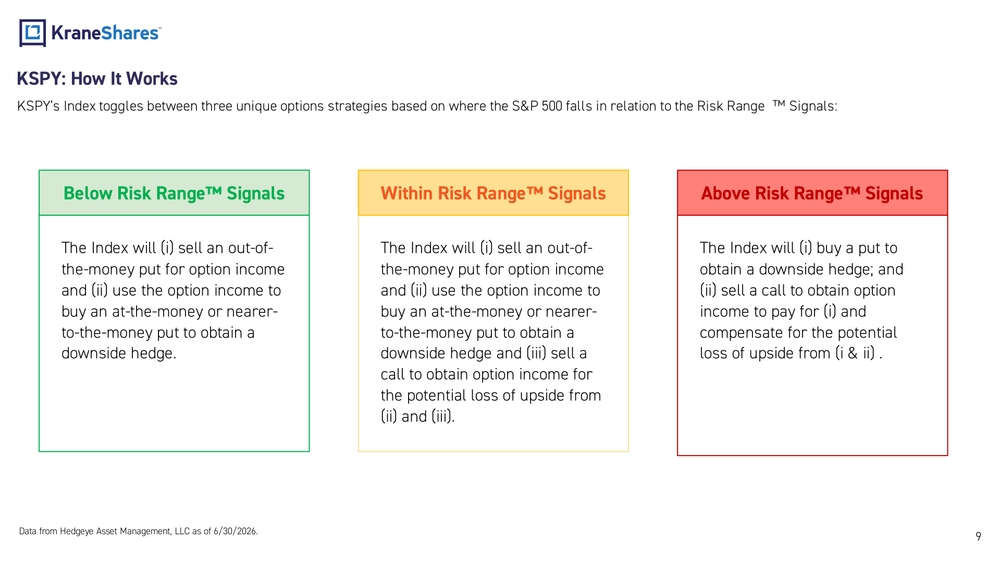
10KSPY: How It Works KSPY’s Index uses Hedgeye’s Risk Range Signals to determine whether to buy and/or sell put and call options, and with what strike prices: CATEGORYCATEGORY DESCRIPTIONS&P 500 POSITIONCALL POSITIONPUT POSITION #1PUT POSITION #2CALL STRIKE PUT STRIKE #1 PUT STRIKE #2 ABOVEABOVE SELL RISK RANGE1LONG SHORT LONG NONE LAST PRICE LAST PRICE NONE BELOWBELOW BUY RISK RANGE2LONG NONE LONG SHORT NONE LAST PRICELAST PRICE MINUS RR WIDTH WITHINWITHIN RISK RANGELONG SHORT LONG SHORTSELL RISK RANGELAST PRICEBUY RISK RANGE Data from Hedgeye Asset Management, LLC as of 6/30/2026. Please see the end of the presentation for definitions.
- Above the red line on slide 4.
- Below the green line on slide 4.
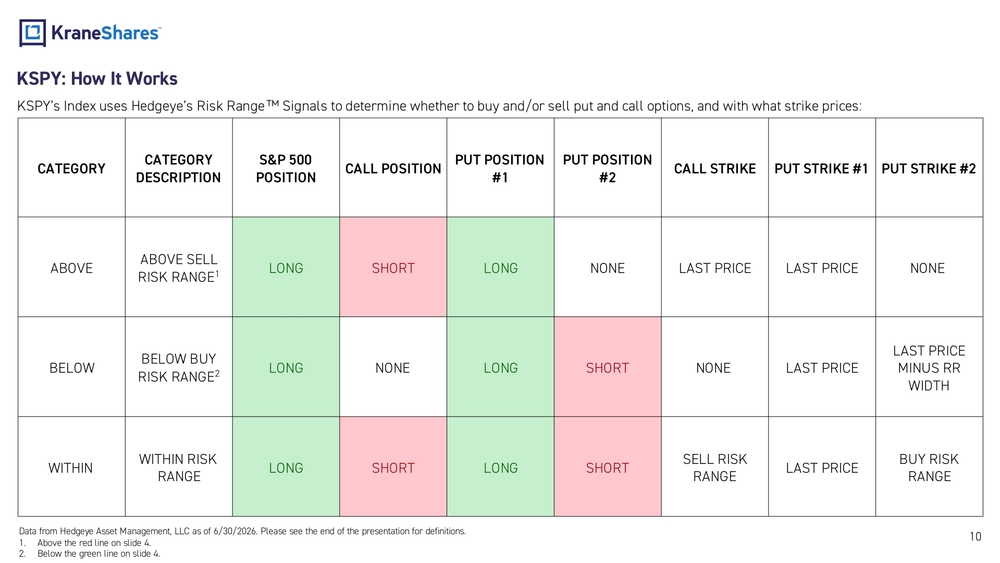
11KSPY: How It Works KSPY’s Index uses Hedgeye’s Risk Range Signals to determine whether to buy and/or sell put and call options, and with what strike prices: Data from Hedgeye Asset Management, LLC as of 12/31/2025.3 21 -15%-10%-5%0%5%10%15% -25% -20% -15% -10% -5% 0% 5% 10% 15%KSPY Return (Example Only) S&P 500 Return (Example Only)1 - Upside Cap When the S&P 500 is Above or Within the Risk Range Signals, KSPY will sell a call to obtain option income. This caps potential upside. When the S&P 500 is Below the Risk Range Signals, no call is sold, and potential upside is un -capped (dashed line at 1). 3 - Downside Hedge Cap When the S&P 500 is Below or Within the Risk Range Signals, KSPY will sell a further out -of-the-money put to fund the downside hedge, which caps hedging for option income. When the S&P 500 is Above the Risk Range Signals, no further out -of-the-money put is sold (dashed line at 3).2 - Constant Downside Hedge KSPY is always long a put to reduce volatility and provide downside risk management.
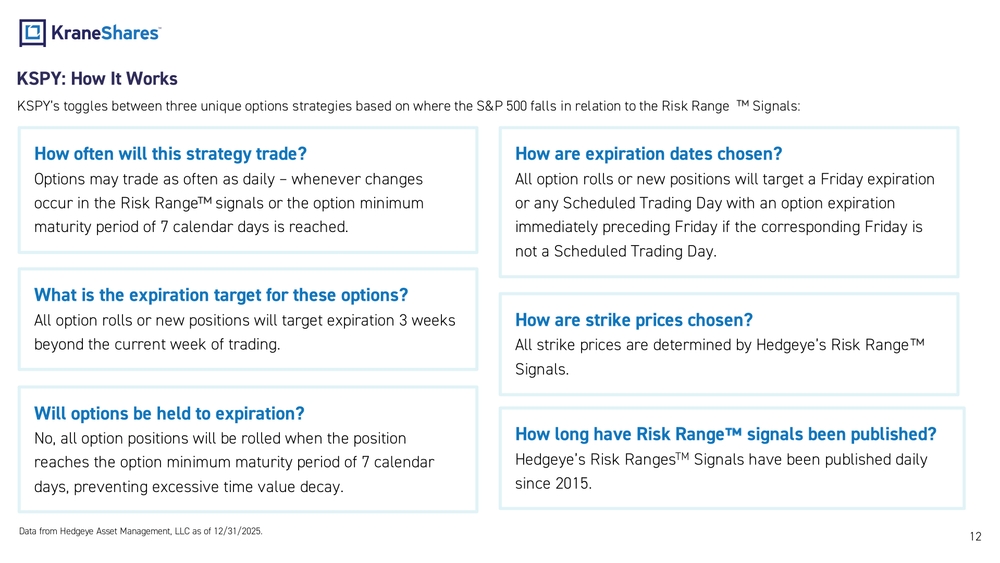
12KSPY: How It Works How are expiration dates chosen? All option rolls or new positions will target a Friday expiration or any Scheduled Trading Day with an option expiration immediately preceding Friday if the corresponding Friday is not a Scheduled Trading Day.How often will this strategy trade? Options may trade as often as daily – whenever changes occur in the Risk Range signals or the option minimum maturity period of 7 calendar days is reached. Will options be held to expiration? No, all option positions will be rolled when the position reaches the option minimum maturity period of 7 calendar days, preventing excessive time value decay.What is the expiration target for these options? All option rolls or new positions will target expiration 3 weeks beyond the current week of trading. How are strike prices chosen? All strike prices are determined by Hedgeye’s Risk Range
Signals. How long have Risk Range signals been published? Hedgeye’s Risk RangesTM Signals have been published daily since 2015.KSPY’s toggles between three unique options strategies based on where the S&P 500 falls in relation to the Risk Range Signals: Data from Hedgeye Asset Management, LLC as of 12/31/2025.
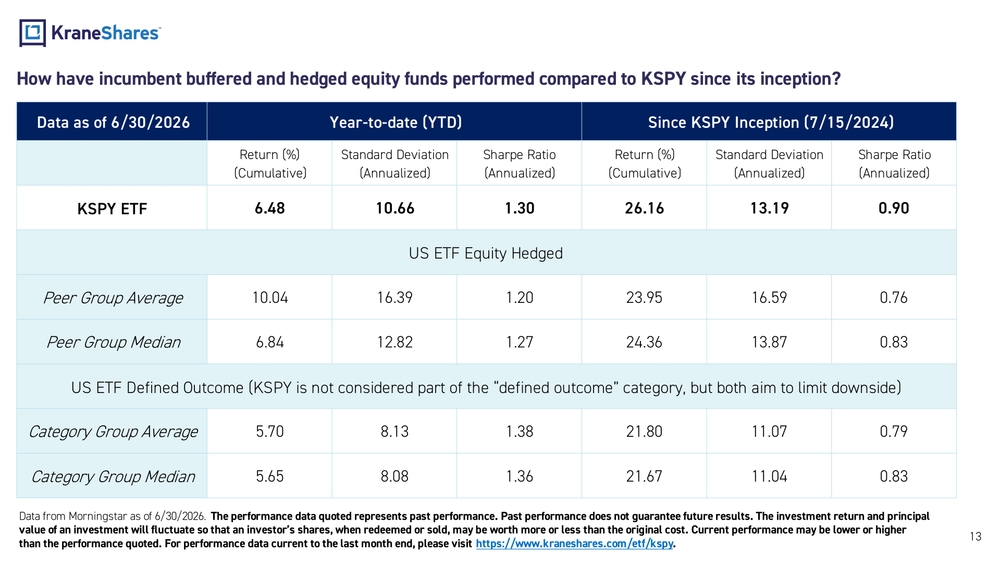
13How have incumbent buffered and hedged equity funds performed compared to KSPY since its inception? Data from Morningstar as of 6/30/2026. The performance data quoted represents past performance. Past performance does not guarantee future results. The investment retu rn and principal value of an investment will fluctuate so that an investor’s shares, when redeemed or sold, may be worth more or less than the or iginal cost. Current performance may be lower or higher than the performance quoted. For performance data current to the last month end, please visit https://www.kraneshares.com/etf/kspy . Data as of 6/30/2026 Year -to-date (YTD) Since KSPY Inception (7/15/2024) Return (%) (Cumulative)Standard Deviation (Annualized)Sharpe Ratio (Annualized)Return (%) (Cumulative)Standard Deviation (Annualized)Sharpe Ratio (Annualized) KSPY ETF 6.48 10.66 1.30 26.16 13.19 0.90 US ETF Equity Hedged Peer Group Average 10.04 16.39 1.20 23.95 16.59 0.76 Peer Group Median 6.84 12.82 1.27 24.36 13.87 0.83 US ETF Defined Outcome (KSPY is not considered part of the “defined outcome” category, but both aim to limit downside) Category Group Average 5.70 8.13 1.38 21.80 11.07 0.79 Category Group Median 5.65 8.08 1.36 21.67 11.04 0.83
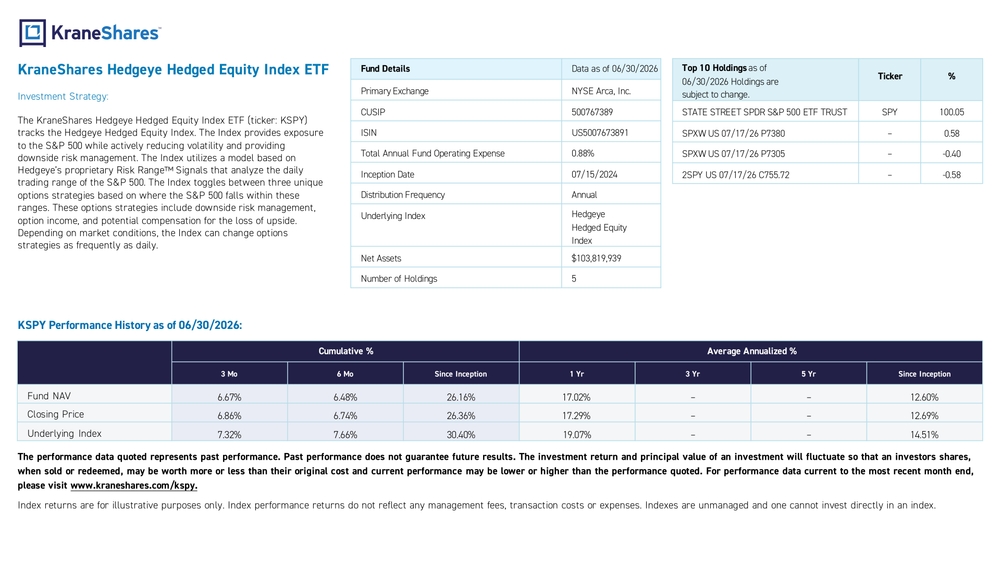
Fund Details Data as of 06/30/2026 Primary Exchange NYSE Arca, Inc. CUSIP 500767389 ISIN US5007673891 Total Annual Fund Operating Expense 0.88% Inception Date 07/15/2024 Distribution Frequency Annual Underlying Index Hedgeye Hedged Equity Index Net Assets $103,819,939 Number ofHoldings 5Top10Holdings asof 06/30/2026 Holdings are subject tochange.Ticker % STATE STREET SPDR S&P 500ETFTRUST SPY 100.05 SPXW US07/17/26 P7380 – 0.58 SPXW US07/17/26 P7305 – -0.40 2SPY US07/17/26 C755.72 – -0.58 KSPY Performance History asof06/30/2026: Cumulative % Average Annualized % 3Mo 6Mo Since Inception 1Yr 3Yr 5Yr Since Inception Fund NAV 6.67% 6.48% 26.16% 17.02% – – 12.60% Closing Price 6.86% 6.74% 26.36% 17.29% – – 12.69% Underlying Index 7.32% 7.66% 30.40% 19.07% – – 14.51%KraneShares Hedgeye Hedged Equity Index ETF Investment Strategy: The KraneShares Hedgeye Hedged Equity Index ETF (ticker: KSPY) tracks the Hedgeye Hedged Equity Index. The Index provides exposure to the S&P 500 while actively reducing volatility and providing downside risk management. The Index utilizes a model based on Hedgeye’s proprietary Risk Range Signals that analyze the daily trading range of the S&P 500. The Index toggles between three unique options strategies based on where the S&P 500 falls within these ranges. These options strategies include downside risk management, option income, and potential compensation for the loss of upside. Depending on market conditions, the Index can change options strategies as frequently as daily. Theperformance data quoted represents past performance. Past performance does notguarantee future results. Theinvestment return andprincipal value ofaninvestment willfluctuate sothat aninvestors shares, when sold orredeemed, may beworth more orless than their original cost andcurrent performance may belower orhigher than theperformance quoted. Forperformance data current tothemost recent month end, please visit www.kraneshares.com/kspy. Index returns areforillustrative purposes only. Index performance returns donotreflect anymanagement fees, transaction costs orexpenses. Indexes areunmanaged andonecannot invest directly inanindex.
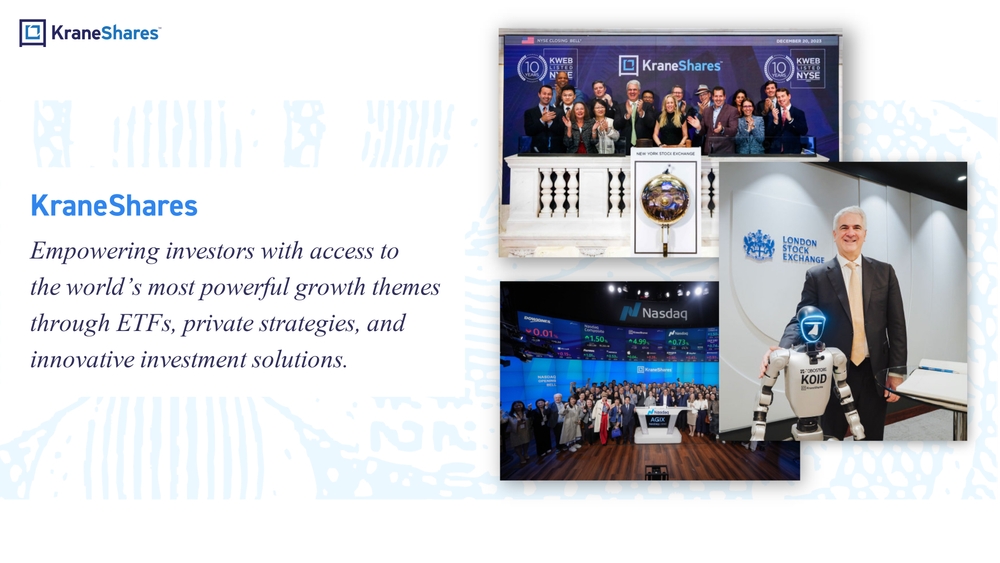
KraneShares Empowering investors with access to the world’ s most powerful growth themes through ETFs, private strategies, and innovative investment solutions.
1616Introduction to Hedgeye Asset Management Hedgeye Asset Management, LLC ("HAM") is a subsidiary of Hedgeye Risk Management, LLC ("Hedgeye" or "HRM") that develops and provides indices and model portfolios based on the intellectual property of Hedgeye, for use in investment products and portfolio services offered by registered investment advisers, investment funds (including exchange traded funds) and other trading systems. Hedgeye distinguishes itself by democratizing access to investment research typically reserved for institutional investors. Their team of over 40 analysts leverages a proven macro research process to discern key market trends and make decisive directional calls. Hedgeye prioritizes transparency and fosters a client -centric approach, empowering investors with the tools to navigate market volatility and prioritize risk management strategies. Data from Hedgeye Asset Management, LLC as of 5/31/2024. HAM is not affiliated with the Trust, Krane, the Trust’s administrat or, custodian, transfer agent or Distributor, or any of their respective affiliates. Krane and HAM have entered into an index provider agreement (the “Agreement”) pursuant to which HAM has licensed the exclusive use of the Index and cert ain related marks to Krane for a fee, and Krane is permitted to sublicense such rights to the Fund and uses the marks for the purpose of promoting and marketing the Fund. Under the Agreement, HAM is compensated, in part, on the asset size of the Fund and therefore benefits directly from investments in the Fund. HAM is a subsidiary of HRM. HRM provides Hedgeye Risk Range signals to HAM under a licensing agreement. As such, HRM benefits directly from investments in the Fund.
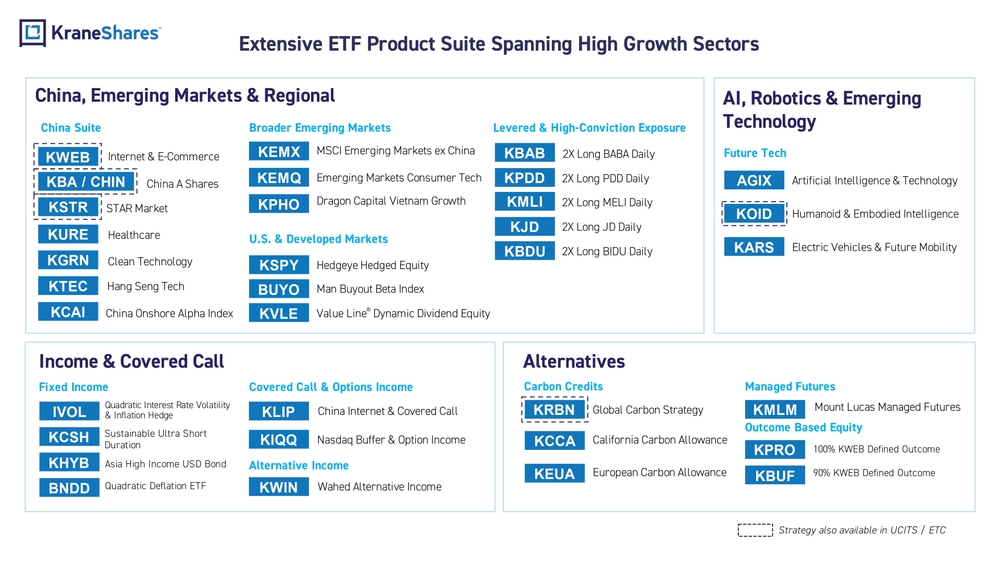
China, Emerging Markets & Regional Alternatives Income & Covered Call AI, Robotics & Emerging Technology KURE Healthcare KGRN Clean TechnologyKSTR STAR Market KTEC Hang Seng TechKWEB Internet & E -Commerce China A Shares KBA / CHIN KCAI China Onshore Alpha IndexAGIX Artificial Intelligence & Technology KOID Humanoid & Embodied Intelligence Electric Vehicles & Future Mobility KARSChina Suite Future TechBroader Emerging Markets KEMQ Emerging Markets Consumer Tech KPHODragon Capital Vietnam GrowthKEMX MSCI Emerging Markets ex China U.S. & Developed Markets KVLE Value Line® Dynamic Dividend EquityHedgeye Hedged Equity KSPY Man Buyout Beta Index BUYO Fixed Income BNDDQuadratic Deflation ETFIVOLQuadratic Interest Rate Volatility & Inflation Hedge KHYB Asia High Income USD BondSustainable Ultra Short DurationKCSH KEUA European Carbon AllowanceGlobal Carbon Strategy KRBNCarbon CreditsKPDD 2X Long PDD Daily KJD 2X Long JD DailyKBAB 2X Long BABA Daily KMLI 2X Long MELI Daily Covered Call & Options Income Managed Futures KMLMMount Lucas Managed Futures KWIN Wahed Alternative IncomeKLIP China Internet & Covered Call Outcome Based Equity KIQQ Nasdaq Buffer & Option IncomeLevered & High- Conviction Exposure KBUF90% KWEB Defined Outcome100% KWEB Defined Outcome KPRO Alternative Income KCCA California Carbon AllowanceExtensive ETF Product Suite Spanning High Growth Sectors Strategy also available in UCITS / ETCKBDU 2X Long BIDU Daily
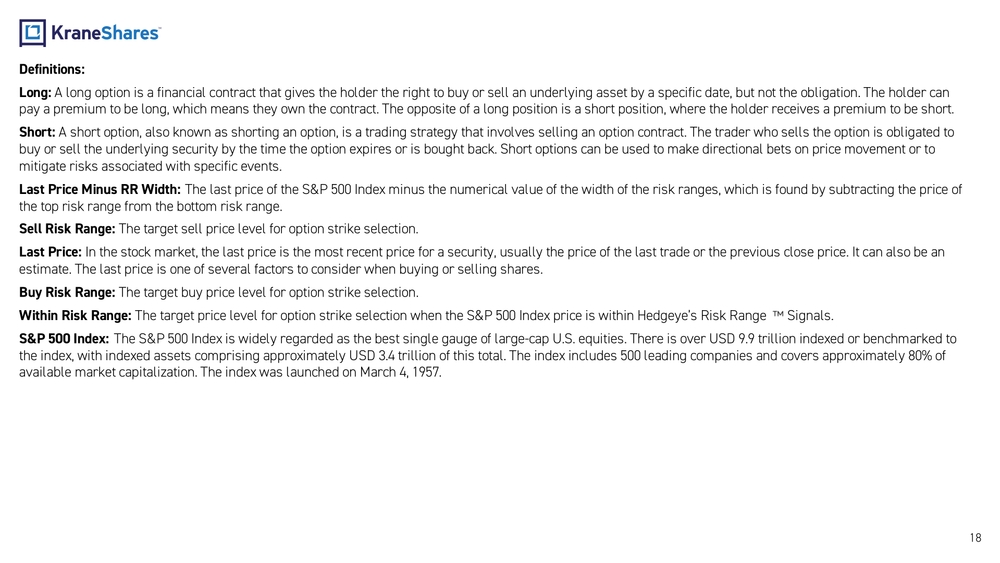
18Definitions: Long: A long option is a financial contract that gives the holder the right to buy or sell an underlying asset by a specific date, but not the obligation. The holder can pay a premium to be long, which means they own the contract. The opposite of a long position is a short position, where the hold er receives a premium to be short. Short: A short option, also known as shorting an option, is a trading strategy that involves selling an option contract. The trader who sells the option is obligated to buy or sell the underlying security by the time the option expires or is bought back. Short options can be used to make direc tional bets on price movement or to mitigate risks associated with specific events. Last Price Minus RR Width: The last price of the S&P 500 Index minus the numerical value of the width of the risk ranges, which is found by subtracting the price of the top risk range from the bottom risk range. Sell Risk Range: The target sell price level for option strike selection. Last Price: In the stock market, the last price is the most recent price for a security, usually the price of the last trade or the previ ous close price. It can also be an estimate. The last price is one of several factors to consider when buying or selling shares. Buy Risk Range: The target buy price level for option strike selection. Within Risk Range: The target price level for option strike selection when the S&P 500 Index price is within Hedgeye’s Risk Range Signals. S&P 500 Index: The S&P 500 Index is widely regarded as the best single gauge of large -cap U.S. equities. There is over USD 9.9 trillion indexed or benchmarked to the index, with indexed assets comprising approximately USD 3.4 trillion of this total. The index includes 500 leading companies and covers approximately 80% of available market capitalization. The index was launched on March 4, 1957.
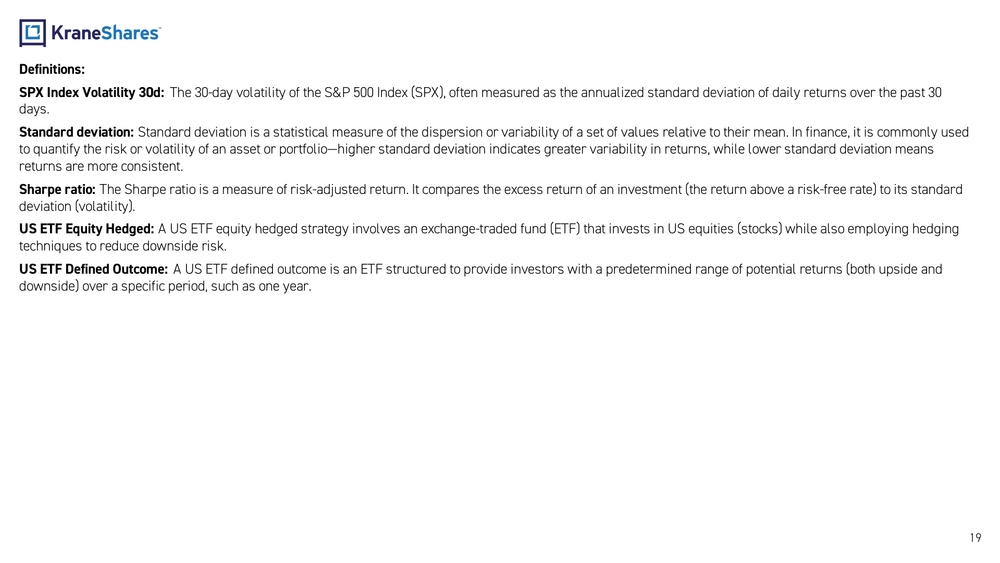
19Definitions: SPX Index Volatility 30d: The 30- day volatility of the S&P 500 Index (SPX), often measured as the annualized standard deviation of daily returns over the past 30 days.Standard deviation: Standard deviation is a statistical measure of the dispersion or variability of a set of values relative to their mean. In finance, it is commonly used to quantify the risk or volatility of an asset or portfolio —higher standard deviation indicates greater variability in returns, while lower standard deviation means returns are more consistent. Sharpe ratio: The Sharpe ratio is a measure of risk -adjusted return. It compares the excess return of an investment (the return above a risk -free rate) to its standard deviation (volatility). US ETF Equity Hedged: A US ETF equity hedged strategy involves an exchange -traded fund (ETF) that invests in US equities (stocks) while also employing hedging techniques to reduce downside risk.US ETF Defined Outcome: A US ETF defined outcome is an ETF structured to provide investors with a predetermined range of potential returns (both upside and downside) over a specific period, such as one year.
20Important Notes Carefully consider the Funds’ investment objectives, risk factors, charges and expenses before investing. This and additional information can be found in the Funds‘ full and summary prospectus, which may be obtained by visiting https://www.kraneshares.com/kspy . Read the prospectus carefully before investing. Risk Disclosures: Investing involves risk, including possible loss of principal. There can be no assurance that a Fund will achieve its stated objectives. Indices are unmanaged and do not include the effect of fees. One cannot invest directly in an index. This information should not be relied upon as research, investment advice, or a recommendation regarding any products, strate gies, or any security in particular. This material is strictly for illustrative, educational, or informational purposes and is subject to change. Certain content represents an assessment of the market environment at a specific time and is not intended to be a forecast of future events or a guarantee of future results; material is as of the dates noted and is subject to change without notice.KSPY may invest in derivatives, which are often more volatile than other investments and may magnify KSPY’s gains or losses. A derivative (i.e., futures/forward contracts, swaps, and options) is a contract that derives its value from the performance of an underlying asset. The primary ris k of derivatives is that changes in the asset’s market value and the derivative may not be proportionate, and some derivatives can have the potential for unlimit ed losses. Derivatives are also subject to liquidity and counterparty risk. KSPY is subject to liquidity risk, meaning that certain investments may become difficult to purchase or sell at a reasonable time and price. If a transaction for these securities is large, it may not be possible to initiate, which may cause KSPY to suffer losses. Counterparty risk is the risk of loss in the event that the counterparty to an agreement fails to make required payments or otherwise comply with the terms of the derivative. Hedges may have imperfect matching between the derivative and the underlying security; there is no assurance that hedging will be effective. Hed ging may reduce or eliminate losses or gains. The Fund will use FLEX options from the Options Clearing Corporation (OCC). There's a risk of the OCC failing t o meet its obligations. The Fund may face challenges in less liquid FLEX options markets and have difficulty closing positions at desired times and prices. In the unlikely event the OCC becomes insolvent, the Fund could suffer losses. Failure by market participants to enter into FLEX options transactions that reflect market value could result in losses. Some FLEX options may expire worthless. Hedgeye Risk Management, LLC’s ("HRM") ability to publish daily Risk Range signals is heavily dependent on the manual activities of a single individual, HRM’S CEO and founder (“Key Man”). In Key Man’s absence, the Risk Range signals will be published by another individual (“Secondary Calculator”). The formula utilized by the Secondary Calculator is based on a formula that incorporates the same factors as the formula used by the Key Man but this formula is not identical to the formula utilized by the Key Man. If the Key Man were to leave HRM or is unable to calculate the Risk Range signals, the Risk Range signals and the Underlying Index may not function as designed and adversely impact KSPY.
21Risk Disclosures Continued: KSPY is new and does not yet have a significant number of shares outstanding. If KSPY does not grow in size, it will be at gr eater risk than larger funds of wider bid - ask spreads for its shares, trading at a greater premium or discount to NAV, liquidation and/or a trading halt. Narrowly focu sed investments typically exhibit higher volatility. KSPY’s assets are expected to be concentrated in a sector, industry, market, or group of concentrations to the ex tent that the Underlying Index has such concentrations. The securities or futures in that concentration could react similarly to market developments. Thus, KSPY is s ubject to loss due to adverse occurrences that affect that concentration. Large capitalization companies may struggle to adapt fast, impacting their growth compared to smaller firms, especially in ex pansive times. This could result in lower stock returns than investing in smaller and mid -sized companies. KSPY is non- diversified. ETF shares are bought and sold on an exchange at market price (not NAV) and are not individually redeemed from the Fund. Howe ver, shares may be redeemed at NAV directly by certain authorized broker- dealers (Authorized Participants) in very large creation/redemption units. The returns shown do not represent the returns you would receive if you traded shares at other times. Shares may trade at a premium or discount to their NAV in the secondar y market. Brokerage commissions will reduce returns. Beginning 12/23/2020, market price returns are based on the official closing price of an ETF share or, if the official closing price isn't available, the midpoint between the national best bid and national best offer ("NBBO") as of the time the ETF calculates the current NAV per share. Prior to that date, market price returns were based on the midpoint between the Bid and Ask price. NAVs are calculated using prices as of 4:00 PM Eastern Time . The KraneShares ETFs and KFA Funds ETFs are distributed by SEI Investments Distribution Company (SIDCO), 1 Freedom Valley Drive, Oaks, PA 19456, which is not affiliated with Krane Funds Advisors, LLC, the Investment Adviser for the Funds, or any sub -advisers for the Fund. [R_US_KS_SEI]
22Index Provider Disclaimers: The Hedgeye® Hedged Equity Index (the “Index”) is a product of HAM which has contracted with S&P Opco, LLC (a subsidiary of S&P Dow Jones Indices LLC) (“SPDJI”) to license the S&P 500 Index in connection with the Index. The S&P 500 Index, S&P®, S&P 500®, the 500, US 500 are t he property of SPDJI and/or its affiliates (“S&P Dow Jones Indices”) and/or their third party licensors. S&P®, S&P 500®, the 500, US 500 are registered trade marks of S&P Global Inc. and/or its affiliates, Dow Jones® is a registered trademark of Dow Jones Trademark Holdings LLC (“Dow Jones”); and these trademarks have been licensed to S&P Dow Jones Indices and have been sublicensed for use for certain purposes by HAM. S&P Dow Jones Indices and its third party licensors shall have no liability for any errors or omissions in the S&P 500 Index and the Index is not owned, endorsed, or approved by or associated with S&P Dow Jones Indices.The Fund is based on the Index and is not sponsored, endorsed, sold or promoted by S&P Dow Jones Indices or its third party lice nsors. Neither S&P Dow Jones Indices nor its third party licensors make any representation or warranty, express or implied, to the owners of the Fund or a ny member of the public regarding the advisability of investing in securities generally or in the Fund particularly or the ability of the Index and/or the S&P 500 Index to track general market performance. S&P Dow Jones Indices’ only relationship to Hedgeye Asset Management, LLC with respect to the Index is the licensing of the S &P 500 Index and certain trademarks, service marks and trade names of S&P Dow Jones Indices or its third party licensors. S&P Dow Jones Indices and its third part y licensors are not responsible for and have not participated in the determination of the prices and amount of the Fund or the timing of the issuance or sale of the Fund or in the determination or calculation of the equation by which the Fund may convert into cash or other redemption mechanics. S&P Dow Jones Indices and its third pa rty licensors have no obligation or liability in connection with the administration, marketing or trading of the Fund. There is no assurance that investment prod ucts based on the Index will accurately track index performance or provide positive investment returns. S&P Dow Jones Indices LLC is not an investment adviser, commo dity trading advisory, commodity pool operator, broker dealer, fiduciary, “promoter” (as defined in the Investment Company Act of 1940, as amended), “expert” as enumerated within 15 U.S.C. § 77k(a) or tax advisor. Inclusion of a security, commodity, crypto currency or other asset within an index is not a recommendation by S&P Dow Jones Indices to buy, sell, or hold such security, commodity, crypto currency or other asset, nor is it considered to be investment advice or commodity trad ing advice.
23Index Provider Disclaimers Continued:
NONE OF S&P DOW JONES INDICES, ITS THIRD PARTY LICENSORS, HEDGEYE OR KRANE GUARANTEES THE ADEQUACY, ACCURACY, TIMELINESS AND/ OR THE
COMPLETENESS OF THE S&P 500 INDEX, THE INDEX OR ANY DATA RELATED THERETO OR ANY COMMUNICATION, INCLUDING BUT NOT LIMITED TO, ORAL OR
WRITTEN COMMUNICATION (INCLUDING ELECTRONIC COMMUNICATIONS) WITH RESPECT THERETO. S&P DOW JONES INDICES AND ITS THIRD PARTY LIC ENSORS
SHALL NOT BE SUBJECT TO ANY DAMAGES OR LIABILITY FOR ANY ERRORS, OMISSIONS, OR DELAYS THEREIN. S&P DOW JONES INDICES AND ITS THIRD PARTY
LICENSORS MAKES NO EXPRESS OR IMPLIED WARRANTIES, AND EXPRESSLY DISCLAIMS ALL WARRANTIES, OF MERCHANTABILITY OR FITNESS FOR A
PARTICULAR PURPOSE OR USE OR AS TO RESULTS TO BE OBTAINED BY HEDGEYE, OWNERS OF THE HEDGEYE HEDGED EQUITY ETF, OR ANY OTHER PERSON OR ENTITY FROM THE USE OF THE S&P 500 INDEX, INDEX OR WITH RESPECT TO ANY DATA RELATED THERETO. WITHOUT LIMITING ANY OF THE FOR EGOING, IN NO
EVENT WHATSOEVER SHALL S&P DOW JONES INDICES OR ITS THIRD PARTY LICENSORS BE LIABLE FOR ANY INDIRECT, SPECIAL, INCIDENTAL, PU NITIVE, OR
CONSEQUENTIAL DAMAGES INCLUDING BUT NOT LIMITED TO, LOSS OF PROFITS, TRADING LOSSES, LOST TIME OR GOODWILL, EVEN IF THEY HAVE BEEN ADVISED
OF THE POSSIBILITY OF SUCH DAMAGES, WHETHER IN CONTRACT, TORT, STRICT LIABILITY, OR OTHERWISE. S&P DOW JONES INDICES HAS NOT REVIEWED,
PREPARED AND/OR CERTIFIED ANY PORTION OF, NOR DOES S&P DOW JONES INDICES HAVE ANY CONTROL OVER, THE LICENSEE PRODUCT REGISTRA TION
STATEMENT, PROSPECTUS OR OTHER OFFERING MATERIALS. THERE ARE NO THIRD- PARTY BENEFICIARIES OF ANY AGREEMENTS OR ARRANGEMENTS BETW EEN
S&P DOW JONES INDICES AND HEDGEYE, OTHER THAN THE LICENSORS OF S&P DOW JONES INDICES.”
Hedgeye Asset Management, LLC (“HAM”) is not affiliated with the Trust, Krane, the Trust’s administrator, custodian, transfer agent or Distributor, or any of their
respective affiliates. Krane and HAM have entered into an index provider agreement (the “Agreement”) pursuant to which HAM ha s licensed the exclusive use of the
Index and certain related marks to Krane for a fee, and Krane is permitted to sublicense such rights to the Fund and uses the marks for the purpose of promoting
and marketing the Fund. Under the Agreement, HAM is compensated, in part, on the asset size of the Fund and therefore benefit s directly from investments in the
Fund. HAM is a subsidiary of HRM. HRM provides Hedgeye Risk Range
signals to HAM under a licensing agreement. As such, HRM benefits directly from
investments in the Fund.
The Fund is not in any way advised, managed, sponsored, endorsed, sold or promoted by HAM or HRM, and neither HAM nor HRM mak e any claim, prediction,
warranty or representation whatsoever, expressly or impliedly, either as to ( i) the results to be obtained from the use of the Index, (ii) the performance or price of the
Index at any particular time on any particular day or otherwise, or (iii) the merchantability, fitness or suitability of the Ind ex for the particular purpose to which it is
being put in connection with the Fund. Neither HAM nor HRM has provided, nor do they provide, any financial or investment adv ice or recommendation in relation to
the Index to Krane or its affiliates, including the Fund. All rights in the Index vest in HAM other than those licensed to Kr ane under the Agreement.
24Index Provider Disclaimers Continued: Neither HAM nor HRM makes any warranty, express or implied, as to results to be obtained by Krane or its affiliates, owners o f shares of the Fund or any other person or entity from the use of the Index or any data included therein. Without limiting any of the foregoing, in no event s hall HAM or HRM have any liability for any special, punitive, indirect or consequential damages (including lost profits) resulting from the use of the Index or any data included therein, even if notified of the possibility of such damages. HRM sells financial research to financial institutions and investors, including the Hedgeye Risk Range signals which are a critical input of the Index provided to the Fund by HRM subsidiary, HAM. HRM publishes Hedgeye Risk Range signals direct to its subscribers who will receive the Risk Range signals before the Fund due to processing time between publication and receipt of the Risk Range signals by the Fund. Solactive AG (“ Solactive ”) is the calculation agent of the Index. The financial instrument that is referencing the Index is not sponsored, endorsed, promoted, sold or supported by Solactive in any way and Solactive makes no express or implied representation, guarantee or assurance with regard to: (a) the advisability in investing in the financial instruments; (b) the quality, accuracy and/or completeness of the Index; and/or (c) the results obtained or to be obtained by any person or entity from the use of the Index. Solactive does not guarantee the accuracy and/or the completeness of the Index and shall not have any liability for any errors or omiss ions with respect thereto.”