Electric Vehicle ETF | KARS | KraneShares
by Kraneshares
info@kraneshares. comDriving The Future: Opportunities From The Electric Vehicle & Future Mobility Ecosystem KARS 9/30/2026
Investment Strategy: KARS seeks to measure the performance of Bloomberg Electric Vehicles Index. The fund is designed to track the performance of companies engaged in the production of electric vehicles and/or their components or engaged in other initiatives that may change the future of mob ility. The Index includes issuers engaged in the electric vehicle production, autonomous driving, lithium and/or copper production, lithium -ion/lead acid battery production, hydrogen fuel cell manufacturing and/or electric infrastructure businesses. KARS Features: •Access to global companies that operate in all areas of new transportation methods, passenger and freight, including electric vehicles, autonomous vehicles, and shared mobility. •Exposure to companies that lead the development of vehicle connectivity like Internet of Vehicles (IoV) and Intelligent Mobil ity. •Exposure to the growth brought on by increased demand for lithium -ion battery and non -ferrous metals like lithium due to electri c vehicle adoption. •Exposure to equities listed in Mainland China, currently the world’s largest electric vehicle market. Future Mobility Sector Highlights: •80% of new car sales and 50% of the global car fleet are projected to be electric by 2040.1 •The global electric vehicle (EV) revenue is projected to reach over $1 trillion by 2029.2 •Global EV sales were over 60 million in 2025, a 12% year -on-year increase from 2024.3 •The market for autonomous vehicles and systems could reach a value of $5.4 trillion by 2035, representing a compound annual g rowth rate (CAGR) of 35% from 2026 to 2035.4KraneShares Electric Vehicles & Future Mobility ETF 1.Estimate from EV Volumes as of 12/31/2025. 2.Estimate from Statista as of 12/31/2025. 3.Data from the International Energy Agency (IEA), Ember Energy, Gas Good, and the European Environment Agency as of 12/31/2025 . 4.Forecast from Precedence Research as of 12/31/2025. CAGR = Constant yearly growth rate that would take a value from its beginning level to its ending level over a multi -year period , assuming gains are reinvested each year.KARS 2
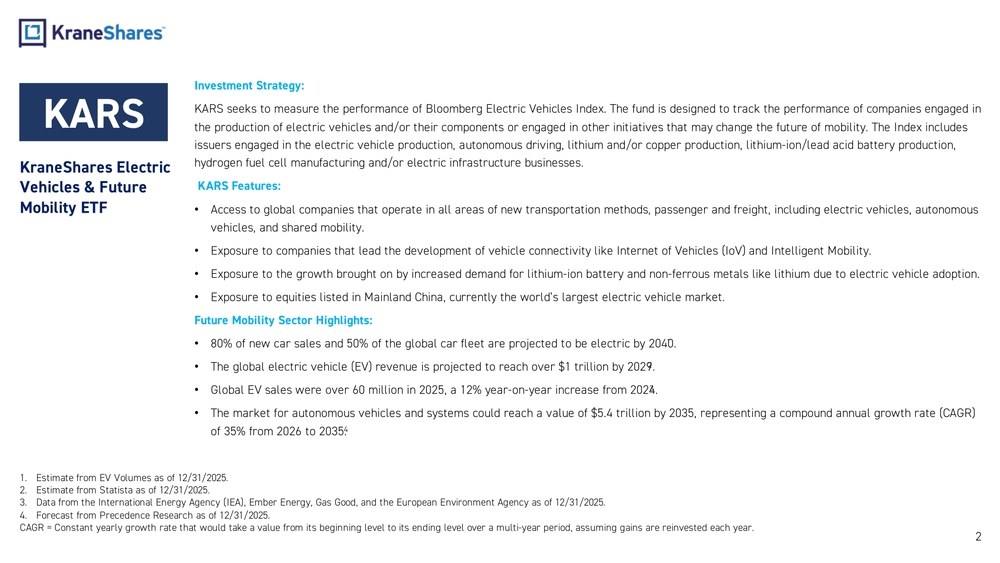
The Electric Vehicle (EV) & Future Mobility Ecosystem Definition Vehicles Electric vehicles (EV) manufacturers are the brands that consumers know and are the largest group in the ecosystem. ComponentsEVs often require complex components, especially for sensors if they are at all self -driving, that are made by specialized firms. BatteriesAdoption of electric vehicles and other new energy vehicles dramatically increases demand for lithium -ion and other types of batteries. Charging Electric vehicle adoption requires robust, widespread, and efficient charging stations and infrastructure. Raw Materials Adoption of electric vehicles and other new energy vehicles may drive demand for raw materials such as lithium. Autonomous Driving Autonomous driving is the new frontier of mobility, improving outcomes and experience. 3
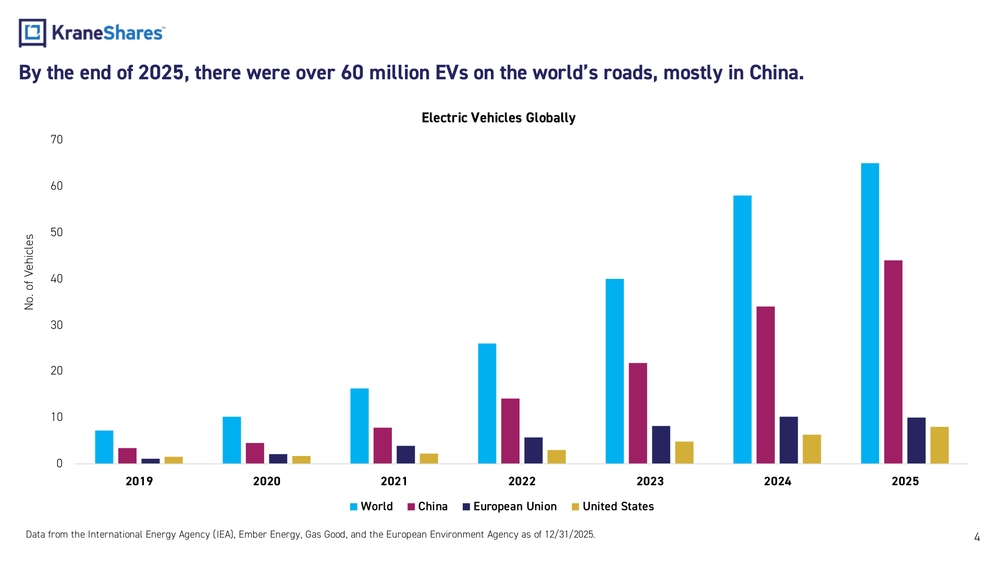
Data from the International Energy Agency (IEA), Ember Energy, Gas Good, and the European Environment Agency as of 12/31/2025 . 4010203040506070 2019 2020 2021 2022 2023 2024 2025No. of VehiclesElectric Vehicles Globally World China European Union United StatesBy the end of 2025, there were over 60 million EVs on the world’s roads, mostly in China.
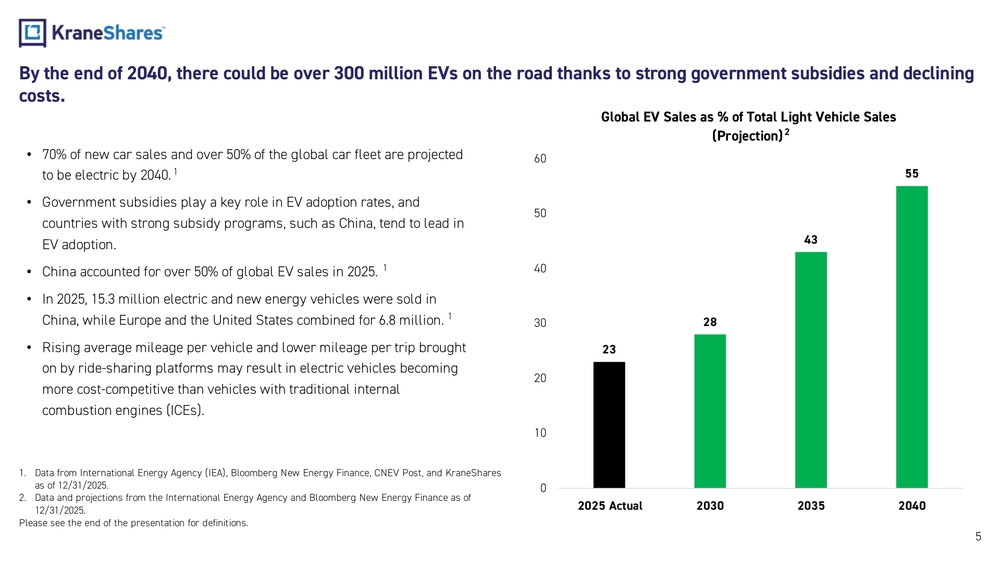
By the end of 2040, there could be over 300 million EVs on the road thanks to strong government subsidies and declining costs. •70% of new car sales and over 50% of the global car fleet are projected to be electric by 2040.1 •Government subsidies play a key role in EV adoption rates, and countries with strong subsidy programs, such as China, tend to lead in EV adoption. •China accounted for over 50% of global EV sales in 2025.1 •In 2025, 15.3 million electric and new energy vehicles were sold in China, while Europe and the United States combined for 6.8 million.1 •Rising average mileage per vehicle and lower mileage per trip brought on by ride -sharing platforms may result in electric vehicles becoming more cost -competitive than vehicles with traditional internal combustion engines (ICEs). 1.Data from International Energy Agency (IEA), Bloomberg New Energy Finance, CNEV Post, and KraneShares as of 12/31/2025. 2.Data and projections from the International Energy Agency and Bloomberg New Energy Finance as of 12/31/2025. Please see the end of the presentation for definitions. 523284355 0102030405060 2025 Actual 2030 2035 2040Global EV Sales as % of Total Light Vehicle Sales (Projection)2
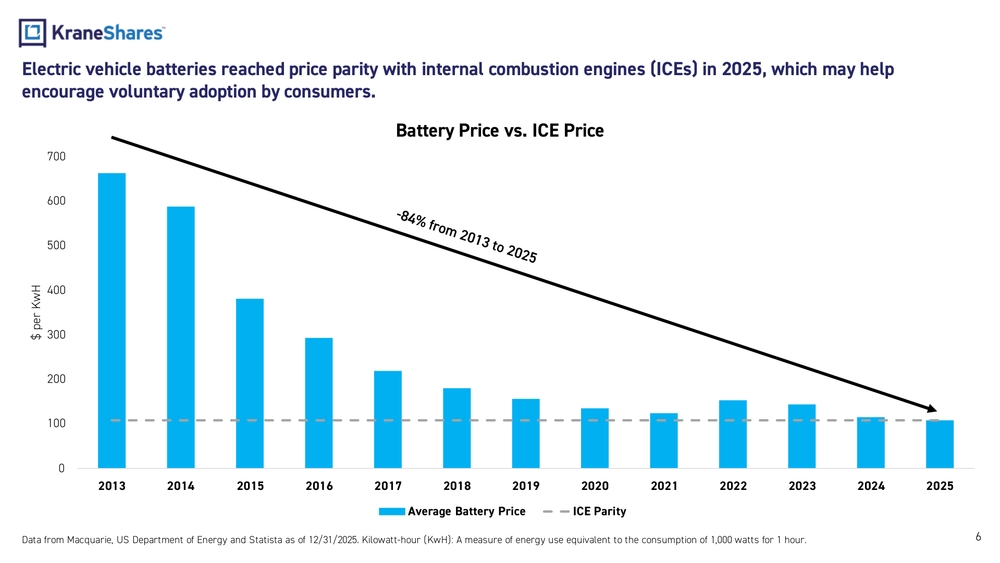
0100200300400500600700 2013 2014 2015 2016 2017 2018 2019 2020 2021 2022 2023 2024 2025$ per KwHBattery Price vs. ICE Price Average Battery Price ICE ParityElectric vehicle batteries reached price parity with internal combustion engines (ICEs) in 2025, which may help encourage voluntary adoption by consumers. Data from Macquarie, US Department of Energy and Statista as of 12/31/2025. Kilowatt -hour (KwH): A measure of energy use equival ent to the consumption of 1,000 watts for 1 hour. 6
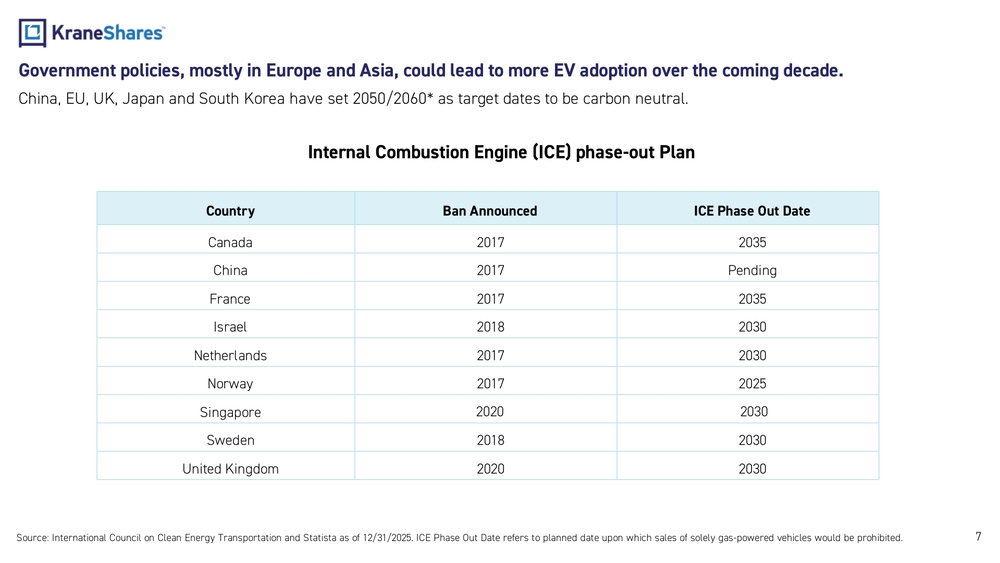
Government policies, mostly in Europe and Asia, could lead to more EV adoption over the coming decade. China, EU, UK, Japan and South Korea have set 2050/2060* as target dates to be carbon neutral. Source: International Council on Clean Energy Transportation and Statista as of 12/31/2025. ICE Phase Out Date refers to plan ned date upon which sales of solely gas -powered vehicles would be prohibited. Internal Combustion Engine (ICE) phase -out Plan 7Country Ban Announced ICE Phase Out Date Canada 2017 2035 China 2017 Pending France 2017 2035 Israel 2018 2030 Netherlands 2017 2030 Norway 2017 2025 Singapore 2020 2030 Sweden 2018 2030 United Kingdom 2020 2030
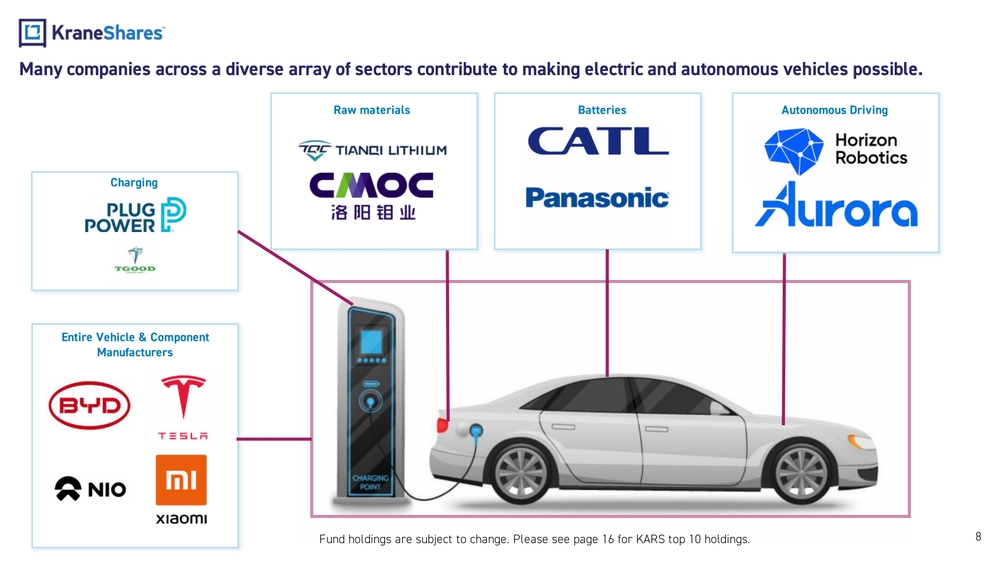
Many companies across a diverse array of sectors contribute to making electric and autonomous vehicles possible. Raw materials Autonomous Driving Entire Vehicle & Component ManufacturersCharging 8 Batteries Fund holdings are subject to change. Please see page 16 for KARS top 10 holdings.
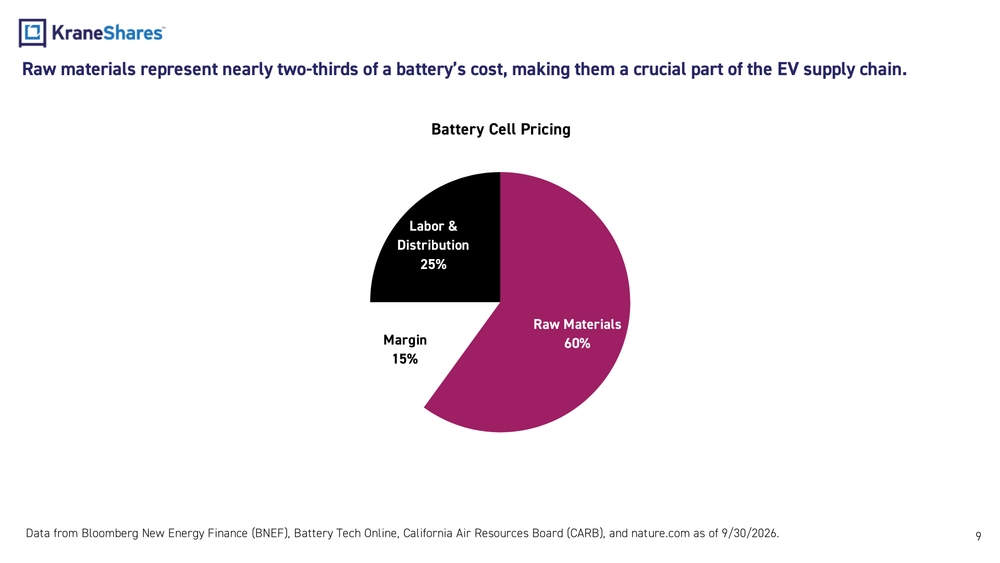
Data from Bloomberg New Energy Finance (BNEF), Battery Tech Online, California Air Resources Board (CARB), and nature.com as of 9/30/2026. 9Raw materials represent nearly two -thirds of a battery’s cost, making them a crucial part of the EV supply chain. Raw Materials 60% Margin 15%Labor & Distribution 25%Battery Cell Pricing
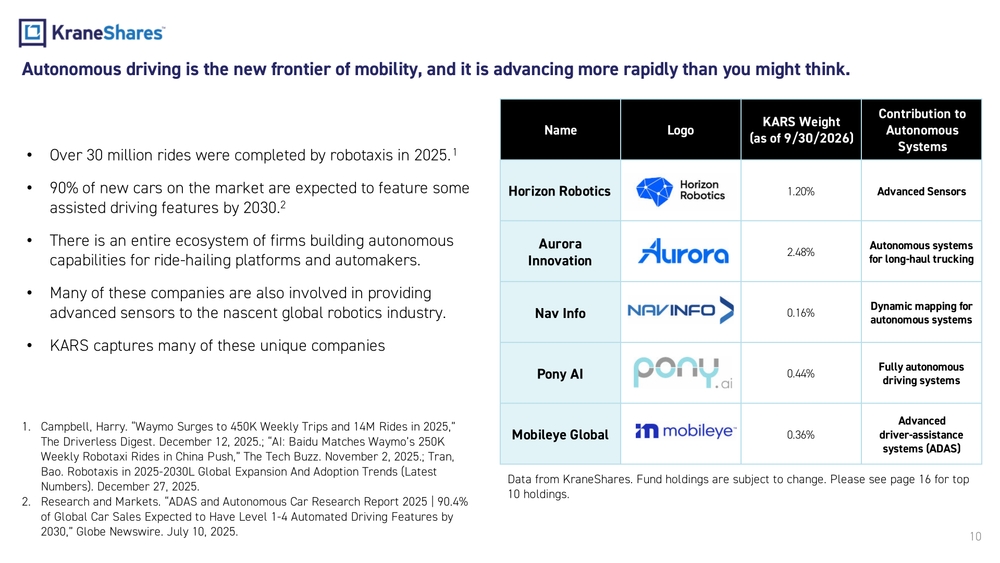
10Autonomous driving is the new frontier of mobility, and it is advancing more rapidly than you might think. •Over 30 million rides were completed by robotaxis in 2025.1 •90% of new cars on the market are expected to feature some assisted driving features by 2030.2 •There is an entire ecosystem of firms building autonomous capabilities for ride -hailing platforms and automakers. •Many of these companies are also involved in providing advanced sensors to the nascent global robotics industry. •KARS captures many of these unique companies Name LogoKARS Weight (as of 9/30/2026)Contribution to Autonomous Systems Horizon Robotics 1.20% Advanced Sensors Aurora Innovation2.48%Autonomous systems for long -haul trucking Nav Info 0.16%Dynamic mapping for autonomous systems Pony AI 0.44%Fully autonomous driving systems Mobileye Global 0.36%Advanced driver -assistance systems (ADAS) Data from KraneShares. Fund holdings are subject to change. Please see page 16 for top 10 holdings.1.Campbell, Harry. “Waymo Surges to 450K Weekly Trips and 14M Rides in 2025,” The Driverless Digest. December 12, 2025.; “AI: Baidu Matches Waymo’s 250K Weekly Robotaxi Rides in China Push,” The Tech Buzz. November 2, 2025.; Tran, Bao. Robotaxis in 2025 -2030L Global Expansion And Adoption Trends (Latest Numbers). December 27, 2025. 2.Research and Markets. “ADAS and Autonomous Car Research Report 2025 | 90.4% of Global Car Sales Expected to Have Level 1 -4 Automated Driving Features by 2030,” Globe Newswire. July 10, 2025.
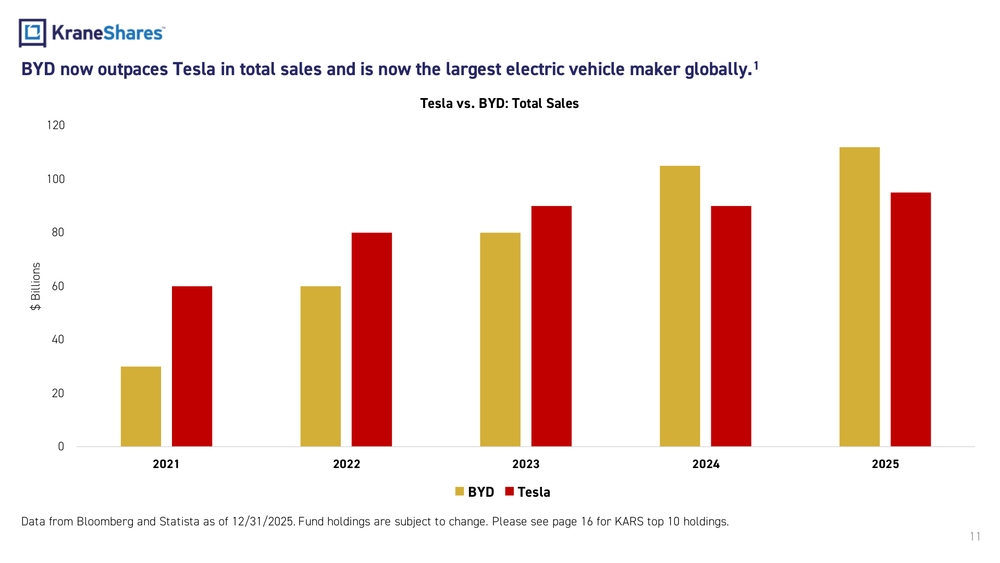
11BYD now outpaces Tesla in total sales and is now the largest electric vehicle maker globally.1 Data from Bloomberg and Statista as of 12/31/2025.020406080100120 2021 2022 2023 2024 2025$ BillionsTesla vs. BYD: Total Sales BYD Tesla Fund holdings are subject to change. Please see page 16 for KARS top 10 holdings.
12We believe certain indexes may exclude key components of the global EV supply chain, while others may include companies with little to no direct revenue from EVs. Company KARS Status Note Weight in KARS Weight in Solactive Autonomous & Electric Vehicles Index Alphabet ExcludedAlphabet is a global internet company with little revenue from EV and autonomous vehicles.0.00% 2.89% BYD OverweightBYD is the world’s largest EV manufacturer.4.22% 1.41% Data from KraneShares and Bloomberg as of 9/30/2026. The Underlying Index includes Bloomberg World Equity Aggregate securities in electric vehicle -related sectors. Bloomberg Intelli gence uses a multi -step process —keyword screening, back -testing, and committee review —to finalize composition, with additional checks for controversies and UN Global Compact viola tions. Index methodology is determined by Bloomberg Intelligence; inclusion does not guarantee future results . Fund holdings are subject to change. Please see page 16 for KARS top 10 holdings.
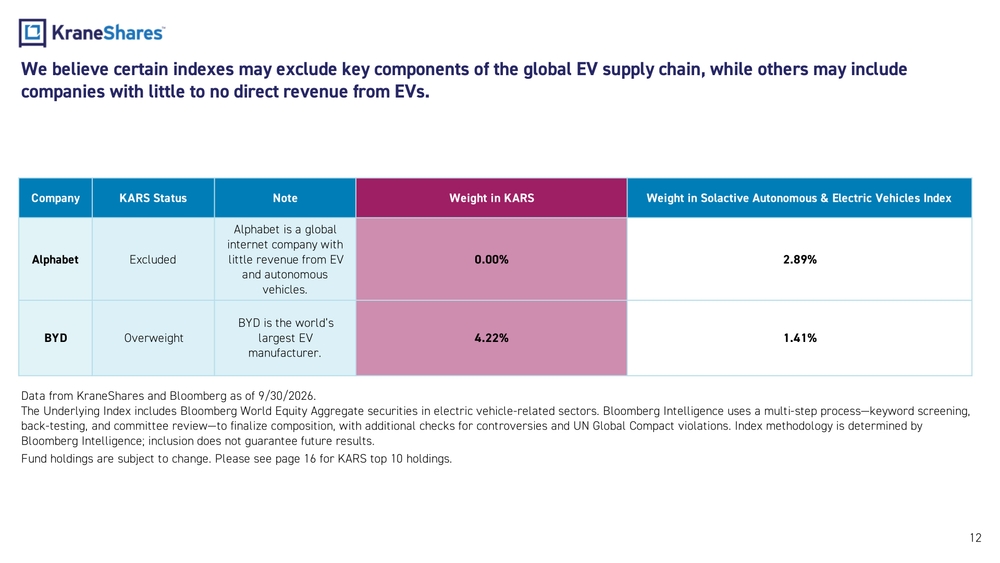
13KARS is overweight China, where the most EVs were sold in 2025,1 compared to other leading EV indexes.KARS ETF Data from Bloomberg and KraneShares as of 9/30/2026 . Please see the end of the presentation for definitions.
- Lewis, Michelle. “Global EV sales jump 21% in 2025 as Europe surges and the US stalls,” Electrek . December 11, 2025. China 46% United States 16%South Korea 10%Australia 7%Japan 5%Others 16%KARS China 13% United States 48%South Korea 6%Australia 5%Japan 9%Others 19%Solactive Autonomous & Electric Vehicles Index China 24% United States 27%South Korea 18%Australia 4%Japan 2%Others 25%NYSE FactSet Global Autonomous Driving & Electric Vehicles Index
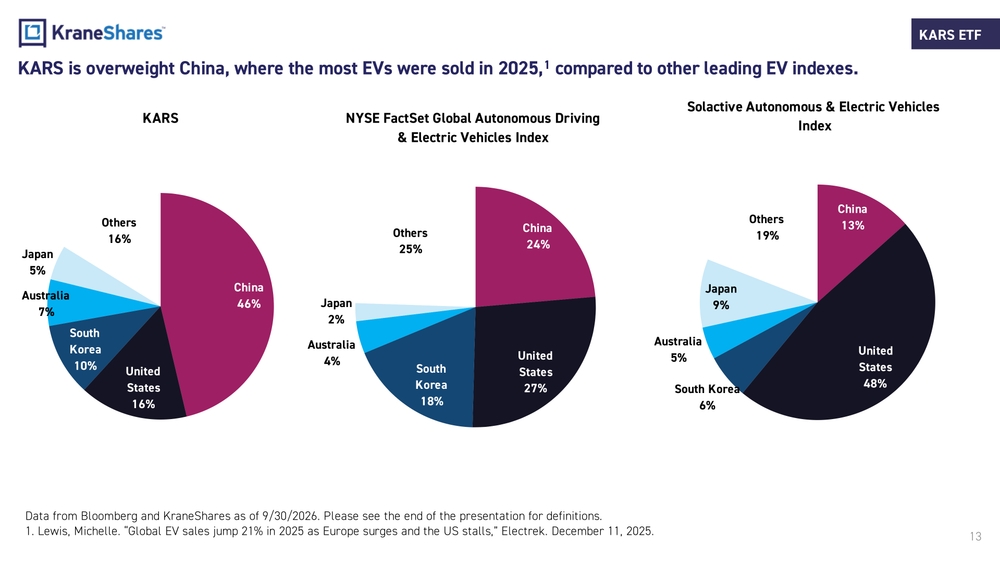
14KARS provides exposure to multiple segments within the electric vehicle ecosystem. Data from Bloomberg and KraneShares as of 9/30/2026 .KARS ETF Vehicles 35% Raw Materials 25%Batteries 15%Components 14%Autonomous 9%Charging 1%KARS Industry Breakdown
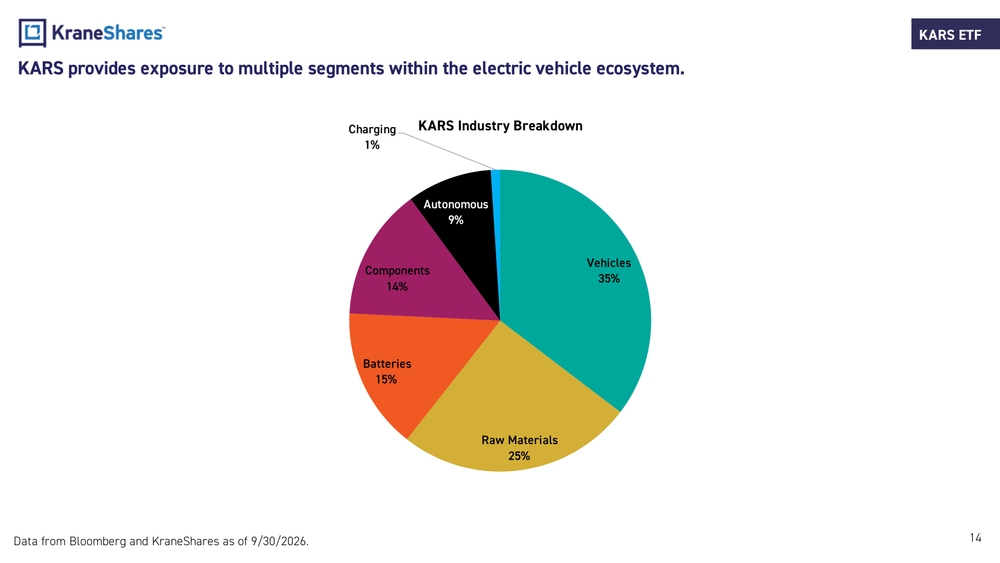
Catalysts for E Vs & Future Mobility Going ForwardGovernment Policy 151.Recovery in consumer sentiment and big - ticket consumption activities in China 2.Battery or range innovation and proliferation of chargers 3.Reaching global policy equilibrium 4.Global cost per kWh potentially falling below the cost of ICE after reaching parity last year 5.Oil price shocks causing anxiety at the pump and accelerating adoption 15
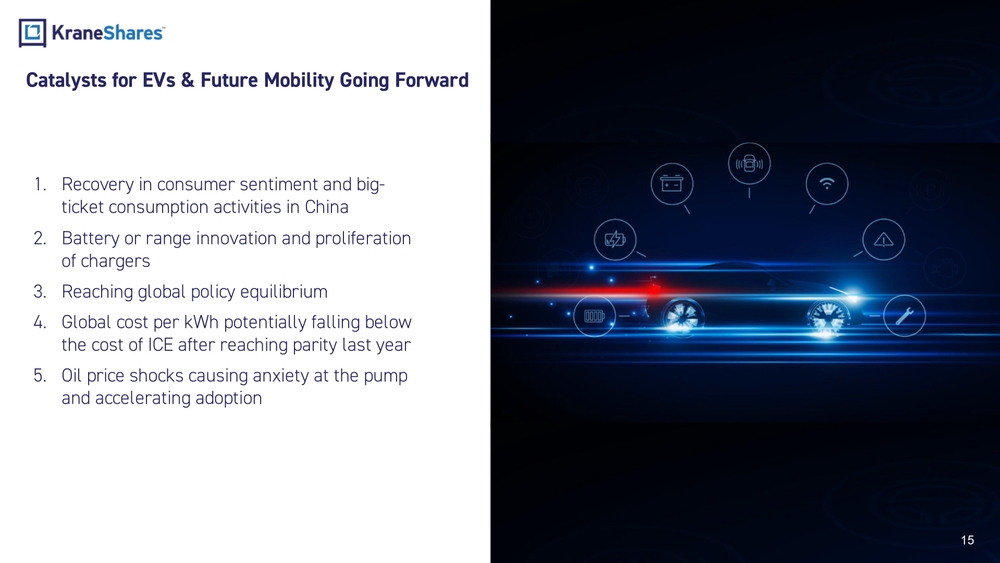
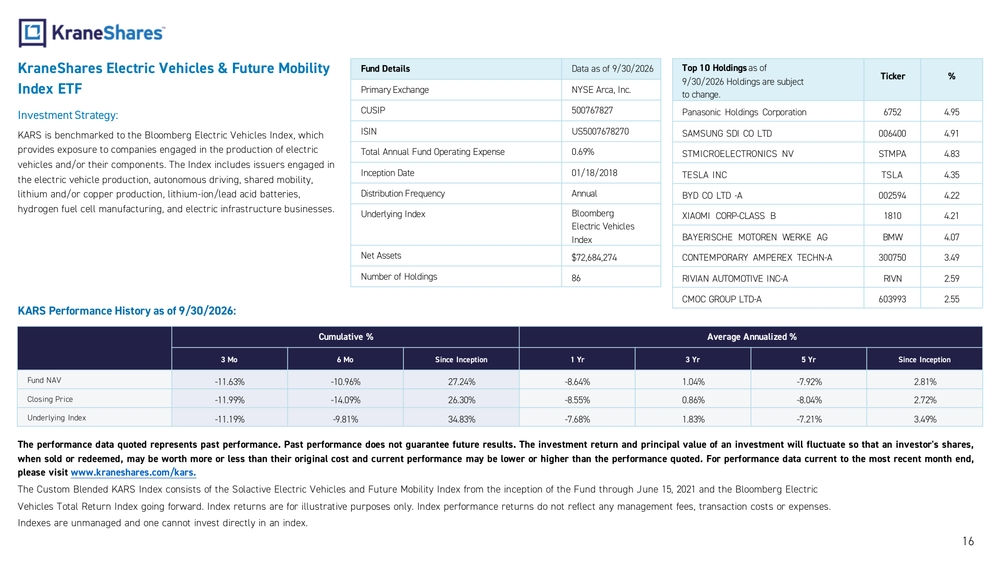
KraneShares Electric Vehicles &Future Mobility Index ETF Investment Strategy: KARS isbenchmarked totheBloomberg Electric Vehicles Index, which provides exposure tocompanies engaged intheproduction ofelectric vehicles and/or their components. TheIndex includes issuers engaged in theelectric vehicle production, autonomous driving, shared mobility, lithium and/or copper production, lithium -ion/lead acid batteries, hydrogen fuelcellmanufacturing, andelectric infrastructure businesses.Fund Details Data as of 9/30/2026 Primary Exchange NYSE Arca, Inc. CUSIP 500767827 ISIN US5007678270 Total Annual Fund Operating Expense 0.69% Inception Date 01/18/2018 Distribution Frequency Annual Underlying Index Bloomberg Electric Vehicles Index Net Assets $72,684,274 Number ofHoldings 86Top10Holdings asof 9/30/202 6Holdings aresubject tochange.Ticker % Panasonic Holdings Corporation 6752 4.95 SAMSUNG SDICOLTD 006400 4.91 STMICROELECTRONICS NV STMPA 4.83 TESLA INC TSLA 4.35 BYD COLTD -A 002594 4.22 XIAOMI CORP -CLASS B 1810 4.21 BAYERISCHE MOTOREN WERKE AG BMW 4.07 CONTEMPORARY AMPEREX TECHN -A 300750 3.49 RIVIAN AUTOMOTIVE INC-A RIVN 2.59 CMOC GROUP LTD-A 603993 2.55 KARS Performance History asof9/30/2026: Cumulative % Average Annualized % 3Mo 6Mo Since Inception 1Yr 3Yr 5Yr Since Inception Fund NAV -11.63% -10.96% 27.24% -8.64% 1.04% -7.92% 2.81% Closing Price -11.99% -14.09% 26.30% -8.55% 0.86% -8.04% 2.72% Underlying Index -11.19% -9.81% 34.83% -7.68% 1.83% -7.21% 3.49% Theperformance data quoted represents past performance. Past performance does notguarantee future results. Theinvestment return andprincipal value ofaninvestment willfluctuate sothat aninvestor 'sshares, when sold orredeemed, may beworth more orless than their original cost andcurrent performance may belower orhigher than theperformance quoted. Forperformance data current tothemost recent month end, please visit www.kraneshares.com/kars. TheCustom Blended KARS Index consists oftheSolactive Electric Vehicles andFuture Mobility Index from theinception oftheFund through June 15,2021 andtheBloomberg Electric Vehicles Total Return Index going forward. Index returns areforillustrative purposes only. Index performance returns donotreflect anymanagement fees, transaction costs orexpenses. Indexes areunmanaged andonecannot invest directly inanindex. 16
KraneShares Empowering investors with access to the world’ s most powerful growth themes through ETFs, private strategies, and innovative investment solutions.
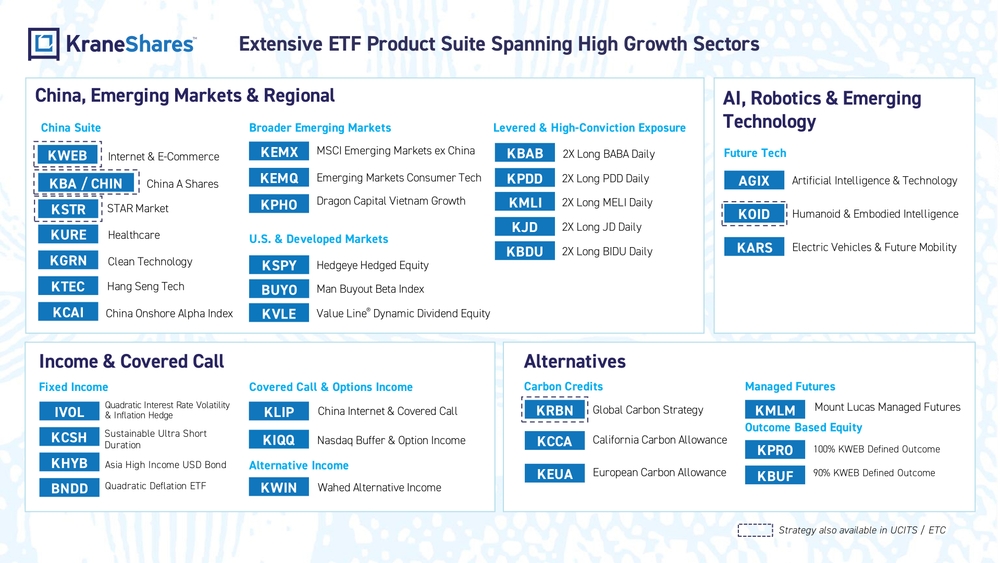
China, Emerging Markets & Regional Alternatives Income & Covered Call AI, Robotics & Emerging Technology KURE Healthcare KGRN Clean TechnologyKSTR STAR Market KTEC Hang Seng TechKWEB Internet & E -Commerce China A Shares KBA / CHIN KCAI China Onshore Alpha IndexAGIX Artificial Intelligence & Technology KOID Humanoid & Embodied Intelligence Electric Vehicles & Future Mobility KARSChina Suite Future TechBroader Emerging Markets KEMQ Emerging Markets Consumer Tech KPHODragon Capital Vietnam GrowthKEMX MSCI Emerging Markets ex China U.S. & Developed Markets KVLE Value Line® Dynamic Dividend EquityHedgeye Hedged Equity KSPY Man Buyout Beta Index BUYO Fixed Income BNDDQuadratic Deflation ETFIVOLQuadratic Interest Rate Volatility & Inflation Hedge KHYB Asia High Income USD BondSustainable Ultra Short DurationKCSH KEUA European Carbon AllowanceGlobal Carbon Strategy KRBNCarbon CreditsKPDD 2X Long PDD Daily KJD 2X Long JD DailyKBAB 2X Long BABA Daily KMLI 2X Long MELI Daily Covered Call & Options Income Managed Futures KMLMMount Lucas Managed Futures KWIN Wahed Alternative IncomeKLIP China Internet & Covered Call Outcome Based Equity KIQQ Nasdaq Buffer & Option IncomeLevered & High -Conviction Exposure KBUF90% KWEB Defined Outcome100% KWEB Defined Outcome KPRO Alternative Income KCCA California Carbon AllowanceExtensive ETF Product Suite Spanning High Growth Sectors Strategy also available in UCITS / ETCKBDU 2X Long BIDU Daily
Important Notes: Carefully consider the Funds’ investment objectives, risk factors, charges and expenses before investing. This and additional information can be found in the Funds' full and summary prospectus, which may be obtained by visiting www.kraneshares.com /kars .Read the prospectus carefully before investing. Risk Disclosures: Investing involves risk, including possible loss of principal. There can be no assurance that a Fund will achieve its stated objectives. Indices are unmanaged and do not include the effect of fees. One cannot invest directly in an index. This information should not be relied upon as research, investment advice, or a recommendation regarding any products, strate gies, or any security in particular. This material is strictly for illustrative, educational, or informational purposes and is subject to change. Certain content represents an assessment of the market environment at a spec ific time and is not intended to be a forecast of future events or a guarantee of future results; material is as of the dates noted and is subject to change without notice. A-Shares are issued by companies in mainland China and traded on local exchanges. They are available to domestic and certain fo reign investors, including QFIs and those participating in Stock Connect Programs like Shanghai -Hong Kong and Shenzhen -Hong Kong. Foreign investments in A -Shares face various regulations and restrictions, including limits on asset repatriation. A -Shares may experience frequent trading halts and illiquidity, which can lead to volatility in the Fund’s share price and increased trading halt risks. The Chinese economy is an emerging market, vulnerable to domestic and regional economic and political changes, often showing more volatility than developed markets. Companies face risks from potential government interventions, and the export -driven economy is sensitive to downturns in key trading partners, impacting the Fund. U.S. - China tensions raise concerns over tariffs and trade restrictions, which could harm China’s exports and the Fund. China's reg ulatory standards are less stringent than in the U.S., resulting in limited information about issuers. Tax laws are unclear and subject to change, potentially impacting the Fund and leading to unexpected liabilities for foreign investors. Fluctuations in currency of foreign countries may have an adverse effect to domestic currency values. The Fund may invest in derivatives, which are often more volatile than other investments and may magnify the Fund’s gains or losses. A derivative (i.e., futures/forward contracts, swaps, and options) is a contract that derives its value from the performance of an underlying asset. The primary risk of derivatives is that changes in the asset’s market value and the derivative may not be proportionate, and some derivatives can have the potential for unlimited losses. Derivatives are also subject to liquidity and counterparty risk. The Fund is subject to liqui dity risk, meaning that certain investments may become difficult to purchase or sell at a reasonable time and price. If a transaction for these securities is large, it may not be possible to initiate, which may cause the Fund to suffer losses. Counterparty risk is the risk of loss in the event that the counterparty to an agreement fails to make required payments or otherwise comply with the terms of the derivative. Narrowly focused investments typically exhibit higher volatility. The Fund’s assets are expected to be concentrated in a sect or, industry, market, or group of concentrations to the extent that the Underlying Index has such concentrations. The securities or futures in that concentration could react similarly to market developments. Thus, the Fund is subject to loss due to adverse occurrences that affect that concentration. In addition to the normal risks associated with investing, investments in smaller companies typically exhibit higher volatility. ETF shares are bought and sold on an exchange at market price (not NAV) and are not individually redeemed from the Fund. Howe ver, shares may be redeemed at NAV directly by certain authorized broker -dealers (Authorized Participants) in very large creation/redemption units. The returns shown do not represent the returns you would r eceive if you traded shares at other times. Shares may trade at a premium or discount to their NAV in the secondary market. Brokerage commissions will reduce returns. Beginning 12/23/2020, market price returns are based on the official closing price of an ETF share or, if the official closing price isn't available, the midpoint between the national best bid and national best offer ("NBBO") as of the time the ETF calculates the current NAV per share. Prior to that date, market price returns were based on the midpoint between the Bid and Ask price. NAVs are calculated using prices as of 4:00 PM Eastern Time. The KraneShares ETFs and KFA Funds ETFs are distributed by SEI Investments Distribution Company (SIDCO), 1 Freedom Valley Dri ve, Oaks, PA 19456, which is not affiliated with Krane Funds Advisors, LLC, the Investment Adviser for the Funds, or any sub -advisers for the Funds.
20Index Definitions: Solactive Autonomous & Electric Vehicles Index: TheSolactive Autonomous & Electric Vehicles Index is an equity index designed to track the price performance of companies that are, or are expected to be, actively involved in the electric vehicle and autonomous driving ecosystem. It includes: Electric vehi cle manufacturers, Producers of electric -vehicle components and key materials (such as batteries and relevant raw materials), Companies developing or supplying autonomous -vehicle technolog ies (sensors, mapping, AI, ADAS, ride -sharing, and connected -transport services). The index is calculated and maintained by Solactive AG, uses free -float market -cap weighting with thematic screening, and is reviewed and reconstituted on a regular schedule (ordinary adjustments twice a year). The Solactive Autonomous & Electric Vehicles Index was launched on April 16, 2018. NYSE FactSet Global Autonomous Driving & Electric Vehicles Index: A rules -based equity benchmark designed to track the performance of globally listed companies involved in the development of autonomous driving and electric vehicles, including producers of autonomous or electric vehicles, batteries, a nd related technologies and components (such as sensors, chips, and software for self -driving systems). The index was launched on January 25, 2019. Term Definitions: Global Electric Vehicle (EV) Sales as % of Light Vehicle Sales: The percentage of light vehicles worldwide that are fully electric. In the auto industry, a light vehicle is generally a road vehicle with a relatively low gross vehicle weight, typically covering passenger cars and smaller trucks/SUVs rather than hea vy trucks or buses.