2024_08_ai_white_paper
by Kraneshares
info@kraneshares.com +1 (212) 933 0393How to Invest in AI Next Decadefor the
2 kraneshares.com info@kraneshares.com +1 (212) 933 0393 Back to Top ↑Table of Contents Executive Summary 3 I. Introduction 4 II. The Long Road to Artificial General Intelligence (AGI) 5 III. The Market Needs an AI-Native Investment Paradigm 9 IV. AGIX Index Construction 16 V. Our Methodology 22 VI. Conclusion 29 Citations 30 Definitions 31 Disclosures 32
3 kraneshares.com info@kraneshares.com +1 (212) 933 0393 Back to Top ↑Executive Summary •The launch of ChatGPT is ushering technology investment into an artificial intelligence (AI)-driven era in which the “Magnificent 7” stocks have significantly outperformed the broader market because they are understood to be the prime beneficiaries of the AI revolution. •We believe the AI revolution is far from complete and not limited to “Magnificent 7” companies. Rather, the impending transformation will involve countless firms, take place over many years, and progress from hardware development (the current stage) to infrastructure to applications, in that order, heading directly towards the theoretical goal of artificial general intelligence (AGI). We believe this monumental transformation requires a new investment paradigm. •The KraneShares Artificial Intelligence & Technology ETF (Ticker: AGIX) uses proprietary scores for both “AI Relevance” and “AI Readiness” to identify leaders in the space and will adjust the portfolio as the industry develops. •AI represents a new investment paradigm. We believe the market needs a new index to define the AI ecosystem, just as the S&P 500 defines US equities and the Nasdaq 100 defines the technology sector.
4 kraneshares.com info@kraneshares.com +1 (212) 933 0393 Back to Top ↑I. Introduction With each technological paradigm shift, a new investment framework becomes necessary. This has been evident in transitions from mobile internet to cloud computing, and now to artificial intelligence. The launch of ChatGPT is ushering technology investment into an AI- driven era. Whether you look at the Nasdaq 100 Index or the S&P 500 Index, you will likely find that these indexes’ overall 2023 earnings per share (EPS) growth was predominantly fueled by the “Magnificent 7” companies (Tesla, Amazon, Alphabet, Apple, Nvidia, Meta, and Microsoft), who are prime beneficiaries of AI. These firms’ substantial investments in AI have been pivotal in driving this recent surge. Despite being the prime beneficiaries currently, these seven companies are hardly representative of the entire AI ecosystem as it stands today. Moreover, as the industry progresses, it will look vastly different than it does today as technology develops and winners and losers are revealed. We believe the AI ecosystem is only in its infancy. Generative AI is only the beginning of this monumental technological revolution. We believe the industry will progress from its current focus on hardware to a focus on infrastructure and, later on, a focus on the actual applications of the technology, competition between which will be the end game of the ecosystem’s evolution. Finally, the development of artificial general intelligence (AGI), which refers to an AI program that can match or even exceed human capabilities, is the proverbial “Holy Grail” of AI development, but we are currently nowhere near being able to develop such a technology.
5 kraneshares.com info@kraneshares.com +1 (212) 933 0393 Back to Top ↑The KraneShares Artificial Intelligence & Technology ETF (Ticker: AGIX) goes beyond Nvidia to capture value across hardware, infrastructure, and application. It will also adjust between these themes as the industry evolves, slowly inching closer AGI, from which the fund gets its name. II. The Long Road to Artificial General Intelligence (AGI) The bottom line is that we are a long, long way away from anything that resembles the highly theoretical “artificial general intelligence” or AGI. Indeed, this theoretical potential future achievement, depicted in multiple works of science fiction, may never even come to fruition. That being said, considering AGI as an end-game of sorts helps conceptualize the long- term development challenge, and massive growth opportunity, presented by the AI ecosystem. Terminology Matters: Large Language Model (Exists): A computational model notable for its ability to achieve general-purpose language processing tasks such as classification. Generative AI (Exists): The use of large language models to parse and present data in a conversational format, enabling the user to save time by reaching inevitable conclusions faster. It can also produce original content based on user inputs. Artificial General Intelligence (Highly Theoretical): An AI program that can match or even exceed human capabilities, able to perform uniquely human tasks such as critical thinking. In late 2022, the introduction of Chat GPT led to a wave of speculation around generative AI and how it could impact corporate earnings,
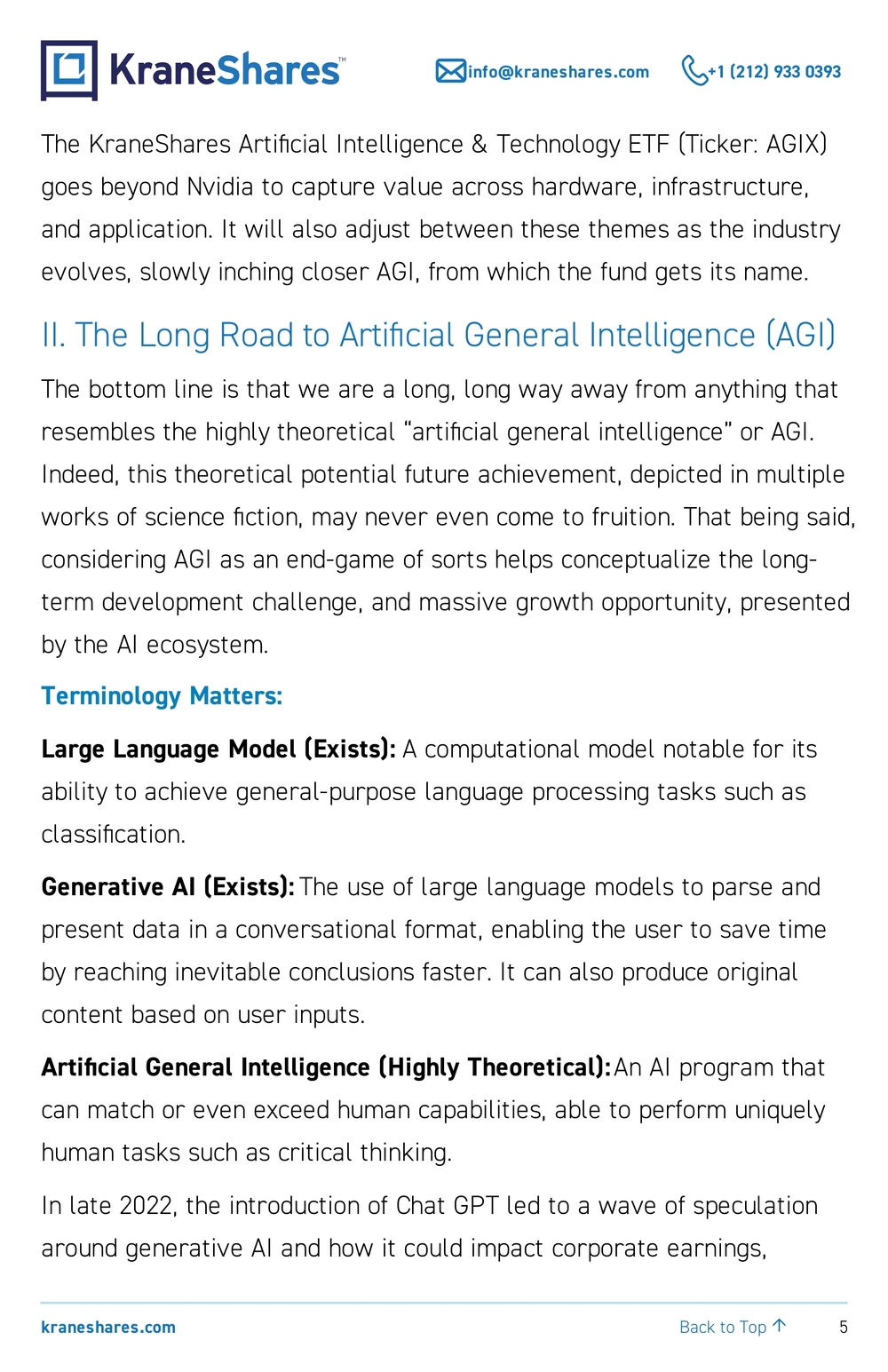
6 kraneshares.com info@kraneshares.com +1 (212) 933 0393 Back to Top ↑the economy, the workforce, and even society. In 2023, we saw such speculation lead to stock price appreciation in the already well-known and heavily-owned “Magnificent 7” stocks. 26%74%85%102% 48%57% 59%81%194%239% 0%50%100%150%200%250% AI-FactorsStock performance ofthe Magnificent 7 In 2023 GPUs DatacenterAdsB usines s Llama ModelsCloud CloudCloudAI Copilo tEdge AI FSD, RoboticsS&P 50 0 Magnificent 7 (without NVDA )Magnificent 7 Mag7AI-related Products Source: Yahoo Finance (Data from Bloomberg as of 12/31/2023). Index returns are for illustrative purposes only and do not represent actual Fund performance. Index returns do not reflect management fees, transaction costs, or expenses. Indexes are unmanaged, and one cannot invest directly in an index. Past performance does not guarantee future results. Please see end of presentation for definitions. This performance trend was then reinforced by corporate earnings. 40% of EPS growth stemmed from technology firms1, with a substantial portion driven by Generative AI.
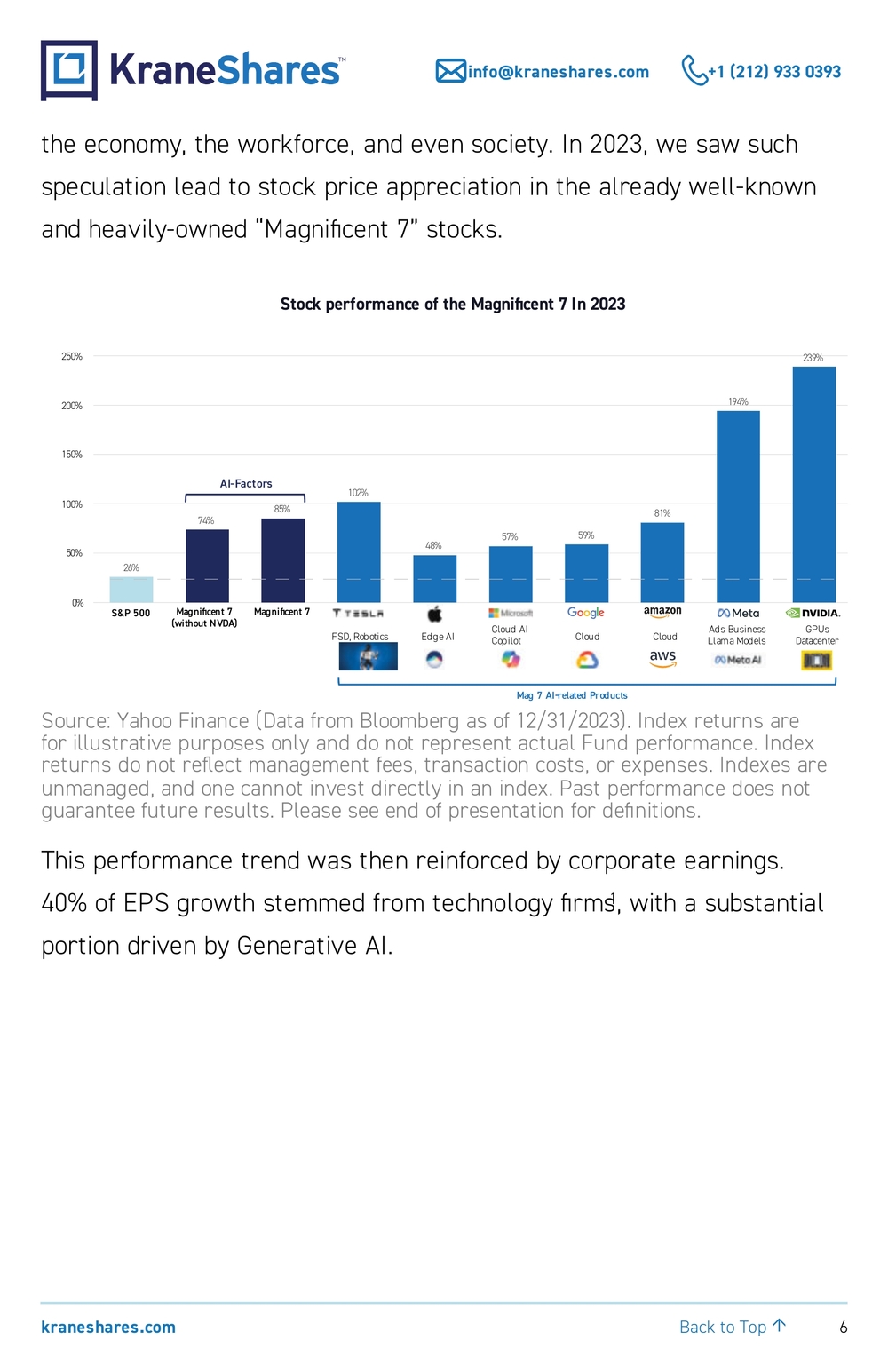
7 kraneshares.com info@kraneshares.com +1 (212) 933 0393 Back to Top ↑$50$100$150$200$250$300 2005 2006 2007 2008 2009 2010 2011 2012 2013 2014 2015 2016 2017 2018 2019 2020 2021 2022 2023 2024 2025S&P 500 Earnings (Historical & Consensus Estimates) ‘21‘22 ‘23‘25 ‘19 ’20 S&P EP SLong Term Trendline =6.5% 12% CAGR ~40% of Earnings Per Share (EPS) driven by tech,mostofwhich is driven by AI AI is Boosting Corporate Earnings Growth With R eal Productivity Increase
Source: Coatue “Build Index of the Future “Forecast from Q1 2024 to Q4 2025. The AGI process has only just begun, and it will undoubtedly go through the same three cycles as previous technological revolutions. We have seen this happen before with the printing press, the steam engine, mass manufacturing, the transition to mainframe data storage, the transition to cloud and mobile computing, and many more. The typical progression is as follows:
- Hardware Investment and Development
- Infrastructure Development
- Application Boom
- Mass Adoption
8 kraneshares.com info@kraneshares.com +1 (212) 933 0393 Back to Top ↑To capture AI alpha above industry beta at each stage, AGIX provides comprehensive coverage across the entire cycle, adjusting as the industry moves along the development timeline. AGIX tracks the Solactive Etna Artificial General Intelligence Index (‘the index), which is designed to capture the performance of companies engaged in developing and applying artificial intelligence technologies. The index has been meticulously filtered down from thousands of listed companies to about 50 and will continuously adjust the number of companies and the weights as the industry evolves. Through this, we can observe the different roles played by various industry sectors in AI development and see truly outstanding AGI companies evolve from early explorers to industry leaders. Numerous companies are reaping the rewards from AI advancements. The core challenge lies in identifying these firms and assembling, monitoring, and adjusting the portfolio with sound evaluation criteria—an imperative underscored by AGIX’s strategic objectives in the AI-native investment landscape.
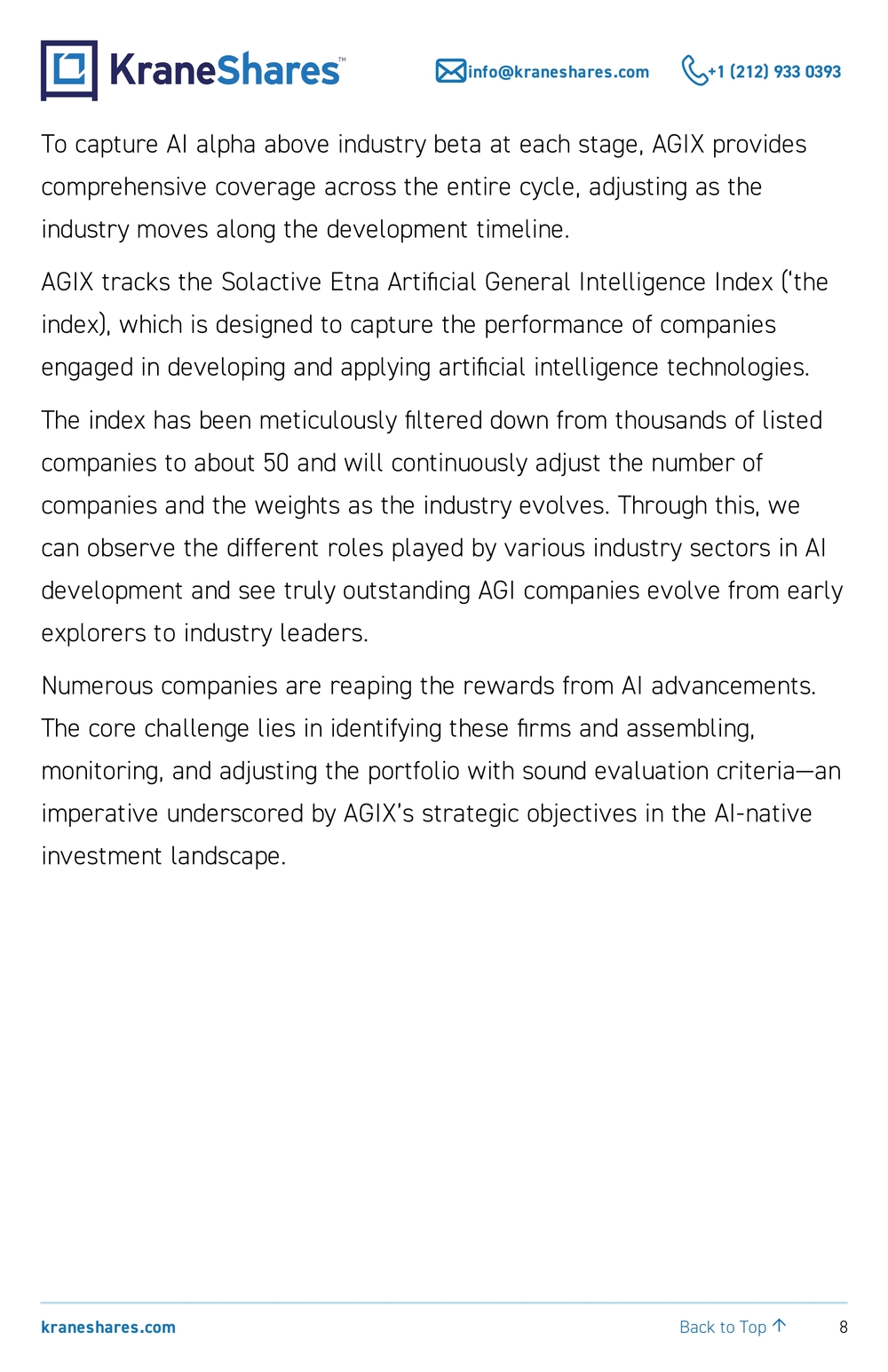
9 kraneshares.com info@kraneshares.com +1 (212) 933 0393 Back to Top ↑We Belie ve There Will Be A Broad Univ erse of P otential AI Beneficiaries Beyond The Mag 7 III. The Market Needs an AI-Native Investment Paradigm We believe we are standing at the threshold of a new era of super- production. Over the past two years, the AI industry has experienced an exhilarating intelligence surge, marked by a frenzy of investment in data centers and large-scale GPU infrastructure. This explosion of intelligence is quantified by models with trillions of parameters, datasets containing hundreds of billions of tokens, and computing power escalating to 10 to the 23rd power (1023) floating point operations per second (FLOPS). Concurrently, cloud platforms have boldly supported their infrastructure construction measured in millions of GPUs and hundreds of billions of dollars. Simultaneously, the anticipated explosive growth of AI-native applications has not yet materialized. While Nvidia has propelled the semiconductor
10 kraneshares.com info@kraneshares.com +1 (212) 933 0393 Back to Top ↑sector into a frenzy, the software sector remains subdued. Despite nearly every software company exploring the adoption of large language models (LLM), few can clearly articulate the decisive revenue generated by LLMs. Unlike the straightforward metrics for purchasing GPUs, the best practices and quantifiable impacts of LLMs remain elusive. This naturally raises a question: what have these massive investments delivered? The silver lining is that history teaches us the virtue of patience. AI is not a killer-app, but a foundational capability Following the discovery of steam power and electricity, humans spent half a century investing in the necessary infrastructure to harness and unleash their transformative potential. In a similar vein, AGI represents a foundational capability that requires significant investment in computing power and explainability research to fully realize its promise. In its nascent stages, expecting AGI to rapidly evolve into a product generating substantial revenue is short-sighted and underestimates its future potential. Some AI-applications are achieving stunning revenue OpenAI’s annual recurring revenue (ARR) surpassed $3 billion by the end of the year.2 According to Sequoia, the combined annual revenue of all other Generative AI startups now exceeds $4 billion.2 This remarkable figure has already outstripped the entire revenue generated by the SaaS industry over the past decade. We are still in the initial stage Every technological revolution in history has progressed through three
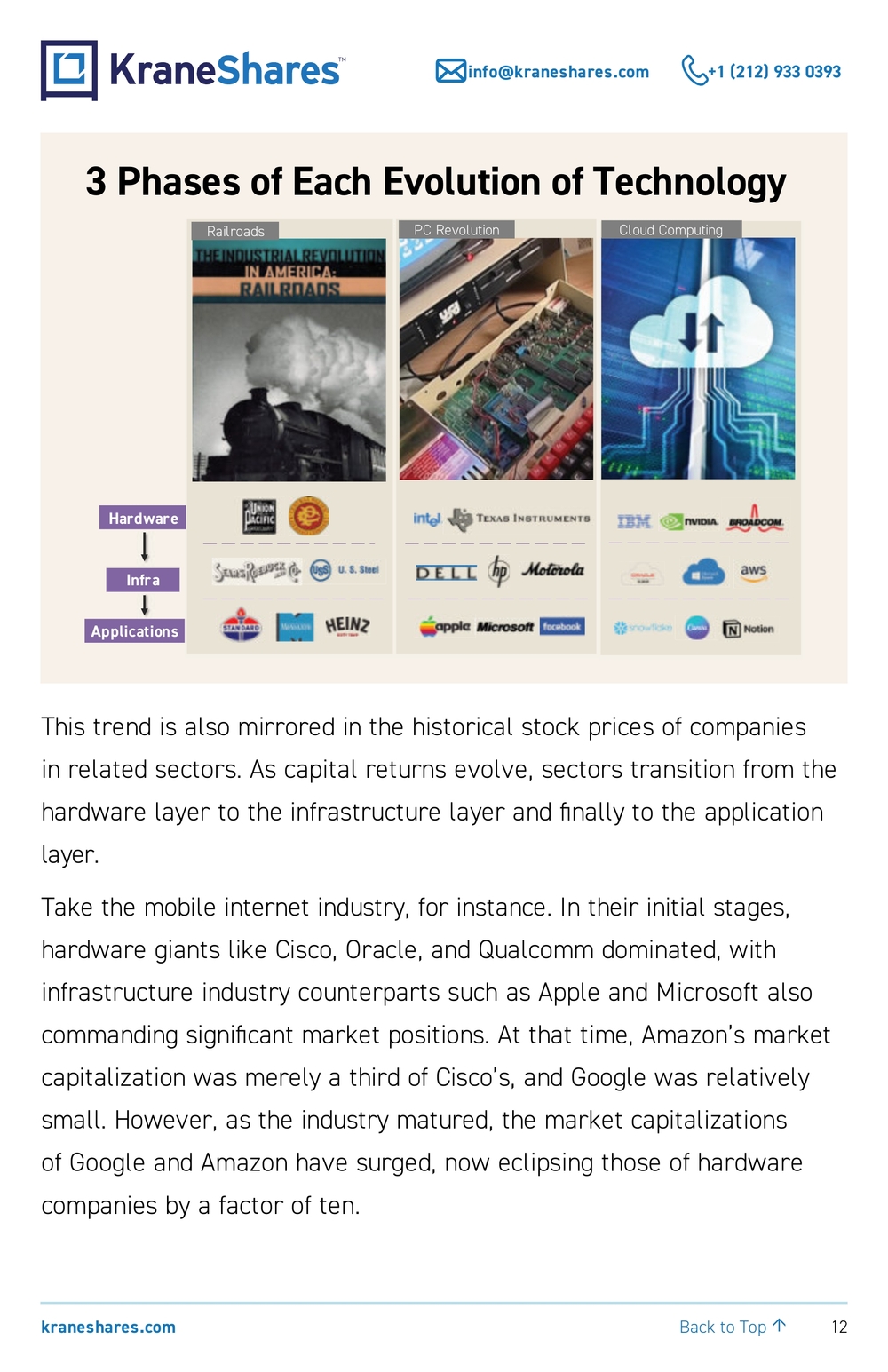
11 kraneshares.com info@kraneshares.com +1 (212) 933 0393 Back to Top ↑distinct stages: hardware investment, infrastructure construction, and the eventual breakout of applications. For example: •The initial construction of railways catalyzed economic growth through improved transportation; •The discovery of Moore’s Law, which is the observation that the number of transistors in an integrated circuit doubles about every two years, along with personal computers and smartphones, preceded and enabled the development of internet and mobile internet applications, respectively. •The establishment of data centers and cloud infrastructure set the stage for the software revolution in cloud computing, driven by enterprises’ gradual migration to the cloud.
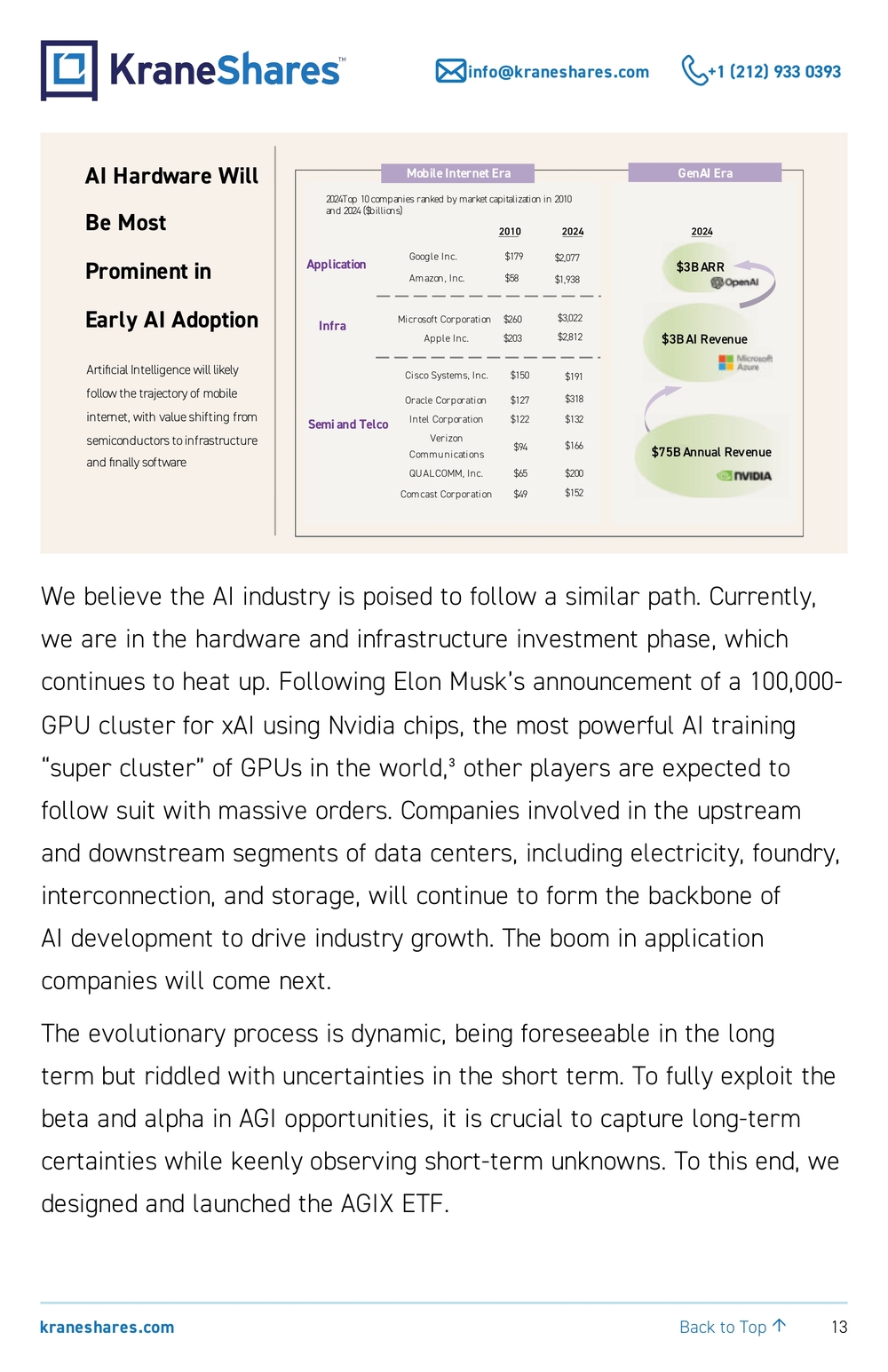
12 kraneshares.com info@kraneshares.com +1 (212) 933 0393 Back to Top ↑ Railroad s PC Revolution Cloud Computing Hardwar e Infra Applications 3 Phases of Each Ev olution of T echnology This trend is also mirrored in the historical stock prices of companies in related sectors. As capital returns evolve, sectors transition from the hardware layer to the infrastructure layer and finally to the application layer. Take the mobile internet industry, for instance. In their initial stages, hardware giants like Cisco, Oracle, and Qualcomm dominated, with infrastructure industry counterparts such as Apple and Microsoft also commanding significant market positions. At that time, Amazon’s market capitalization was merely a third of Cisco’s, and Google was relatively small. However, as the industry matured, the market capitalizations of Google and Amazon have surged, now eclipsing those of hardware companies by a factor of ten.
13 kraneshares.com info@kraneshares.com +1 (212) 933 0393 Back to Top ↑Semi and Telco$191 $150 Cisco Systems ,Inc. $318 $127 OracleC orporation $132 $122 Intel Corporatio n $166 $94Verizo n Communications $200 $65 QUALCOMM, Inc. $152 $49 Comcas tCorporatio nInfra$3,02 2 $260 Microsof tCorporation $2,81 2 $203 Apple Inc.Applicatio n$2,07 7 $179 Google Inc. $1,93 8 $58 Amazon, Inc. Artificia lIntelligence will likely follow the trajectory of mobile internet, with value shifting from semiconductors to infrastructure and finally softwareAIHardware Will Be Most Prominen tin Early AI AdoptionMobile Internet Era $3BA RR $3BA I Revenu e $75BA nnual Revenue20102024Top 10companie sranked by marke tcapitalization in2010 and2024 ($billions ) 2024 2024GenA IEra We believe the AI industry is poised to follow a similar path. Currently, we are in the hardware and infrastructure investment phase, which continues to heat up. Following Elon Musk’s announcement of a 100,000- GPU cluster for xAI using Nvidia chips, the most powerful AI training “super cluster” of GPUs in the world,³ other players are expected to follow suit with massive orders. Companies involved in the upstream and downstream segments of data centers, including electricity, foundry, interconnection, and storage, will continue to form the backbone of AI development to drive industry growth. The boom in application companies will come next. The evolutionary process is dynamic, being foreseeable in the long term but riddled with uncertainties in the short term. To fully exploit the beta and alpha in AGI opportunities, it is crucial to capture long-term certainties while keenly observing short-term unknowns. To this end, we designed and launched the AGIX ETF.
14 kraneshares.com info@kraneshares.com +1 (212) 933 0393 Back to Top ↑AGIX offers a universal framework to anchor the distant future while embracing the present. AI’s role as either a disruptor or an enabler of existing companies defies a singular classification. It embodies both intelligence and a novel paradigm for application development and interaction. AI will generate new automated agent products while integrating into existing businesses, fostering both incremental and hybrid innovations. The “emergence” and “leap” in model capabilities could lead to a nonlinear unlocking of AI’s economic value. Due to its discontinuous nature, mature companies with established workflows, user-base and data may initially benefit from AI-driven cost savings and deepened competitive moats. These companies are primarily those that are already listed or about to go public. AI could lead to cost structures and business models never seen before in the market. The development of the mobile internet and smart phones made content creation simpler, offering a completely new type of business model. The same could happen in the software industry because of AI. In the past decade, cloud computing introduced the subscription model for software business. In the same vein, AI could transform the whole industry into a new business paradigm. Thus, we believe that a new investment tool, like the AGIX Index, reflecting the dynamic evolution of the entire AI industry is necessary, and it can also serve as a benchmark for industry reference and tracking. The Dow Jones Industrial Average represents the maturity of American
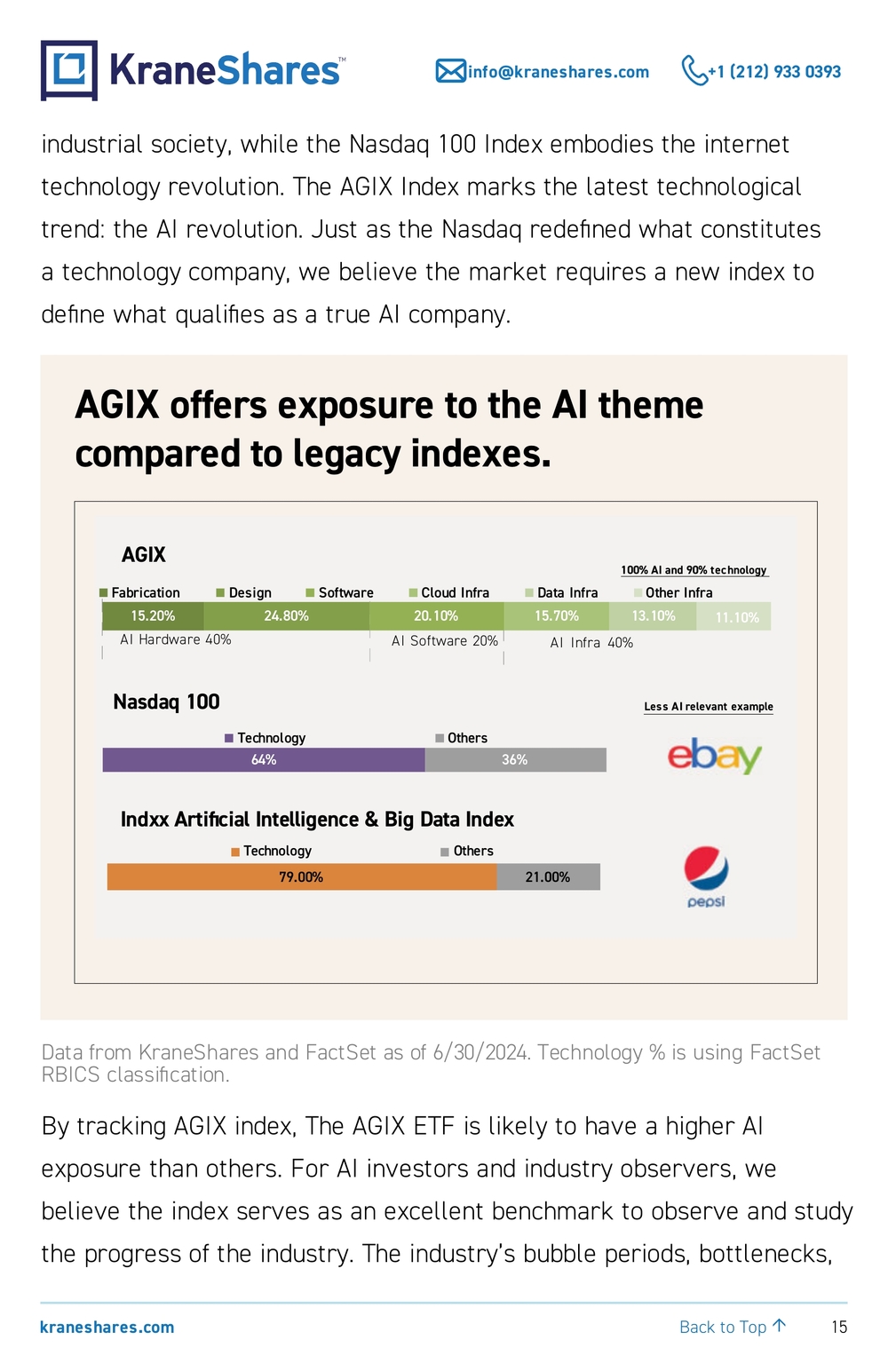
15 kraneshares.com info@kraneshares.com +1 (212) 933 0393 Back to Top ↑industrial society, while the Nasdaq 100 Index embodies the internet technology revolution. The AGIX Index marks the latest technological trend: the AI revolution. Just as the Nasdaq redefined what constitutes a technology company, we believe the market requires a new index to define what qualifies as a true AI company. AGIX 64% 36%Technology OthersNasdaq 100 79.00% 21.00%Technology OthersIndxx Artificial Intelligence &Big Data IndexLess AI relevant exampl e AIHardware 40% AISoftware 20% AIInfra 40%100% AI and90% technology 15.20% 24.80% 20.10% 15.70% 13.10% 11.10%Fabrication Design Software CloudInfra DataInfra OtherInfraAGIX offers e xposure to the AI theme compared to legacy ind exes. Data from KraneShares and FactSet as of 6/30/2024. Technology % is using FactSet RBICS classification. By tracking AGIX index, The AGIX ETF is likely to have a higher AI exposure than others. For AI investors and industry observers, we believe the index serves as an excellent benchmark to observe and study the progress of the industry. The industry’s bubble periods, bottlenecks,
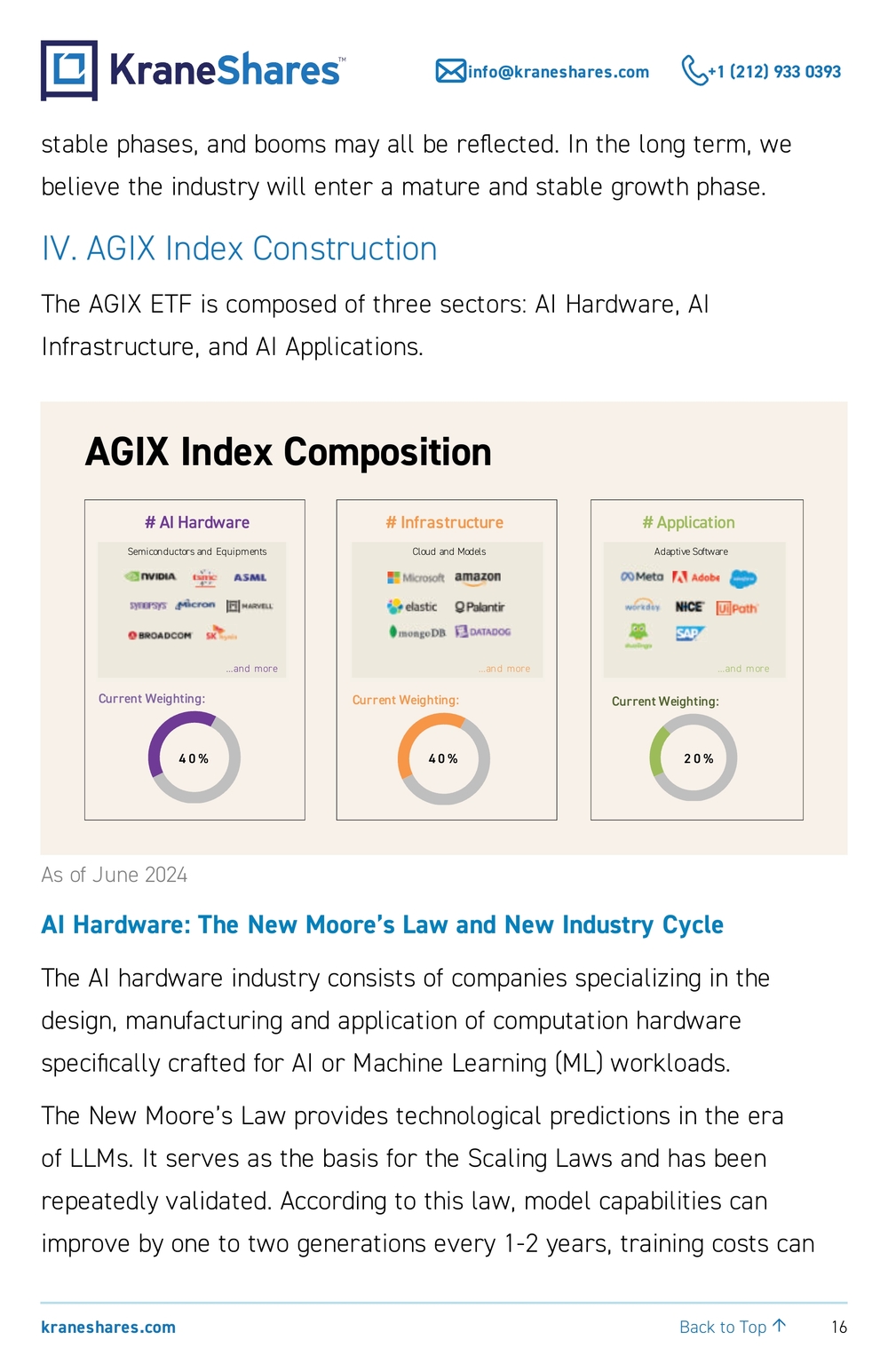
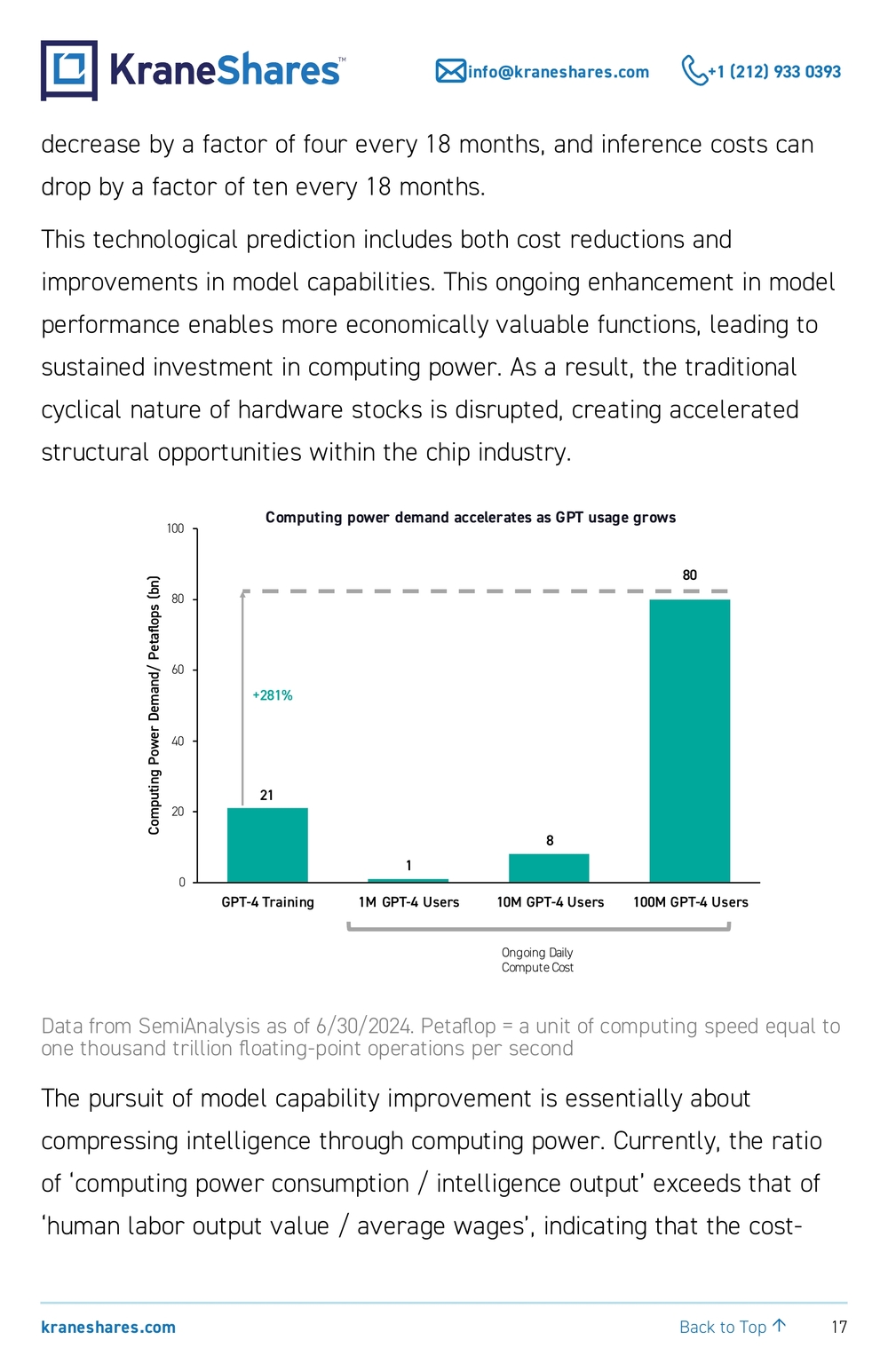
16 kraneshares.com info@kraneshares.com +1 (212) 933 0393 Back to Top ↑stable phases, and booms may all be reflected. In the long term, we believe the industry will enter a mature and stable growth phase. IV. AGIX Index Construction The AGIX ETF is composed of three sectors: AI Hardware, AI Infrastructure, and AI Applications. #AI Hardware …andm ore CurrentW eighting :#Infrastructure #Application …and more …and more 40% 40% 20%Semiconductors and Equipments Cloud and Models Adaptive Software CurrentW eighting : CurrentW eighting :AGIX Inde x Composition As of June 2024 AI Hardware: The New Moore’s Law and New Industry Cycle The AI hardware industry consists of companies specializing in the design, manufacturing and application of computation hardware specifically crafted for AI or Machine Learning (ML) workloads. The New Moore’s Law provides technological predictions in the era of LLMs. It serves as the basis for the Scaling Laws and has been repeatedly validated. According to this law, model capabilities can improve by one to two generations every 1-2 years, training costs can
17 kraneshares.com info@kraneshares.com +1 (212) 933 0393 Back to Top ↑decrease by a factor of four every 18 months, and inference costs can drop by a factor of ten every 18 months. This technological prediction includes both cost reductions and improvements in model capabilities. This ongoing enhancement in model performance enables more economically valuable functions, leading to sustained investment in computing power. As a result, the traditional cyclical nature of hardware stocks is disrupted, creating accelerated structural opportunities within the chip industry. 21 1880 020406080100 GPT-4Training1 MGPT-4Users1 0MGPT-4Users 100MGPT-4UsersComputing Power Demand/ Petaflops (bn) Ongoin gDaily Compute Cost+281%Computing power demand accelerates as GPT usage grow s Data from SemiAnalysis as of 6/30/2024. Petaflop = a unit of computing speed equal to one thousand trillion floating-point operations per second The pursuit of model capability improvement is essentially about compressing intelligence through computing power. Currently, the ratio of ‘computing power consumption / intelligence output’ exceeds that of ‘human labor output value / average wages’, indicating that the cost-
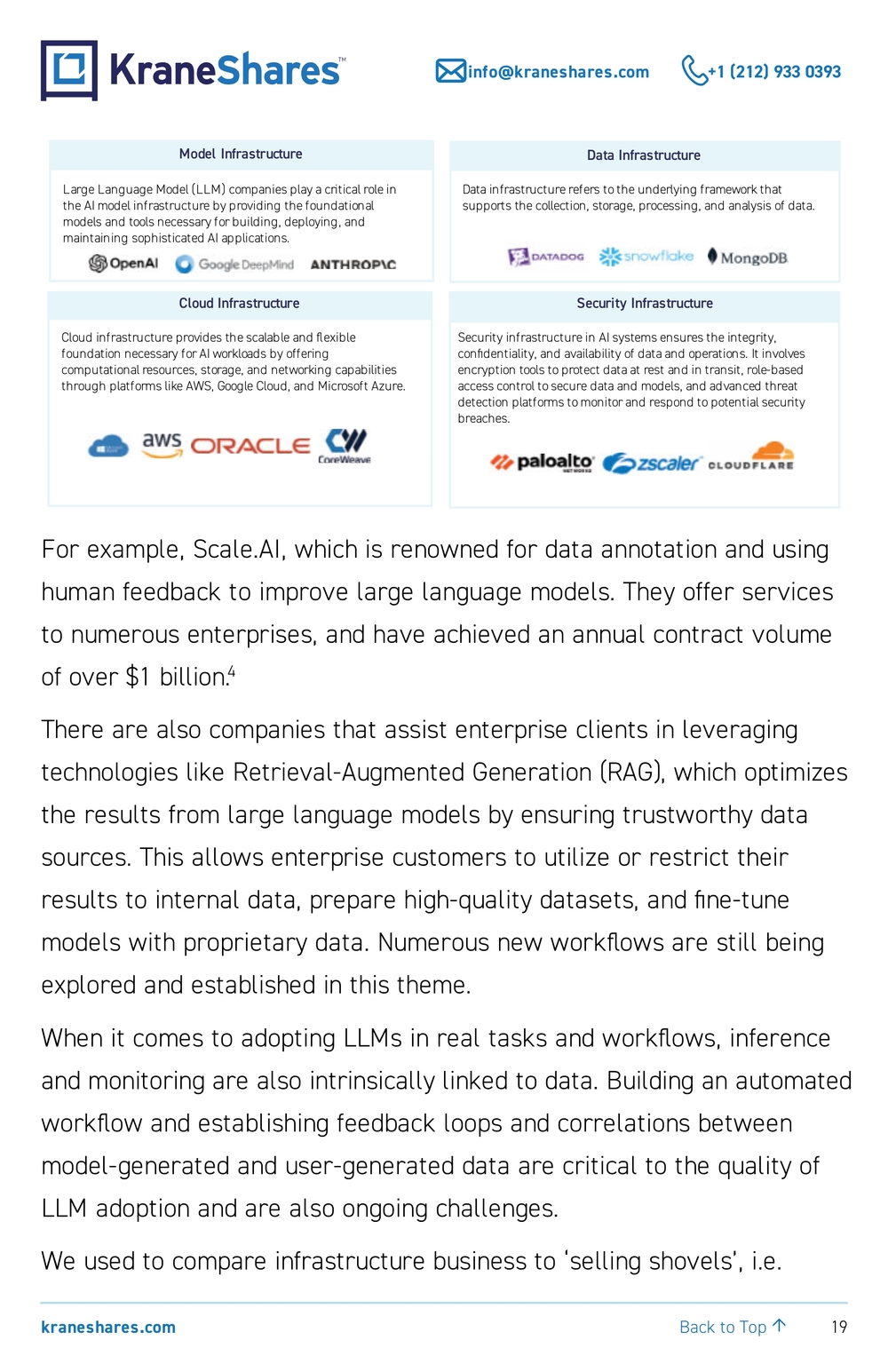
18 kraneshares.com info@kraneshares.com +1 (212) 933 0393 Back to Top ↑effectiveness of generating intelligence has not yet reached a critical threshold. We have reason to believe that the arms race for computing power will continue for at least another 12-24 months. AI Infrastructure: Data as Alchemy, Not Just Shovels AI infrastructure includes companies that focus on model management, monitoring and operations to support the development, deployment and improvement of AI/ML models over their lifecycle. Cloud service providers (CSPs) including Microsoft’s Azure, Amazon Web Services, and Google Cloud are the primary beneficiaries of this industry. They not only boost revenue through GPU training but also gain from enterprise customers accessing LLM automated protocol interfaces (APIs). Various CIO interviews and surveys reveal that enterprises prefer using models via familiar cloud vendors for enhanced security, privacy, and customer service. According to Microsoft’s Q3 2024 earnings call, Cloud model Azure Arc now has 33,000 companies, up over 2X year- over-year. For AI applications to work and scale, their underlying infrastructure must be AI-ready. We are also optimistic about companies that play a crucial role in data services, which represent the cornerstone of foundational models and AI-native applications, essentially the refined output of computation.
19 kraneshares.com info@kraneshares.com +1 (212) 933 0393 Back to Top ↑Large Languag eModel(LLM)companies play a critical role in theAImodelinfrastructure by providin gthe foundational models andt oolsnecessary forb uilding, deploying, an d maintaining sophisticated AI applications . Security infrastructure inAIsystems ensure stheintegrity, confidentiality, and availability of data an doperations. Itinvolves encryption toolstoprotect data at rest an dintransit ,role-base d access contro ltosecure data an dmodels, and advanced threat detectio nplatforms tomonitor an drespond topotentia lsecurity breaches .Cloudi nfrastructure provide sthescalable and flexibl e foundation necessary fo rAI workload sby offering computational resources ,storage, an dnetworkin gcapabilitie s throug hplatforms likeAWS, Googl eCloud, an dMicrosoft Azure .Data infrastructure refers totheunderlying framewor kthat support sthecollection ,storage ,processing, and analysis of data . Data Infrastructure Clou dInfrastructure Security InfrastructureMode lInfrastructure For example, Scale.AI, which is renowned for data annotation and using human feedback to improve large language models. They offer services to numerous enterprises, and have achieved an annual contract volume of over $1 billion.4 There are also companies that assist enterprise clients in leveraging technologies like Retrieval-Augmented Generation (RAG), which optimizes the results from large language models by ensuring trustworthy data sources. This allows enterprise customers to utilize or restrict their results to internal data, prepare high-quality datasets, and fine-tune models with proprietary data. Numerous new workflows are still being explored and established in this theme. When it comes to adopting LLMs in real tasks and workflows, inference and monitoring are also intrinsically linked to data. Building an automated workflow and establishing feedback loops and correlations between model-generated and user-generated data are critical to the quality of LLM adoption and are also ongoing challenges. We used to compare infrastructure business to ‘selling shovels’, i.e.
20 kraneshares.com info@kraneshares.com +1 (212) 933 0393 Back to Top ↑capturing a relatively small portion of the value chain. However, in the AI era, infrastructure related to data is more akin to alchemy, meaning that it is capable of proverbially “turning stone into gold” or creating massive value from low value inputs. Data quality directly determines a model’s effectiveness. The emerging data stack that maximizes the value of enterprise data for models is poised to create immense value. AI infrastructure companies capture a large share of the profits generate by AI native applications. AI applications are, in many cases, still searching for product fits at the current stage. AI applications refer to companies that leverage AI technologies within their business models, products and services to drive efficiencies, cost savings, new revenue streams or improved customer experiences. According to Meta’s 2024 Q1 earnings call, capital expenditures on AI and the metaverse-development division Reality Labs will range between $35 and $40 billion by the end of 2024. However, the massive adoption of Generative AI has a long way to go. According to Andreesen Horowitz, although over half of the top 70 companies in the Fortune 500 are internally investing in AI, at the same time they are uncertain about the practical products they can develop with LLMs.5 Integrating models into existing complex workflows is the best way to let mass market users know the magic of Generative AI and finally pay for the new technology.
21 kraneshares.com info@kraneshares.com +1 (212) 933 0393 Back to Top ↑Luckily, we are now standing on the brink of a surge in GenAI’s massive adoption: •Companies have started disclosing specific AI-related growth in earnings calls. For instance, Elastic (ESTC) reported 1,000 paying users for its vector search function.6 •Now Assistant, the AI-powered copilot launched by ServiceNow (NOW) became the fastest-ever product released by the company. •Chief Information Officers (CIOs) are increasingly optimistic about, Morgan Stanley Research indicates that 33% of CIOs expect their first AI/LLM projects to be in production in the second half of 2024.7 •The reduction in model costs is more predictable and measurable. While we cannot fully guarantee that intelligence will double annually, we can expect model inference costs to drop ten-fold each year.8 •With over 60% of the global population already using smart devices,9 AGI has a vast number of interactive entry points and a massive amount of terminal data. Once we reach a balance between model capability and cost, AI will likely dominate more rapidly than anticipated. The hardware overweight could reverse itself in coming years in the AGIX Index. Aligning with the AGIX Index, AI hardware, infrastructure, and application companies currently account for 40%, 40%, and 20% of the AGIX ETF, respectively, as of August 6, 2024. Given the current investment focus
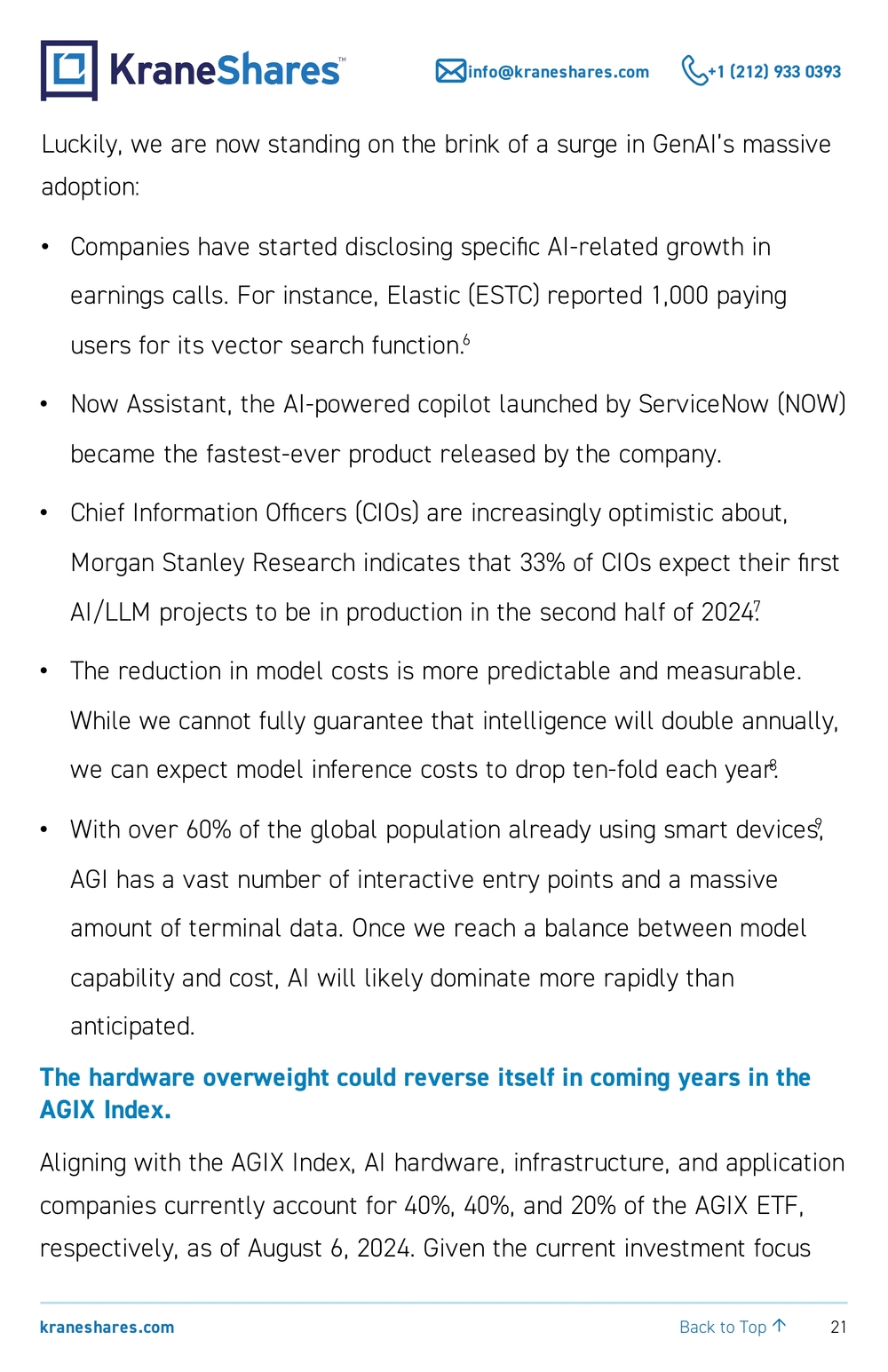
22 kraneshares.com info@kraneshares.com +1 (212) 933 0393 Back to Top ↑on hardware, this sector currently has a higher proportion. As model capabilities advance, more applications will emerge, prompting us to adjust the sector weights to reflect changes in industry value capture. V. Our Methodology We use a holistic framework to assess AI opportunities. We evaluate public companies across four key dimensions that capture the breadth and depth of their AI capabilities and commercial traction. This multi- faceted assessment provides a comprehensive view of each company’s AI potential and competitive positioning. AIRelevance AIReadinessHIGH HIGHLOWEnablersAdopters Beginner sLeaders AGIX P otential Matrix We evaluate companies based on two scores: AI Relevance and AI Readiness.
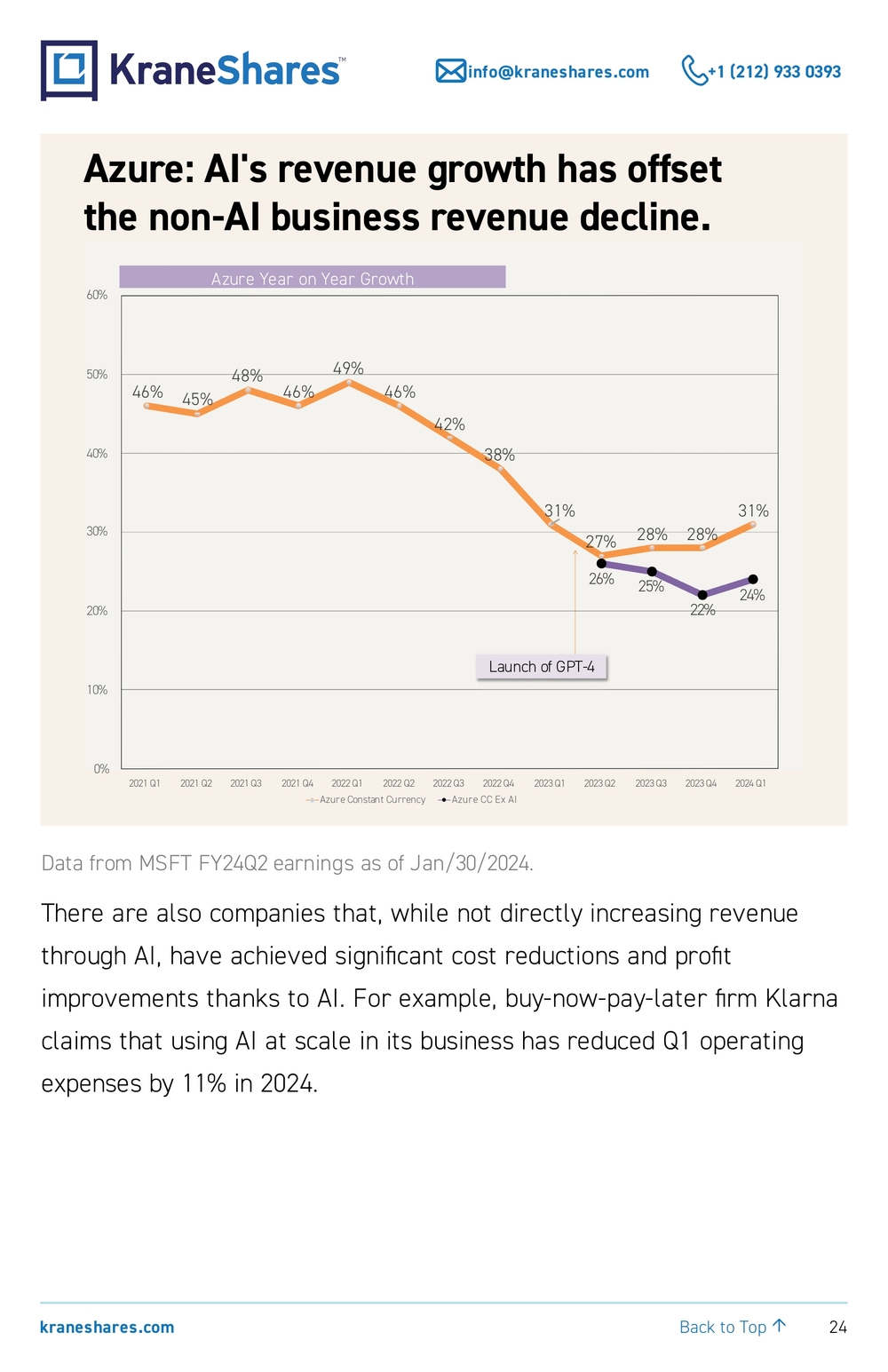
23 kraneshares.com info@kraneshares.com +1 (212) 933 0393 Back to Top ↑AI Readiness assesses how integrated AI is within a company’s current operations. The more AI positively impacts the business and generates revenue, the higher the AI Readiness score. Typical companies with high AI readiness include: •Nvidia is a leader in AI hardware, NVIDIA is the most direct beneficiary of the AGI wave, providing the essential physical infrastructure for AI development and operation. •CSPs such as Azure, Amazon Web Services, and Google Cloud are also highly AI relevant. Cloud platforms are crucial for enterprises to train and deploy models, serving as key distribution channels for AI models. For instance, according to company reports for the first quarter, Azure’s AI revenue accounts for 7%, and AWS’s AI revenue contribution is estimated at 3%, with a quarter-on-quarter increase of 2%, largely driven by Anthropic.
24 kraneshares.com info@kraneshares.com +1 (212) 933 0393 Back to Top ↑46%45%48% 46%49% 46% 42% 38% 31% 27%28%2 8%31% 26%25% 22%24% 0%10%20%30%40%50%60% 2021 Q1 2021 Q2 2021 Q3 2021Q 4 2022Q 1 2022Q 2 2022Q 3 2022Q 4 2023Q 1 2023Q 2 2023Q 3 2023Q 4 2024Q 1 AzureConstant Currency AzureCCExAI Launch ofGPT-4Azur eYearonYearGrowt hAzure: AI's re venue growth has offset the non-AI business re venue decline . Data from MSFT FY24Q2 earnings as of Jan/30/2024. There are also companies that, while not directly increasing revenue through AI, have achieved significant cost reductions and profit improvements thanks to AI. For example, buy-now-pay-later firm Klarna claims that using AI at scale in its business has reduced Q1 operating expenses by 11% in 2024.
25 kraneshares.com info@kraneshares.com +1 (212) 933 0393 Back to Top ↑AI relevance emphasizes a forward-looking perspective, measuring the potential business impact and revenue that the integration of AI could bring to a company in the foreseeable future. As LLMs become more advanced, scenarios currently limited by existing intelligence levels will be unlocked, providing companies with significant AI exposure. To capture alpha returns, it’s crucial to identify ‘value troughs’ ahead of the market. Most software and application companies have yet to experience the revenue growth from AI that semiconductor and infrastructure companies have already enjoyed. However, these companies are investing in AI-driven product lines to secure future market value 3-5 years in advance. Typical companies with high AI relevance include: •Apple recently lunched “Apple Intelligence”, which seamlessly integrates AI tools into iPhones. As the mobile operating system with the highest penetration in the United States, Apple has a strategic advantage when it comes to rolling out AI tools and services. •Adobe introduced the GenAI suite Firefly and integrated LLMs into existing products. It provides a perfect example that software with established workflow can take the role as distributors of LLMs, they can adopt model capabilities into and lead to substantial revenue growth. •ServiceNow is highly experienced with enterprise customers‘ IT and data systems. Therefore, when numerous companies seek to deploy
26 kraneshares.com info@kraneshares.com +1 (212) 933 0393 Back to Top ↑Generative AI, ServiceNow is often their first choice. Since last year, ServiceNow has frequently mentioned its robust AI-related order growth and positive feedback from enterprise clients publicly. The criteria can be visualized in the AGIX Potential Matrix. In the AGIX Potential Matrix, the horizontal axis represents AI Readiness while the vertical axis represents AI Relevance. Within the matrix, there are four quadrants: •Leaders: These companies not only achieve revenue growth from AI but are also key drivers of the AI development. Their growth and the evolution of AI are mutually reinforcing. •Enablers: Typically stand in sectors like chip manufacturing, cloud platforms, and data infra, they play a crucial role in supporting the development of the AI industry even though their businesses do not directly utilize AI. •Adopters: Companies that have made AI a strategic investment, having launched AI-driven products or business lines that are expected to generate new revenue or increase the user base in the foreseeable future. •Beginners: Compared to Adopters, these companies have simpler and more basic attempts at AI, mostly limited to function features.
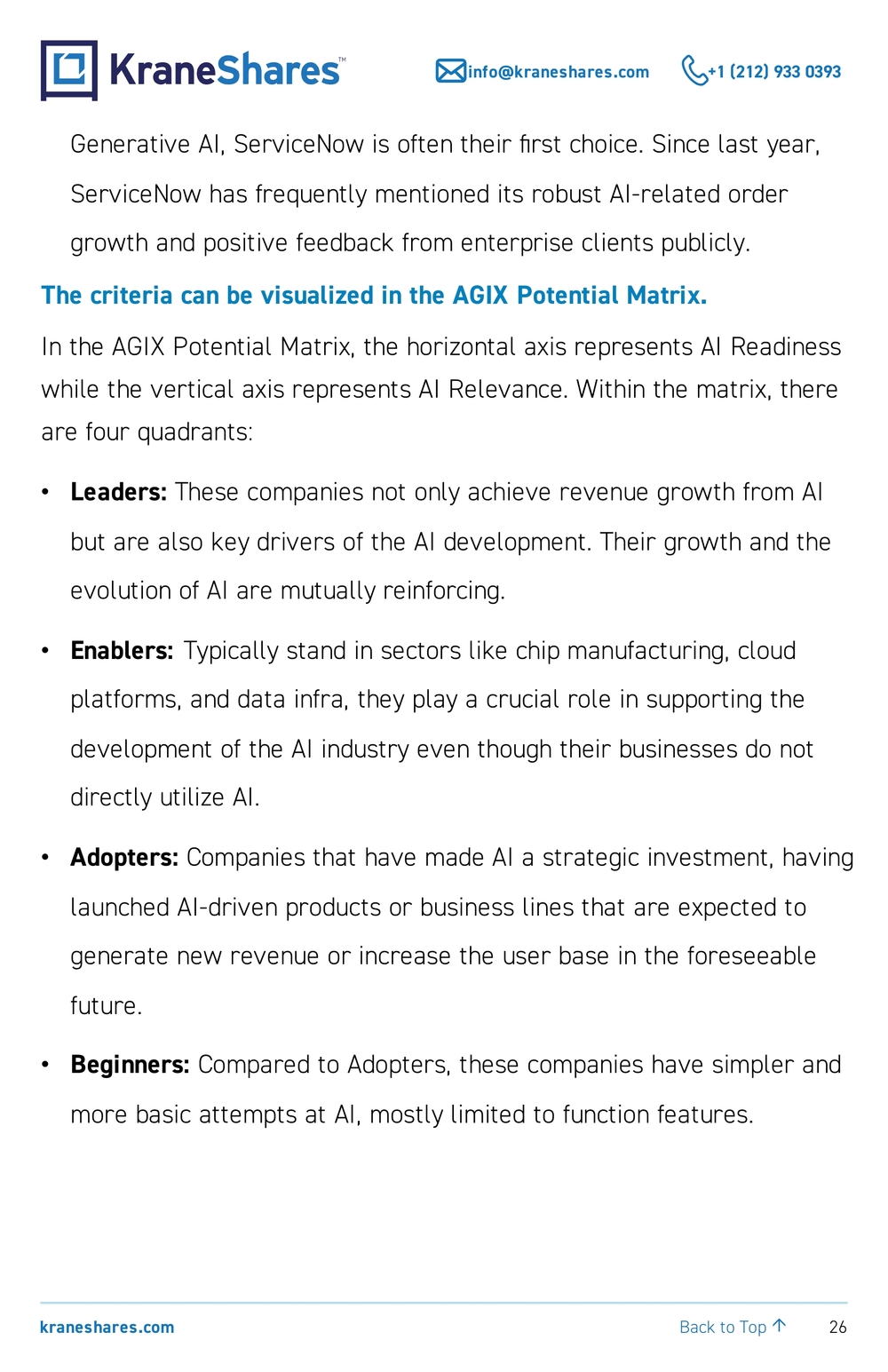
27 kraneshares.com info@kraneshares.com +1 (212) 933 0393 Back to Top ↑ AIRelevanc e AIReadines sHIGH HIGHLOW#Adopters Companies make significant strategic investment sin AI, or have already launchedA I-driven product s orbusiness line swhich are expected to bring new revenue streams or growth soon .#Leaders Companies not only achieve revenue growth from AI but are also key drivers of th eAI development. Theirgrowth and th eevolution of AI ar e mutually reinforcing.
Beginners
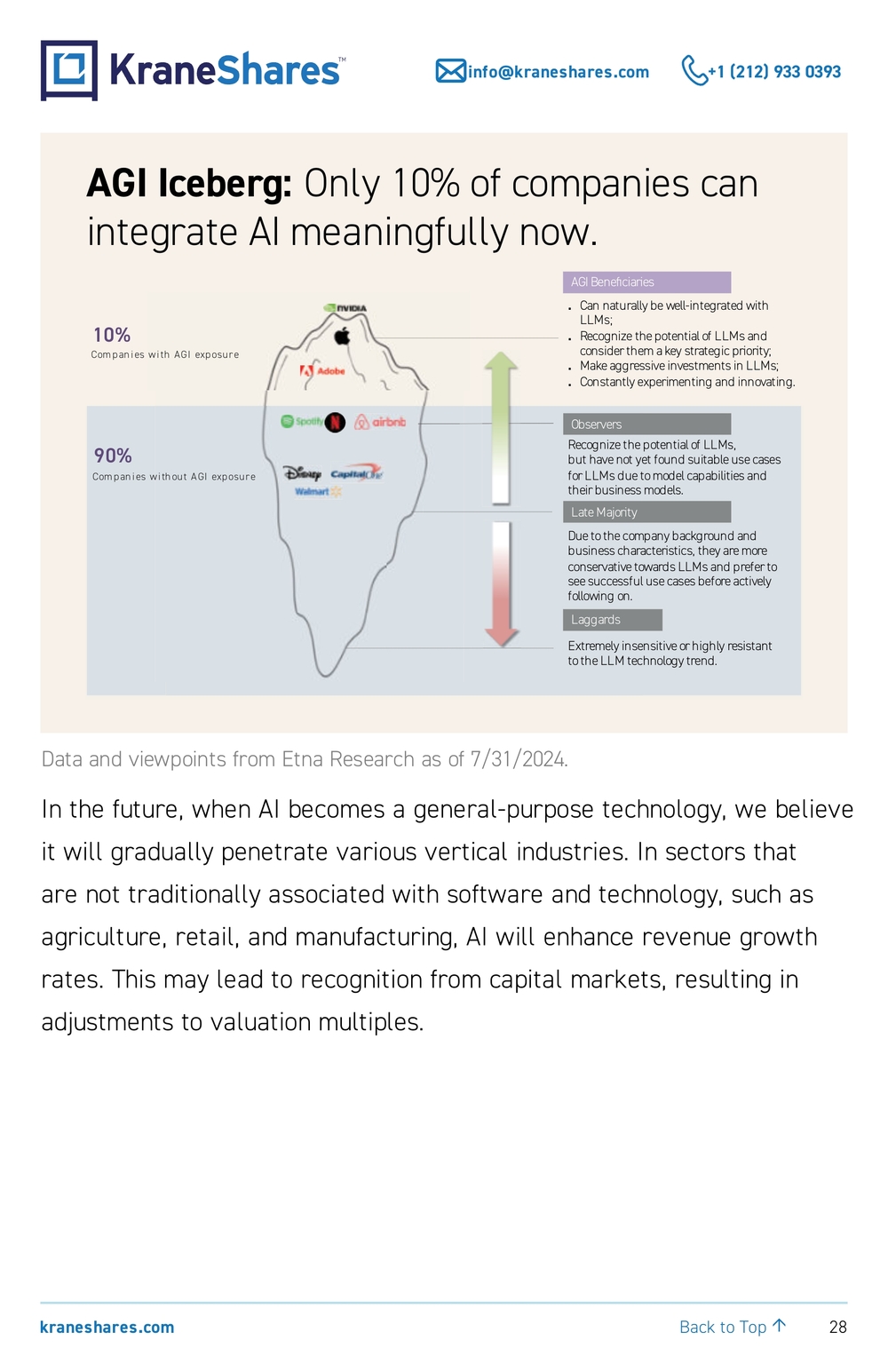
Compared to Adopters, their attempts with AI arem ore elementary, often limited to th e feature level.#Enabler s Typically standi n sectors like chip manufacturing, clou dplatforms, an d data infra, they play a crucial role in supporting th edevelopment of th e AI industry even though their businesse sdo not directly utiliz eAI.AGIX P otential Matrix Given the scarcity of companies with genuine AI Readiness and AI Relevance, the companies included in the ETF currently represent merely the tip of the “AGIX Iceberg”. At present, we estimate that only around 10% of all companies worldwide can integrate AI meaningfully now.
28 kraneshares.com info@kraneshares.com +1 (212) 933 0393 Back to Top ↑10% Companie swithA GIexposure 90% Companie swithout AGIexposur e.Cann aturally be well-integrated with LLMs; .Recognize the potentia lof LLMs and consider them a key strategic priority; .Make aggressive investments in LLMs; .Constantly experimenting and innovating.AGIBeneficiaries Observer s Late MajorityRecognize the potentia lof LLMs, but have not yet found suitable use cases for LLMs due to model capabilities and their business models . Due to the company background and business characteristics, they are more conservative towards LLM sand prefer to see successful use cases before actively following on . Laggards Extremely insensitive or highly resistant to the LLM technology trend.AGI Iceberg: Only 10% of companies can integr ate AI meaningfully now .
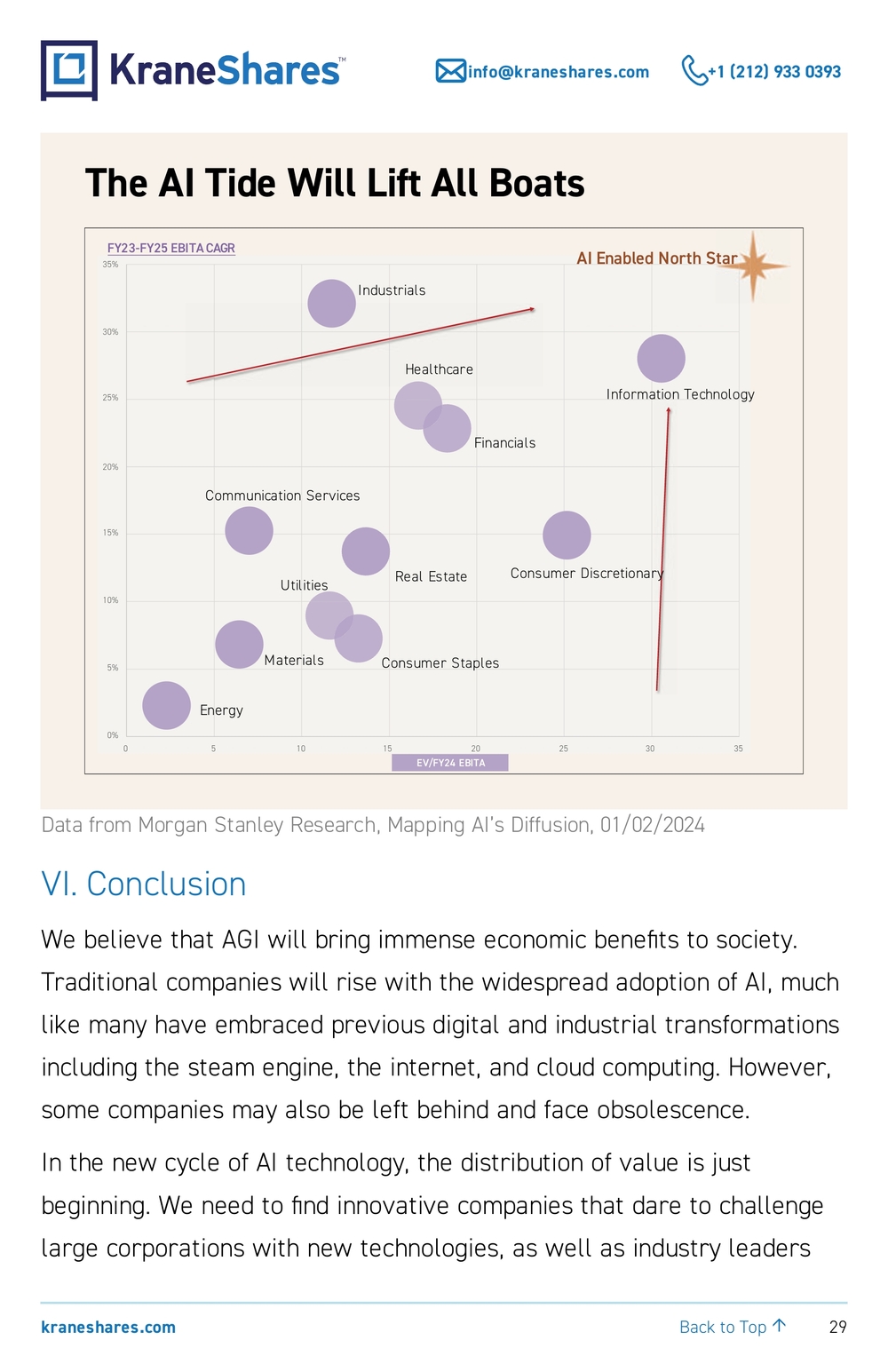
Data and viewpoints from Etna Research as of 7/31/2024. In the future, when AI becomes a general-purpose technology, we believe it will gradually penetrate various vertical industries. In sectors that are not traditionally associated with software and technology, such as agriculture, retail, and manufacturing, AI will enhance revenue growth rates. This may lead to recognition from capital markets, resulting in adjustments to valuation multiples.
29 kraneshares.com info@kraneshares.com +1 (212) 933 0393 Back to Top ↑FY23-FY2 5EBITA CAGR 0%5%10%15%20%25%30%35% 05 10 15 20 25 30 35Energy EV/FY24E BITAIndustrials Information Technolog y Consumer DiscretionaryFinancial sHealthcare Communicatio nService s Real Estate Material s Consumer Staple sAIEnable dNorth Star Utilitie s The AI Tide Will Lift All Boats
Data from Morgan Stanley Research, Mapping AI’s Diffusion, 01/02/2024 VI. Conclusion We believe that AGI will bring immense economic benefits to society. Traditional companies will rise with the widespread adoption of AI, much like many have embraced previous digital and industrial transformations including the steam engine, the internet, and cloud computing. However, some companies may also be left behind and face obsolescence. In the new cycle of AI technology, the distribution of value is just beginning. We need to find innovative companies that dare to challenge large corporations with new technologies, as well as industry leaders
30 kraneshares.com info@kraneshares.com +1 (212) 933 0393 Back to Top ↑who can maintain their value over the long term. AGIX’s index seeks to identify these companies and adjust its portfolio alongside the industry as it migrates from hardware to infrastructure to application. We believe AGIX could become the benchmark for the AI industry, much like the Dow Jones Industrial Average became the benchmark for the mature US industrial sector and the Nasdaq 100 index became the benchmark for the US technology sector. For AGIX standard performance, top 10 holdings, risks, and other fund information, please visit www.kraneshares.com/agix . Citations
- Data from Bloomberg as of 12/31/2023.
- Data from Sequoia as of 6/30/2024.
- Trueman, Charlotte. “xAI’s Memphis Supercluster has gone live with up to 100,000 Nvidia H100 GPUs,” Data Center Dynamics. July 23, 2024.
- Data from Scale.AI as of 3/31/2024.
- Data from Andreesen Horowitz as of 6/30/2024.
- Data from Elastic as of 3/31/2024.
- Stanley, Edward. “Thematics: Mapping AI’s Diffusion,” Morgan Stanley Research. January 2, 2024.
- Data from Etna Research as of 6/30/2024.
- Data from Statista as of 12/31/2023.