2026_spring_internet_report (1)
by Kraneshares
info@kraneshares.com +1 (212) 933 0393Spring 2026 China Internet Quarterly Earnings ReportCan Chip Design Help Baidu & Alibaba Unlock Shareholder Value?

2 kraneshares.com info@kraneshares.com +1 (212) 933 0393 Back to Top ↑Introducing The KraneShares China/Emerging Markets Internet & Consumer Technology ETF Suite Option Income KLIP KWEB Covered Calls providing monthly distributions*Growth KWEB China Internet & Consumer TechnologyKEMQ Broad Emerging Markets Internet & Consumer Technology KPRO and KBUF have characteristics unlike many other traditional investment products and may not be suitable for all investors. For more information regarding whether an investment in the Funds is right for you, please read the Funds’ prospectuses, including “Investor Suitability Considerations.” *Past performance does not guarantee future results. The performance data quoted represents past performance and current returns may be higher or lower.BufferKPRO 100% KWEB Defined Outcome January 2027KBUF 90% KWEB Defined Outcome January 2027
3 kraneshares.com info@kraneshares.com +1 (212) 933 0393 Back to Top ↑Table of Contents China Internet Recent Highlights 4 KWEB Performance 5 KWEB Top 10 Holdings Financials Summary 6 KWEB Key Metrics 7 Subsector Analysis 9 Theme Highlight – Can Chip Design Help Baidu & Alibaba Unlock Shareholder Value?14 Top 10 KWEB Holdings: Quarterly Earnings Update 21 Tencent 21 Alibaba 22 PDD Holdings 23 Meituan 24 NetEase 25 Baidu 26 Trip.com 27 JD.com 29 KE Holdings 30 JD Health 30 Citations 32 Definitions 32 Disclosures 33
4 kraneshares.com info@kraneshares.com +1 (212) 933 0393 Back to Top ↑China Internet Recent Highlights •China recorded the greatest monthly increase in its consumer price index (CPI) in two years in February⁴ after struggling with deflationary pressure that has weighed on consumption. •China’s National Bureau of Statistics (NBS) released its annual economic data update for 2025: •China's total retail sales increased 3.7% in 2025, while online retail sales increased 8.6%.⁴ •Rural disposable income increased 6% in 2025 compared to less than 5% for urban households.5 This, combined with lower E-Commerce penetration, could make rural households the new driver of online spending growth. •KWEB’s holdings only trade at 16 times earnings per share, on average, compared to 28 times earnings per share for US internet companies.3 •In its second quarter earnings, Alibaba said its chipmaking unit T-Head is projected to generate approximately RMB 10 billion in revenue annually, which is more than Cambricon, a leading China- based fabless chipmaker. •Baidu has filed for a Hong Kong listing of its fabless chipmaking unit Kunlunxin, and there has been recent speculation that Alibaba may spin off its chipmaker, T-Head, as well. In this edition’s theme highlight, we explore whether and how these moves could help these two internet giants unlock greater value for their shareholders.
5 kraneshares.com info@kraneshares.com +1 (212) 933 0393 Back to Top ↑KraneShares CSI China Internet ETF (Ticker: KWEB) Performance Cumulative % Data as of: 03/31/2026 Fund NAV Closing Price Index 1 Month -11.00 % -8.47% -11.01% 3 Month -18.74% -16.51% -18.72% 6 Month -30.19% -28.24% -30.07% YTD -18.74% -16.51% -18.72% Since Inception 42.91% 45.89% 44.10% Avg Annualized % Data as of quarter end: 03/31/2026 Fund NAV Closing Price Index 1 Year -15.27% -13.65% -15.65% 3 Year -0.21% 0.55% -0.59% 5 Year -15.07% -14.89% -15.12% 10 Year -0.13% 0.04% -0.10% Since Inception 2.86% 3.02% 2.92% KWEB’s gross expense ratio is 0.70%. Inception Date: 7/31/2013. KWEB Index is the CSI Overseas China Internet Index. The performance data quoted represents past performance. Past performance does not guarantee future results. The investment return and principal value of an investment will fluctuate so that an investor’s shares, when sold or redeemed, may be worth more or less than their original cost, and current performance may be lower or higher than the performance quoted. For performance data current to the most recent month end, please call +(1) 855 8KRANE8 or visit our website at www. kraneshares.com/kweb .
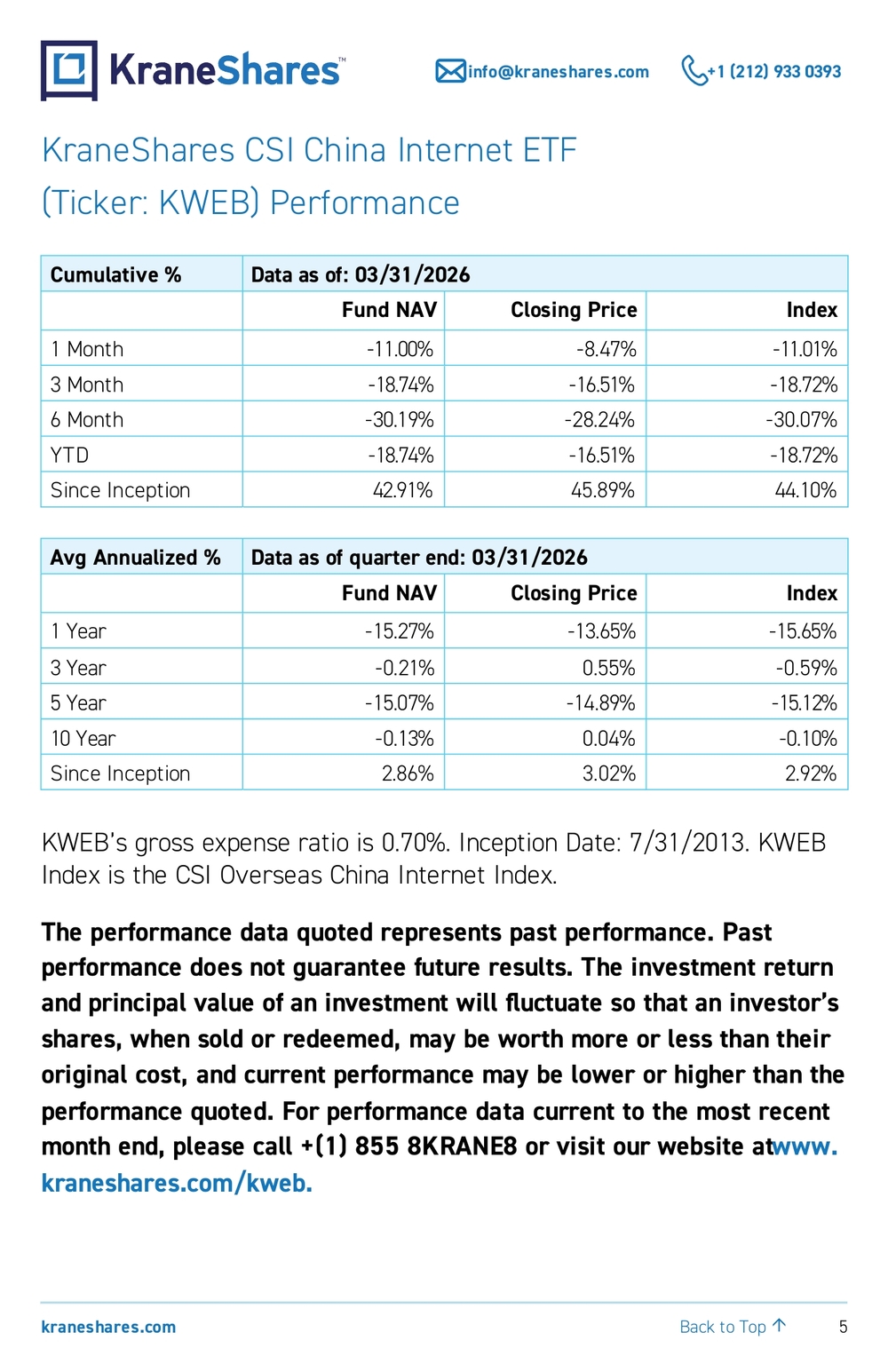
6 kraneshares.com info@kraneshares.com +1 (212) 933 0393 Back to Top ↑KWEB Top 10 Holdings Financials Summary Top 10 KWEB HoldingsKWEB Weight (%)Revenue ($ B)Net Income ($ B)Revenue Growth (%)Net Margin (%)Earnings per Share ($) Tencent 10.23 28.3 7.3 13 26% 0.9 Alibaba 8.77 41.2 2.3 2 6% 0.8 PDD Holdings 7.91 17.5 3.5 12 20% 2.3 Meituan 7.5 13 -2.1 4 -16% -0.4 NetEase 6.09 3.9 1 3 26% 0.5 Baidu 4.36 4.6 0.5 -4 11% 1.5 Trip.com 4.24 2.2 0.4 21 18% 0.6 JD.com 3.97 49.7 -0.1 2 0% -0.1 KE Holdings 3.89 3.1 0 -29 0% 0 JD Health 3.87 5.4 0.2 28 4% 0.1 Total Weighted Average Total 60.83 168.9 13 3% 6% 5.3 Data as of 12/31/2025. Please see the end of the report for definitions. Figures are adjusted (non-GAAP) and % changes are year-over-year (YoY) unless otherwise indicated. Holdings are subject to change. Please see the end of the report for definitions and KWEB’s top ten holdings as of the most recent quarter-end. * JD Health figures are year-over-year for the second half of 2025.
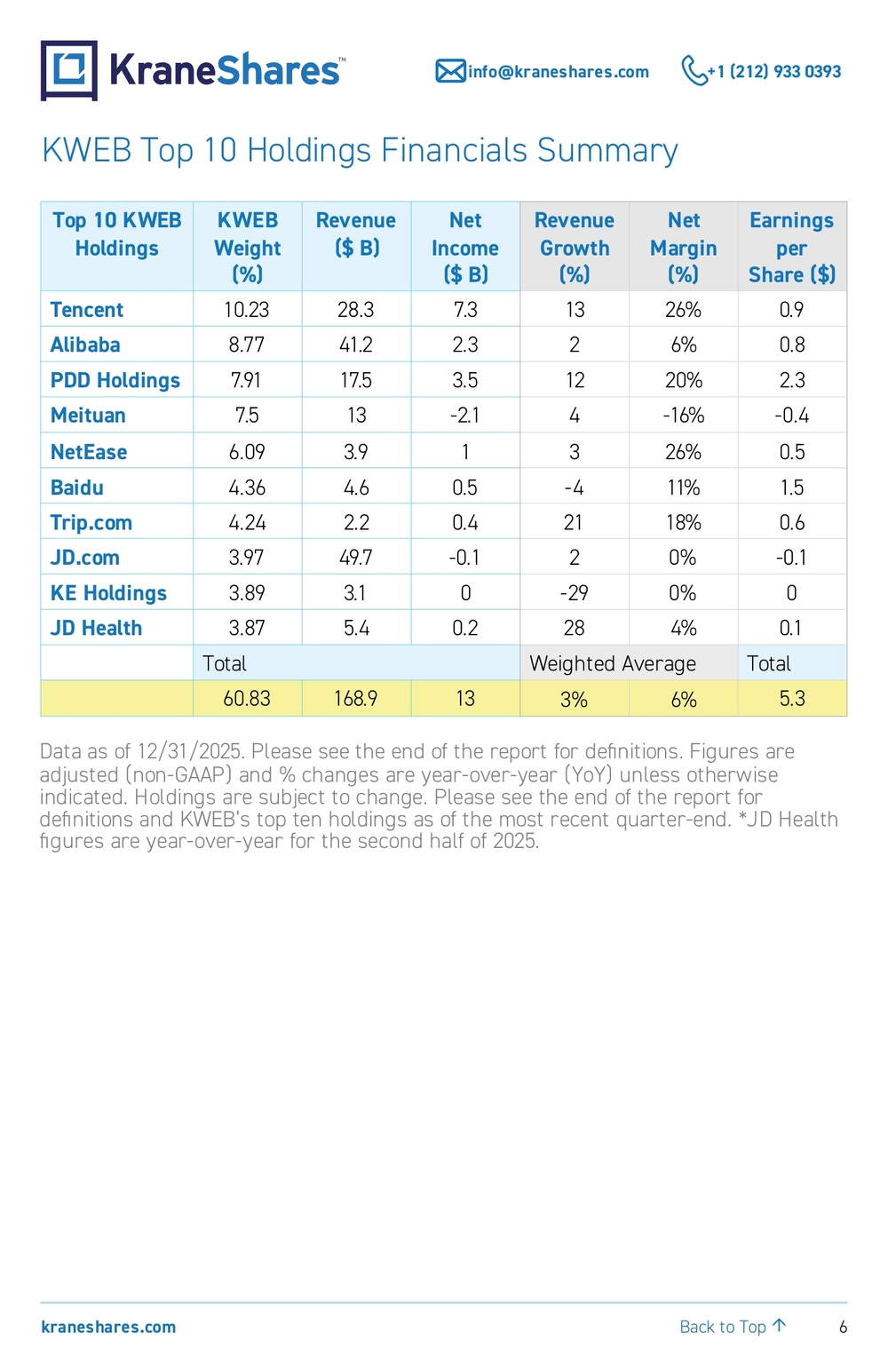
7 kraneshares.com info@kraneshares.com +1 (212) 933 0393 Back to Top ↑KWEB Key Metrics E-Commerce 19% Entertainment 12% Gaming 12% Local Services 8%Travel 8%AI & Cloud 6%Healthcare 6%Logistics 5%FinTech 5%Real Estate 4%Recruitment 4%Education 3%Social Media 2%Live Streaming 2%Traditional Search 2% Autos 1%KWEB Subsector Revenue Breakdown Data from KraneShares as of 12/31/2025. Based on estimated revenue sources for KWEB holdings.
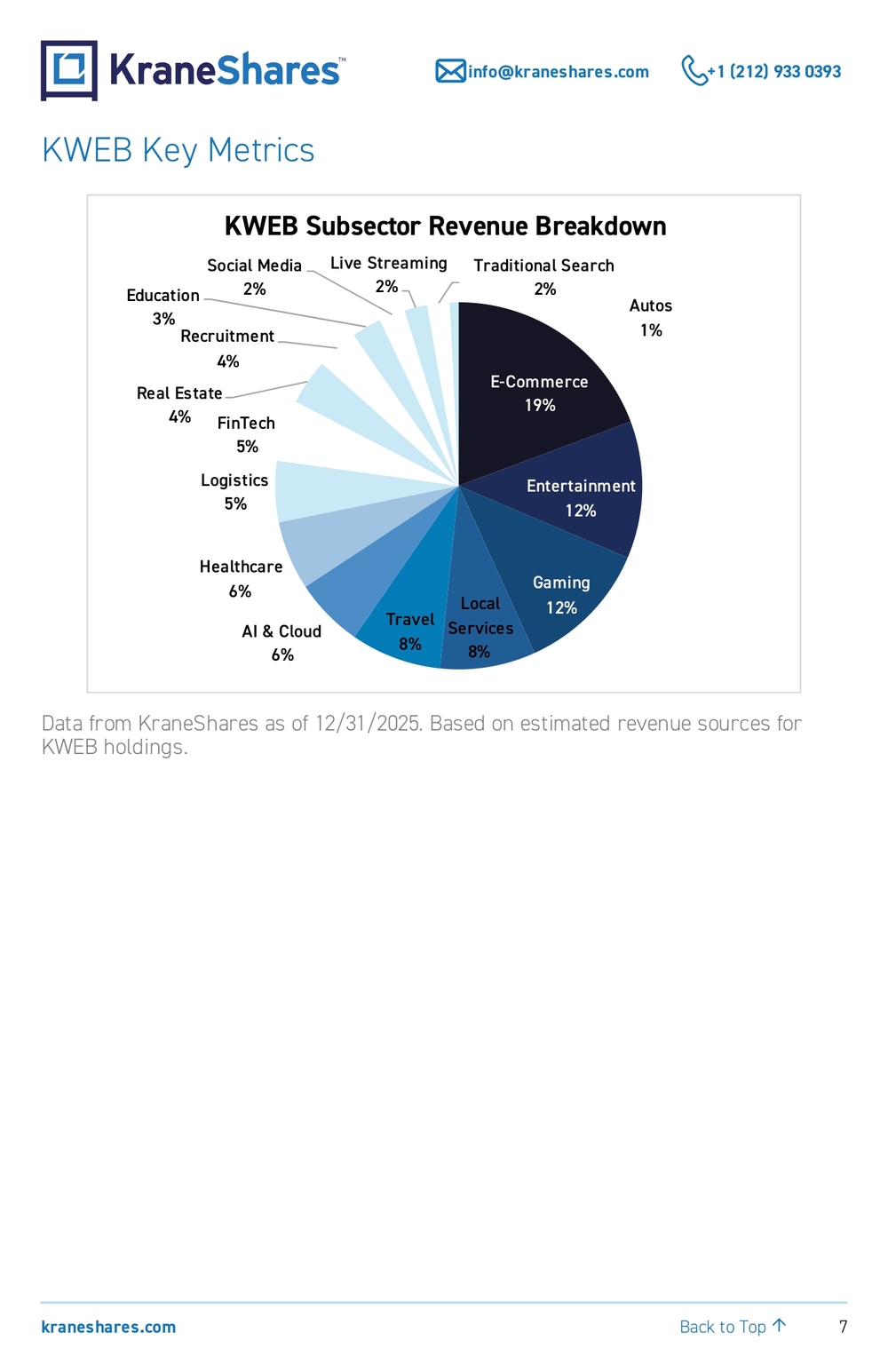
8 kraneshares.com info@kraneshares.com +1 (212) 933 0393 Back to Top ↑14192429343944 31-JAN-2023 31-MAR-2023 31-MAY-2023 31-JUL-2023 29-SEP-2023 30-NOV-2023 31-JAN-2024 29-MAR-2024 31-MAY-2024 31-JUL-2024 30-SEP-2024 29-NOV-2024 31-JAN-2025 31-MAR-2025 31-MAY-2025 31-JUL-2025 30-SEP-2025 30-NOV-2025 31-JAN-2026 10-MAR-2026Price to Earnings (P/E) China Internet US Internet Data from FactSet as of 3/10/2026. China Internet is represented by the holdings of KWEB. US Internet is represented by the Dow Jones US Internet Index. Please see the end of the report for definitions. -40-20020406080100 Local Services Education AI & Cloud Healthcare Recruitment Entertainment Logistics Social Media Travel GamingFintech Live Streaming E-Commerce Traditional Search Autos Real EstateAverage % ChangeSubsector Revenue Growth Data from Bloomberg and KraneShares as of 12/31/2025. For NetEase Music, Ali Health, XD, and Zhong An Insurance, Ping An Health, China Literature, and East Buy, semi-annual results for the second half of 2025 are used. Q4 2025 year-over-year actual results are used for all others. Baidu’s local services revenue growth is estimated using KraneShares’ model. Some subsector revenue are estimates where the company does not break out the segment in their earnings.
9 kraneshares.com info@kraneshares.com +1 (212) 933 0393 Back to Top ↑-40-30-20-10010203040 Live Streaming Traditional Search Healthcare Gaming Entertainment AI & Cloud Social Media E-Commerce Local Services Fintech Travel Education Logistics Recruitment Real EstateAutosAverage % ChangeSubsector Performance (12-Month) Data from Bloomberg and KraneShares as of 3/11/2026. Subsector Analysis Sources: Bloomberg, The Benchmark Company, company releases & filings, and KraneShares. Changes are year-over-year (YoY) for the fourth quarter of 2025, unless otherwise indicated. Revenue figures are adjusted (non-GAAP). Local Services revenues for KWEB companies increased 78% in the fourth quarter. Strong consumer subsidy spending from JD, Meituan, and Alibaba ensured consistent user retention and steady volume increases, while weighing on profitability. JD, in particular, tripled revenue from JD Now, a specialized service offering delivery of various consumer goods within 30 minutes to urban consumers. However, growth could slow as the platforms have agreed to reduce spending on promotions and prioritize profitability. Education technology and private tutoring platform TAL Education increased revenue by 27%. TAL reported strong growth in both its online and offline tutoring programs, as well as a successful Singles’
10 kraneshares.com info@kraneshares.com +1 (212) 933 0393 Back to Top ↑Day promotion season for its learning devices. TAL also unveiled a new learning device for children ages six to eleven, called the “AI Buddy”, at the 2026 Consumer Electronics Show (CES) in Las Vegas, where it received a “CES Picks” award. AI & Cloud revenues increased 25%. Tencent made WeChat and QQ compatible with the popular international agentic AI platform Open Claw. Meanwhile, Alibaba released the latest version of its Qwen large language model (LLM), projected cloud revenues doubling every year over the next five years, and said its chipmaking unit T-Head is on track to reach RMB 10 billion in annual revenue, close to the annual revenue of Cambricon, a leading China-based fabless chipmaker. OpenAI announced it would be closing its Sora video creation platform, effectively ceding the space to Kuaishou’s Kling AI globally. Kling AI had already achieved monthly active users (MAUs) of nearly 12 million, while Sora had only reached 2 to 4 million MAUs. Healthcare platforms JD Health and Ali Health reported results for the second half of 2025, with revenue increasing 18%, on average. Ali Health beat estimates on revenue and net income for the full year of 2025. Both platforms benefited from a shift in distribution strategy by many pharmaceutical companies, from hospital procurement to direct online sales. This shift has been partly driven by regulatory reforms and anti- graft initiatives in recent years. Recruitment platform Kanzhun, which operates the popular “BOSS Zhipin” job search app, increased revenue 14% in the fourth quarter. Management noted strong demand for employment driven by Lunar
11 kraneshares.com info@kraneshares.com +1 (212) 933 0393 Back to Top ↑New Year holiday consumption trends. Meanwhile, blue-collar jobs outperformed placements for white-collar roles. Entertainment revenues increased 13%. Bilibili and Tencent Music both benefited from improved monetization for their premium subscribers. Logistics revenues increased 11%. JD Logistics, a logistics spinoff from JD.com, increased revenue by 22%, likely benefiting from increased usage on the parent platform for instant commerce. Platform Full Truck Alliance, sometimes referred to as the “Uber of trucking”, increased revenue and profitability in the fourth quarter through efforts to overhaul its model to favor commission-based orders, rather than wholesale future capacity sales. The company also reported a 12% increase in completed orders. Social Media revenues increased 10% on average, led by Tencent’s WeChat, which benefited from a pickup in advertising spending driven by new AI tools. Meanwhile, despite seeing more tepid growth than WeChat, Weibo noted strong growth in the E-Commerce and auto segments of its social media advertising sales and expects this momentum to continue throughout 2026. Travel revenues increased 9%. High demand for domestic travel among China’s consumers, especially for experience-based bookings, led to decent growth for travel booking platforms. Trip.com saw strong growth in both its overseas business and domestic China travel. Gaming revenues increased 6%. However, key game makers within KWEB delivered highly variable results. Tencent, the growth leader for
12 kraneshares.com info@kraneshares.com +1 (212) 933 0393 Back to Top ↑the quarter, saw international games growth outpace domestic games growth by a significant margin, on the back of popular international titles like PUBG. Meanwhile, NetEase’s revenue was lower than expected in the fourth quarter as demand for legacy titles was subdued. Finally, XD turned profitable thanks to improving economics for its game-sharing platform, known as TapTap, in China. E-Commerce revenues increased a modest 4%, challenged by a high base in the final quarter of 2025. Trade-in subsidy usage has declined since then, as many households have already taken advantage of the program by upgrading home appliances and other large items. Meanwhile, core domestic commerce growth was sluggish for both JD.com and Alibaba, though PDD Holdings experienced strong growth in both domestic and international commerce thanks to an advertising push and expansion into lower-tier cities and rural areas. FinTech revenues also increased 4%, led by insurance platform Zhong An, which benefited from growth in new categories such as pet and drone insurance. Meanwhile, growth was challenged for consumer lending platforms like Qfin, which faced regulatory caps on interest rates and new loan origination rules that tightened liquidity. Meanwhile, Tencent’s WeChat Pay continued to experience strong growth. Live Streaming revenues increased 4%. East Buy rebounded from the loss of some celebrity key opinion leaders (KOLs) in 2024. Meanwhile, Kuaishou experienced a slight decrease in its live streaming revenue, but reported upgrades to its live streaming platform such as the introduction
13 kraneshares.com info@kraneshares.com +1 (212) 933 0393 Back to Top ↑of multi-host live streaming events as well as the integration of live streamed products into AI suggestion models. Traditional Search revenue for Baidu has hit record lows, down 15%, as AI-powered search continues to take market share. This led the company’s CEO to effectively declare that AI has become the “new core” of Baidu during the company’s earnings call. Auto platform Autohome reported an -18% decrease in revenue, driven by lower advertising spending from internal combustion engine (ICE) automakers. Meanwhile, the platform faced strong competition from short-video platforms for advertising spending from electric vehicle (EV) brands. Lead generation and customer support services for dealers were more resilient but did not offset declines in the company’s core businesses. Real Estate platform KE Holdings reported a 29% decline in revenue, which its management attributed to a high base effect for the new home transactions in the final quarter of 2025. Overall, price recovery in China’s residential real estate market remains gradual.
14 kraneshares.com info@kraneshares.com +1 (212) 933 0393 Back to Top ↑Theme Highlight – Can Chip Design Help Baidu & Alibaba Unlock Shareholder Value? In the age of AI, hardware is crucial. Large language models (LLMs) and other AI systems demand extreme amounts of computing power. Seemingly, the only limitation to their development is the quantity and quality of the chips that they can access. The valuations of the world’s largest chip designers and manufacturers are a testament to the importance of chips to AI development. Taiwan Semiconductor Manufacturing (TSMC) is a key manufacturer, or fabricator, of the high-end microchips that AI systems run on, and has seen its share price increase 429% since Chat GPT launched in November. Meanwhile, Nvidia, a key chip designer, also known as a fabless chipmaker, has seen its share price rise 1,270% since ChatGPT was launched.
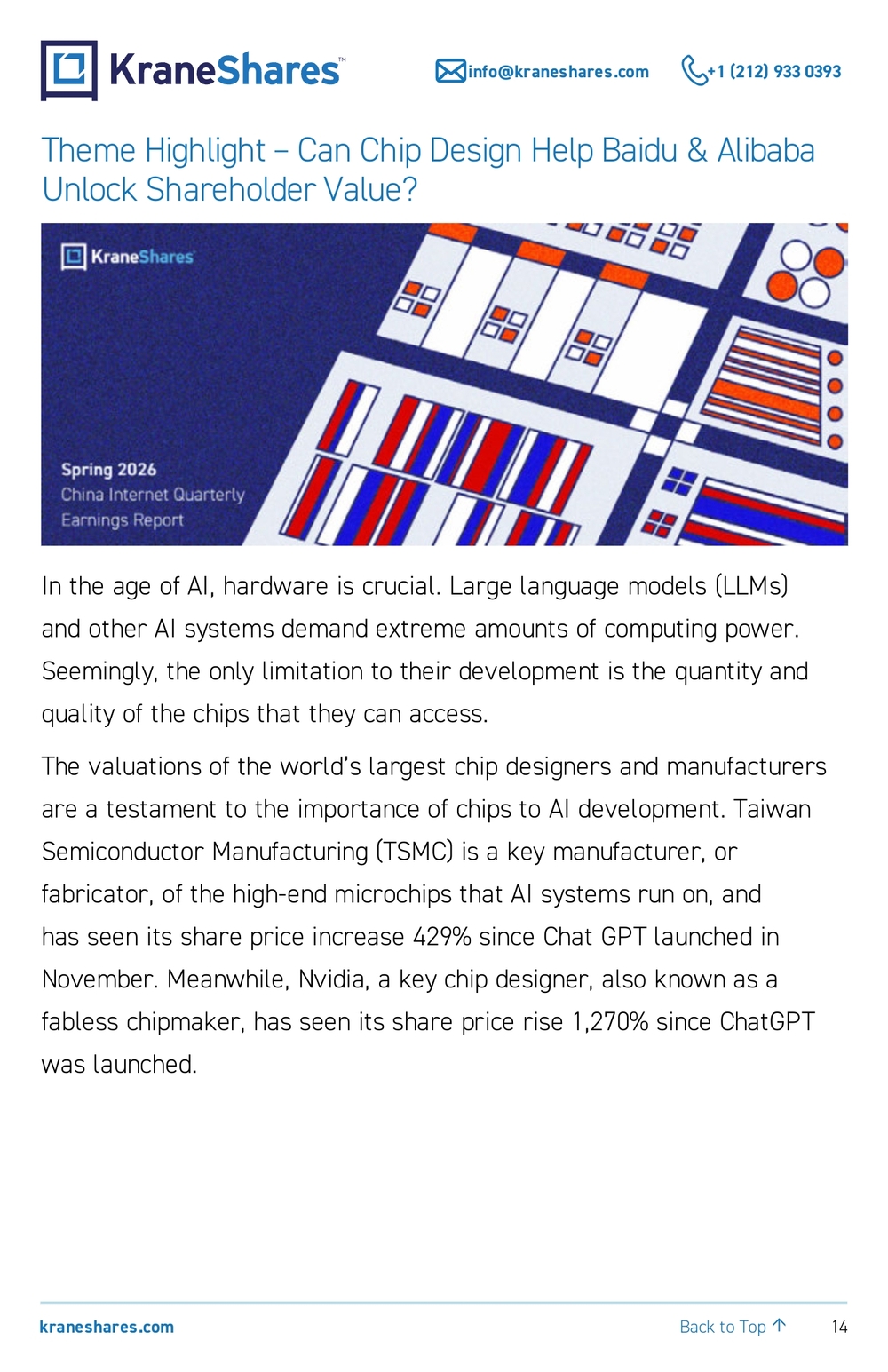
15 kraneshares.com info@kraneshares.com +1 (212) 933 0393 Back to Top ↑020,00040,00060,00080,000100,000120,000140,000160,000 10/1/2022 1/1/2023 4/1/2023 7/1/2023 10/1/2023 1/1/2024 4/1/2024 7/1/2024 10/1/2024 1/1/2025 4/1/2025 7/1/2025 10/1/2025 1/1/2026Growth of 10,000 unitsTSMC & Nvidia Performance Since 10/31/2022 TSMC Nvidia Data from Bloomberg as of 2/28/2026. Past performance does not guarantee future results. Facing an uncertain supply of high-end chips due to US export restrictions under the Biden administration, Alibaba and Baidu invested heavily in their own chip design capabilities. Today, these ventures have the potential to help them unlock significant shareholder value. A simple Sum of The Parts (SOTP) analysis of Baidu and Alibaba, including their respective chip design arms, Kunlunxin and T-Head, suggests markets may not be valuing these internet giants properly. Although chip design accounts for a small portion of revenue for both companies, if these businesses could command the same valuation multiples as global peers like Nvidia or China-based fabless peers like Cambricon, both businesses would be worth significantly more.
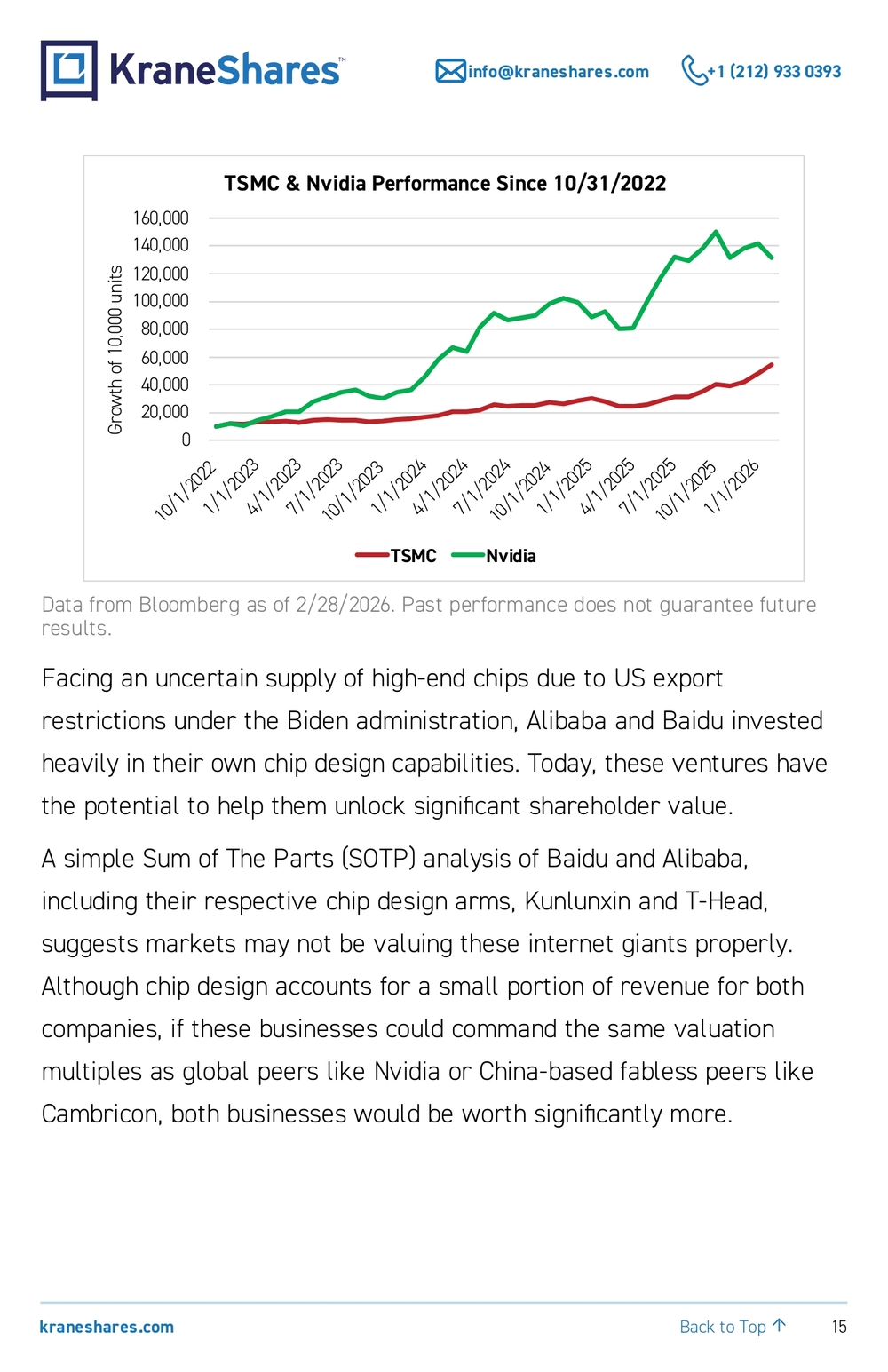
16 kraneshares.com info@kraneshares.com +1 (212) 933 0393 Back to Top ↑Sum of The Parts (SOTP) Analysis of Baidu & Alibaba Baidu and Alibaba represent full-stack AI ecosystems, generating value across models, cloud, and now semiconductors. These capabilities were added on top of existing businesses in advertising and E-Commerce for Baidu and Alibaba, respectively, making these companies conglomerates. Baidu’s new technological edge is also added on top of a relatively mature robotaxi business: Apollo Go. Starting with Baidu, we conducted a sum of the parts analysis to find the implied market valuation of its businesses, derived from Baidu's overall market capitalization and assumptions about these businesses' contribution to overall revenue. Baidu's chip design unit Kunlunxin and its robotaxi unit Apollo Go appear undervalued compared to the valuations the markets are currently applying to comparable businesses Cambricon and Waymo, for chip design and robotaxis, respectively. 020406080100120 Total Market CapA pollo Go Market ValueK unlunxin Market ValueW aymo ValuationC ambricon Market Cap$ BillionsBaidu - Valuation Comparison Baidu Comparable s Data and estimates from KraneShares, Bloomberg, and company reports as of 3/24/2026. Companies may never reach valuation implied by SOTP Analysis.
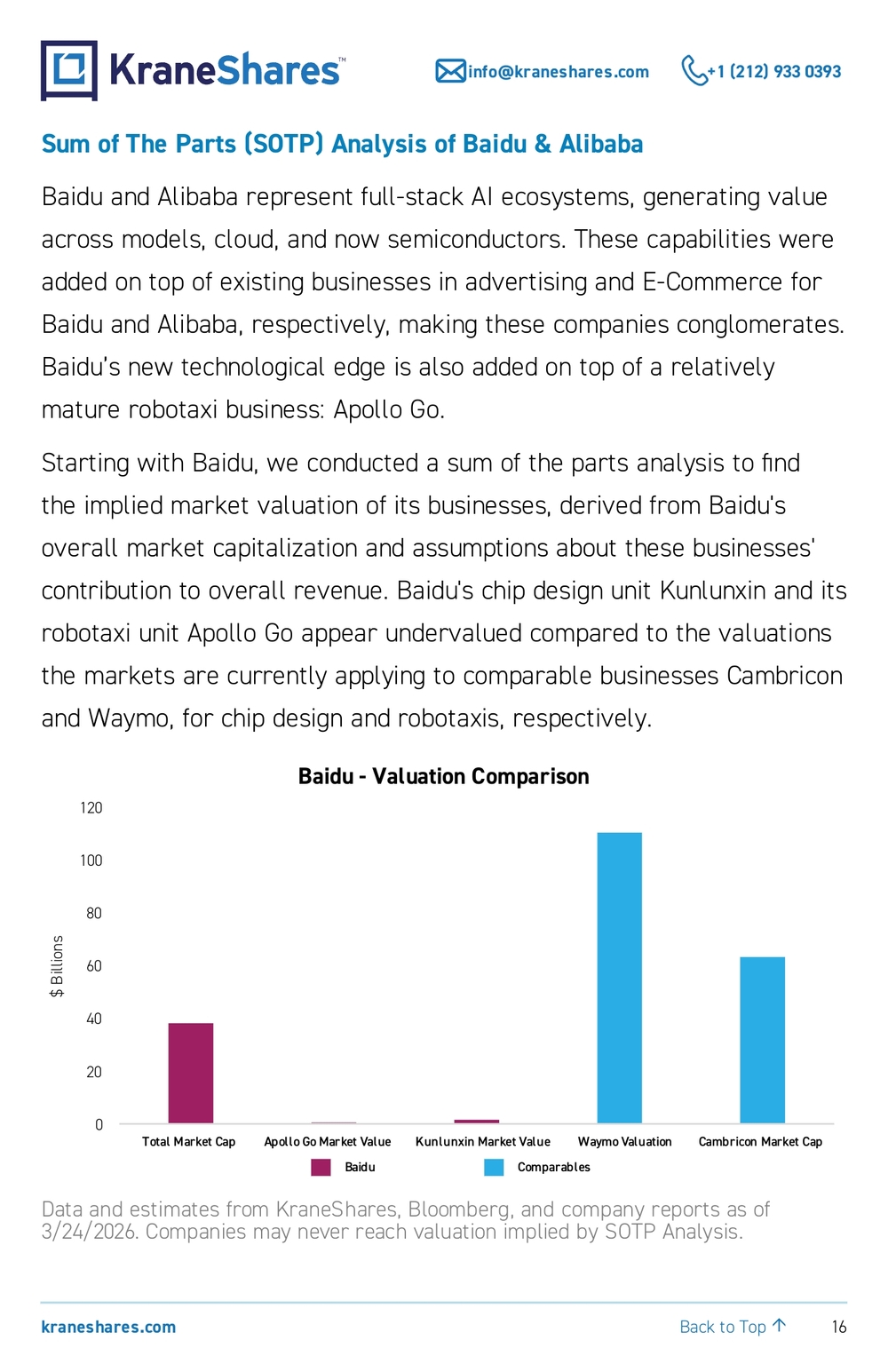
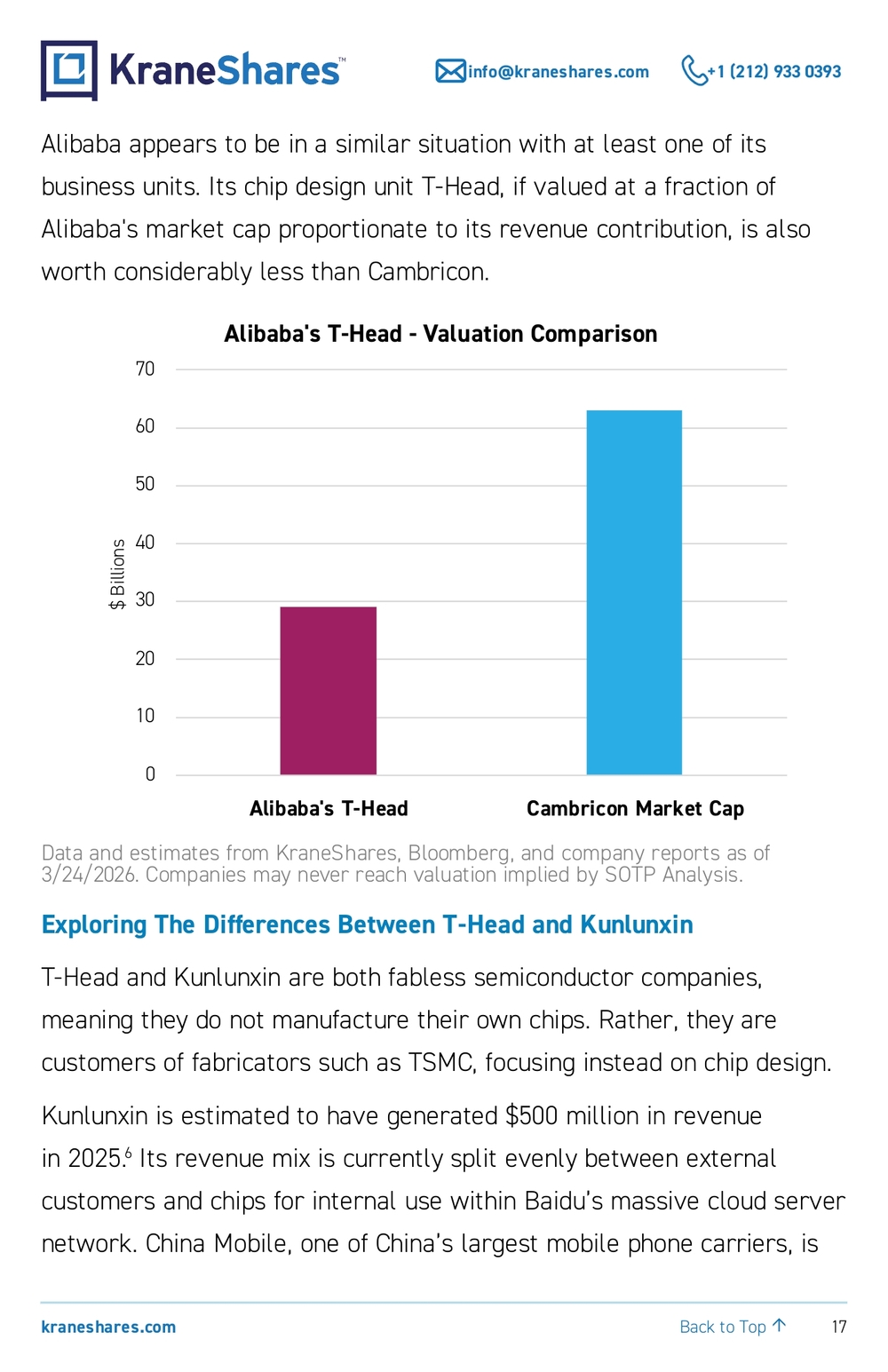
17 kraneshares.com info@kraneshares.com +1 (212) 933 0393 Back to Top ↑Alibaba appears to be in a similar situation with at least one of its business units. Its chip design unit T-Head, if valued at a fraction of Alibaba's market cap proportionate to its revenue contribution, is also worth considerably less than Cambricon. 010203040506070 Alibaba's T-Head Cambricon Market Cap$ BillionsAlibaba's T-Head - Valuation Comparison Data and estimates from KraneShares, Bloomberg, and company reports as of 3/24/2026. Companies may never reach valuation implied by SOTP Analysis. Exploring The Differences Between T-Head and Kunlunxin T-Head and Kunlunxin are both fabless semiconductor companies, meaning they do not manufacture their own chips. Rather, they are customers of fabricators such as TSMC, focusing instead on chip design. Kunlunxin is estimated to have generated $500 million in revenue in 2025.6 Its revenue mix is currently split evenly between external customers and chips for internal use within Baidu’s massive cloud server network. China Mobile, one of China’s largest mobile phone carriers, is
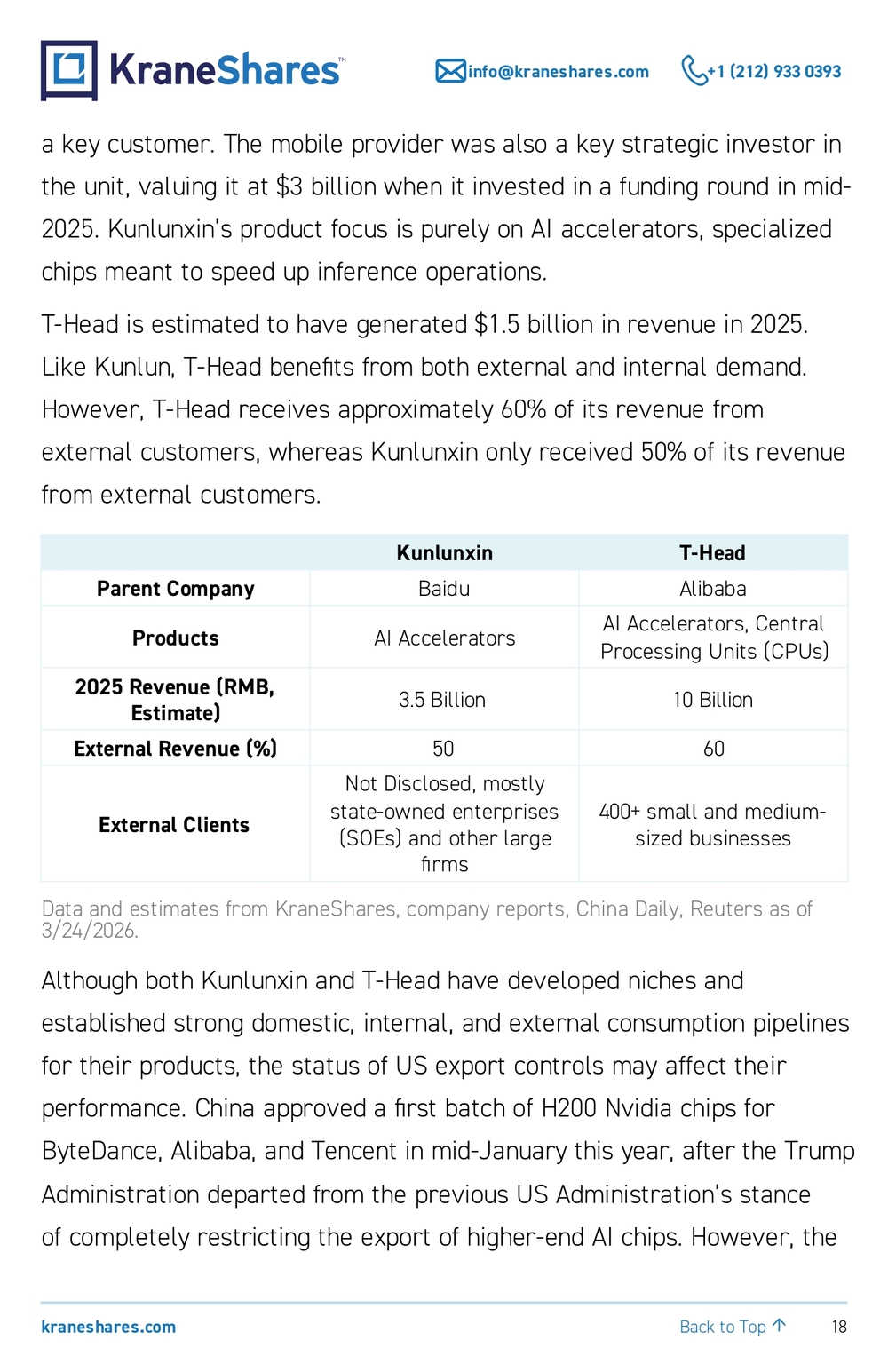
18 kraneshares.com info@kraneshares.com +1 (212) 933 0393 Back to Top ↑a key customer. The mobile provider was also a key strategic investor in the unit, valuing it at $3 billion when it invested in a funding round in mid- 2025. Kunlunxin’s product focus is purely on AI accelerators, specialized chips meant to speed up inference operations. T-Head is estimated to have generated $1.5 billion in revenue in 2025. Like Kunlun, T-Head benefits from both external and internal demand. However, T-Head receives approximately 60% of its revenue from external customers, whereas Kunlunxin only received 50% of its revenue from external customers. Kunlunxin T-Head Parent Company Baidu Alibaba Products AI AcceleratorsAI Accelerators, Central Processing Units (CPUs) 2025 Revenue (RMB, Estimate)3.5 Billion 10 Billion External Revenue (%) 50 60 External ClientsNot Disclosed, mostly state-owned enterprises (SOEs) and other large firms400+ small and medium- sized businesses Data and estimates from KraneShares, company reports, China Daily, Reuters as of 3/24/2026. Although both Kunlunxin and T-Head have developed niches and established strong domestic, internal, and external consumption pipelines for their products, the status of US export controls may affect their performance. China approved a first batch of H200 Nvidia chips for ByteDance, Alibaba, and Tencent in mid-January this year, after the Trump Administration departed from the previous US Administration’s stance of completely restricting the export of higher-end AI chips. However, the
19 kraneshares.com info@kraneshares.com +1 (212) 933 0393 Back to Top ↑extent to which Nvidia chips will be available in China remains uncertain, and Kunlunxin and T-Head could step in to make up for lost demand, when necessary. The continued uncertainty of overseas chip availability to China-based customers remains an opportunity for these players, alongside Cambricon. Potential Spin Off Scenarios Baidu has already filed for a Hong Kong IPO of Kunlunxin. However, Alibaba has not indicated any intended change for T-Head within its corporate structure. Below are three possible spin-off scenarios for Kunlunxin and T-Head. Scenario #1: The parent companies could choose to keep the IPO float low and maintain a large stake, potentially a controlling one, in the business. If the spinoffs are in high demand with investors, this is an ideal strategy, as the companies would benefit most from the potential appreciation of the floated shares. This would be similar to how JD.com maintained a 50% ownership stake in its own logistics business after spinning it off as JD Logistics through a Hong Kong IPO in 2021.7 Scenario #2: The parent companies could float the entirety of their fabless chipmaking units on the Hong Kong Stock Exchange and not keep a meaningful stake. We believe this is unlikely, as the units are relatively small and will find it difficult to attract sufficient outside investor demand to lead to the valuations mentioned above on their own. This would lead to a potential one-time windfall for the companies’ shareholders, which could be distributed to investors as a dividend or be reinvested into their businesses. Given Baidu’s currently high cash position, we believe the company would likely decide to distribute the windfall from the IPO as a dividend.
20 kraneshares.com info@kraneshares.com +1 (212) 933 0393 Back to Top ↑Scenario #3: Alibaba could decide not to follow in Baidu’s footsteps and keep its T-head unit wholly owned inside the company. This would limit the increase in its share price, though market sentiment around chip IPOs stemming from Baidu’s spinoff may potentially raise Alibaba’s valuation if its revenue share increases. The company could still decide to pursue an internal restructuring, thereby calling out T-Head as a key component of its business and breaking out its revenue consistently. Alibaba pursued a similar strategy in 2023 by breaking itself into six businesses without any spin-offs. This may have triggered investors to look at the company through the lens of an SOTP analysis. Alibaba’s stock has risen over 80% since that restructuring.² Conclusion Alibaba and Baidu are full-stack AI value generators if you include their chipmaking units in a holistic analysis of their businesses. A sum of the parts of analysis suggests that these units are undervalued relative to comparable businesses. Spinning off their chipmaking units, or at least forcing the market to value them separately, could generate significant shareholder value.
21 kraneshares.com info@kraneshares.com +1 (212) 933 0393 Back to Top ↑KWEB Top 10 Holdings Earnings Update Sources: Bloomberg, CICC Research, The Benchmark Company, company releases & filings, KraneShares. Changes are year-over-year unless otherwise indicated. Revenue figures are adjusted (non-GAAP) Tencent Tencent is a diversi fied consumer technology company with businesses in social media, AI cloud services, payments, and online advertising. Tencent’s most well-known product is WeChat, one of China’s premier social media platforms, with over 1 billion monthly active users (MAUs). Tencent’s Hunyuan chatbot integrates DeepSeek and consistently ranked as one of the most-downloaded apps on Apple’s app store in China in 2025. Tencent By The Numbers (Q4 2025) •Revenue +13% to RMB 194.4B ($28.3B) •Net Income RMB 50.0B ($7.3B) •Net Margin 26% •Earnings per Share RMB 5.9 ($0.9) Tencent’s results for the fourth quarter were mostly in line with estimates, as free cash flow increased sixfold. During the earnings call, management noted the increasing integration of its Hunyuan large language model with super apps WeChat and QQ. The company spent RMB 18 billion on AI initiatives in 2025 and will substantially increase its AI capital commitments in 2026. Cloud services achieved an operating profit of RMB 5 billion after breaking even in 2024, which is impressive. In other business lines, user time spent on social media increased by 20% in 2025, E-Commerce advertising decreased as companies focused on
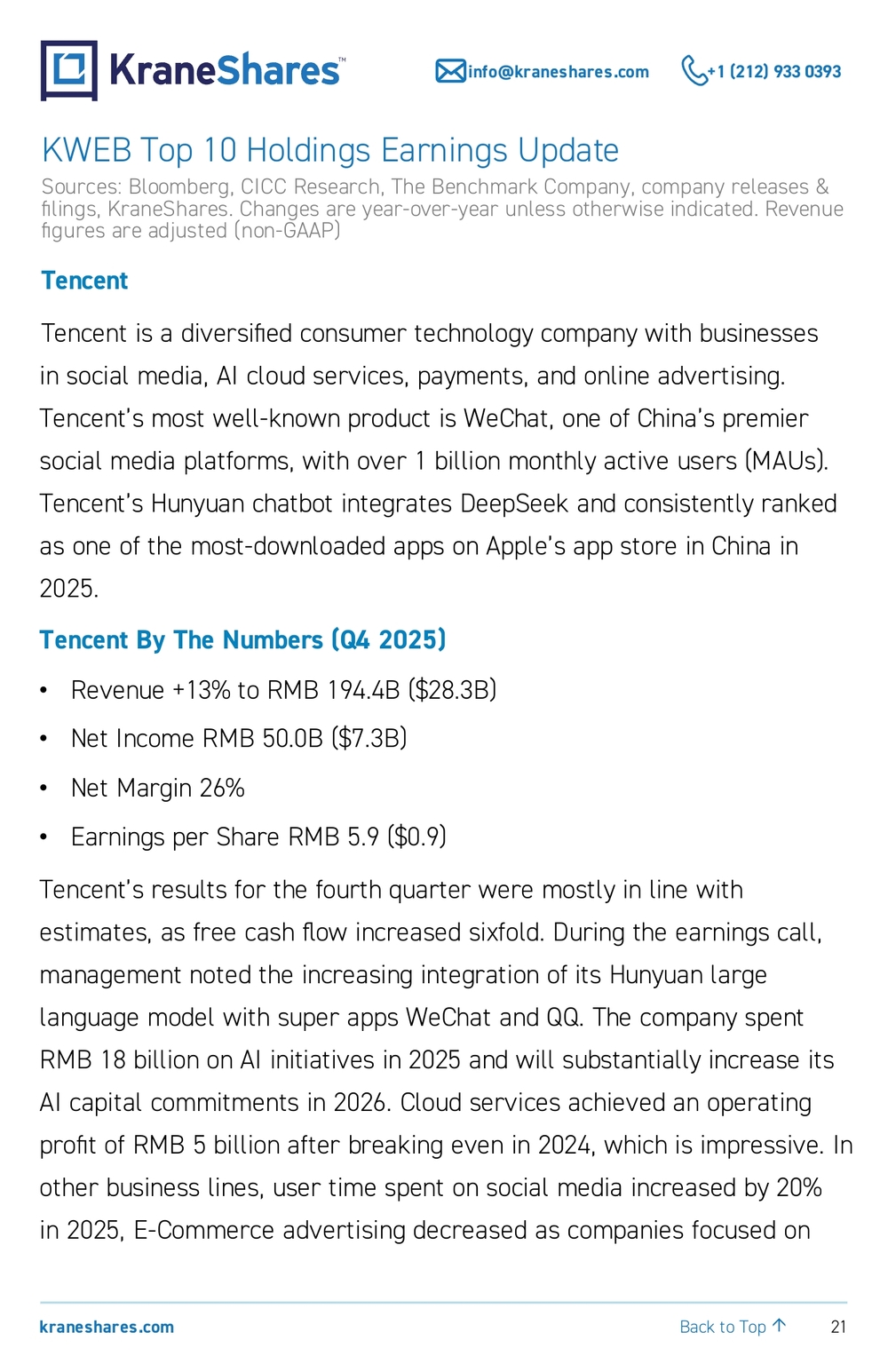
22 kraneshares.com info@kraneshares.com +1 (212) 933 0393 Back to Top ↑user subsidies rather than ads, margins improved in Tencent's marketing services, and international games growth outpaced domestic. Tencent announced a dividend of $0.68 per share for 2025, reflecting the strong free cash flow growth and demonstrating the company's shareholder-friendly orientation. Management stated that they will be slowing the pace of buybacks in favor of dividends. Nonetheless, the company still plans to repurchase approximately $57 billion worth of shares by May. Alibaba Alibaba is a conglomerate primarily engaged in E-Commerce and AI cloud services. The company operates an online marketplace offering a wide variety of consumer goods. The company has also expanded beyond E-Commerce and is now a consortium of six businesses, covering cloud, domestic E-Commerce, global digital commerce, media, logistics, and local services. Alibaba By The Numbers (Q4 2025) •Revenue +2% to RMB 284.4B ($41.2B) •Net Income RMB 15.7B ($2.3B) •Net Margin 6% •Earnings per Share RMB 5.7 ($0.8) Revenue growth was heavily influenced by the divestment from brick- and-mortar retail businesses, Sun Art and In Time, completed in early 2025. Excluding revenue from those businesses in the YoY comparison, the company increased revenue by 6%.
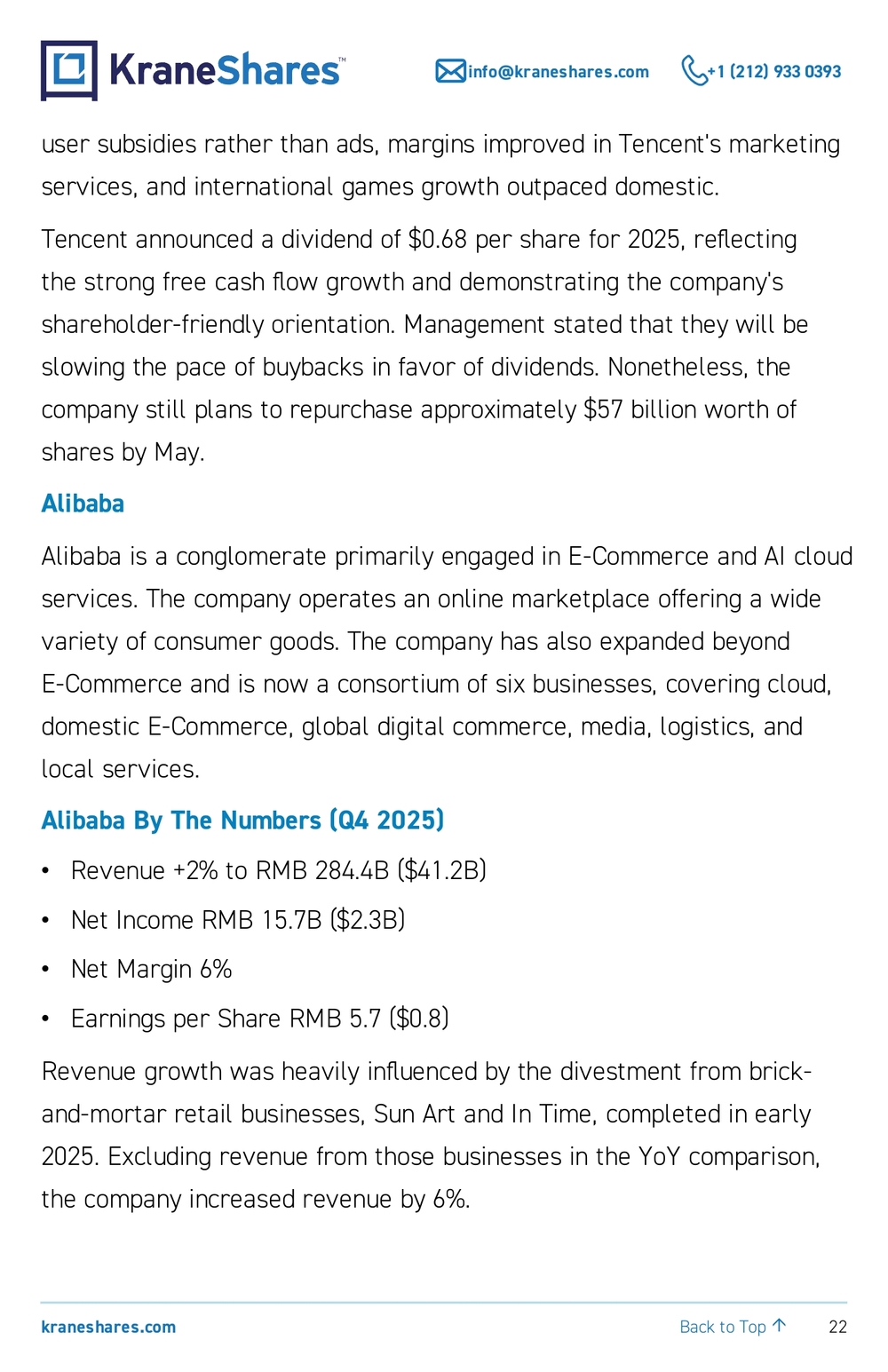
23 kraneshares.com info@kraneshares.com +1 (212) 933 0393 Back to Top ↑Alibaba’s AI-driven cloud revenue increased by 35%, marking the 10th consecutive quarter of double-digit growth and surpassing the 26% growth in the third quarter. The company set a goal of doubling external cloud revenue each year over the next five years. Alibaba launched Qwen 3.5 plus, the latest version of its large language model (LLM), during the Lunar New Year holiday. The Qwen model has achieved an astonishing one billion cumulative downloads since the first version was launched, via Hugging Face. Meanwhile, investments in instant commerce and AI initiatives weighed on profitability during the quarter. However, instant commerce investments could be paying off, as the segment saw improved unit economics during the quarter and 56% growth. Alibaba plans to repurchase $22.6 billion worth of shares through 2027. PDD Holdings PDD is an innovative global E-Commerce platform focused on user experience. It was one of the fi rst to embrace a social media-like model for online shopping. The company’s apps are known for their group-buying capabilities, the integration of gaming into shopping and coupon earning, and rock-bottom prices on private-label goods. PDD is also famous for pioneering the lowering of overhead costs through an on-demand manufacturing model. PDD operates under the name “Pinduoduo” in China and “Temu” in the rest of the world.
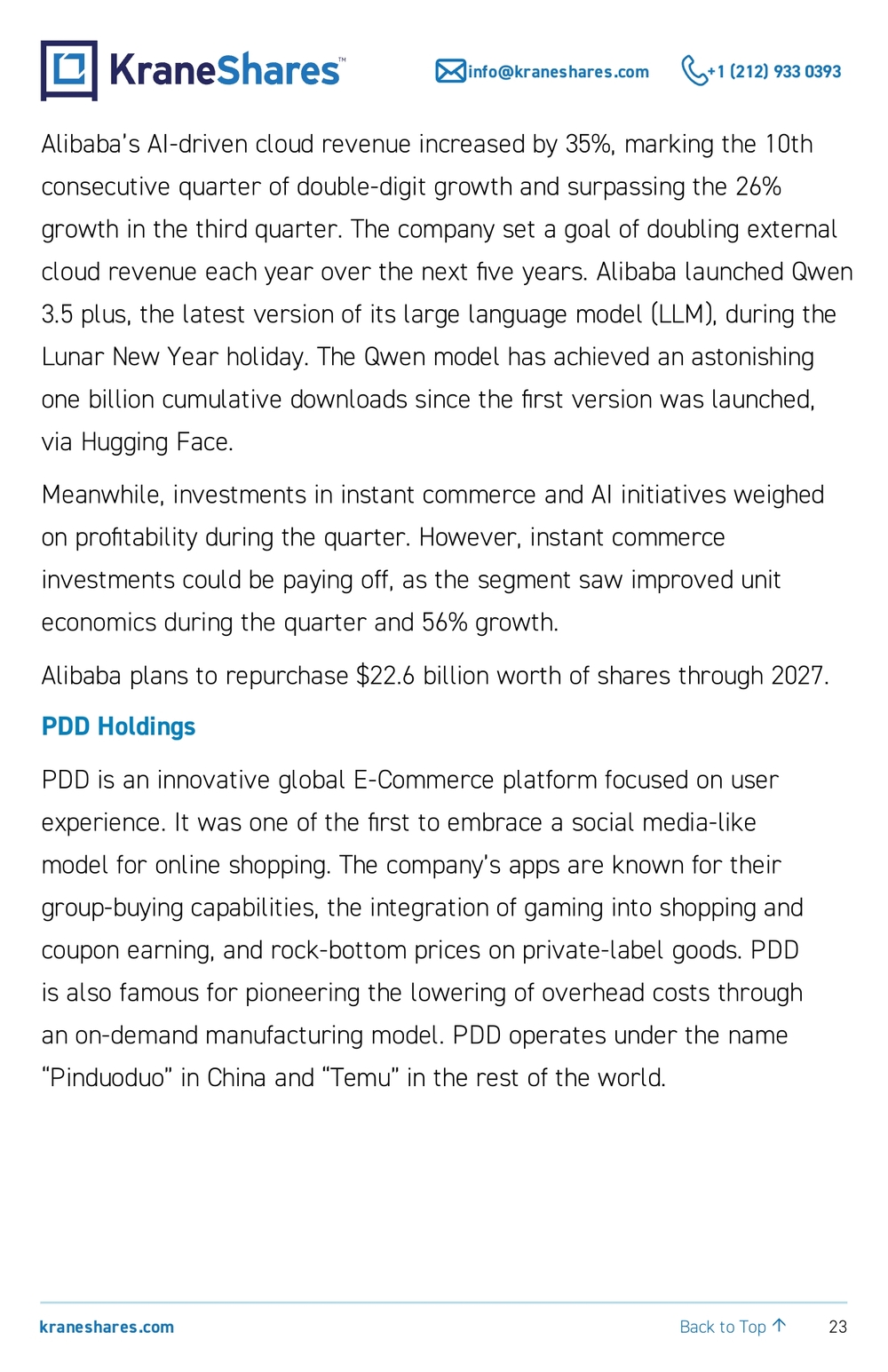
24 kraneshares.com info@kraneshares.com +1 (212) 933 0393 Back to Top ↑PDD By The Numbers (Q4 2025) •Revenue +12% to RMB 120.6B ($17.5B) •Net Income RMB 24.1B ($3.5B) •Net Margin 20% •Earnings per Share RMB 15.8B ($2.3) PDD’s results for the fourth quarter exceeded expectations for revenue, but the company was less profitable than expected, mostly due to the launch of an RMB 100 billion merchant support program and other supply chain investments. Net income declined year-over-year due to these significant capital investments. Management noted strong results from promotional periods throughout 2025, such as Singles’ Day and the Spring Festival. Online marketing and transaction services contributed significantly to the revenue increase for the quarter. Although PDD does not break out geographic revenue in their earnings reports, based on internet traffic data, we believe that international commerce grew faster than China commerce in the fourth quarter, and that Temu could be approaching 40% of overall sales. Meituan Meituan is an E-Commerce company that specializes in food delivery and other local services. The company operates many business lines, including general retail, restaurant booking, and travel booking services, and it serves over 600 million registered users. Meituan is one of China’s leading “super apps” that offer a wide variety of services, including those from third parties.
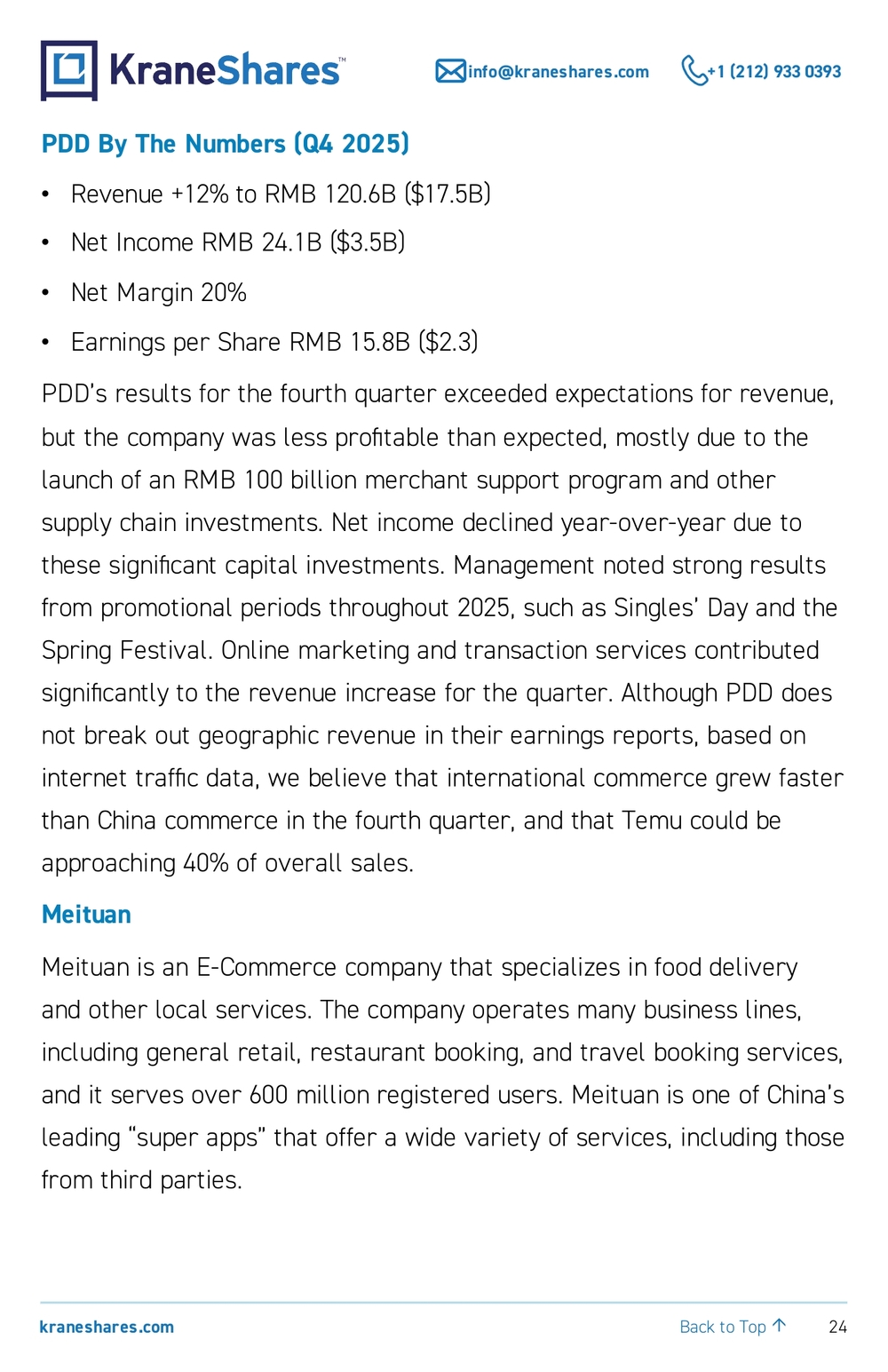
25 kraneshares.com info@kraneshares.com +1 (212) 933 0393 Back to Top ↑Meituan By The Numbers (Q4 2025) •Revenue +4% to RMB 92.1B ($13.0B) •Net Income RMB -15.0B (-$2.1B) •Net Margin -16% •Earnings per Share RMB -2.8 (-$0.4) Meituan missed estimates for both revenue and net income in the fourth quarter as losses deepened due to high levels of consumer subsidies to defend its restaurant delivery business from competition from Alibaba and JD. However, we believe the platform could see a significant reprieve from such intense competition, after being included in an industry group of twelve internet platforms who will seek to reduce pricing pressures on one another. Meituan also made investments into consumer experiences, including the launch of an AI-powered chat function and upgrades to the offerings in its premium membership program. Meanwhile, Meituan has also expanded its product categories to include certain medical products. Meituan intends to repurchase approximately $6 billion worth of its shares through June. NetEase NetEase is a consumer information technology company primarily dealing in online, PC, and mobile games. It is one of the largest gaming companies in the world, and its titles include Knives Out and Naraka: Bladepoint. NetEase By The Numbers (Q4 2025) •Revenue +3% to RMB 26.8B ($3.9B) •Net Income RMB 6.9B ($1.0B)
26 kraneshares.com info@kraneshares.com +1 (212) 933 0393 Back to Top ↑ •Net Margin 26% •Earnings per Share (EPS) RMB 3.4 ($0.5) NetEase missed analyst estimates on its top and bottom lines due to a slowdown in overall game growth, driven by a decline in legacy titles such as Justice Mobile. However, NetEase continues to implement AI enhancements across all its existing titles, and the game maker’s pioneering AI-powered, lifelike non-personal characters (NPCs) should help with user retention over the long term. Meanwhile, promotions during the Lunar New Year holiday may help reverse the slowdown in growth for key titles. Although NetEase slowed the pace of share buybacks in the fourth quarter, the company still intends to repurchase nearly $4 billion in shares by 2029. Baidu Baidu is a technology company with substantial businesses in arti ficial intelligence, search engines, cloud computing, mobility solutions, and more. Baidu operates China’s most popular search engine. Meanwhile, Baidu’s ERNIE AI chatbot has over 100 million users, and its Apollo program operates the world’s largest fl eet of robo-taxis. Baidu By The Numbers (Q4 2025) •Revenue -4% to RMB 31.7B ($4.6B) •Net Income RMB 3.4B ($0.5B) •Net Margin 11% •Earnings per Share RMB 10.3 ($1.5)
27 kraneshares.com info@kraneshares.com +1 (212) 933 0393 Back to Top ↑Baidu’s overall revenue declined YoY, but increased quarter-over- quarter (QoQ). Meanwhile, higher tax expenses weighed on net income. Nonetheless, AI marketing services revenue doubled over the course of 2025. During the earnings call, Founder and CEO Robin Li declared that “AI has become the new core of Baidu”, replacing traditional search. Although revenue from this “new core” now accounts for over 40% of the company’s overall revenue, it could not reverse the overall YoY decline. Baidu's robotaxi service Apollo Go reached 300,000 rides a week, as total cumulative rides reached 3.4 million. Although the company has not yet provided any revenue figures for Apollo Go, investors should be reassured by the recent $110 billion valuation of its peer Waymo, which is more than twice Baidu’s entire market capitalization. The company also made its first-ever dividend payment in 2026, continued its stock buyback, and reiterated plans to spin off its chipmaking unit Kunlunxin in a Hong Kong IPO. Trip.com Trip.com is a travel booking site widely recognized as an international competitor to Expedia. It provides search and complete booking services for fl ights, hotels, trains, car rentals, and more. The company offers international and domestic travel booking services to Chinese and global customers.
28 kraneshares.com info@kraneshares.com +1 (212) 933 0393 Back to Top ↑Trip.com Music By The Numbers (Q4 2025) •Revenue +21% to RMB 15.1B ($2.2B) •Net Income RMB 2.8B ($0.4B) •Net Margin 18% •Earnings per Share RMB 4.1 ($0.6) In January, China’s State Administration for Market Regulation (SAMR) began an antitrust inquiry into Trip.com, which is the country’s largest travel booking platform by revenue. We believe the inquiry is routine, considering Trip.com’s dominant market position. As consumers and merchants appear to only benefit from the platform’s size, we expect the outcome will be limited to a nominal fine and potentially minor adjustments to ensure optionality for merchants. Trip.com continues to grow market share abroad, especially in the Asia- Pacific region, through strong brand recognition driven by strategic advertising and seamless booking experience. We noticed in our travels throughout Asia in 2025 the ubiquity of Trip.com’s logo in major international airports, even adorning some jet bridges. The company stated that they expect continued strong growth in third-country international travel booking, internal tourism in China, as well as inbound tourism in China. Trip.com played a role in the journeys of 20 million travelers in 2025. Trip.com intends to repurchase approximately $5 billion worth of its shares.
29 kraneshares.com info@kraneshares.com +1 (212) 933 0393 Back to Top ↑JD.com JD.com is one of the largest E-Commerce platforms in China. JD owns a large and growing marketplace for a wide variety of goods and offers its own logistics service. JD offers its services to over 500 million users. JD.com By The Numbers (Q4 2025) •Revenue +2% to RMB 342.8B ($49.7B) •Net Income RMB -0.7B (-$0.1B) •Net Margin 0% •Earnings per Share RMB -0.7 (-$0.1) JD’s fourth-quarter earnings showed a net loss but exceeded low analyst expectations on both the top and bottom lines, potentially signifying that the worst of the instant-commerce subsidy competition could be behind us. The revenue comparison with the fourth quarter of 2024 is challenging, as 2024’s platform activity benefited from consumers rushing to take advantage of trade-in subsidies for home appliances and electronics. The company indicated increased investment in its Jingxi budget E-Commerce platform for lower-tier cities, which is immensely positive not only for JD but also for the E-Commerce subsector, as it could signal that overall penetration is expanding once again. JD maintains a strong dividend and share repurchase policy. It will pay a dividend of $1 per American depositary receipt (ADR) on April 9, 2026. It also completed $3 billion in share buybacks in 2025 and has $2 billion remaining in its current program.
30 kraneshares.com info@kraneshares.com +1 (212) 933 0393 Back to Top ↑KE Holdings KE Holdings is China’s leading online housing transaction and services platform. Originally a brick-and-mortar real estate brokerage, “Beike”, as the company is known to consumers, expanded into an integrated online and of fline ecosystem, providing solutions for property sales, rentals, home renovation, and mortgages. KE Holdings By The Numbers (Q4 2025) •Revenue -29% to RMB 21.4B ($3.1B) •Net Income RMB 0 ($0) •Net Margin 0% •Earnings per Share RMB 0 ($0) KE Holdings reported a year-over-year revenue decline, which management attributed to a high base effect in the new homes business from the fourth quarter of 2024. Meanwhile, profitability was constrained during the period by key capital investments in platform efficiency. Meanwhile, KE Holdings continues to diversify its services, with housing transactions now accounting for less than two-thirds of overall revenue, and an increasing share of revenue coming from interior design services and other pre- and post-transaction services, such as data and analytics. KE Holdings intends to repurchase approximately $1.8 billion worth of its own shares through August of 2028. JD Health JD Health International Inc. is JD.com’s healthcare subsidiary and the largest online healthcare platform in China. Its core business comprises an online retail pharmacy offering prescription and over-the-counter (OTC) drugs, medical devices, and health products. The platform also